2015 NISSAN ALTIMA navigation system
[x] Cancel search: navigation systemPage 327 of 441
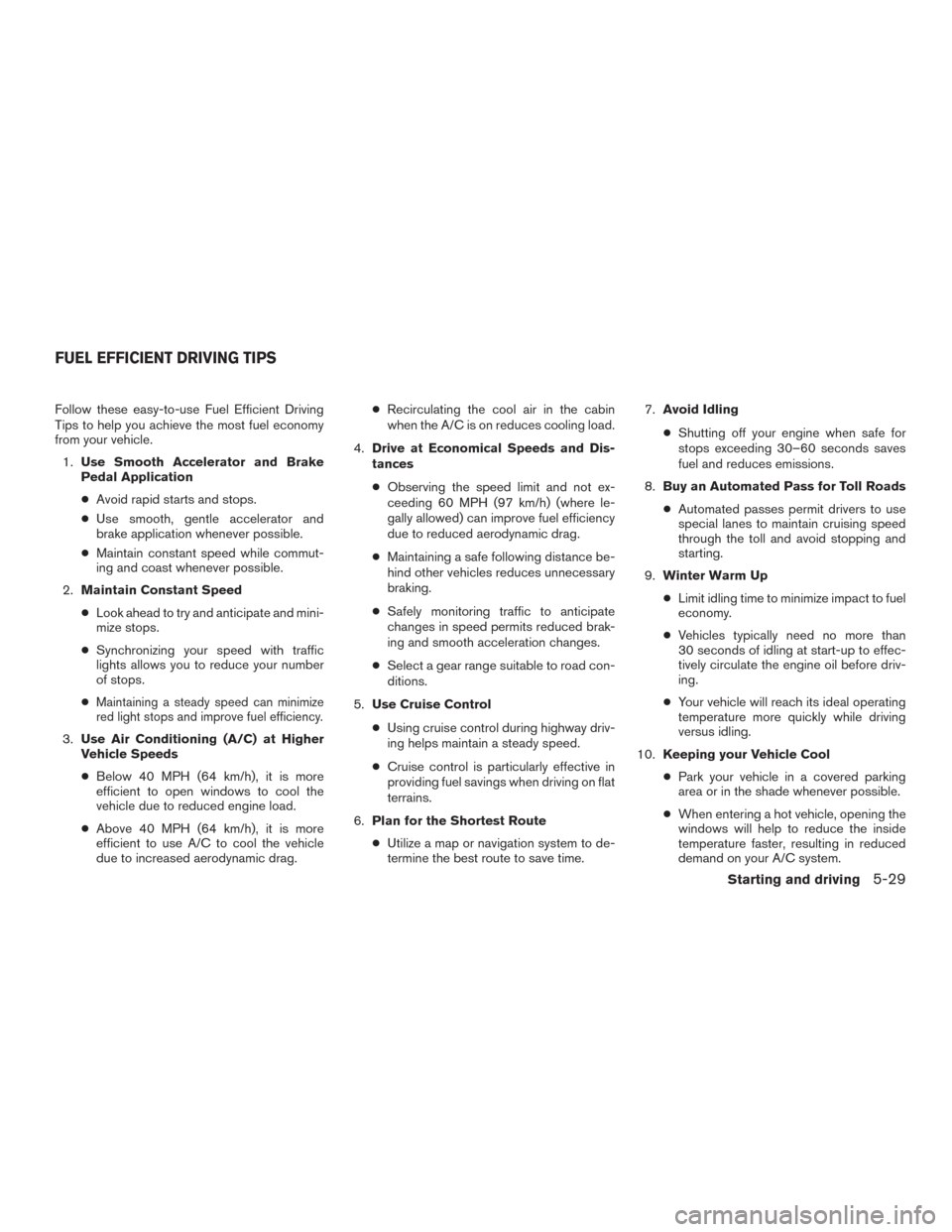
Follow these easy-to-use Fuel Efficient Driving
Tips to help you achieve the most fuel economy
from your vehicle.1. Use Smooth Accelerator and Brake
Pedal Application
● Avoid rapid starts and stops.
● Use smooth, gentle accelerator and
brake application whenever possible.
● Maintain constant speed while commut-
ing and coast whenever possible.
2. Maintain Constant Speed
● Look ahead to try and anticipate and mini-
mize stops.
● Synchronizing your speed with traffic
lights allows you to reduce your number
of stops.
●
Maintaining a steady speed can minimize
red light stops and improve fuel efficiency.
3. Use Air Conditioning (A/C) at Higher
Vehicle Speeds
● Below 40 MPH (64 km/h), it is more
efficient to open windows to cool the
vehicle due to reduced engine load.
● Above 40 MPH (64 km/h), it is more
efficient to use A/C to cool the vehicle
due to increased aerodynamic drag. ●
Recirculating the cool air in the cabin
when the A/C is on reduces cooling load.
4. Drive at Economical Speeds and Dis-
tances
● Observing the speed limit and not ex-
ceeding 60 MPH (97 km/h) (where le-
gally allowed) can improve fuel efficiency
due to reduced aerodynamic drag.
● Maintaining a safe following distance be-
hind other vehicles reduces unnecessary
braking.
● Safely monitoring traffic to anticipate
changes in speed permits reduced brak-
ing and smooth acceleration changes.
● Select a gear range suitable to road con-
ditions.
5. Use Cruise Control
● Using cruise control during highway driv-
ing helps maintain a steady speed.
● Cruise control is particularly effective in
providing fuel savings when driving on flat
terrains.
6. Plan for the Shortest Route
● Utilize a map or navigation system to de-
termine the best route to save time. 7.
Avoid Idling
● Shutting off your engine when safe for
stops exceeding 30–60 seconds saves
fuel and reduces emissions.
8. Buy an Automated Pass for Toll Roads
● Automated passes permit drivers to use
special lanes to maintain cruising speed
through the toll and avoid stopping and
starting.
9. Winter Warm Up
● Limit idling time to minimize impact to fuel
economy.
● Vehicles typically need no more than
30 seconds of idling at start-up to effec-
tively circulate the engine oil before driv-
ing.
● Your vehicle will reach its ideal operating
temperature more quickly while driving
versus idling.
10. Keeping your Vehicle Cool
● Park your vehicle in a covered parking
area or in the shade whenever possible.
● When entering a hot vehicle, opening the
windows will help to reduce the inside
temperature faster, resulting in reduced
demand on your A/C system.
FUEL EFFICIENT DRIVING TIPS
Starting and driving5-29
Page 433 of 441
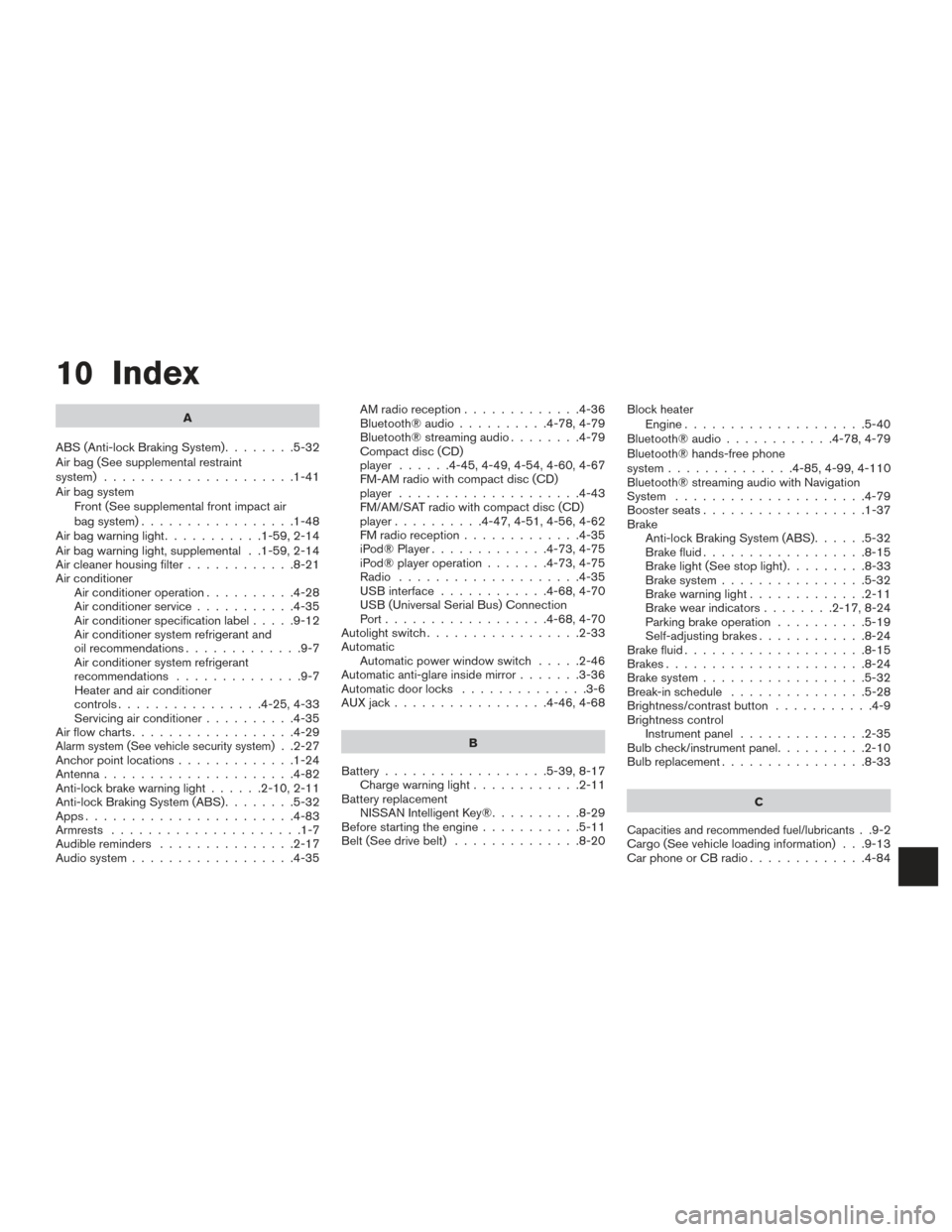
10 Index
A
ABS (Anti-lock Braking System) ........5-32
Air bag (See supplemental restraint
system) .....................1-41
Air bag system Front (See supplemental front impact air
bag system) .................1-48
Airbagwarninglight...........1-59,2-14
Air bag warning light, supplemental . .1-59, 2-14
Air cleaner housing filter ............8-21
Air conditioner Air conditioner operation ..........4-28
Air conditioner service ...........4-35
Air conditioner specification label .....9-12
Air conditioner system refrigerant and
oil recommendations .............9-7
Air conditioner system refrigerant
recommendations ..............9-7
Heater and air conditioner
controls................4-25,4-33
Servicing air conditioner ..........4-35
Airflowcharts..................4-29
Alarm system (See vehicle security system). .2-27
Anchor point locations .............1-24
Antenna .....................4-82
Anti-lock brake warning light ......2-10,2-11
Anti-lock Braking System (ABS) ........5-32
Apps .......................4-83
Armrests .....................1-7
Audible reminders ...............2-17
Audio system ..................4-35 AMradioreception.............4-36
Bluetooth®audio..........4-78,4-79
Bluetooth® streaming audio
........4-79
Compact disc (CD)
player ......4-45,4-49,4-54,4-60,4-67
FM-AM radio with compact disc (CD)
player ....................4-43
FM/AM/SAT radio with compact disc (CD)
player..........4-47,4-51,4-56,4-62
FMradioreception.............4-35
iPod® Player .............4-73,4-75
iPod® player operation .......4-73,4-75
Radio ....................4-35
USB interface ............4-68,4-70
USB (Universal Serial Bus) Connection
Port..................4-68,4-70
Autolight switch .................2-33
Automatic Automatic power window switch .....2-46
Automatic anti-glare inside mirror .......3-36
Automatic door locks ..............3-6
AUXjack.................4-46,4-68
B
Battery ..................5-39,8-17
Chargewarninglight............2-11
Battery replacement NISSAN Intelligent Key® ..........8-29
Before starting the engine ...........5-11
Belt (See drive belt) ..............8-20 Block heater
Engine ....................5-40
Bluetooth® audio ............4-78,4-79
Bluetooth® hands-free phone
system..............4-85,4-99,4-110
Bluetooth® streaming audio with Navigation
System .....................4-79
Boosterseats..................1-37
Brake Anti-lock Braking System (ABS) ......5-32
Brake fluid ..................8-15
Brakelight(Seestoplight).........8-33
Brake system ................5-32
Brakewarninglight.............2-11
Brakewearindicators........2-17,8-24
Parking brake operation ..........5-19
Self-adjusting brakes ............8-24
Brake fluid ....................8-15
Brakes ......................8-24
Brake system ..................5-32
Break-inschedule ...............5-28
Brightness/contrast button ...........4-9
Brightness control Instrument panel ..............2-35
Bulb check/instrument panel ..........2-10
Bulbreplacement................8-33
C
Capacities and recommended fuel/lubricants..9-2
Cargo (See vehicle loading information) . . .9-13
Car phone or CB radio .............4-84
Page 434 of 441
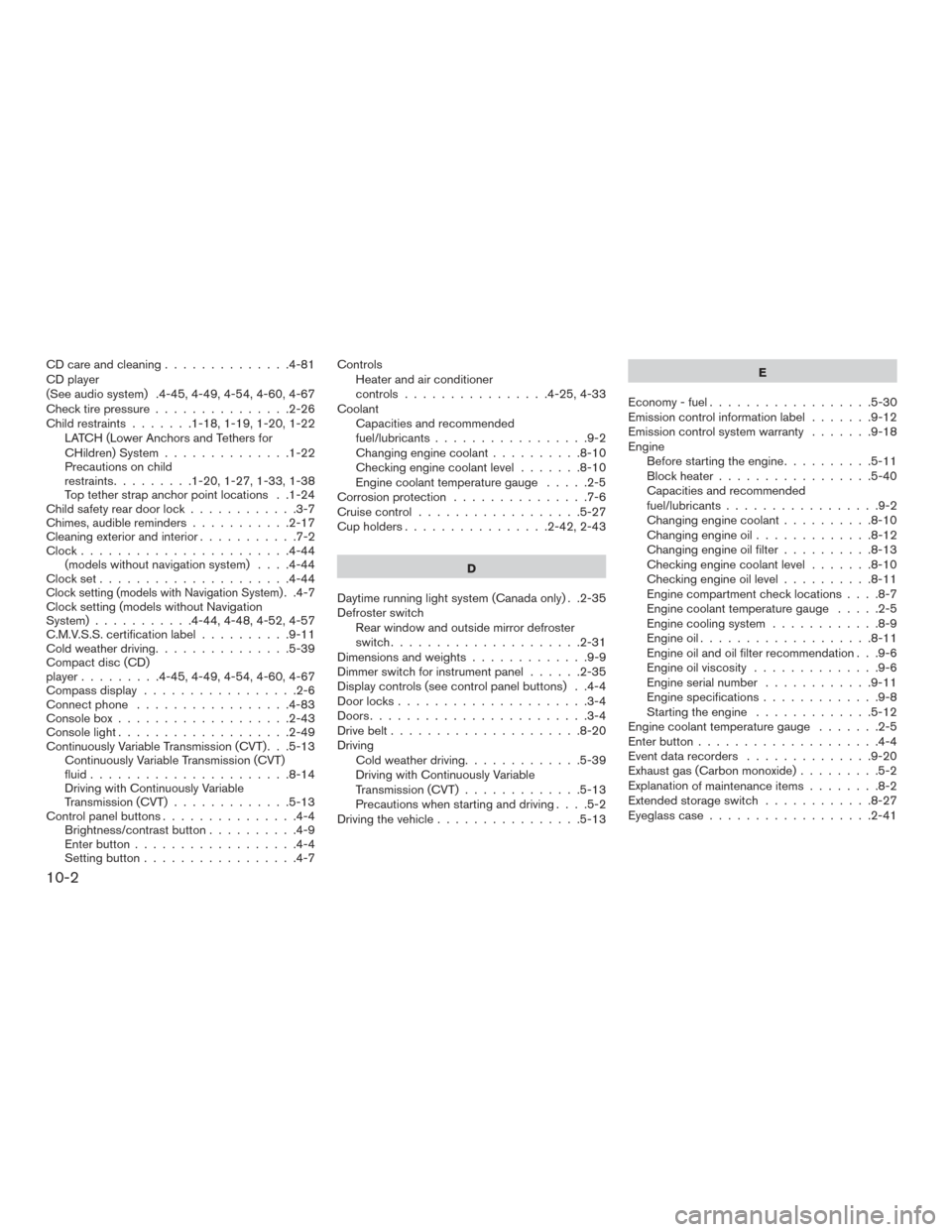
CD care and cleaning..............4-81
CD player
(See audio system) .4-45, 4-49, 4-54, 4-60, 4-67
Check tire pressure ...............2-26
Child restraints .......1-18,1-19,1-20,1-22
LATCH (Lower Anchors and Tethers for
CHildren) System ..............1-22
Precautions on child
restraints.........1-20,1-27,1-33,1-38
Top tether strap anchor point locations . .1-24
Child safety rear door lock ............3-7
Chimes, audible reminders ...........2-17
Cleaningexteriorandinterior...........7-2
Clock.......................4-44 (models without navigation system) ....4-44
Clockset.....................4-44
Clock setting (models with Navigation System)..4-7
Clock setting (models without Navigation
System) ...........4-44,4-48,4-52,4-57
C.M.V.S.S. certification label ..........9-11
Cold weather driving ...............5-39
Compact disc (CD)
player .........4-45,4-49,4-54,4-60,4-67
Compass display .................2-6
Connect phone .................4-83
Consolebox...................2-43
Consolelight...................2-49
Continuously Variable Transmission (CVT) . . .5-13 Continuously Variable Transmission (CVT)
fluid ......................8-14
Driving with Continuously Variable
Transmission (CVT) .............5-13
Control panel buttons ...............4-4
Brightness/contrast button ..........4-9
Enterbutton..................4-4
Setting button .................4-7 Controls
Heater and air conditioner
controls................4-25,4-33
Coolant Capacities and recommended
fuel/lubricants .................9-2
Changingenginecoolant..........8-10
Checking engine coolant level .......8-10
Engine coolant temperature gauge .....2-5
Corrosion protection ...............7-6
Cruisecontrol..................5-27
Cupholders................2-42,2-43
D
Daytime running light system (Canada only) . .2-35
Defroster switch Rear window and outside mirror defroster
switch.....................2-31
Dimensionsandweights.............9-9
Dimmer switch for instrument panel ......2-35
Display controls (see control panel buttons) . .4-4
Door locks .....................3-4
Doors ........................3-4
Drive belt .....................8-20
Driving Cold weather driving .............5-39
Driving with Continuously Variable
Transmission (CVT) .............5-13
Precautions when starting and driving ....5-2
Driving the vehicle ................5-13 E
Economy-fuel..................5-30
Emission control information label .......9-12
Emission control system warranty .......9-18
Engine Before starting the engine ..........5-11
Blockheater.................5-40
Capacities and recommended
fuel/lubricants.................9-2
Changing engine coolant ..........8-10
Changingengineoil.............8-12
Changing engine oil filter ..........8-13
Checking engine coolant level .......8-10
Checking engine oil level ..........8-11
Engine compartment check locations ....8-7
Engine coolant temperature gauge .....2-5
Engine cooling system ............8-9
Engineoil...................8-11
Engine oil and oil filter recommendation . . .9-6
Engine oil viscosity ..............9-6
Engine serial number ............9-11
Engine specifications .............9-8
Starting the engine .............5-12
Engine coolant temperature gauge .......2-5
Enter button ....................4-4
Event data recorders ..............9-20
Exhaust gas (Carbon monoxide) .........5-2
Explanation ofmaintenance
items ........8-2
Extended storage switch ............8-27
Eyeglass case ..................2-41
10-2