2015 MITSUBISHI OUTLANDER SPORT clutch
[x] Cancel search: clutchPage 12 of 384
If this problem occurs...
Quick index 2-3
2
N00200900867
If this problem occurs...
Problem
Do this
Ref. Page
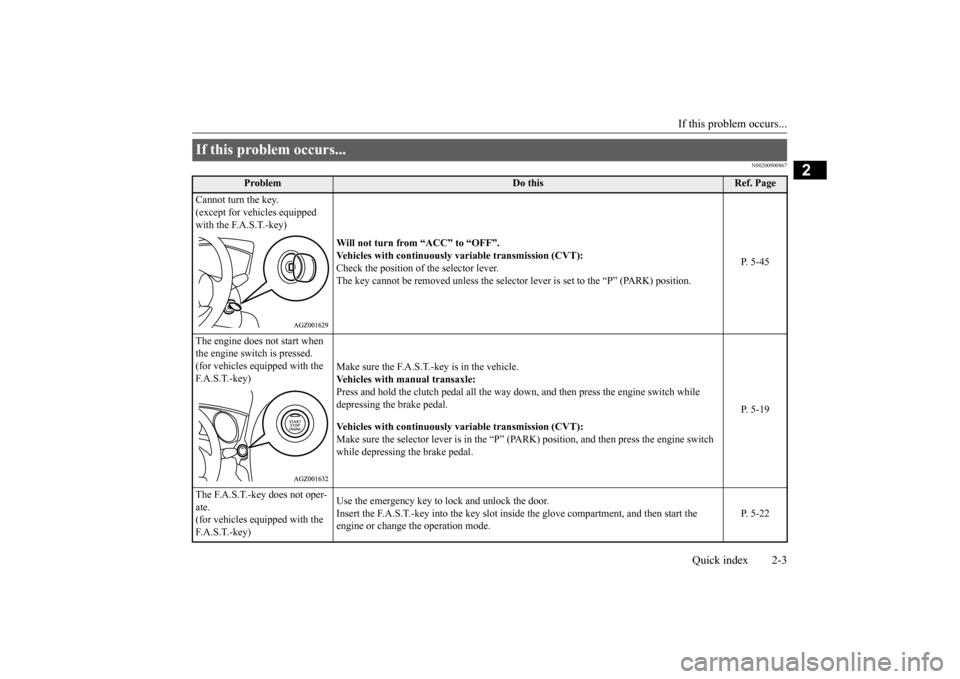
Cannot turn the key. (except for vehicles equipped with the F.A.S.T.-key)
Will not turn from “ACC” to “OFF”. Vehicles with continuously
variable transmission (CVT):
Check the position of the selector lever. The key cannot be removed unless the selector lever is set to the “P” (PARK) position.
P. 5-45
The engine does not start when the engine switch is pressed. (for vehicles equipped with the F. A . S . T. - k e y )
Make sure the F.A.S.T.-key is in the vehicle. Vehicles with manual transaxle: Press and hold the clutch pedal all the way
down, and then press the engine switch while
depressing the brake pedal. Vehicles with continuously
variable transmission (CVT):
Make sure the selector lever is in the “P” (P
ARK) position, and then press the engine switch
while depressing the brake pedal.
P. 5-19
The F.A.S.T.-key does not oper- ate. (for vehicles equipped with the F. A . S . T. - k e y )
Use the emergency key to lock and unlock the door. Insert the F.A.S.T.-key into the key slot insi
de the glove compartment, and then start the
engine or change the operation mode.
P. 5-22
BK0206700US.bo
ok 3 ページ 2014年3月25日 火曜日 午後4時42分
Page 80 of 384
Free-hand Advanced Security Transmitt
er (F.A.S.T.-key) (if so equipped)
Features and controls 5-17
5
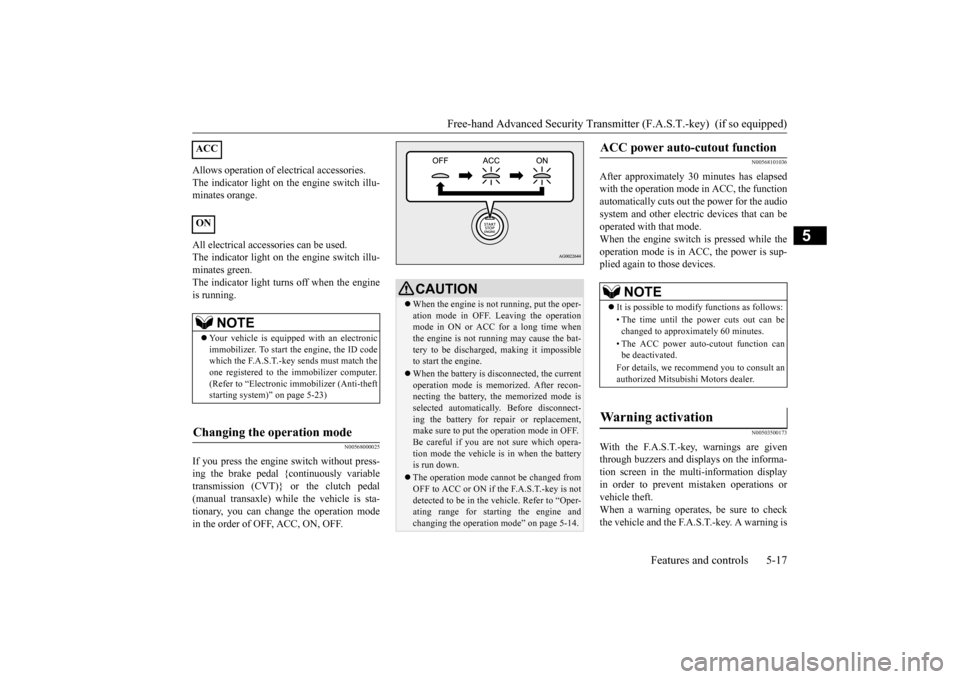
Allows operation of electrical accessories. The indicator light on the engine switch illu- minates orange. All electrical accessories can be used. The indicator light on the engine switch illu-minates green.The indicator light turn
s off when the engine
is running.
N00568000025
If you press the engine switch without press- ing the brake pedal {continuously variabletransmission (CVT)} or the clutch pedal (manual transaxle) while the vehicle is sta- tionary, you can change the operation modein the order of OFF, ACC, ON, OFF.
N00568101036
After approximately 30 minutes has elapsedwith the operation mode in ACC, the functionautomatically cuts out the power for the audio system and other electri
c devices that can be
operated with that mode.When the engine switch is pressed while the operation mode is in ACC, the power is sup- plied again to those devices.
N00503500173
With the F.A.S.T.-key, warnings are given through buzzers and displays on the informa- tion screen in the multi-information displayin order to prevent mistaken operations or vehicle theft. When a warning operates, be sure to checkthe vehicle and the F.A.S.T.-key. A warning is
ACC ON
NOTE
Your vehicle is equipped with an electronic immobilizer. To start the engine, the ID codewhich the F.A.S.T.-key sends must match the one registered to the immobilizer computer. (Refer to “Electronic immobilizer (Anti-theftstarting system)” on page 5-23)
Changing the operation mode
CAUTION When the engine is not running, put the oper- ation mode in OFF. Leaving the operation mode in ON or ACC for a long time whenthe engine is not running may cause the bat- tery to be discharged, making it impossible to start the engine. When the battery is disconnected, the current operation mode is memorized. After recon-necting the battery, the memorized mode is selected automatically. Before disconnect- ing the battery for repair or replacement,make sure to put the operation mode in OFF. Be careful if you are not sure which opera- tion mode the vehicle is in when the batteryis run down. The operation mode cannot be changed from OFF to ACC or ON if the F.A.S.T.-key is not detected to be in the vehicle. Refer to “Oper- ating range for starting the engine andchanging the operation mode” on page 5-14.
ACC power auto-cutout function
NOTE
It is possible to modify functions as follows: • The time until the power cuts out can be changed to approximately 60 minutes. • The ACC power auto-cutout function can be deactivated. For details, we recommend you to consult an authorized Mitsubishi Motors dealer.
Warning activation
BK0206700US.bo
ok 17 ページ 2014年3月25日 火曜日 午後4時42分
Page 83 of 384
Free-hand Advanced Security Transmitte
r (F.A.S.T.-key) (if so equipped)
5-20 Features and controls
5
Your vehicle is equipped with an electroni- cally controlled fuel injection system. This is a system that automatically controls fuel injection. There is usually no need to depressthe accelerator pedal when starting the engine. To prevent battery drain, wait a few secondsbetween attempts to restart the engine. 1. Make sure all occupants are properly seated with seat belts fastened. 2. Make sure the parking brake is applied.3. Press and hold the brake pedal down with your right foot.
4. Press and hold the clutch pedal all the way down (manual transaxle). 5. On vehicles equipped with manual trans- axle, place the gearshift lever in the “N”(Neutral) position. On vehicles equipped with continuously variable transmission (CVT), make surethe selector lever is in the “P” (PARK) position. 6. Press the engine switch. 7. Confirm that all warning lights and warn- ing displays are functioning properly.
After several attempts, you may experience that the engine still does not start. 1. Make sure that all electric devices, such as lights, air conditioning blower and rear window defogger, are turned off.2. While depressing the brake pedal {contin- uously variable transmission (CVT)} or the clutch pedal (manual transaxle), pressthe accelerator pedal halfway and hold itthere, then crank the engine. Release the accelerator pedal, immediately after the engine starts.3. If the engine still will not start, the engine could be flooded with too much gasoline. While depressing the brake pedal (CVT)or the clutch pedal (manual transaxle), push the accelerator pedal all the way down and hold it there, then press theengine switch to crank the engine. If the engine does not start after 5 to 6 seconds, push the engine switch to stop crankingthe engine, and release the accelerator pedal. Put the operation mode in OFF.
WA R N I N G Never run the engine in a closed or poorly ventilated area any longer than is needed to move your vehicle out of the area. Car- bon monoxide gas, which is odorless and extremely poisonous, could build up andcause serious injury or death.CAUTION Do not push-start the vehicle.Do not run the engine
at high rpms or drive
at high speeds until the engine has had a chance to warm up.
Starting the engine
NOTE
On vehicles equipped with continuously variable transmission (CVT), the engine can only be started when the selector lever is inthe “P” (PARK) or “N” (NEUTRAL) posi- tion. For safety reasons, the engine should bestarted when the selector lever is in the “P” (PARK) position in which the driving wheels lock.NOTE
Minor noises may be heard on engine start- up. These will disappear as the engine warmsup.
When the engine is hard to start
BK0206700US.bo
ok 20 ページ 2014年3月25日 火曜日 午後4時42分
Page 84 of 384
Free-hand Advanced Security Transmitt
er (F.A.S.T.-key) (if so equipped)
Features and controls 5-21
5
Wait a few seconds, and then press the engine switch to crank the engine again while depressing the brake pedal (CVT) or the clutch pedal (manual transaxle), butdo not push the accelerator pedal. If the engine fails to start, repeat these proce- dures. If the engine still will not start, con-tact your local Mitsubishi Motors dealer or a repair facility of your choice for assistance.
Startability of continuously variable trans- mission (CVT) vehicles with an ambienttemperature of
-22 °F (-30 °C) or lower
When the ambient temperature is -22 °F (-30 °C) or lower, it may not be possible to startfrom a standstill even with the selector lever in the “D” (DRIVE) or “R” (REVERSE) position.This phenomenon occurs because the trans- axle has not warmed up sufficiently; it does not indicate a problem. If this occurs, placethe selector lever in the “P” (PARK) position and let the engine idle for at least 10 minutes. The transaxle will warm up, and you will beable to start normally. Do not leave the vehicle during warm-up operation.
N00568200014
1. Stop the vehicle.
2. Fully engage the parking brake while depressing the brake pedal. 3. On vehicles with a manual transaxle, press the engine switch to stop the engine,and then move the gearshift lever to the 1st (on a uphill) or “R” (Reverse) (on a downhill) position.On vehicles equipped with continuously variable transmission (CVT), move the selector lever to the “P” (PARK) position,and then press the engine switch to stopthe engine.
N00568300028
Insert the F.A.S.T.-key into the key slot in the glove box. Starting the engine and changing the operation mode should be now possible. Remove the F.A.S.T.-key from the key slot after starting the engine
or changing the oper-
ation mode.
Stopping the engine
WA R N I N G Do not operate the engine switch while driving except in an emergency. If the engine is stopped while driving, the brake servomechanism will cease to function andbraking efficiency will deteriorate. Also, the power steering system will not func- tion and it will require greater manualeffort to operate the steering. This could result in a serious accident.NOTE
If you have to bring the engine to an emer- gency stop while driving, press and hold the engine switch for 3 seconds or more, or press it quickly 3 times or more. The engine willstop and the operation mode will go to ACC. On vehicles equipped with continuously variable transmission (CVT), do not stop the engine with the selector lever in any position other than the “P” (PARK) position. If theengine is stopped with the selector lever in any position other than the “P” (PARK) posi- tion, the operation mode will go to ACC rather than OFF. Put the operation mode in OFF after placingthe selector lever in the “P” (PARK) posi- tion.
If the F.A.S.T.-key is not operat- ing properly
BK0206700US.bo
ok 21 ページ 2014年3月25日 火曜日 午後4時42分
Page 109 of 384
Starting the engine 5-46 Features and controls
5
Do not operate the starter motor continu- ously for longer than
15 seconds as this
could run the battery down or damage thestarter motor. If the engine does not start, turn the ignition switch back to the “OFF” position, wait a few seconds, and then tryagain. Trying repeatedly with the engine or starter motor still turning will damage the starter mechanism. If the engine will not start because the bat- tery is weak or discharged, refer to “Jump-starting the engine” (on page 8-2) for instructions. A longer warm up period will only con- sume extra fuel. The
engine is warmed up
enough for driving when the bar graph ofengine coolant temperature display starts to move. Refer to “Interrupt display screen (With ignition switch or operationmode in ON)” on page 5-93.
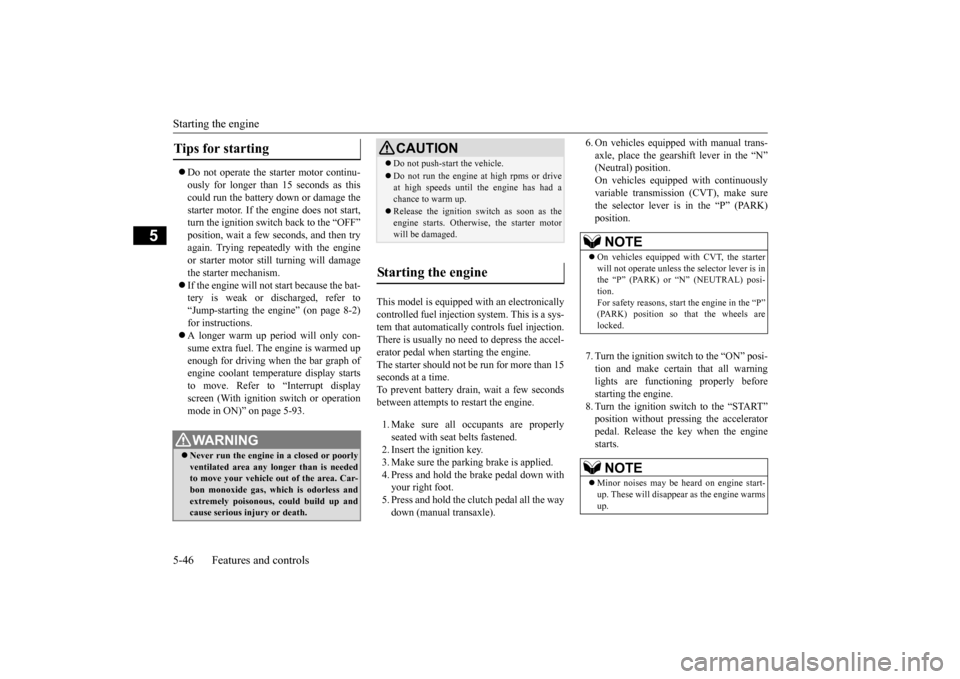
This model is equipped with an electronically controlled fuel injection system. This is a sys-tem that automatically controls fuel injection. There is usually no need to depress the accel- erator pedal when starting the engine.The starter should not be run for more than 15 seconds at a time. To prevent battery drain, wait a few secondsbetween attempts to restart the engine. 1. Make sure all occupants are properly seated with seat belts fastened. 2. Insert the ignition key.3. Make sure the parking brake is applied. 4. Press and hold the brake pedal down with your right foot.5. Press and hold the clutch pedal all the way down (manual transaxle).
6. On vehicles equipped with manual trans- axle, place the gearshift lever in the “N” (Neutral) position. On vehicles equipped with continuouslyvariable transmission (CVT), make sure the selector lever is in the “P” (PARK) position. 7. Turn the ignition switch to the “ON” posi- tion and make certain that all warning lights are functioning properly beforestarting the engine. 8. Turn the ignition switch to the “START” position without pressing the acceleratorpedal. Release the key when the engine starts.
Tips for starting
WA R N I N G Never run the engine in a closed or poorly ventilated area any longer than is needed to move your vehicle out of the area. Car-bon monoxide gas, which is odorless and extremely poisonous, could build up and cause serious injury or death.
CAUTION Do not push-start the vehicle.Do not run the engine
at high rpms or drive
at high speeds until the engine has had a chance to warm up. Release the ignition switch as soon as the engine starts. Otherwise, the starter motorwill be damaged.
Starting the engine
NOTE
On vehicles equipped with CVT, the starter will not operate unless the selector lever is in the “P” (PARK) or “N” (NEUTRAL) posi- tion.For safety reasons, start the engine in the “P” (PARK) position so that the wheels are locked.NOTE
Minor noises may be heard on engine start- up. These will disappear as the engine warms up.
BK0206700US.bo
ok 46 ページ 2014年3月25日 火曜日 午後4時42分
Page 110 of 384
Manual transaxle (if so equipped)
Features and controls 5-47
5
After several attempts, you may experience that the engine still does not start. 1. Make sure that all electric devices, such as lights, air conditioning blower and rear window defogger, are turned off. 2. While depressing the brake pedal {contin-uously variable transmission (CVT)} orthe clutch pedal (manual transaxle), press the accelerator pedal halfway and hold it there, then crank the engine. Release theaccelerator pedal, immediately after the engine starts.
3. If the engine still will not start, the engine could be flooded with too much gasoline. While depressing the brake pedal (CVT) or the clutch pedal (manual transaxle),push the accelerator pedal all the way down and hold it there, then crank the engine for 5 to 6 seconds. Return the igni-tion switch to the “OFF” position and release the accelerator pedal. Wait a few seconds, and then crank the engine againfor 5 to 6 seconds while depressing thebrake pedal (CVT) or the clutch pedal (manual transaxle), but do not push the accelerator pedal. Release the ignition keyif the engine starts. If the engine fails to start, repeat these procedures. If the engine still will not start, contact yourlocal Mitsubishi Motors dealer or a repair facility of your choice for assistance.
When the ambient temperature is -22 °F (-30 °C) or lower, it may not be possible to start from a standstill even with the selector leverin the “D” (DRIVE) or “R” (REVERSE) position.
This occurs because the transaxle has not warmed up sufficiently; it does not indicate a problem. If this occurs, place the selector lever in the “P” (PARK) position and let theengine idle for at least 10 minutes. The transaxle will warm up, and you will be able to start normally.Do not leave the vehicle during warm-up operation.
N00512701152
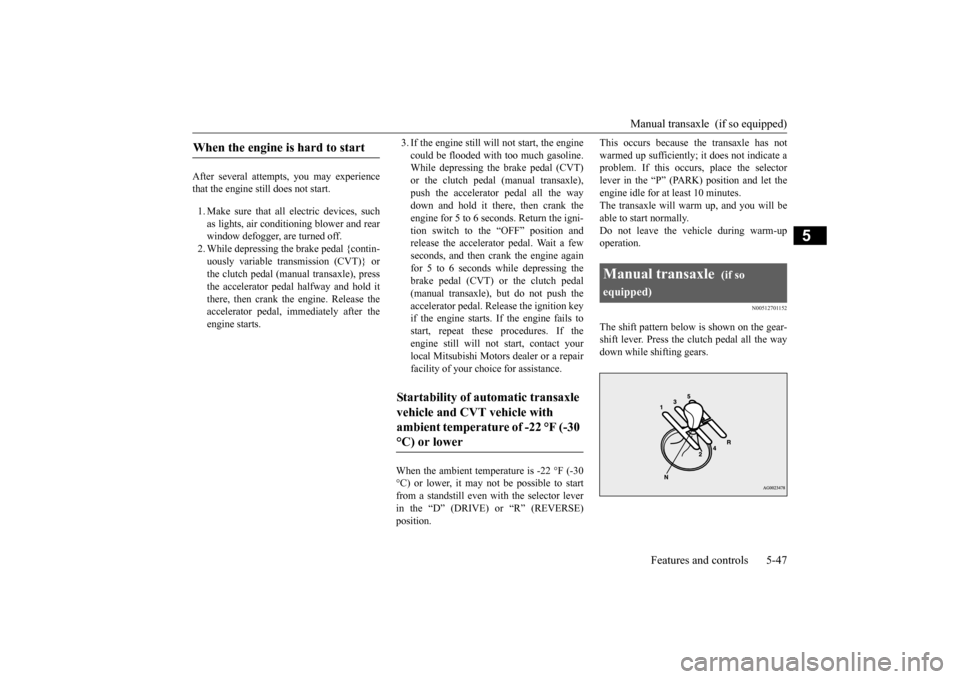
The shift pattern below is shown on the gear-shift lever. Press the clutch pedal all the way down while shifting gears.
When the engine is hard to start
Startability of automatic transaxle vehicle and CVT vehicle with ambient temperature of -22 °F (-30 °C) or lower
Manual transaxle
(if so
equipped)
BK0206700US.bo
ok 47 ページ 2014年3月25日 火曜日 午後4時42分
Page 111 of 384
Manual transaxle (if so equipped) 5-48 Features and controls
5
Press the clutch pedal all the way down and shift into 1st or “R” (Reverse) position. Then gradually release the clutch pedal whiledepressing the accelerator pedal.
N00537400052
Always use care to change the gear with the vehicle speed matched to the engine speed. Proper shifting will improve fuel economyand prolong engine life.
N00512901154
For the best fuel economy and performance inusing your manual transaxle, upshift as listedbelow. At low altitude locations, upshift as listed below. At high altitude locations, upshift as listed below.
NOTE
During cold weather, shifting may be diffi- cult until the transaxle lubricant has warmed up. This is normal and not harmful to the transaxle.
To start
CAUTION Do not move the gearshift lever into reverse while the vehicle is moving forward; doing so will damage the transaxle. Do not rest your foot on the clutch pedal because this will cause premature clutch wear or damage. Do not coast in the “N” (Neutral) position (illegal in many states). Do not use the gearshift lever as a handrest, because this can result in premature wear of the transaxle shift forks.NOTE
If it is hard to shift into 1st, depress the clutch pedal a second time; the shift will then be easier.
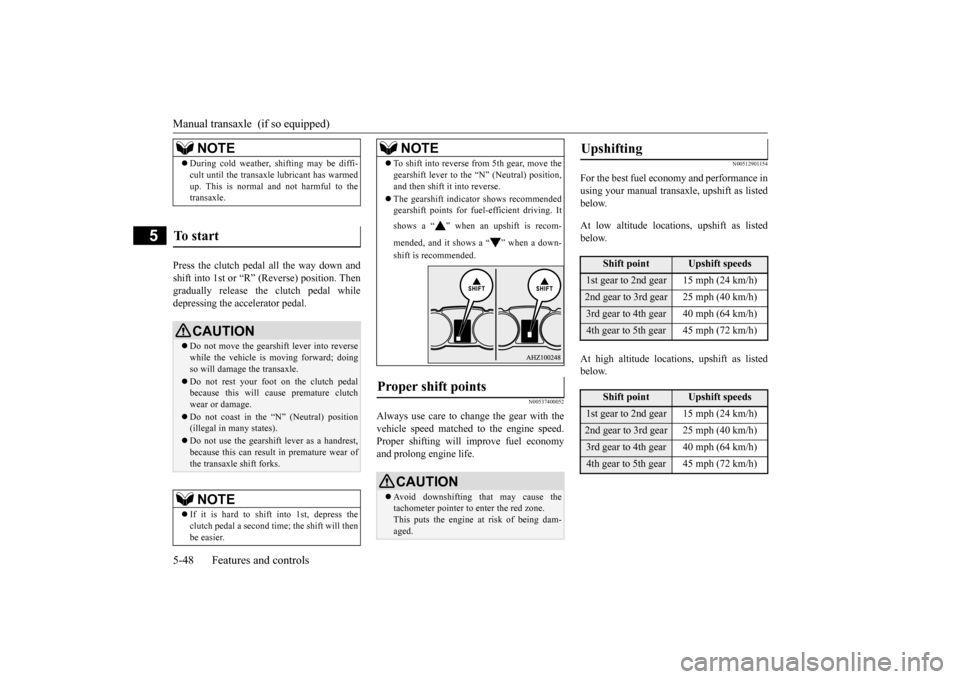
To shift into reverse from 5th gear, move the gearshift lever to the “N” (Neutral) position, and then shift it into reverse. The gearshift indicator shows recommended gearshift points for fuel-efficient driving. It shows a “ ” when an upshift is recom- mended, and it shows a “ ” when a down- shift is recommended.
Proper shift points
CAUTION Avoid downshifting that may cause the tachometer pointer to enter the red zone. This puts the engine at risk of being dam-aged.NOTE
Upshifting
Shift point
Upshift speeds
1st gear to 2nd gear 15 mph (24 km/h)2nd gear to 3rd gear 25 mph (40 km/h)3rd gear to 4th gear 40 mph (64 km/h)4th gear to 5th gear 45 mph (72 km/h)
Shift point
Upshift speeds
1st gear to 2nd gear 15 mph (24 km/h)2nd gear to 3rd gear 25 mph (40 km/h)3rd gear to 4th gear 40 mph (64 km/h)4th gear to 5th gear 45 mph (72 km/h)
BK0206700US.bo
ok 48 ページ 2014年3月25日 火曜日 午後4時42分
Page 134 of 384
Cruise control (if so equipped) Features and controls 5-71
5
N00546300031 N00518301600
Cruise control is an automatic speed control system that keeps a set speed. It can be acti- vated at speeds from about 25 mph(40 km/h). Cruise control does not work at speeds below about 25 mph (40 km/h).To w i n g
CAUTION When towing the vehicle with only the front wheels or only the rear wheels raised off the ground, do not place the ignition switch in the “ON” position or do not put the operationmode in ON. Placing the ignition switch in the “ON” position or putting the operation mode in ON could cause the ASC to operate,resulting in an accident. Note that the correct towing method depends on the transmission type and the vehicle’sdrive configuration. For details, refer to “Towing” on page 8-12.
Cruise control (if so equipped)
CAUTION When you do not wish to drive at a set speed, turn off the cruise control for safety.
Do not use cruise control when driving con- ditions will not allow you to stay at the same speed, such as in heavy traffic or on roads that are winding, icy, snow-covered, wet, slippery, on a steep downhill slope. On vehicles equipped with manual transaxle, do not move the gearshift lever to the “N”(Neutral) position while driving at a set speed without depressing the clutch pedal. The engine will run too fast and might bedamaged.NOTE
Cruise control may not be able to keep your speed on uphills or downhills. Your speed may decrease on a steep uphill. You may use the accelerator pedal if you want to stay at your set speed. Your speed may increase to more than the set speed on a steep downhill. You have to usethe brake to control your speed. As a result, the set speed driving is deactivated.CAUTION
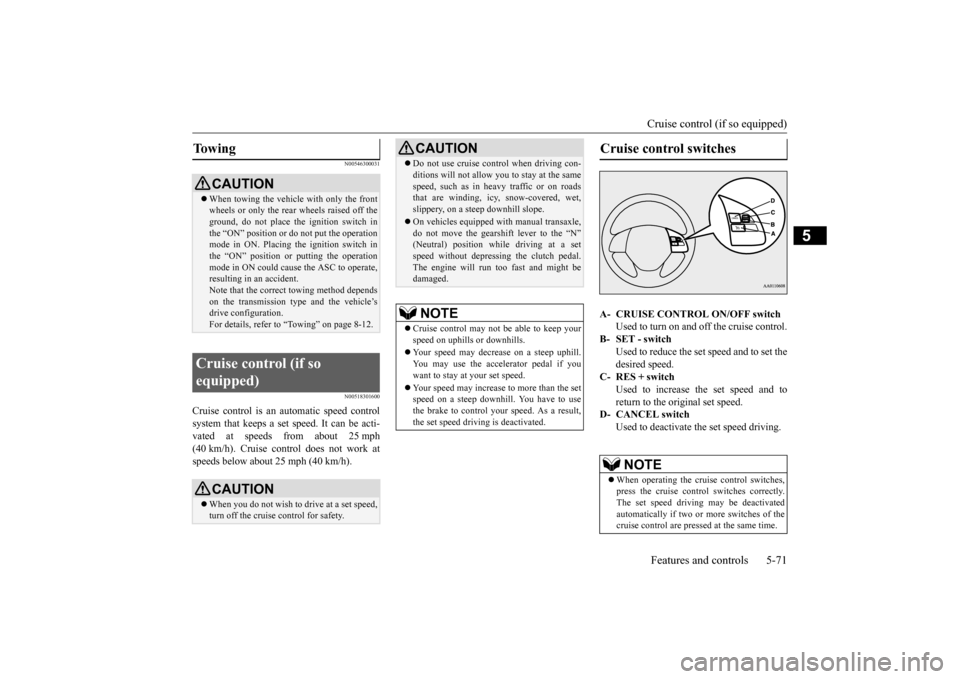
Cruise control switches A- CRUISE CONTROL ON/OFF switch
Used to turn on and off the cruise control.
B- SET - switch
Used to reduce the set speed and to set the desired speed.
C- RES + switch
Used to increase the set speed and toreturn to the original set speed.
D- CANCEL switch
Used to deactivate the set speed driving.NOTE
When operating the cruise control switches, press the cruise control switches correctly.The set speed driving may be deactivated automatically if two or more switches of the cruise control are pressed at the same time.
BK0206700US.bo
ok 71 ページ 2014年3月25日 火曜日 午後4時42分