2015 MINI Hardtop 2 Door flat tire
[x] Cancel search: flat tirePage 187 of 244
Repairing a flat tireSafety measures in case of a breakdown
Park the vehicle as far away as possible
from passing traffic and on solid ground.
Switch on the hazard warning system.
Turn the steering wheel until the front wheels
are in the straight-ahead position and engage
the steering wheel lock.
Secure the vehicle against rolling away by set‐
ting the parking brake.
Have all vehicle occupants get out of the vehi‐
cle and ensure that they remain outside the im‐
mediate area in a safe place, such as behind a
guardrail.
If necessary, set up a warning triangle at an ap‐
propriate distance.
Comply with all safety guidelines and regula‐
tions. ◀
Mobility System
The concept
With the Mobility System, minor tire damage
can be sealed quickly to enable continued
travel. To accomplish this, sealant is pumped
into the tires, which seals the damage from the
inside.
The compressor can be used to check the tire
inflation pressure.
Hints▷Follow the instructions on using the Mobi‐
lity System found on the compressor and
sealant container.▷Use of the Mobility System may be ineffec‐
tive if the tire puncture measures approx.
1/8 in/4 mm or more.▷Contact the nearest service center if the tire
cannot be made drivable.▷If possible, do not remove foreign bodies
that have penetrated the tire.▷Pull the speed limit sticker off the sealant
container and apply it to the steering
wheel.▷The use of a sealant can damage the TPM
wheel electronics. In this case, have the
electronics checked at the next opportunity
and have them replaced if needed.
Enclosed areas
Do not let the engine run in enclosed
areas, since breathing in exhaust fumes may
lead to loss of consciousness and death. The
exhaust gases contain carbon monoxide, an
odorless and colorless but highly toxic gas. ◀
Storage The Mobility System is located under the cargo
floor panel.
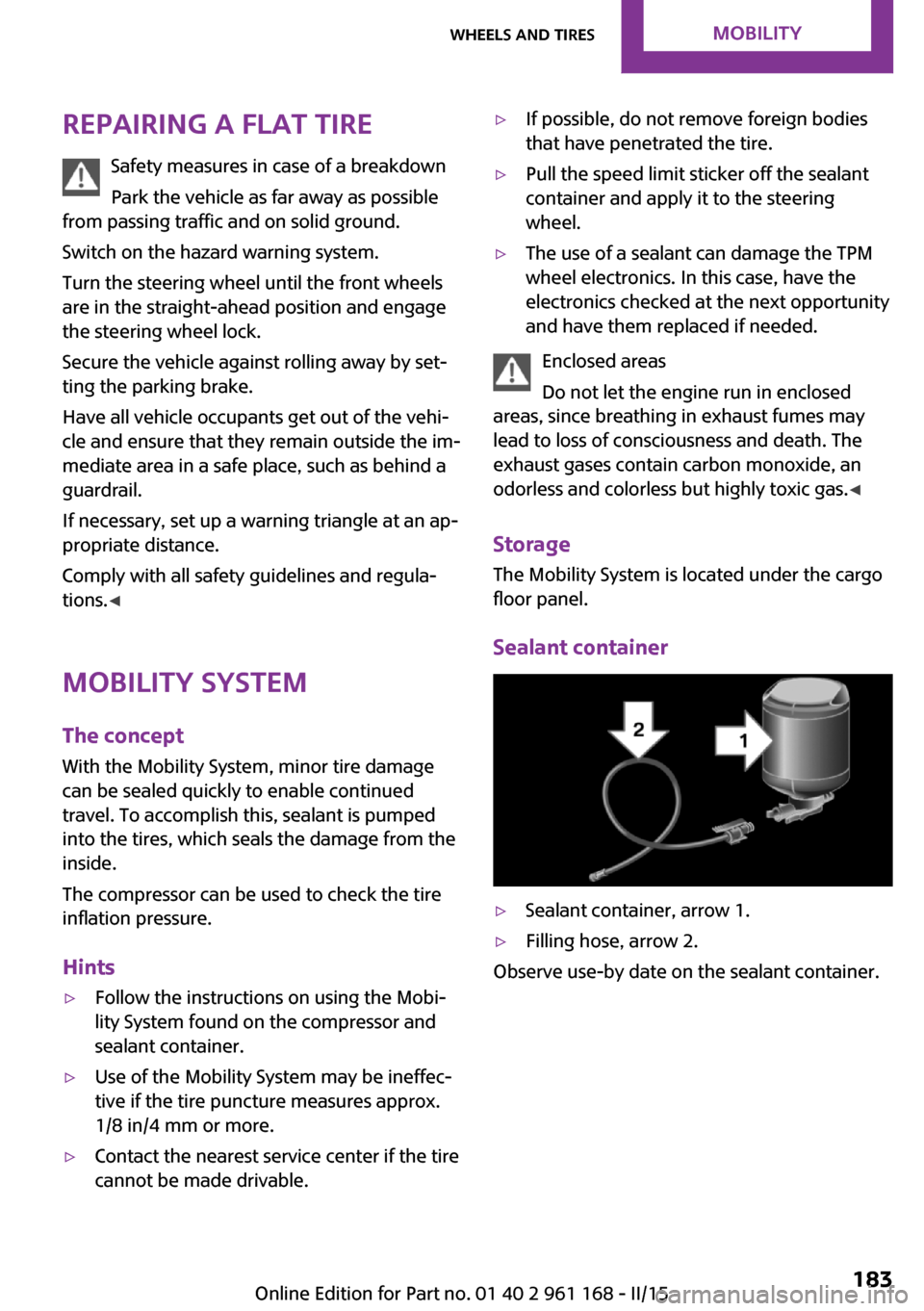
Sealant container
▷Sealant container, arrow 1.▷Filling hose, arrow 2.
Observe use-by date on the sealant container.
Seite 183Wheels and tiresMOBILITY183
Online Edition for Part no. 01 40 2 961 168 - II/15
Page 188 of 244
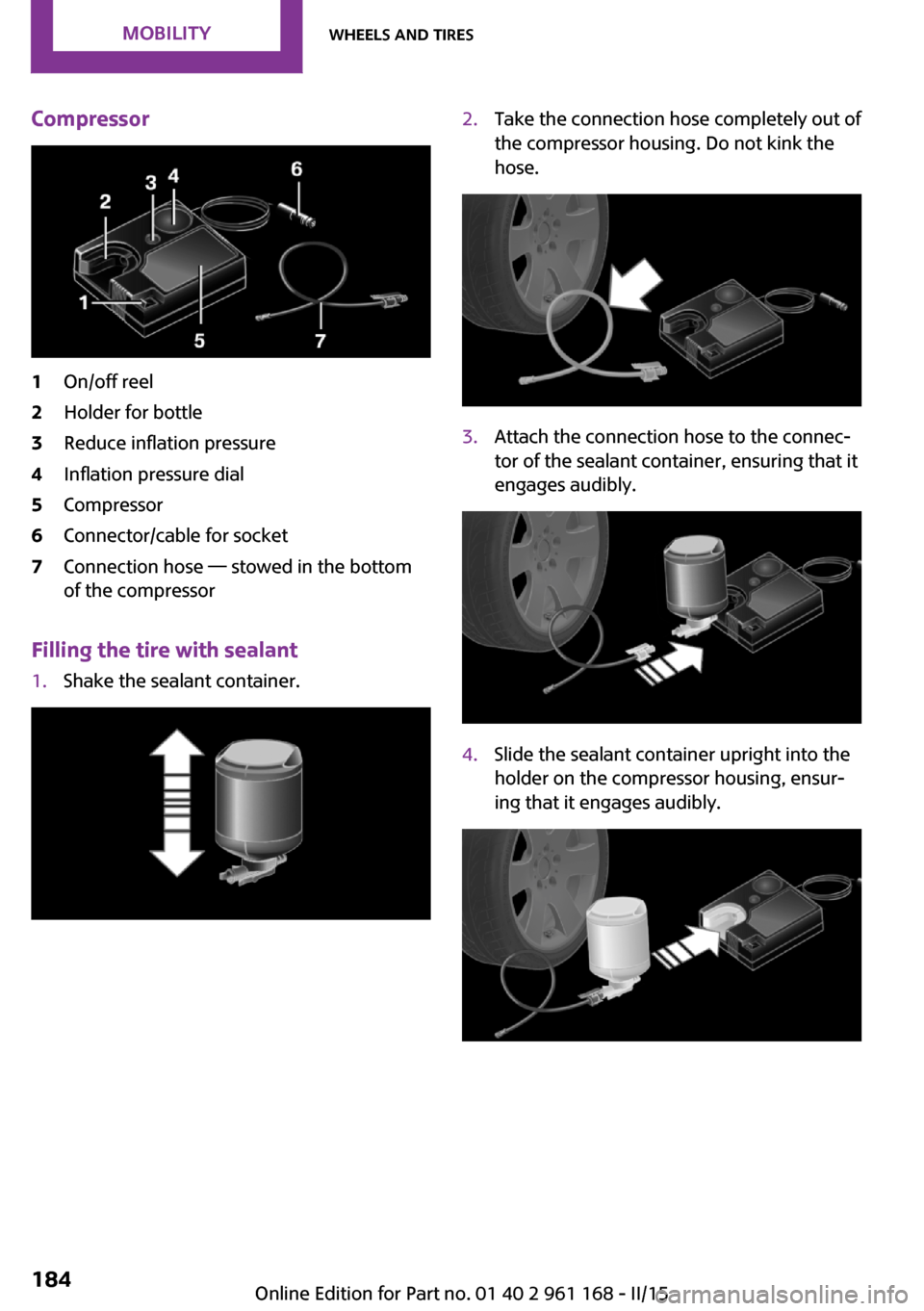
Compressor1On/off reel2Holder for bottle3Reduce inflation pressure4Inflation pressure dial5Compressor6Connector/cable for socket7Connection hose — stowed in the bottom
of the compressor
Filling the tire with sealant
1.Shake the sealant container.2.Take the connection hose completely out of
the compressor housing. Do not kink the
hose.3.Attach the connection hose to the connec‐
tor of the sealant container, ensuring that it
engages audibly.4.Slide the sealant container upright into the
holder on the compressor housing, ensur‐
ing that it engages audibly.Seite 184MOBILITYWheels and tires184
Online Edition for Part no. 01 40 2 961 168 - II/15
Page 189 of 244

5.Screw the connection hose onto the tire
valve of the defective wheel.6.With the compressor switched off, insert
the plug into a power socket inside the ve‐
hicle.7.With the ignition turned on or the engine
running, switch on the compressor.
Let the compressor run for approx. 3 to 8 mi‐
nutes to fill the tire with sealant and achieve a
tire inflation pressure of approx. 2.5 bar.
While the tire is being filled with sealant, the
tire inflation pressure may sporadically reach
approx. 5 bar. Do not switch off the compressor
at this point.
Switch off the compressor after 10 mi‐
nutes
Do not allow the compressor to run longer than
10 minutes; otherwise, the device will overheat
and may be damaged. ◀
If a tire inflation pressure of 2 bar is not
reached:1.Switch off the compressor.2.Unscrew the filling hose from the wheel.3.Drive forward and back to distribute the
sealant in the tire.4.Inflate the tire again using the compressor.
If a tire inflation pressure of 2 bar cannot be
reached, contact your service center.
Stowing the Mobility System
1.Remove the connection hose of the sealant
container from the wheel.2.Remove the connection hose from the seal‐
ant container.3.Wrap the empty sealant container and con‐
nection hose in suitable material to avoid
dirtying the cargo area.4.Stow the Mobility System back in the vehi‐
cle.
Distributing the sealant
Immediately drive approx. 5 mls/10 km/h to
ensure that the sealant is evenly distributed in the tire.
Do not exceed a speed of 50 mph/80 km/h.
If possible, do not drive at speeds less than
12 mph/20 km/h.
Seite 185Wheels and tiresMOBILITY185
Online Edition for Part no. 01 40 2 961 168 - II/15
Page 190 of 244
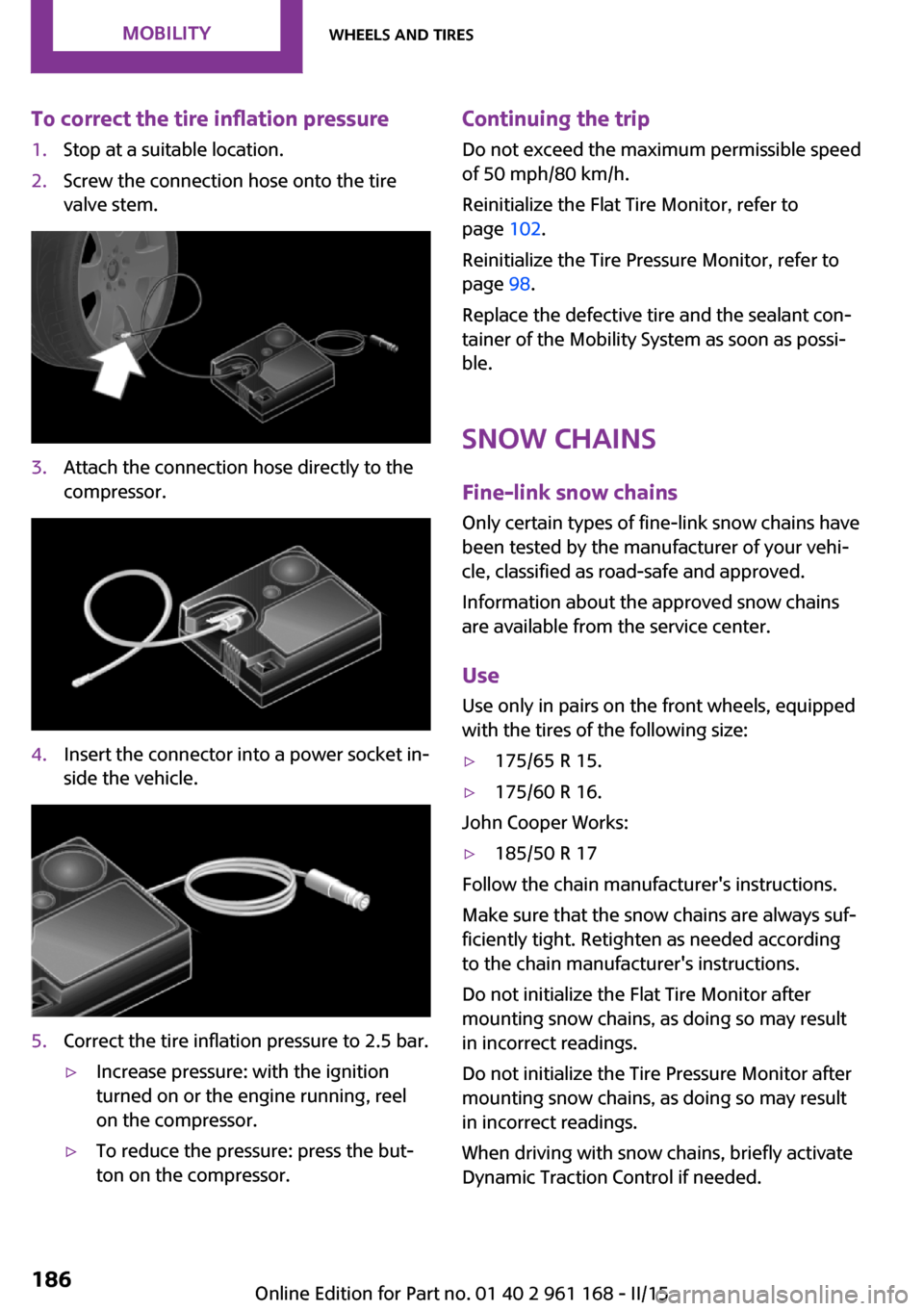
To correct the tire inflation pressure1.Stop at a suitable location.2.Screw the connection hose onto the tire
valve stem.3.Attach the connection hose directly to the
compressor.4.Insert the connector into a power socket in‐
side the vehicle.5.Correct the tire inflation pressure to 2.5 bar.▷Increase pressure: with the ignition
turned on or the engine running, reel
on the compressor.▷To reduce the pressure: press the but‐
ton on the compressor.Continuing the trip
Do not exceed the maximum permissible speed
of 50 mph/80 km/h.
Reinitialize the Flat Tire Monitor, refer to
page 102.
Reinitialize the Tire Pressure Monitor, refer to
page 98.
Replace the defective tire and the sealant con‐
tainer of the Mobility System as soon as possi‐
ble.
Snow chains Fine-link snow chains
Only certain types of fine-link snow chains have
been tested by the manufacturer of your vehi‐
cle, classified as road-safe and approved.
Information about the approved snow chains
are available from the service center.
Use Use only in pairs on the front wheels, equipped
with the tires of the following size:▷175/65 R 15.▷175/60 R 16.
John Cooper Works:
▷185/50 R 17
Follow the chain manufacturer's instructions.
Make sure that the snow chains are always suf‐
ficiently tight. Retighten as needed according
to the chain manufacturer's instructions.
Do not initialize the Flat Tire Monitor after
mounting snow chains, as doing so may result
in incorrect readings.
Do not initialize the Tire Pressure Monitor after
mounting snow chains, as doing so may result
in incorrect readings.
When driving with snow chains, briefly activate
Dynamic Traction Control if needed.
Seite 186MOBILITYWheels and tires186
Online Edition for Part no. 01 40 2 961 168 - II/15
Page 208 of 244

The wire is long enough to guide the socket
down and through between any heat shield
that may be installed and the bumper.4.Replace defective bulb.5.To install the new bulb, proceed in reverse
order of removal.
Right fog lamp:
1.Turn the bulb socket counterclockwise and
remove.
The wire is long enough to guide the socket
down and through between any heat shield
that may be installed and the bumper.2.Replace defective bulb.3.To install the new bulb, proceed in reverse
order of removal.
Side turn signal, bulb replacement
Follow the general instructions on lights and
bulbs, refer to page 198.
Bulbs:
▷With orange lens: W5W▷With white lens: WY5W diadem1.Pull the turn signal housing at the top out
of the catch, then unhook it at the bottom.2.Turn the bulb socket counterclockwise and
remove.3.Replace the bulb.4.Proceed in the reverse order to insert the
new bulb and install the turn signal hous‐
ing.
First hook the turn signal housing to the
bottom, then at the top press it into the
latch.
Changing wheels
Hints
When using run-flat tires or tire sealants, a tire
does not need to be changed immediately in
the event of pressure loss due to a flat tire.
Which is why no spare tire is available.
The tools for changing wheels are available as
accessories from your service center.
Seite 204MOBILITYReplacing components204
Online Edition for Part no. 01 40 2 961 168 - II/15
Page 211 of 244
The defective wheel cannot be stored in the
emergency wheel bracket because of its
size.3.Check tire inflation pressure at the next op‐
portunity and correct as needed.4.Reinitialize the Flat Tire Monitor, refer to
page 102.
Reinitialize the Tire Pressure Monitor, refer
to page 99.5.Replace the damaged tires as soon as pos‐
sible.
Driving with emergency wheel
Watch the speed when driving with the
emergency wheel
Drive conservatively and do not exceed a speed
of 50 mph/80 km/h; otherwise, changed driving
characteristics such as reduced lane stability
while braking, extended braking distance and
changed self-steering properties in the limit
area. ◀
Mount one emergency wheel only
Only a single emergency wheel may be
mounted. Reinstall wheels and tires of the orig‐
inal size as quickly as possible; otherwise, there
is a safety risk. ◀
Vehicle battery
Maintenance
The battery is maintenance-free, i.e., the elec‐
trolyte will last for the life of the battery.
Your service center will be glad to advise you
on questions regarding the battery.
Battery replacement Use approved vehicle batteries only
Only use vehicle batteries that have been
approved for your vehicle by the manufacturer;
otherwise, the vehicle could be damaged and
systems or functions may not be fully availa‐
ble. ◀
After a battery replacement, have the battery
registered on the vehicle by your service center
to ensure that all comfort features are fully
available and that any Check Control messages
are no longer displayed.
Charging the battery
General information Make sure that the battery is always sufficiently
charged to guarantee that the battery remains
usable for its full service life.
The battery may need to be charged in the fol‐
lowing cases:▷When making frequent short-distance
drives.▷If the vehicle is not used for prolonged peri‐
ods, longer than a month.▷Steptronic transmission: when parked for
long periods of time in selector lever posi‐
tion D, R or N.
Note
Do not connect charging devices to the
12 volt socket in the vehicle
Do not connect battery chargers to the factory-
installed 12 volt sockets in the vehicle as this
may damage the vehicle battery due to an in‐ creased power consumption. ◀
Starting aid terminals In the vehicle, only charge the battery via the
starting aid terminals, refer to page 210, in the
engine compartment with the engine off.
Power failure
After a temporary power loss, some equipment
needs to be reset.
Individual settings need to be reprogrammed:
▷Time: update.Seite 207Replacing componentsMOBILITY207
Online Edition for Part no. 01 40 2 961 168 - II/15
Page 236 of 244

Dimmable exterior mirrors 54
Dimmable interior rearview mirror 55
Direction indicator, refer to Turn signals 65
Display, electronic, instrument cluster 73
Display, engine tempera‐ ture 82
Display lighting, refer to In‐ strument lighting 93
Displays 72
Displays, cleaning 217
Disposal, coolant 194
Disposal, vehicle battery 208
Distance control, refer to PDC 123
Distance to destination 82
Divided screen view, split screen 24
Door lock, refer to Remote control 34
Drive mode, GREEN mode 162
Drive-off assistant 114
Drive-off assistant, refer to DSC 111
Driving Dynamics Control 113
Driving Excitement, SPORT 83
Driving instruction, GREEN mode 164
Driving instructions, break- in 154
Driving mode 113
Driving notes, general 154
Driving stability control sys‐ tems 111
Driving style analysis 166
Driving tips 154
DSC Dynamic Stability Con‐ trol 111
DTC Dynamic Traction Con‐ trol 112
Dynamic Damping Con‐ trol 112 Dynamic Stability Control
DSC 111
Dynamic Traction Control DTC 112
E
Electronic displays, instrument cluster 73
Electronic oil measure‐ ment 190
Electronic Stability Program ESP, refer to DSC 111
Emergency detection, remote control 35
Emergency release, fuel filler flap 170
Emergency start function, en‐ gine start 35
Emergency wheel, compact wheel, refer to Emergency
wheel 205
Energy Control 78
Engine, automatic Start/Stop function 62
Engine, automatic switch- off 62
Engine compartment 188
Engine compartment, working in 188
Engine coolant 193
Engine idling when driving, coasting 165
Engine oil 190
Engine oil, adding 191
Engine oil additives 191
Engine oil change 192
Engine oil filler neck 191
Engine oil types, alterna‐ tive 192
Engine oil types, ap‐ proved 192
Engine start during malfunc‐ tion 35
Engine start, jump-start‐ ing 209 Engine start, refer to Starting
the engine 61
Engine stop 61
Engine temperature, dis‐ play 82
Entering a car wash 214
Equipment, interior 139
Error displays, see Check Con‐ trol 73
ESP Electronic Stability Pro‐ gram, refer to DSC 111
Exchanging wheels/tires 181
Exhaust system 155
Exterior mirror, automatic dimming feature 54
Exterior mirrors 53
External start 209
External temperature dis‐ play 77
External temperature warn‐ ing 77
Eyes for securing cargo 158
F
Failure message, see Check Control 73
False alarm, refer to Uninten‐ tional alarm 44
Fan, refer to Air flow 133, 136
Favorites buttons, onboard monitor 24
Filler neck for engine oil 191
Fine wood, care 216
First aid kit 209
Fitting for towing, see tow fit‐ ting 212
Flat tire, changing wheels 204
Flat Tire Monitor FTM 102
Flat tire, repairing 183
Flat tire, Tire Pressure Monitor TPM 98
Flat tire, warning lamp 99, 102
Flooding 155
Floor carpet, care 217 Seite 232REFERENCEEverything from A to Z232
Online Edition for Part no. 01 40 2 961 168 - II/15
Page 237 of 244

Floor mats, care 217
Fogged up windows 133
Folding back rear seat back‐ rests 145
Fold-out position, windshield wipers 67
Foot brake 155
Front airbags 95
Front-end collision warning with City Braking func‐
tion 105
Front fog lights 93
front-seat passenger airbags, automatic deactivation 97
Front-seat passenger airbags, indicator lamp 97
FTM Flat Tire Monitor 102
Fuel 172
Fuel consumption, current 78
Fuel consumption, refer to Average fuel consump‐
tion 82
Fuel filler flap 170
Fuel gauge 77
Fuel lid 170
Fuel quality 172
Fuel recommendation 172
Fuel, tank capacity 224
Fuse 208
G Garage door opener, refer to Universal Integrated Remote
Control 139
Gasoline 172
Gear change, Steptronic trans‐ mission 69
Gear shift indicator 79
General driving notes 154
Glare shield 143
Glass sunroof, refer to Panor‐ amic glass sunroof 46
Glove compartment 147
GREEN mode 162 GREEN mode, bonus
range 164
GREEN mode driving style analysis 166
GREEN mode indicator 162
GREEN - program, driving dy‐ namics 113
GREEN tip 164
Gross vehicle weight, ap‐ proved 221
Ground clearance 156
H Halogen headlights 199
Handbrake, refer to parking brake 64
Hand-held transmitter, alter‐ nating code 140
Hazard warning flashers 209
Head airbags 95
Headlight control, auto‐ matic 91
Headlight courtesy delay fea‐ ture 91
Headlight flasher 65
Headlight glass 198
Headlights, care 215
Head restraints 48
Head restraints, front 51
Head restraints, rear 52
Head-up Display 86
Head-up Display, standard view 87
Heavy cargo, stowing 158
High-beam Assistant 92
High beams 65
High beams/low beams, refer to High-beam Assistant 92
Hills 156
Hill start assistant, refer to Drive-off assistant 114
Hints 6
Holder for beverages 148
Homepage 6
Hood 188 Horn 14
Hot exhaust system 155
HUD Head-up Display 86
Hydroplaning 155
I
Ice warning, see External tem‐ perature warning 77
Icy roads, see External tem‐ perature warning 77
Identification marks, tires 178
Identification number, see ve‐ hicle identification number 9
Ignition key, refer to Remote control 34
Ignition off 60
Ignition on 60
Illuminated ring, central in‐ strument cluster 85
Indication of a flat tire 99, 102
Indicator lamp, see Check Control 73
Individual air distribu‐ tion 133, 136
Individual settings, refer to Personal Profile 35
Inflation pressure, tires 174
Inflation pressure warning, tires 102
Info display, refer to On-Board computer 81
Initialize, Tire Pressure Moni‐ tor TPM 99
Initializing, Flat Tire Monitor FTM 102
Instrument cluster 72
Instrument cluster, electronic displays 73
Instrument lighting 93
Integrated key 34
Integrated Owner's Manual in the vehicle 30
Intelligent Safety 103
Intensity, AUTO program 136 Seite 233Everything from A to ZREFERENCE233
Online Edition for Part no. 01 40 2 961 168 - II/15