2015 MERCEDES-BENZ S-Class length
[x] Cancel search: lengthPage 128 of 502
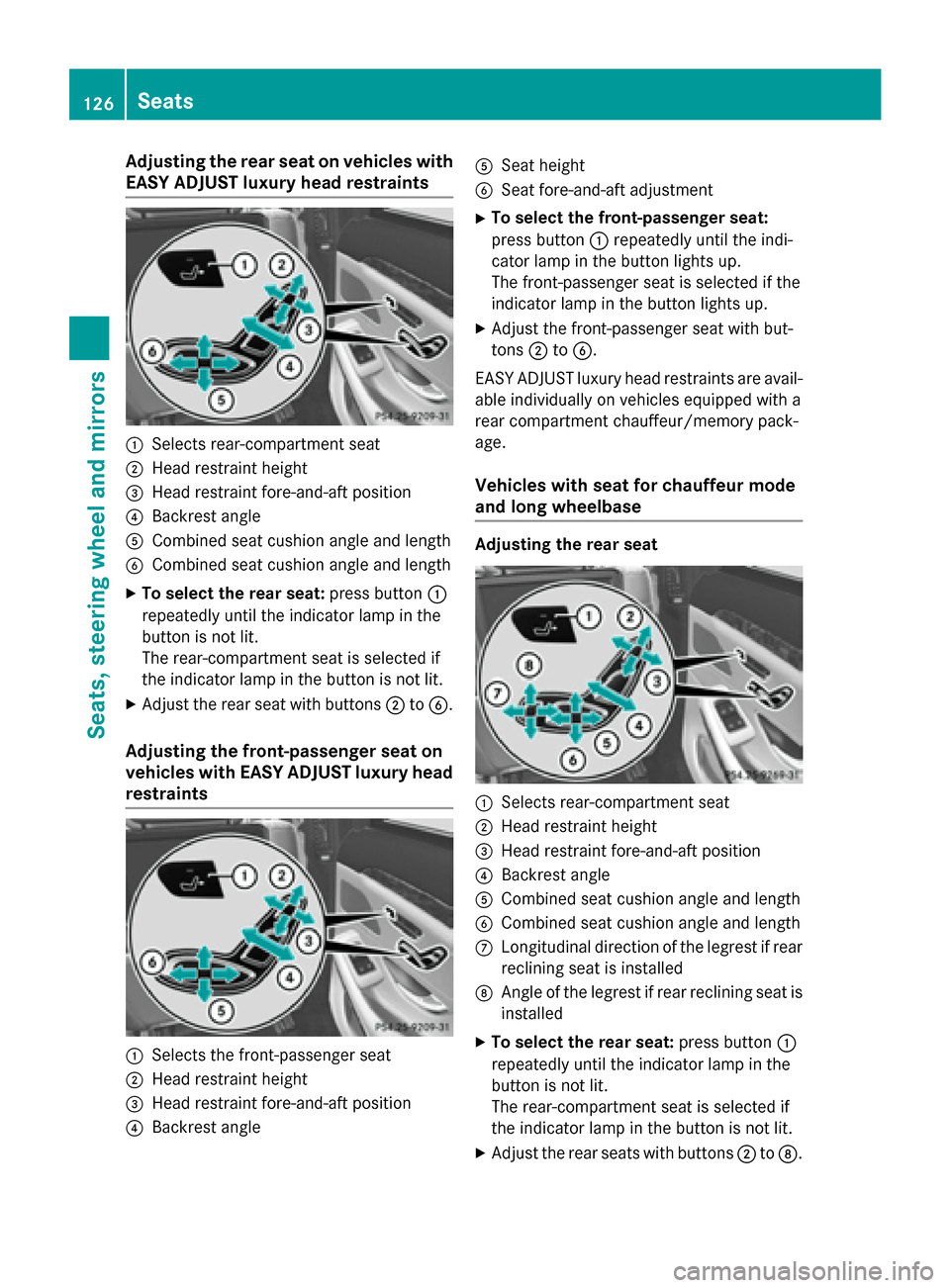
Adjusting the rear seat on vehicles with
EASY ADJUST luxury head restraints :
Selects rear-compartment seat
; Head restraint height
= Head restraint fore-and-aft position
? Backrest angle
A Combined seat cushion angle and length
B Combined seat cushion angle and length
X To select the rear seat: press button:
repeatedly until the indicator lamp in the
button is not lit.
The rear-compartment seat is selected if
the indicator lamp in the button is not lit.
X Adjust the rear seat with buttons ;toB.
Adjusting the front-passenger seat on
vehicles with EASY ADJUST luxury head
restraints :
Selects the front-passenger seat
; Head restraint height
= Head restraint fore-and-aft position
? Backrest angle A
Seat height
B Seat fore-and-aft adjustment
X To select the front-passenger seat:
press button :repeatedly until the indi-
cator lamp in the button lights up.
The front-passenger seat is selected if the
indicator lamp in the button lights up.
X Adjust the front-passenger seat with but-
tons ;toB.
EASY ADJUST luxury head restraints are avail-
able individually on vehicles equipped with a
rear compartment chauffeur/memory pack-
age.
Vehicles with seat for chauffeur mode
and long wheelbase Adjusting the rear seat
:
Selects rear-compartment seat
; Head restraint height
= Head restraint fore-and-aft position
? Backrest angle
A Combined seat cushion angle and length
B Combined seat cushion angle and length
C Longitudinal direction of the legrest if rear
reclining seat is installed
D Angle of the legrest if rear reclining seat is
installed
X To select the rear seat: press button:
repeatedly until the indicator lamp in the
button is not lit.
The rear-compartment seat is selected if
the indicator lamp in the button is not lit.
X Adjust the rear seats with buttons ;toD. 126
SeatsSeats
, steering wheel and mirrors
Page 225 of 502

The electric parking brake is also engaged
automatically if:
R DISTRONIC PLUS brings the vehicle to a
standstill or
R the HOLD function is keeping the vehicle
stationary
R Active Parking Assist is holding the vehicle
at a standstill
In addition, at least one of the following con-
ditions must be fulfilled:
R there is a system malfunction.
R the power supply is insufficient.
R the vehicle is stationary for a lengthy
period.
The red F(USA only) or !(Canada
only) indicator lamp in the instrument cluster
lights up.
The electric parking brake is not automati-
cally engaged if the engine is switched off by the ECO start/stop function.
Releasing automatically The electric parking brake is released auto-
matically when all of the following conditions
are fulfilled:
R the engine is running.
R the transmission is in position Dor R.
R the seat belt has been fastened.
R you depress the accelerator pedal.
If the automatic transmission is in position R,
the trunk lid must be closed.
If your seat belt is not fastened, the following conditions must be fulfilled to automatically
release the electric parking brake:
R the driver's door is closed.
R you have shifted out of transmission posi-
tion Por you have previously driven faster
than 2 mph (3 km/h).
Ensure that you do not depress the acceler-
ator pedal unintentionally. Otherwise the
parking brake will be released and the vehicle
will start to move. Emergency braking The vehicle can also be braked during an
emergency by using the electric parking
brake.
X While driving, push handle :of the electric
parking brake (Y page 222).
The vehicle is braked as long as you keep
handle :of the electric parking brake
pressed. The longer electric parking brake
handle :is depressed, the greater the brak-
ing force.
During braking:
R a warning tone sounds
R the Release parking brake Release parking brake message
appears
R the red F(USA only) or !(Canada
only) indicator lamp in the instrument clus- ter flashes
When the vehicle has been braked to a stand- still, the electric parking brake is engaged. Parking the vehicle for a long period
If you leave the vehicle parked for longer than
four weeks, the battery may be damaged by
exhaustive discharging and further damaged
in the event of this occurring again.
X Connect a trickle charger.
i You can obtain information about trickle
chargers from a qualified specialist work-
shop.
If you leave the vehicle parked for longer than
six weeks, the vehicle may suffer damage as a result of lack of use.
X Visit a qualified specialist workshop and
seek advice.
PLUG-IN HYBRID vehicles: observe the
important safety notes for the high-voltage
battery (Y page 429). Parking
223Driving and parking Z
Page 267 of 502

recognize them at all. The system is not a
substitute for a well-rested and attentive
driver.
The functionality of ATTENTION ASSIST is
restricted and warnings may be delayed or
not occur at all:
R if the length of the journey is less than
approximately 30 minutes
R if the road condition is poor, e.g. if the sur-
face is uneven or if there are potholes
R if there is a strong side wind
R if you have adopted a sporty driving style
with high cornering speeds or high rates of
acceleration
R if you are predominantly driving slower
than 37 mph (60 km/h) or faster than
125 mph (200 km/h)
R if you are driving with the active Steer
Assist of DISTRONIC PLUS
R if the time has been set incorrectly
R in active driving situations, such as when
you change lanes or change your speed
ATTENTION ASSIST is reset when you con-
tinue your journey and starts assessing your
tiredness again if:
R you switch off the engine.
R you take off your seat belt and open the
driver's door, e.g. for a change of drivers or
to take a break.
Displaying the attention level You can have current status information dis-
played in the assistance menu (Y page 308)
of the on-board computer. X
Select the Assistance display for Attention
Assist using the on-board computer
(Y page 307).
The following information is displayed: R length of the journey since the last break.
R the attention level determined by ATTEN-
TION ASSIST, displayed in a bar display in
five levels from high to low.
R if ATTENTION ASSIST is unable to calculate
the attention level and cannot output a
warning, the System Passive
System Passive message
appears. The bar display then changes the
display, e.g. if you are driving at a speed
below 37 mph (60 km/h) or above 124 mph
(200 km/h).
Activating ATTENTION ASSIST X
Activate ATTENTION ASSIST using the on-
board computer (Y page 310).
The system determines the attention level
of the driver depending on the setting
selected:
Standard selected: the sensitivity with
which the system determines the attention
level is set to normal.
Sensitive selected: the sensitivity is set
higher. The attention level detected by Atten- tion Assist is adapted accordingly and the
driver is warned earlier.
When ATTENTION ASSIST is deactivated, the é symbol appears in the multifunction
display in the assistance graphic display.
When ATTENTION ASSIST has been deactiva- ted, it is automatically reactivated after the
engine has been stopped. The sensitivity
selected corresponds to the last selection
activated (standard/sensitive).
Warning in the multifunction display If fatigue or increasing lapses in concentra-
tion are detected, a warning appears in the
multifunction display:
Attention Assist: Attention Assist:
Take a break!
Take a break! Driving systems
265Driving and parking Z
Page 431 of 502

R
you first remove the negative terminal
clamp and then the positive terminal
clamp. Never swap the terminal clamps.
Otherwise, the vehicle's electronic sys-
tem may be damaged.
R the transmission is locked in position P
after disconnecting the battery. The vehi-
cle is secured against rolling away. You
can then no longer move the vehicle.
The batteries and the covers of the positive
terminal clamps must always be installed
securely during operation.
Comply with safety precautions and take pro-
tective measures when handling batteries. Risk of explosion.
Fire, open flames and smoking are
prohibited when handling the bat-
tery. Avoid creating sparks. Electrolyte or battery acid is corro-
sive. Avoid contact with skin, eyes
or clothing.
Wear suitable protective clothing,
especially gloves, apron and face-
guard.
Immediately rinse electrolyte or
acid splashes off with clean water. Contact a physician if necessary. Wear eye protection.
Keep children away.
Observe this Operator's Manual.
For safety reasons, Mercedes-Benz recom-
mends that you only use batteries which have been tested and approved for your vehicle by
Mercedes-Benz. These batteries provide
increased impact protection to prevent vehi- cle occupants from suffering acid burns
should the battery be damaged in the event of
an accident.
In order for the battery to achieve the maxi-
mum possible service life, it must always be
sufficiently charged.
Like other batteries, the vehicle battery may
discharge over time if you do not use the
vehicle. In this case, have the battery discon- nected at a qualified specialist workshop. You
can also charge the battery with a charger
recommended by Mercedes-Benz. Contact a
qualified specialist workshop for further infor- mation.
Have the battery condition of charge checked
more frequently if you use the vehicle mainly
for short trips or if you leave it standing idle
for a lengthy period. Consult a qualified spe-
cialist workshop if you wish to leave your
vehicle parked for a long period of time.
i Remove the SmartKey if you park the
vehicle and do not require any electrical
consumers. The vehicle will then use very
little energy, thus conserving battery
power.
i Hybrid vehicles:
if the battery condition
of charge is sufficient, the high-voltage bat- tery can also supply the 12 V battery with
energy. This only happens if the condition
of charge of the 12 V battery requires this,
e.g. after using electrical consumers for an extended period with the engine switched
off. As the on-board voltage is continuously
monitored this can also be performed when the engine is switched off. The condition of
charge of the 12 V battery and the on-board
voltage are thereby kept stable for a longer period. High-voltage battery – important
safety notes
Only hybrid vehicles are equipped with a high-
voltage battery. Battery (vehicle)
429Roadside Assistance Z
Page 432 of 502

G
DANGER
The vehicle's high voltage electrical system is under high voltage. If you modify components
in the vehicle's high-voltage electrical system or touch damaged components, you may be
electrocuted. The components in the vehi-
cle's high-voltage electrical system may be
damaged in an accident, although the damage
is not visible. There is a risk of fatal injury.
Following an accident, do not touch any high- voltage components and never modify the
vehicle's high-voltage electrical system. Have
the vehicle towed away after an accident and the vehicle's high-voltage electrical system
checked by a qualified specialist workshop. G
WARNING
In the event of a vehicle fire, the internal pres- sure of the high-voltage battery can exceed a
critical value. In this case flammable gas
escapes through a ventilation valve on the
underbody. The gas can ignite. There is a risk of injury.
Leave the danger zone immediately. Secure
the danger area at a suitable distance, whilst
observing legal requirements. G
WARNING
If the housing of the high-voltage battery has
been damaged, electrolyte and gases may
leak out. These are poisonous and caustic.
There is a risk of injury.
Avoid contact with skin, eyes or clothing.
Immediately rinse electrolyte splashes off
with water and seek medical attention
straight away.
! Exhaustive discharge caused by the vehi-
cle standing idle for lengthy periods can
damage the high-voltage battery. If the
vehicle is idle for lengthy periods leave the high-voltage battery connected to a charg-
ing station.
Consult an authorized Mercedes-Benz Center
if you wish to leave your vehicle parked for a
long period of time. Charging the 12 V battery
AMG vehicles:
! Only use battery chargers with a maxi-
mum charging voltage of 14.4 V.
All other vehicles G
WARNING
During charging and jump-starting, explosive
gases can escape from the battery. There is a risk of an explosion.
Particularly avoid fire, open flames, creating
sparks and smoking. Ensure there is sufficient
ventilation while charging and jump-starting.
Do not lean over a battery. G
WARNING
Battery acid is caustic. There is a risk of injury. Avoid contact with the skin, eyes or clothing.
Do not inhale any battery gases. Do not lean
over the battery. Keep children away from
batteries. Wash battery acid immediately with water and seek medical attention. G
WARNING
A discharged battery can freeze at tempera-
tures below freezing point. When jump-start-
ing the vehicle or charging the battery, gases can escape from the battery. There is a risk of
an explosion.
Allow the frozen battery to thaw out before
charging it or jump-starting.
! Only use battery chargers with a maxi-
mum charging voltage of 14.8 V.
All vehicles:
! Only charge the battery using the jump-
starting connection point.
The jump-starting connection point is in the
engine compartment (Y page 432).
X Open the hood.
X Connect the battery charger to the positive
terminal and ground point in the same
order as when connecting the donor bat- 430
Battery (vehicle)Roadside Assistance
Page 434 of 502

Jump-starting
For the jump-starting procedure, use only the jump-starting connection point, consisting of a positive terminal and a ground point, in the engine compartment.
All vehicles except AMG vehicles: G
WARNING
Battery acid is caustic. There is a risk of injury.
Avoid contact with skin, eyes or clothing. Do not inhale any battery gases. Do not lean over the
battery. Keep children away from batteries. Wash away battery acid immediately with plenty of
clean water and seek medical attention. G
WARNING
During charging and jump-starting, explosive gases can escape from the battery. There is a risk of an explosion.
Particularly avoid fire, open flames, creating sparks and smoking. Ensure there is sufficient ven-
tilation while charging and jump-starting. Do not lean over a battery. G
WARNING
During the charging process, a battery produces hydrogen gas. If a short circuit occurs or sparks
are created, the hydrogen gas can ignite. There is a risk of an explosion.
R Make sure that the positive terminal of a connected battery does not come into contact with
vehicle parts.
R Never place metal objects or tools on a battery.
R It is important that you observe the described order of the battery terminals when connecting
and disconnecting a battery.
R When jump-starting, make sure that the battery poles with identical polarity are connected.
R It is particularly important to observe the described order when connecting and disconnecting
the jumper cables.
R Never connect or disconnect the battery terminals while the engine is running. G
WARNING
A discharged battery can freeze at temperatures below freezing point. When jump-starting the
vehicle or charging the battery, gases can escape from the battery. There is a risk of an explosion.
Allow the frozen battery to thaw out before charging it or jump-starting.
! Avoid repeated and lengthy starting attempts. Otherwise, the catalytic converter could be
damaged by the non-combusted fuel.
If, at low temperatures, the indicator lamps/warning lamps in the instrument cluster do not
light up, it is highly likely that the discharged battery has frozen. In this case, you may neither
charge the battery nor jump-start the vehicle. The service life of a thawed-out battery may be
shorter. The starting characteristics can be impaired, particularly at low temperatures. Have
the thawed-out battery checked at a qualified specialist workshop.
All vehicles: 432
Jump-startingRoadside Assistance
Page 498 of 502

S-Class with a short wheelbase
All models
Vehicle length
201.4 in (5116 mm)
Vehicle width
including exterior
mirrors
83.9 in (2130 mm)
Vehicle height
58.9 in (1496 mm)
Wheelbase
119.5 in (3035 mm)
Turning radius
39.0 ft (11.90
m) Maximum roof load
220 lb (100 kg)
Maximum trunk
load
220 lb (100 kg)
S-Class with a long wheelbase
Missing values were not available at time of
going to print. AMG vehicles
Vehicle length
208.1 in (5287 mm)
Vehicle height
59.0 in (1499 mm)
Vehicle width
including exterior
mirrors 83.9 in (2130 mm)
Wheelbase
124.6 in (3165 mm)
Maximum roof load
220 lb (100 kg)
Model (AMG vehi-
cles) Maximum trunk
load S 65 AMG
All other models
100 kg Model (AMG vehi-
cles) Turning radius
S 63 AMG 4MATIC
41.0 ft (12.50
m) S 65 AMG
40.4 ft (12.30
m) All other models
Vehicle length
206.5 in (5246 mm)
Vehicle width
including exterior
mirrors
83.9 in (2130 mm)
Wheelbase
124.6 in (3165 mm)
Turning radius
40.4 ft (12.30
m) Maximum roof load
220 lb (100 kg)
Maximum trunk
load
220 lb (100 kg)
Model Vehicle height
S 550 PLUG-IN
HYBRID
S 550
S 550 4MATIC
58.8 in (1494 mm)
S 600
58.9 in (1497 mm)
High-voltage battery
(S 550 L PLUG-IN HYBRID)
Model
Lithium-ion
Energy content
8.7 kWh
Nominal capacity
22 Ah
Range in electric-only
mode (according to
NEDC)496
Vehicle dataTechnical data
Page 499 of 502

High-voltage battery
(S 550 L PLUG-IN HYBRID)
Charging time at 16 A
(using a charging station
or wallbox)
Approx. 2 h
Charging time at 8 A
(using a mains socket)
S‑Class MAYBACH
All models
Vehicle length
214.7 in (5453 mm)
Vehicle height
59.0 in (1498 mm)
Vehicle width
including exterior
mirrors
83.9 in (2130 mm)
Wheelbase
132.5 in (3365 mm)
Turning radius
42.3 ft (12.90
m) Maximum roof load
220 lb (100 kg)
Maximum trunk
load
220 lb (100 kg) Vehicle data
497Technical data Z