2015 MERCEDES-BENZ E-CLASS SALOON stop start
[x] Cancel search: stop startPage 340 of 497

Problem
Possible causes/consequences and
M
MSolutions ?
The red coolant warn-
ing lamp comes on
while the engine is run-
ning.
The coolant level is too low.
If the coolant level is correct,t
he airflow to the engine radiator may
be blocked or the electric engine radiator fan may be malfunc-
tioning.
The coolant is too hot and the engine is no longer being cooled
sufficiently.
X Observe the additional display messages in the multifunction
display.
X Stop the vehicle immediately, paying attention to road and traf-
fic conditions, and switch off the engine.
X Safeguard the vehicle against rolling away (Y page 205).
X Leave the vehicle and keep asafe distance from the vehicle until
the engine has cooled down.
X Check the coolant level and top up the coolant, observing the
warning notes (Y page 382).
X If you have to top up the coolant frequently, have the engine
cooling system checked.
X Make sure that the air supply to the engine radiator is not
blocked, e.g. by frozen slush.
X Do not start the engine again until the coolant temperature is
below 120 †. The engine may otherwise be damaged.
X Drive to the nearest qualified specialist workshop.
X Avoid putting the engine under heavy load as you do so, e.g.
driving in mountainous terrain and stop-start traffic. ?
The red coolant warn-
ing lamp comes on
while the engine is run-
ning.
Awarning tone
also sounds. The coolant temperature has exceeded 120 †. The airflow to the
engine radiator may be blocked or the coolant level may be too
low.
G WARNING
The engine is not being cooled sufficiently and may be damaged.
Never drive with an overheated engine. Driving when your engine is overheated can cause some fluids which may have leaked into
the engine compartmen ttocatch fire.
In addition, steam from an overheated engine can cause serious
burns, which can occur just by opening the bonnet.
There is arisk of injury.
X Observe the additional display messages in the multifunction
display.
X Stop the vehicle immediately, paying attention to road and traf-
fic conditions, and switch off the engine.
X Safeguard the vehicle against rolling away (Y page 205).Warning and indicator lampsint
he instrument cluster
337On-board computer and displays Z
Page 341 of 497

Problem
Possible causes/consequences and
M
MSolutions X
Leave the vehicle and keep asafe distance from the vehicle until
the engine has cooled down.
X Check the coolant level and top up the coolant, observing the
warning notes (Y page 382).
X If you have to top up the coolant frequently, have the engine
cooling system checked.
X Make sure that the air supply to the engine radiator is not
blocked, e.g. by frozen slush.
X If the coolant temperature is below 120 †, you can continue
driving to the nearest qualified specialist workshop.
X Avoid putting the engine under heavy load as you do so, e.g.
driving in mountainous terrain and stop-start traffic. Driving systems
Problem
Possible causes/consequences and
M MSolutions ·
The red distance warn-
ing lamp lights up while
the vehicle is in motion. The distance to the vehicle in front is too small for the speed
selected.
X Increase the distance. ·
The red distance warn-
ing lamp lights up while
the vehicle is in motion. Aw arning tone also
sounds. You are approaching
avehicle, apedestrian or astationary obsta-
cle in your line of travel at too high aspeed.
X Be prepared to brake immediately.
X Pay careful attention to the traffic situation. You may have to
brake or take evasive action.
Observe the additional information on PRE‑ SAFE®
Brake
(Y page 87).
Observe the additional information on the distance warning func-
tion of COLLISION PREVENTION ASSIST PLUS (Y page 80).338
Warning and indicator lampsint
he instrument clusterOn-board computer and displays
Page 384 of 497

Depending on your driving style
,the vehicle
consumes up to 0.8 litres of oi lper 1000 km.
Th eo ilconsumption ma ybehighertha nt his
when the vehicl eisnew or if yo ufrequently
drive at high engine speeds.
Depending on the engine ,the oi ldipst ick may
be installe datadifferent location.
When checking the oi llev el:
R park the vehicl eonalevel surface
R the engine shoul dbeswitched off for
approximately fiv eminute sift he engine is
at normal operating temperature
R if the engine is not at normal operating
temperature, e.g .ifthe engine wa sonly
started briefly, wait approximately
30 minute sbefor ec arrying ou tthe meas-
urement
Checking the oi llevel using the oi ldip-
stick G
WARNING
Certain components in the engine compart-
ment could be ver yhot,e .g.t he engine ,the
radiato rand parts of the exhaust system.
There is ariskofi njury when accessing the
engine compartment.
As fa rasp ossible, allo wthe engine to cool
down and onl ytouch the components descri-
be dint he following. Example: vehicles with
apetrol engine Example: vehicles with
adiese lengine
X Pull oi ldipst ick:outoft he oi ldipst ick
tube.
X Wipe off oi ldipst ick:.
X Slowl yslide oild ipst ick:into the guide
tub etot he stop ,and take it ou tagain.
If the level is between MIN mark =and
MAX mark ;,the oi llev el is correct.
X If the oi llev el ha sdropped to MIN mark =
or below, top up with 1.0 lofengine oil.
Addin gengin eoil G
WARNING
Certain components in the engine compart-
ment could be ver yhot,e .g.t he engine ,the
radiato rand parts of the exhaust system.
There is ariskofi njury when accessing the
engine compartment.
As fa rasp ossible, allo wthe engine to cool
down and onl ytouch the components descri-
be dint he following. Engine compartment
381Maintenance and care Z
Page 386 of 497
Allow the engine to coo
lbefore opening the
cap .Wearg love sa nd protective eyewear
when opening. Slowl yturn the cap half aturn
to allo wpressure to escape. X
Park the vehicl eonalevel surface.
Onl ycheck the coolant level if the vehicl eis
on alevel surface and the engine has
coole ddown.
X Turn the key to position 2in the ignition
lock (Y page 179).
On vehicles with KEYLESS-GO ,press the
Start/Stop button twice (Y page 179).
X Check the coolant temperature display in
the instrument cluster.
The coolant temperature must be below
70 †.
X Turn the key to position 0in the ignition
lock (Y page 179).
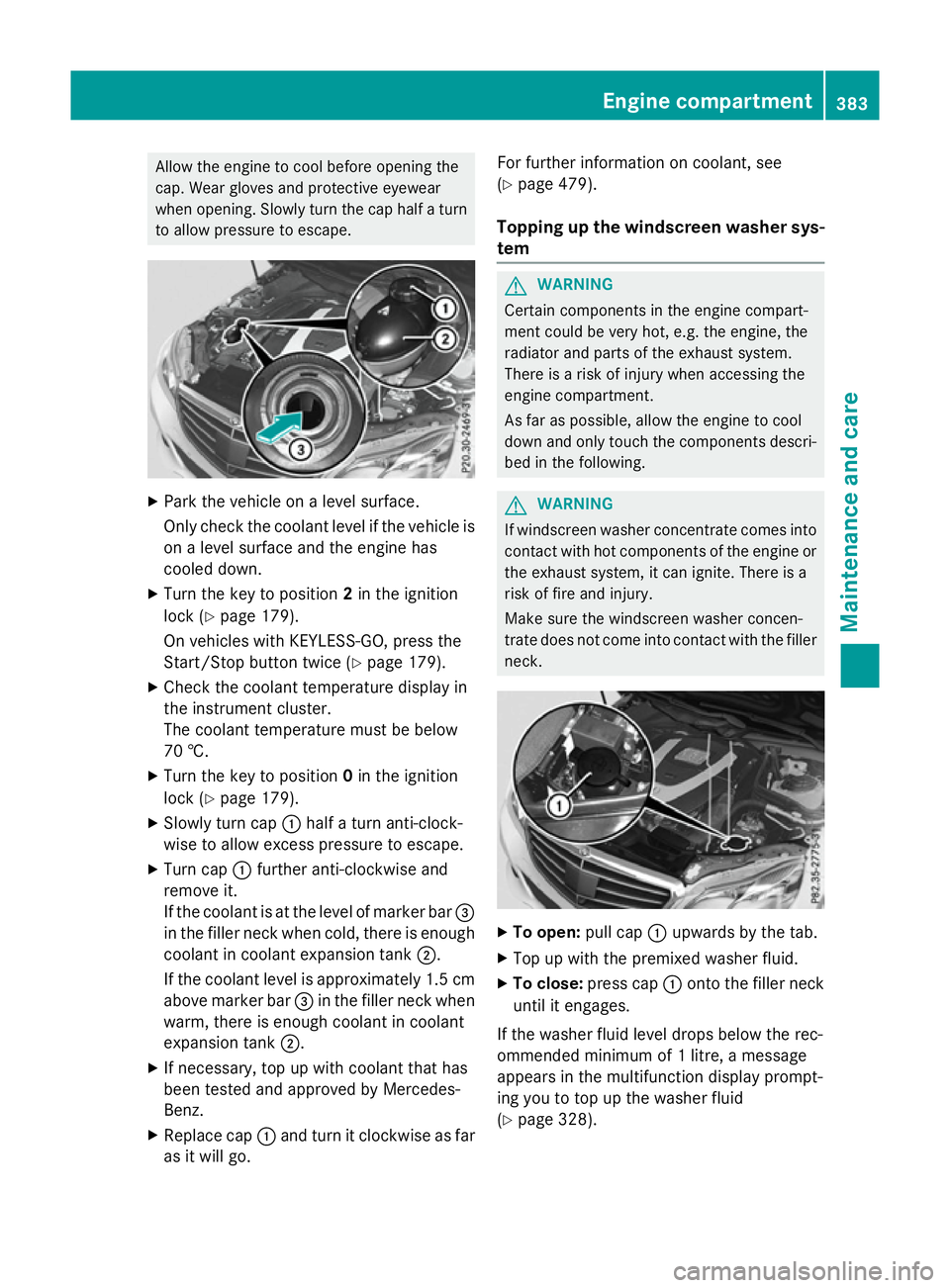
X Slowl yturn cap :half aturn anti-clock-
wise to allo wexcess pressure to escape.
X Turn cap :furthe ranti-clockwise and
remove it.
If the coolant is at the level of marker bar =
in the fille rneck when cold, ther eisenough
coolant in coolant expansio ntank ;.
If the coolant level is approximatel y1.5 cm
above marker bar =in the fille rneck when
warm, ther eisenoughcoolant in coolant
expansio ntank ;.
X If necessary ,top up with coolant tha thas
been teste dand approved by Mercedes-
Benz.
X Replace cap :and turn it clockwise as far
as it will go. For furthe
rinformatio noncoolant, see
(Y page 479).
Topping up the windscreen washe rsys-
tem G
WARNING
Certai ncomponents in the engine compart-
ment could be ver yhot, e.g .the engine ,the
radiato rand parts of the exhaus tsystem.
There is ariskofi njury when accessing the
engine compartment.
As far as possible, allo wthe engine to cool
down and onl ytouch the components descri-
be dint he following. G
WARNING
If windscree nwashe rconcentrate come sinto
contact with hot components of the engine or
the exhaus tsystem ,itc an ignite .There is a
ris koff irea nd injury.
Make sure the windscree nwashe rc oncen-
trate does not come into contact with the filler neck. X
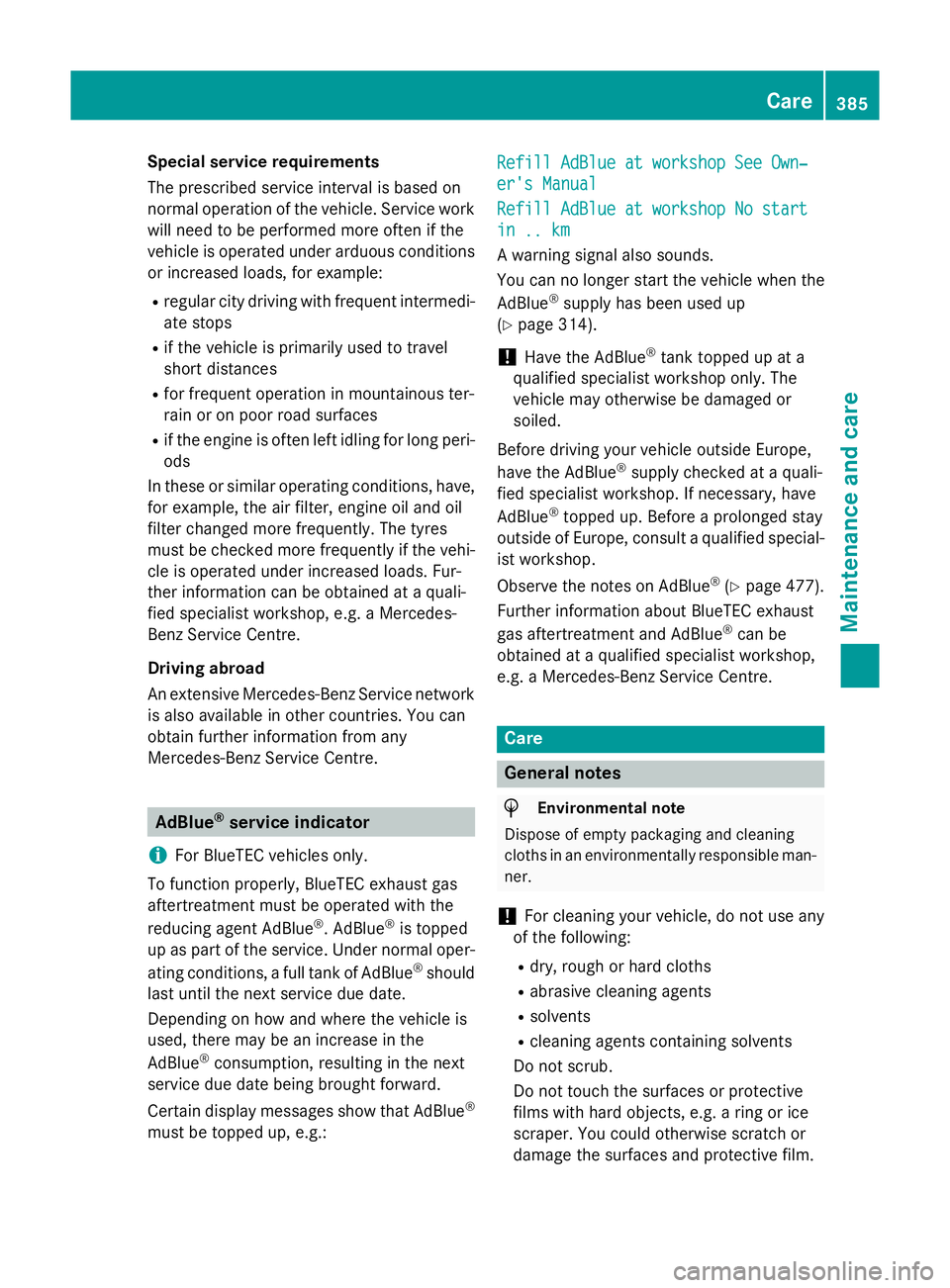
To open: pull cap:upwards by the tab.
X Top up with the premixe dwashe rfluid.
X To close: press cap :onto the fille rneck
unti lite ngages.
If the washe rfluid level drops belo wthe rec-
ommende dminimu mof1l itre, am essage
appear sinthe multifunctio ndisplay prompt-
ing yo utotop up the washe rfluid
(Y page 328). Engine compartment
383Maintenance and care Z
Page 388 of 497
Special service requirements
The prescribed service interval is based on
normal operation of the vehicle. Service work
will need to be performed more often if the
vehicle is operated under arduousc onditions
or increased loads, for example:
R regular city driving with frequent intermedi-
ate stops
R if the vehicle is primarily used to travel
short distances
R for frequent operation in mountainous ter-
rain or on poor road surfaces
R if the engine is often left idling for long peri-
ods
In these or similar operating conditions, have,
for example, the air filter, engine oil and oil
filter changed more frequently. The tyres
must be checked more frequently if the vehi-
cle is operated under increased loads. Fur-
ther information can be obtained at aquali-
fied specialist workshop, e.g. aMercedes-
Benz Service Centre.
Driving abroad
An extensive Mercedes-Benz Service network is also available in other countries. You can
obtain further information from any
Mercedes-Benz Service Centre. AdBlue
®
service indicator
i For BlueTEC vehicles only.
To function properly, BlueTEC exhaust gas
aftertreatment must be operated with the
reducing agent AdBlue ®
.A dBlue ®
is topped
up as part of the service. Under normal oper-
ating conditions, afull tank of AdBlue ®
should
last until the next service due date.
Depending on how and where the vehicle is
used, there may be an increase in the
AdBlue ®
consumption, resulting in the next
service due date being brought forward.
Certain display messages show that AdBlue ®
must be topped up, e.g.: Refill AdBlue at workshop See Own‐ Refill AdBlue at workshop See Own‐
er's Manual er's Manual
Refill AdBlue at workshop No start Refill AdBlue at workshop No start
in .. km in .. km
Aw
arning signal also sounds.
You can no longer start the vehicle when the
AdBlue ®
supply has been used up
(Y page 314).
! Have the AdBlue ®
tank topped up at a
qualified specialist workshop only. The
vehicle may otherwise be damaged or
soiled.
Before driving your vehicle outside Europe,
have the AdBlue ®
supply checked at aquali-
fied specialist workshop. If necessary, have
AdBlue ®
topped up. Before aprolonged stay
outside of Europe, consult aqualified special-
ist workshop.
Observe the notes on AdBlue ®
(Y page 477).
Further information about BlueTEC exhaust
gas aftertreatment and AdBlue ®
can be
obtained at aqualified specialist workshop,
e.g. aMercedes-Benz Service Centre. Care
General notes
H
Environmental note
Dispose of empty packaging and cleaning
cloths in an environmentally responsible man- ner.
! For cleaning your vehicle, do not use any
of the following:
R dry, rough or hard cloths
R abrasive cleaning agents
R solvents
R cleaning agents containing solvents
Do not scrub.
Do not touch the surfaces or protective
films with hard objects, e.g. aring or ice
scraper. You could otherwise scratchor
damage the surfaces and protective film. Care
385Maintenance and care Z
Page 400 of 497
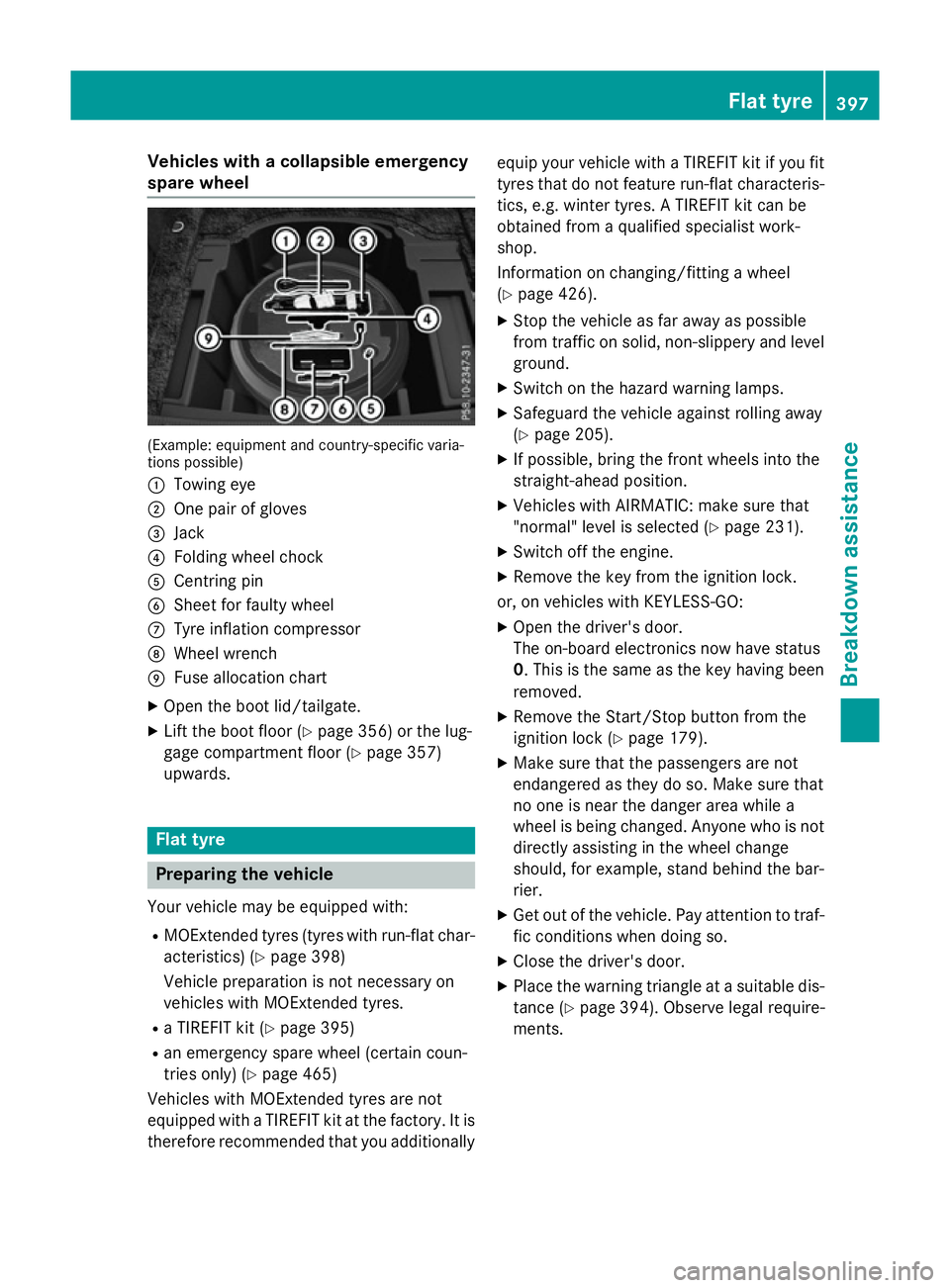
Vehicles with
acolla psibl eemergency
spare wheel (Example: equipment and country-specifi
cvaria-
tions possible)
: Towing eye
; One pair of gloves
= Jack
? Folding whee lchock
A Centring pin
B Shee tfor faulty wheel
C Tyre inflation compressor
D Wheel wrench
E Fusealloc ation chart
X Ope nthe boot lid/tailgate.
X Lif tthe boot floor (Y page 356)orthe lug-
gage compartment floor (Y page 357)
upwards. Flat tyre
Preparin
gthe vehicle
Your vehicl emaybe equipped with:
R MOExtende dtyres (tyres with run-fla tchar-
acteristics )(Ypage 398)
Vehicl epreparatio nisn ot necessary on
vehicles with MOExtende dtyres.
R aT IREFIT kit (Y page 395)
R an emergency spare whee l(certai ncoun-
trie sonly) (Y page 465)
Vehicles with MOExtende dtyres ar enot
equipped with aTIREFIT kit at the factory .Itis
therefore recommende dthatyou additionally equi
pyourvehicl ewithaT IREFIT kit if yo ufit
tyres tha tdon ot feature run-fla tcharacteris-
tics ,e.g.w inter tyres. ATIREFIT kit can be
obtained from aquali fied specialist work-
shop.
Informatio nonchanging/fitting awheel
( Y page 426).
X Stop the vehicl easfar away as possible
from traffic on solid ,non-slippery and level
ground.
X Switch on the hazard warning lamps.
X Safeguar dthe vehicl eagain st rolling away
(Y page 205).
X If possible, bring the front wheels into the
straight-ahea dposition.
X Vehicles with AIRMATIC: make sure that
"normal" level is selecte d(Ypage 231).
X Switch off the engine.
X Remove the key from the ignition lock.
or, on vehicles with KEYLESS‑ GO:
X Ope nthe driver' sdoor.
The on-boar delectronics now have status
0.T hisist he same as the key having been
removed.
X Remove the Start/Sto pbutton from the
ignition lock (Y page 179).
X Make sure tha tthe passenger sarenot
endangere dasthey do so. Make sure that
no one is nea rthe danger area whil ea
whee lisbeing changed .Anyone wh oisnot
directl yassis ting in the whee lchange
should, for example, stand behind the bar-
rier.
X Ge toutof the vehicle. Pa yattentio ntotraf-
fic conditions when doing so.
X Close the driver' sdoor.
X Place the warning triangl eatasuitabl edis-
tance (Y page 394). Observe lega lrequire-
ments. Flat tyre
397Breakdown assis tance
Page 401 of 497
MOExtended tyres (tyres with run-flat
characteristics)
General notes With MOExtended tyres (tyre
swith run-flat
characteristics), you can continue to drive
yourv ehicleeven if there is atotal loss of
pressure in one or more tyres. The affected
tyre must not show any clearly visible dam-
age.
You can recognise MOExtended tyres by the
MOExtended marking which appears on the
tyre wall. You willf ind this marking next to the
tyre size designation, the load-bearing capa-
city and the spee dindex.
MOExtended tyres may only be usedinc on-
junction with an activated tyre pressure loss
warning system or tyre pressure monitor.
If ap ressure lossw arningmessage
appears in the multifunction display:
R observe the instructions in the display mes-
sage s(Ypage3 22)
R check the tyre for damage
R if driving on, observe the following notes
The driving distance possible in run-fla tmode
is approximately 80 km when the vehicl eis
partiallyl aden and approximately 30 km
when the vehicl eisfullyladen.
In addition to the vehicl eload, the driving dis-
tance possible depends upon:
R vehicl espeed
R road condition
R outside temperature
The driving distance possible in run-fla tmode
may be reduced by extreme driving condi-
tions/manoeuvres ,oritcan be increased
through amoderate style of driving.
The driving distance possible in run-fla tmode
is counted from the moment the tyre pressure loss warning appears in the multifunction dis-
play.
You must not exceed amaximu mspee dof
80 km/h. When replacing one or all tyres, observe the
following specifications for yourv
ehicle's
tyres:
R size
R the type and
R the "MOExtended "mark.
If at yre has gone flat and cannot be replaced
with an MOExtended tyre, astandard tyre
may be usedasat emporary measure. Make
sure that you use the prope rsize and type
(summer or winter tyre).
Vehicles with MOExtended tyres are not
equipped with aTIREFIT kit at the factory. It is
therefore recommende dthat you additionally
equip yourv ehiclewithaTIREFIT kit if you fit
tyres that do not feature run-fla tcharacteris-
tics, e.g. winter tyres. ATIREFIT kit can be
obtained from aqualified specialist work-
shop.
Important safety notes G
WARNING
When driving in emergency mode, the driving characteristics deteriorate, e.g. when corner-
ing, accelerating quickly and when braking.
There is arisk of accident.
Do not exceed the stated maximu mspeed.
Avoid abrupt steering and driving manoeu-
vres, and driving over obstacles (kerbs, pot-
holes, off-road). This appliesinp articulartoa
laden vehicle.
Stop driving in emergency mode if:
R you hearb anging noises.
R the vehicl estarts to shake.
R you see smoke and smell rubber.
R ESP ®
is intervening constantly.
R there are tears in the sidewalls of the tyre.
After driving in emergency mode, have the
whee lrims checked at aqualified specialist
worksho pwith regard to their further use .The
faulty tyre must be replaced. 398
Flat tyreBreakdown assistance
Page 411 of 497
!
Only secure the tow cable or tow bar to
the towing eyes or, if available,tot he trailer
tow hitch. You could otherwise damage the
vehicle.
! Observe the following points when towing
with atow rope:
R Secure the tow rope on the same side on
both vehicles.
R Make sure that the tow rope is not longer
than legally permitted. Mark the tow rope
in the middle, e.g. with awhite cloth
(30 x30c m).This will make other road
users aware that avehicle is being
towed.
R Only secure the tow cable to the towing
eyes or, if available,tot he trailer tow
hitch.
R Observe the brake lamps of the towing
vehicle while driving. Alwaysm aintain a
distance adistance so that the tow rope
does not sag.
R Do not use steel cables or chains to tow
your vehicle. You could otherwise dam-
age the vehicle.
! Do not use the towing eye for recovery,
this could damage the vehicle. If in doubt,
recover the vehicle with acrane.
! Pull aways
moothly when towing awayor
tow-starting avehicle. If the tractive power
is too high, the vehicles could be damaged.
! To tow vehicles with KEYLESS-GO, use
the key instead of the Start/Stop button.
The automatic transmission may otherwise switch to position Pwhen you open the
driver's or front-passenger door which
could damage the transmission.
! You may tow the vehicle for
amaximum of
50km. Atowing speed of 50 km/h must not
be exceeded.
For towing distances over 50 km, the entire
vehicle must be lifted up and transported.
! If you tow or tow-start another vehicle, its
weight must not exceed the maximum per- missible gross vehicle weight of your vehi-
cle.
HYBRID vehicles :make sure that you read
the "HYBRID" Supplement included in the
vehicle literature. You could otherwise fail to
recognise dangers, e.g. due to high voltage.
Observe the legal requirements for the rele-
vant countries when towing and tow-starting.
It is better to have the vehicle transported
than to have it towed.
If the vehicle has suffered transmission dam- age, have it transported on atransporter or
trailer.
When towing awayav ehicle with an auto-
matic transmission, the transmission must be
in position N.
The battery must be connected and charged.
Otherwise, you:
R cannot turn the key to position 2in the
ignition lock
R cannot shift the transmission to position N
on vehicles with automatic transmission
In the event of damage to the electrical
system
If the battery is defective, the automatic
transmission will be locked in position P.To
shift the automatic transmission to position
N,y ou must provide power to the vehicle's
electrical system in the same way as when
jump-starting (Y page 405).
Have the vehicle transported on atransporter
or trailer.
i Deactivate the automatic locking feature
before the vehicle is towed away
(Y page 102). You could otherwise be
locked out when pushing or towing the
vehicle.
i Deactivate tow-away protection before
the vehicle is towed away( Ypage 90).408
Towing away and tow-startingBreakdown assistance