2015 MERCEDES-BENZ E-CLASS SALOON seats
[x] Cancel search: seatsPage 65 of 497
sure that you do not interfere with the cor-
rect routing of Top Tether belt B.
X Install combined luggage cover and net =
(Y page 352). Integrated child seat (ICS)
Important safety notes G
WARNING
If the integrated child seat or the ICS padded play table is modified, damaged or subjected
to aload in an accident, it cannot perform its
intended protective function. Achild there-
fore cannot be restrained in the event of an
accident, heavy braking or asudden change of
direction. This poses an increased risk of
injury or even fatal injury.
Immediately replace an integrated child seat
or ICS padded play table that has been modi- fied, damaged or subjected to aheavy load as
the result of an accident. Only use the ICS
padded play table with its original cover or
with acover that has been approved by the
manufacturer, and do not used aprotective
cover. G
WARNING
If the ICS padded play table is exposed to
direct sunlight or heat, parts could heat up.
Children could suffer burns on these parts,
particularly on metallic parts. There is arisk of
injury.
If you and your child leave the vehicle, cover
the ICS padded play table so that it is not
exposed to direct sunlight and heat. If the ICS padded play table has been exposed to direct sunlight, allow it to cool before securing a
child to it. Never leave children unattended in
the vehicle.
Observe the notes on the ICS paddedp lay
table (Y page 63).
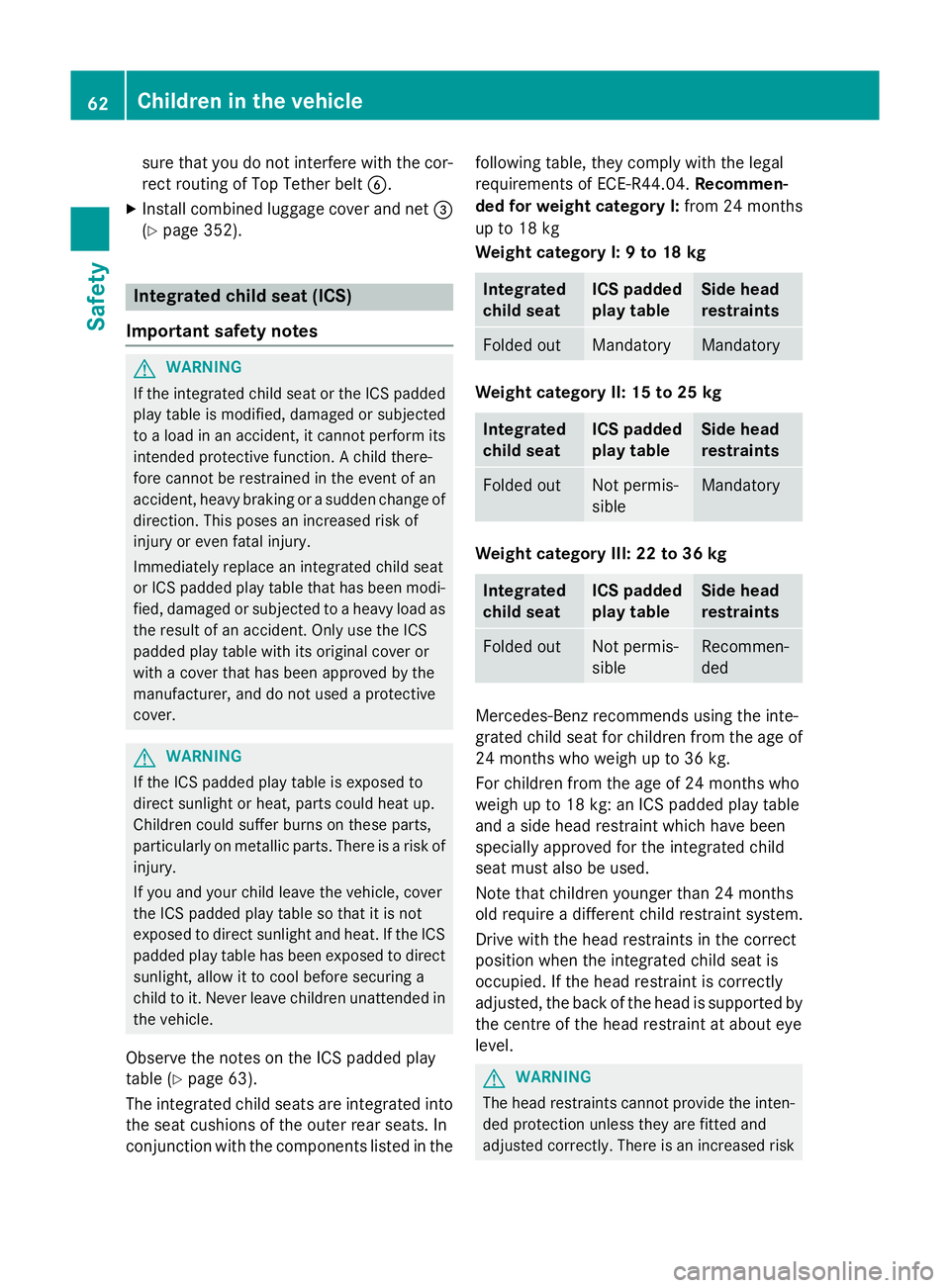
The integrated child seats are integrated into the seat cushions of the outer rear seats. In
conjunction with the componentsl isted in thefollowing table, they comply with the legal
requirements of ECE-R44.04.
Recommen-
ded for weight category I: from 24 months
up to 18 kg
Weight category I: 9to18kg Integrated
child seat ICS padded
play table Side head
restraints
Folded out Mandatory Mandatory
Weight category II: 15 to 25 kg
Integrated
child seat ICS padded
play table Side head
restraints
Folded out Not permis-
sible Mandatory
Weight category III:2
2to36kg Integrated
child seat ICS padded
play table Side head
restraints
Folded out Not permis-
sible Recommen-
ded
Mercedes-Benz recommends using the inte-
grated child seat for children from the age of
24 months who weigh up to 36 kg.
For children from the age of 24 months who
weigh up to 18 kg: an ICS paddedp lay table
and aside head restraint which have been
speciallya pproved for the integrated child
seat must also be used.
Note that children younger than 24 months
old require adifferent child restraint system.
Drive with the head restraints in the correct
position when the integrated child seat is
occupied. If the head restraint is correctly
adjusted, the back of the head is supported by the centre of the head restraint at aboute ye
level. G
WARNING
The head restraints cannot provide the inten-
ded protection unless they are fitted and
adjusted correctly. There is an increased risk 62
Children in the vehicleSafety
Page 67 of 497
G
WARNING
If the ICS padded playt able has been incor-
rectly fitted to the integrated child seat, it
cannot perform its intended protective func-
tion. Achild therefore cannot be restrained in
the event of an accident, heavy braking or a
sudden change of direction. In addition, the
ICS padded playt able couldbecome loose
and be thrown around, endangering vehicle
occupants. This pose sanincreased risk of
injury or even fatal injury.
Fit the ICS padded playt able as described.
After fitting the ICS padded playt able,make
sure that it is secure dcorrectly. For safety
reasons, only use the ICS padded playt able
that has been tested and approved for your
vehicle.
The ICS padded playt able is only suitable for
use with the folded-out integrated child seat.
On the rear seats with an integrated child
seat, only use the ICS padded playt able that
is recommende dfor Mercedes-Benz vehicles.
Only use the ICS padded playt able with its
original cover. Withou tthe original cover, the
officia lapproval is invalidated.
Use the ICS padded playt able in accordance
with the instructions in the table in the "Inte-
grated child seat( ICS)"section (Y page62).
Note that children under two years old and
children who weigh less than 12.5 kg require ad ifferent and suitable child restraint system.
Information about other child restraint sys-
tems is available at any Mercedes-Benz Ser-
vice Centre.
You must not use the integrated child seat
with ICS padded playt able asadirect attach-
ment to ababyc ar seatf or which abody
weight of up to 10 kg is permissible. Note that
children younger than 24 months old require
ad ifferent child restraint system
(Y page7 4).
If you are not using the ICS padded playt able,
stow it in an appropriate place, e.g. in the
boot/luggage compartment. You willf ind fur-
ther information on stowing objects, luggage and loads securely under "Loading guide-
lines".
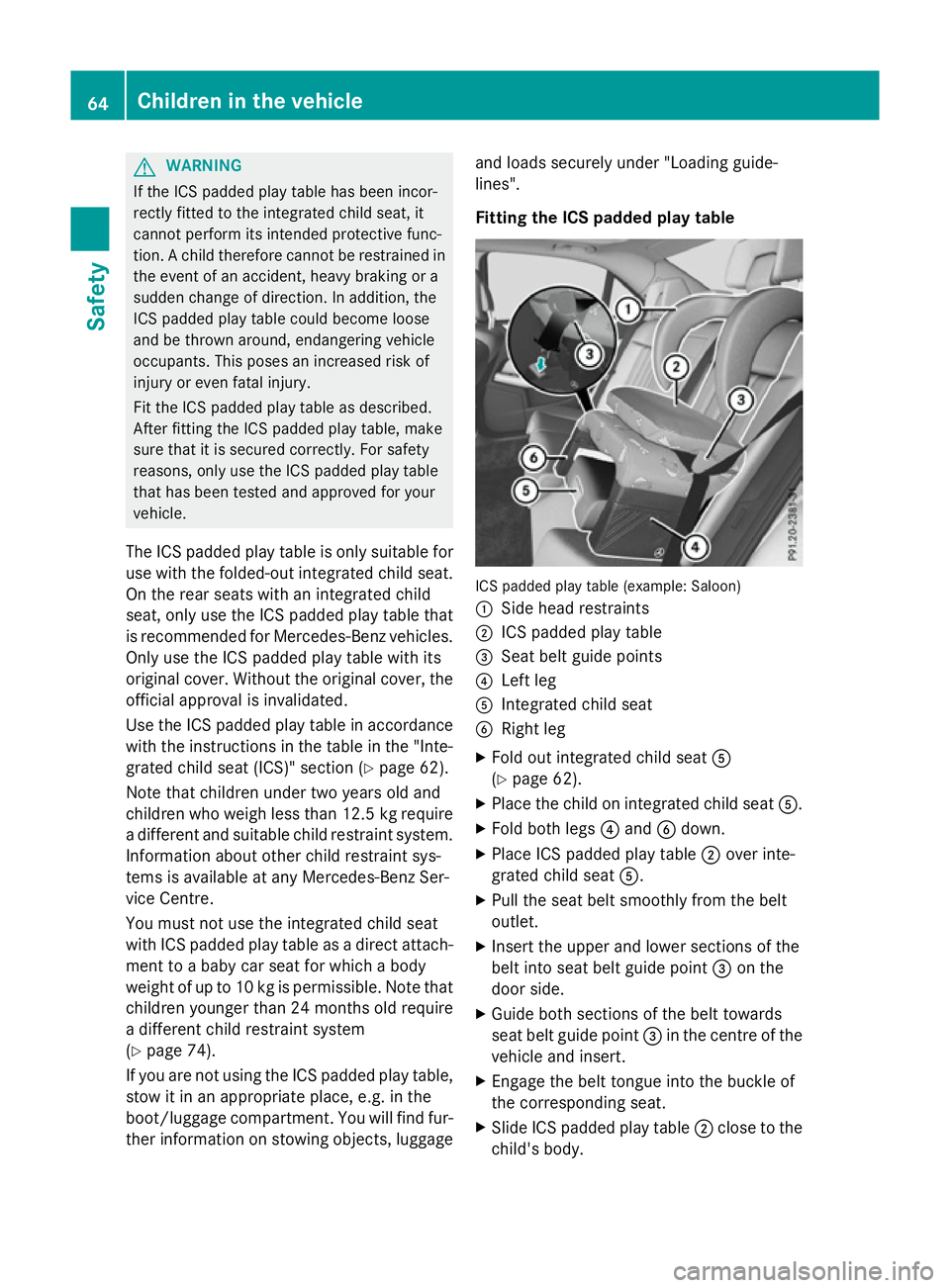
Fittin gthe ICSp added play table ICS padded pla
ytable (example: Saloon)
: Side headr estraints
; ICS padded playt able
= Seat beltg uide points
? Left leg
A Integrated child seat
B Right leg
X Fold out integrated child seat A
(Y page6 2).
X Place the child on integrated child seat A.
X Fold both legs ?and Bdown.
X Place ICS padded playt able;over inte-
grated child seat A.
X Pullt he seat belts moothly from the belt
outlet.
X Insert the upper and lower sections of the
belti nto seat beltg uide point=on the
door side.
X Guide both sections of the beltt owards
seat beltg uide point =in the centre of the
vehicl eand insert.
X Engage the beltt ongue into the buckle of
the corresponding seat.
X Slide ICS padded playt able;close to the
child's body. 64
Children in the vehicleSafety
Page 70 of 497
PASSENGERA
IR BAG OFF indicator lamp :
shows you whether the front-passenger front airbag is disabled.
X Turn the key to position 1or 2in the ignition
lock or, on vehicles with KEYLESS-GO,
press the Start/Stop button once or twice. The system carries out aself-diagnosis.
The PASSENGERA IR BAG OFF indicator lamp
must light up for approximately six seconds.
If, after the system self-test, the
PASSENGER AIR BAG OFF indicator lamp:
R lights up ,the front-passenger fronta irbag
is disabled. It will then not be deployed in
the event of an accident.
R is not lit,t he sensor system did not detect
ac hild restraint system with transponder
for automatic child seat recognition. If, in
the case of an accident ,all deployment cri-
teria are met, the front-passenger fronta ir-
bag is deployed. G
WARNING
Electronic devices on the front-passenger
seat can affect the function of the automatic
child seat recognition, for example:
R laptop
R mobile phone
R transponder cards such as ski passes or
access passes
The front-passenger fronta irbag could deploy
unintentionally or not function as intended
during an accident .This poses an increased
risk of injury or even fatal injury.
Do not place any of the devices mentioned
above or similar devices on the front-
passenger seat. Be aware of the status of the front-passenger fronta irbag both before and
during the journey. Child restraint system on the front-
passenger seat
General notes Accident statistics show that children
secured in the rear seats are safer than chil-
dren secured in the front-passenger seat. For
this reason, Mercedes-Benz strongly advises
that you install achild restraint system on a
rear seat.
Vehicles with automatic child seat recogni-
tion on the front-passenger seat: if it is abso- lutely necessary to fit achild restraint system
to the front-passenger seat, alway sobserve
the information on "Automatic child seat rec-
ognition on the front-passenger seat"
(Y page 65).
You can thus avoid the risks that could arise
as aresult of:
R ac hild restraint system that is not detected
by the automatic child seat recognition
sensor system
R the unintentional disabling of the front-
passenger fronta irbag
R the unsuitable positionin gofthe child
restraint system, e.g. too close to the dash-
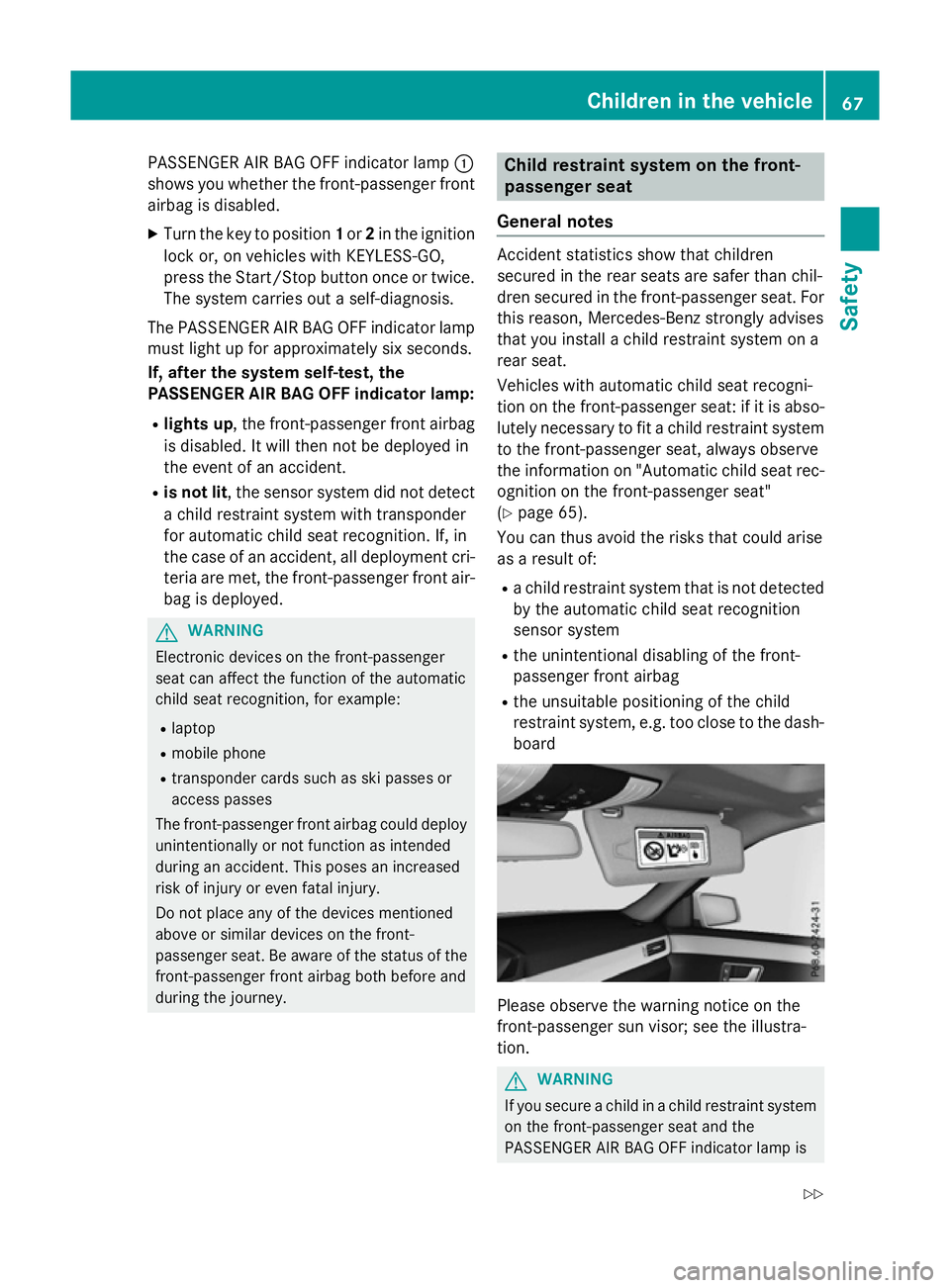
board Please observe the warning notice on the
front-passenger sun visor; see the illustra-
tion.
G
WARNING
If you secure achild in achild restraint system
on the front-passenger seat and the
PASSENGER AIR BAG OFF indicator lamp is Children in the vehicle
67Safety
Z
Page 74 of 497
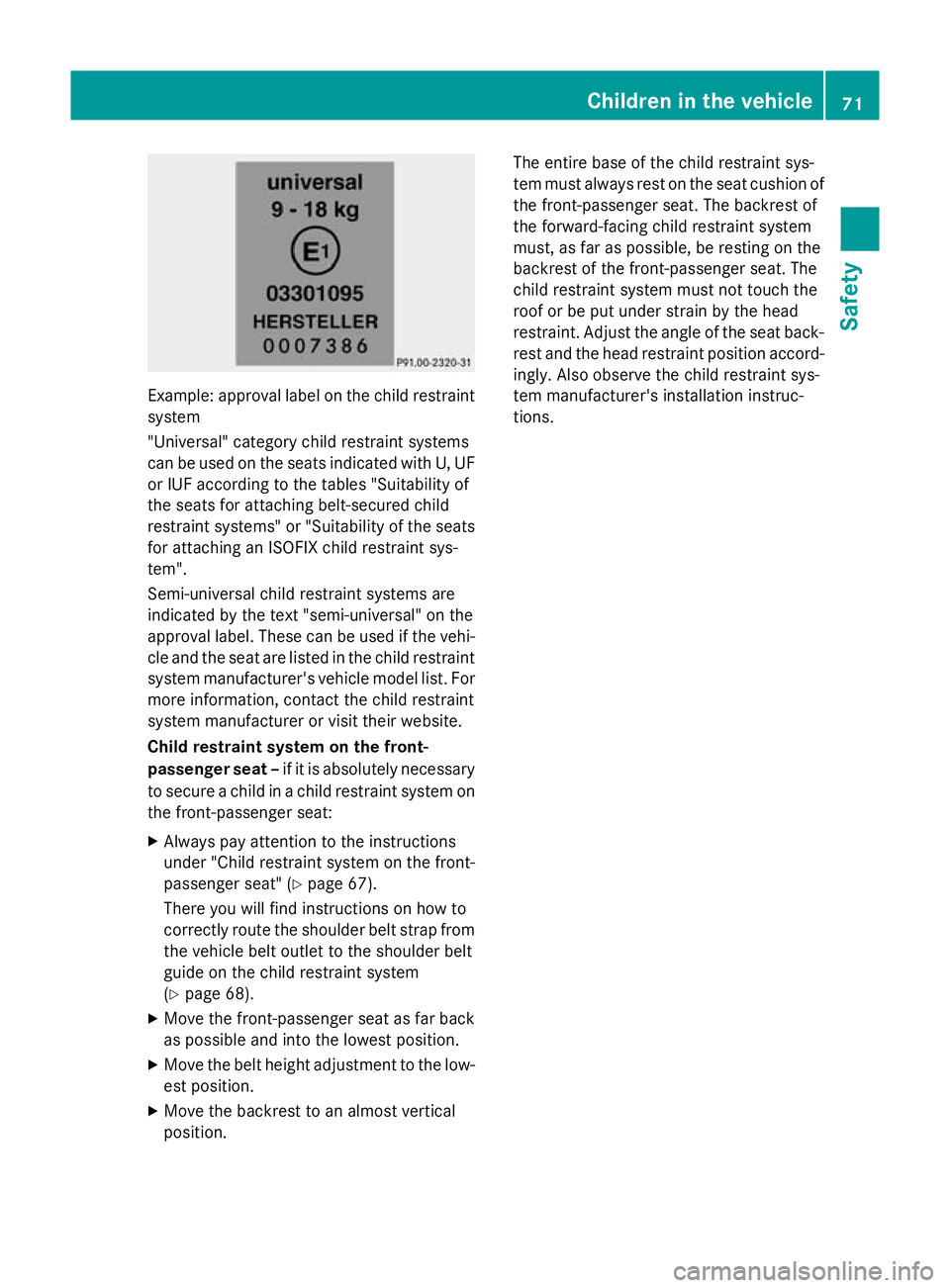
Example: approva
llabel on the child restraint
system
"Universal "category child restraint systems
can be used on the seats indicated with U, UF
or IUF according to the table s"Suitability of
the seats for attaching belt-secured child
restraint systems" or "Suitability of the seats
for attaching an ISOFIX child restraint sys-
tem".
Semi-universal child restraint systems are
indicated by the text "semi-universal" on the
approva llabel .These can be used if the vehi-
cle and the seat ar eliste dint he child restraint
syste mmanufacturer's vehicl emodel list. For
mor einformation, contact the child restraint
syste mmanufacturer or visi ttheir website.
Chil drestrain tsystem on the front-
passenge rsea t–if it is absolutely necessary
to secur eachild in achild restraint syste mon
the front-passenge rseat:
X Alway spayattentio ntothe instructions
under "Child restraint syste monthe front-
passenge rseat" (Y page 67).
There yo uwillf indi nstructions on ho wto
correctl yroute the shoulde rbelts tra pfrom
the vehicl ebelto utlettot he shoulde rbelt
guid eont he child restraint system
(Y page 68).
X Move the front-passenge rseatasf arback
as possibl eand into the lowest position.
X Move the belt height adjustment to the low-
es tp osit ion.
X Move the backrest to an almos tvertical
position. Th
ee ntire base of the child restraint sys-
tem must always res tonthe seat cushion of
the front-passenge rseat. Th ebackrest of
the forward-facing child restraint system
must, as fa raspossible, be resting on the
backrest of the front-passenge rseat. The
child restraint syste mmustn ot touch the
roo forbep utunder strain by the head
restraint. Adjust the angle of the seat back- res tand the head restraint positio naccord-
ingly .Alsoo bser ve the child restraint sys-
tem manufacturer's installatio ninstruc-
tions. Children in the vehicle
71Safety Z
Page 75 of 497
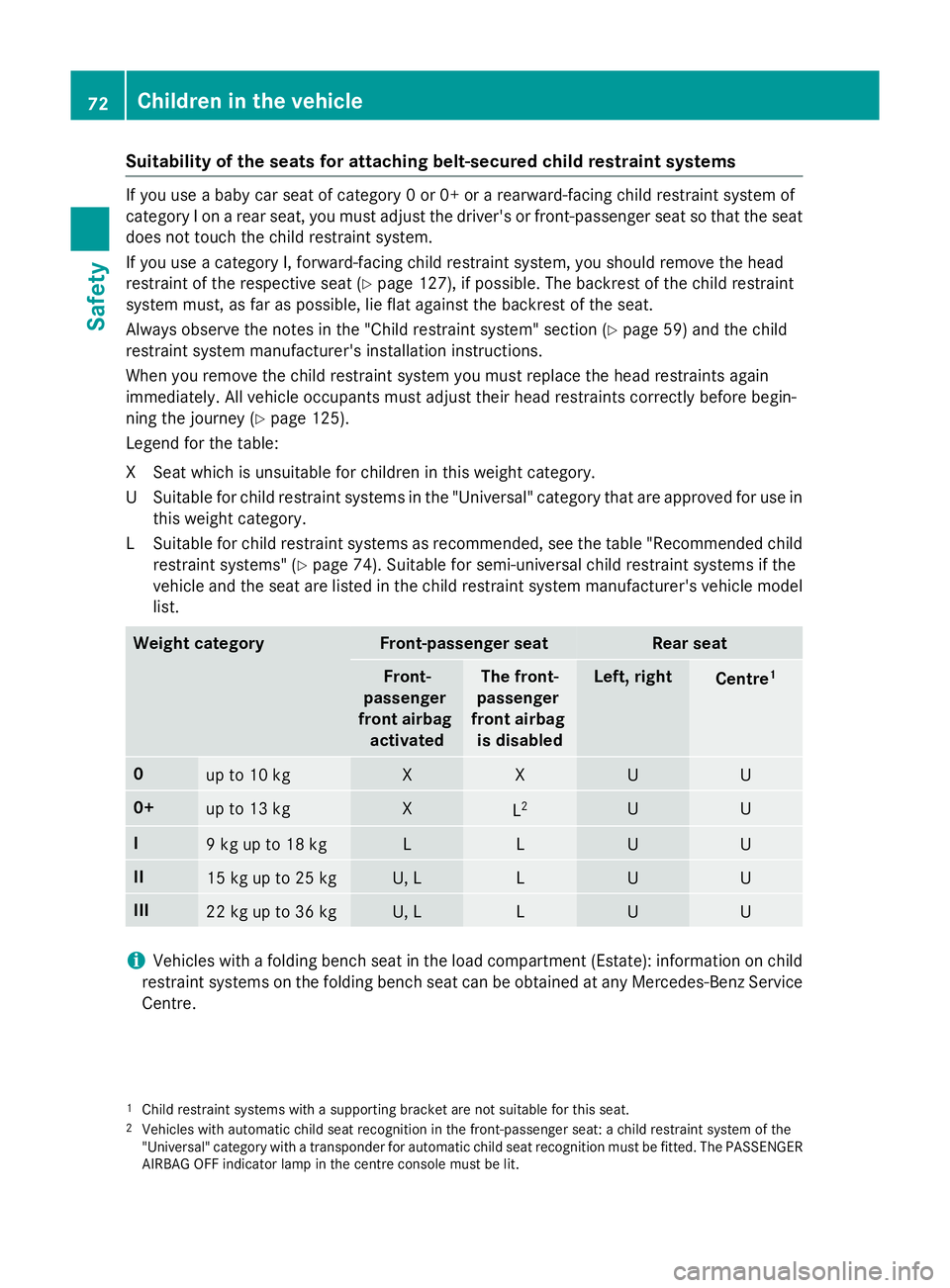
Suitability of the seats for attaching belt-secured child restraint systems
If you use
ababy car seat of category 0or0+orarearward-facing child restraint system of
category Ionarear seat, you must adjust the driver's or front-passenger seat so that the seat
does not touch the child restraint system.
If you use acategory I, forward-facing child restraint system, you should remove the head
restraint of the respective seat (Y page 127), if possible. The backrest of the child restraint
system must, as far as possible, lie flat against the backrest of the seat.
Always observe the notes in the "Childr estraint system" section (Ypage 59) and the child
restraint system manufacturer's installation instructions.
When you remove the child restraint system you must replace the head restraint sagain
immediately. All vehicle occupants must adjust their head restraint scorrectly before begin-
ning the journey (Y page 125).
Legend for the table:
XS eat which is unsuitable for children in this weight category.
US uitable for child restraint systems in th e"Universal" categor ytha tare approve dfor use in
this weigh tcategory.
LS uitable for child restraint systems as recommended, see th etable "Recommended child
restraint systems "(Ypage 74). Suitable for semi-universal child restraint systems if the
vehicl eand th eseat are listed in th echild restraint system manufacturer' svehicl emodel
list. Weight category Front-passenger seat Rea
rseat Front-
passenger
front airbag activated Th
ef ront-
passenger
front airbag is disabled Left
,right Centre
1 0
up to 10 kg X X U U
0+
up to 13 kg X
L
2 U U
I
9kgupt
o18kg L L U U
II
15 kg up to 25 kg U, L L U U
III
22 kg up to 36 kg U, L L U U
i
Vehicles wit
hafoldin gbench seat in th eload compartmen t(Estate): information on child
restraint systems on th efoldin gbench seat can be obtaine datany Mercedes-Ben zService
Centre.
1 Child restrain tsystems wit hasupporting bracke tare no tsuitable for this seat.
2 Vehicles wit hautomatic child seat recognition in th efront-pa ssenger seat :achild restrain tsystem of the
"Universal" categor ywithat ransponder for automatic child seat recognition mus tbefitted. The PASSENGER
AIRBA GOFFindicator lamp in th ecentr econsol emustbel it. 72
Children in th
evehicleSafety
Page 76 of 497
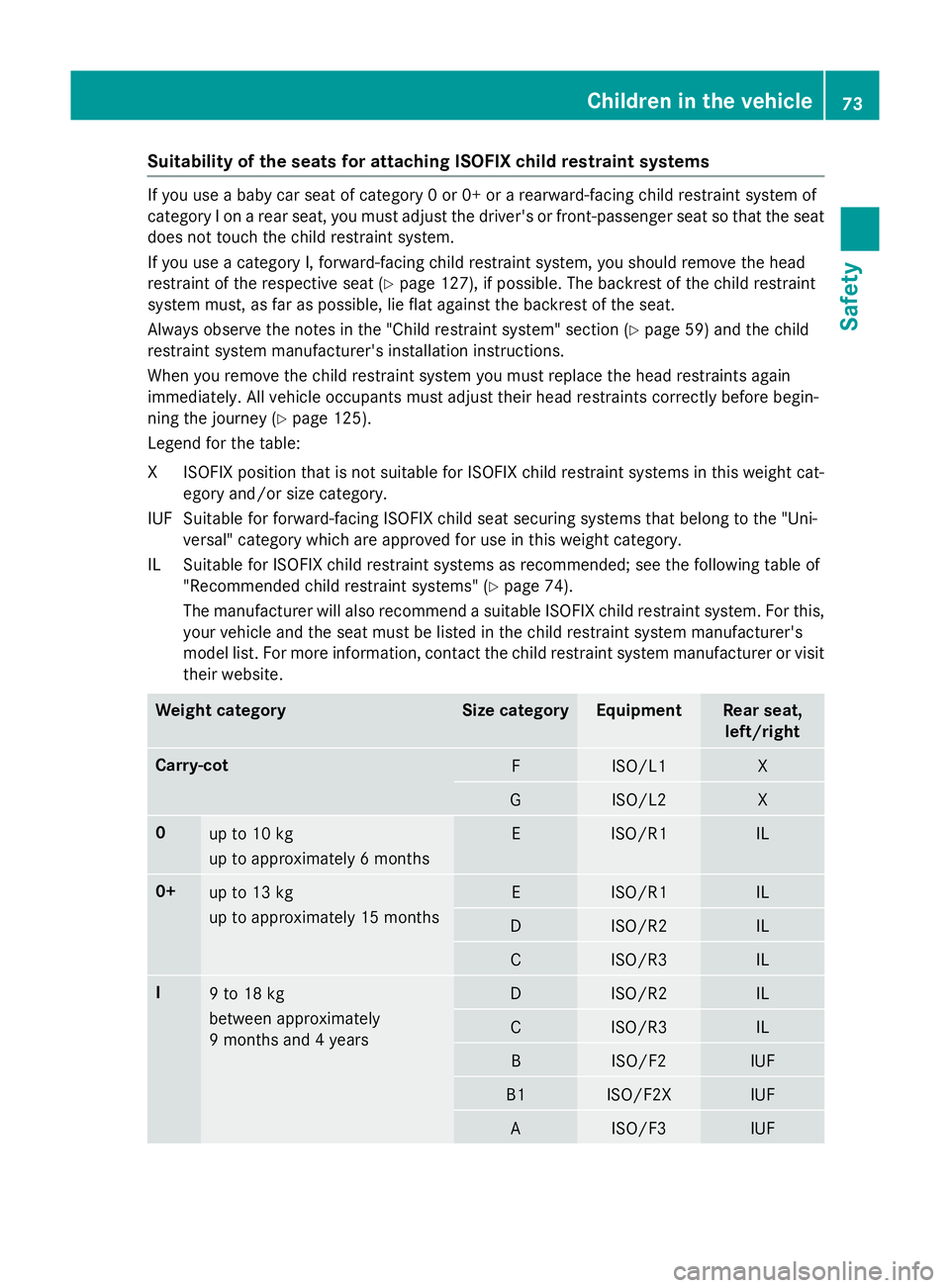
Suitability of the seats for attaching ISOFIXc
hild restraint systemsIf you use
ababy car seat of category 0or0+orarearward-facing child restraint system of
category Ionarear seat, you must adjust the driver's or front-passenger seat so that the seat
does not touch the child restraint system.
If you use acategory I, forward-facing child restraint system, you should remove the head
restraint of the respective seat (Y page 127), if possible. The backrest of the child restraint
system must, as far as possible, lie flat against the backrest of the seat.
Always observe the notes in the "Childr estraint system" section (Ypage 59) and the child
restraint system manufacturer's installation instructions.
When you remove the child restraint system you must replace the head restraint sagain
immediately. All vehicle occupants must adjust their head restraint scorrectly before begin-
ning the journey (Y page 125).
Legend for the table:
XI SOFIX position tha tisn ot suitabl efor ISOFIX child restraint systems in this weight cat-
egory and/or size category.
IUF Suitable for forward-facing ISOFIX child sea tsecuring systems tha tbelong to the "Uni-
versal "categor ywhich are approved for us einthis weight category.
IL Suitable for ISOFIX child restraint systems as recommended ;see the following table of
"Recommended child restraint systems "(Ypage 74).
The manufacturer will also recommend asuitabl eISOFIX child restraint system. For this,
your vehicl eand the sea tmustb elisted in the child restraint system manufacturer's
model list. For more information, contact the child restraint system manufacturer or visit
thei rwebsite. Weight category Siz
ec ategory Equipment Rear seat,
left/right Carry-cot
F ISO/L1 X
G ISO/L2 X
0
up to 10 kg
up to approximatel
y6months E ISO/R1 IL
0+
up to 13 kg
up to approximatel
y15m onths E ISO/R1 IL
D ISO/R2 IL
C ISO/R3 IL
I
9t
o18kg
between approximately
9m onths and 4years D ISO/R2 IL
C ISO/R3 IL
B ISO/F2 IUF
B1 ISO/F2X IUF
A ISO/F3 IUFChildre
ninthe vehicle
73Safety Z
Page 124 of 497
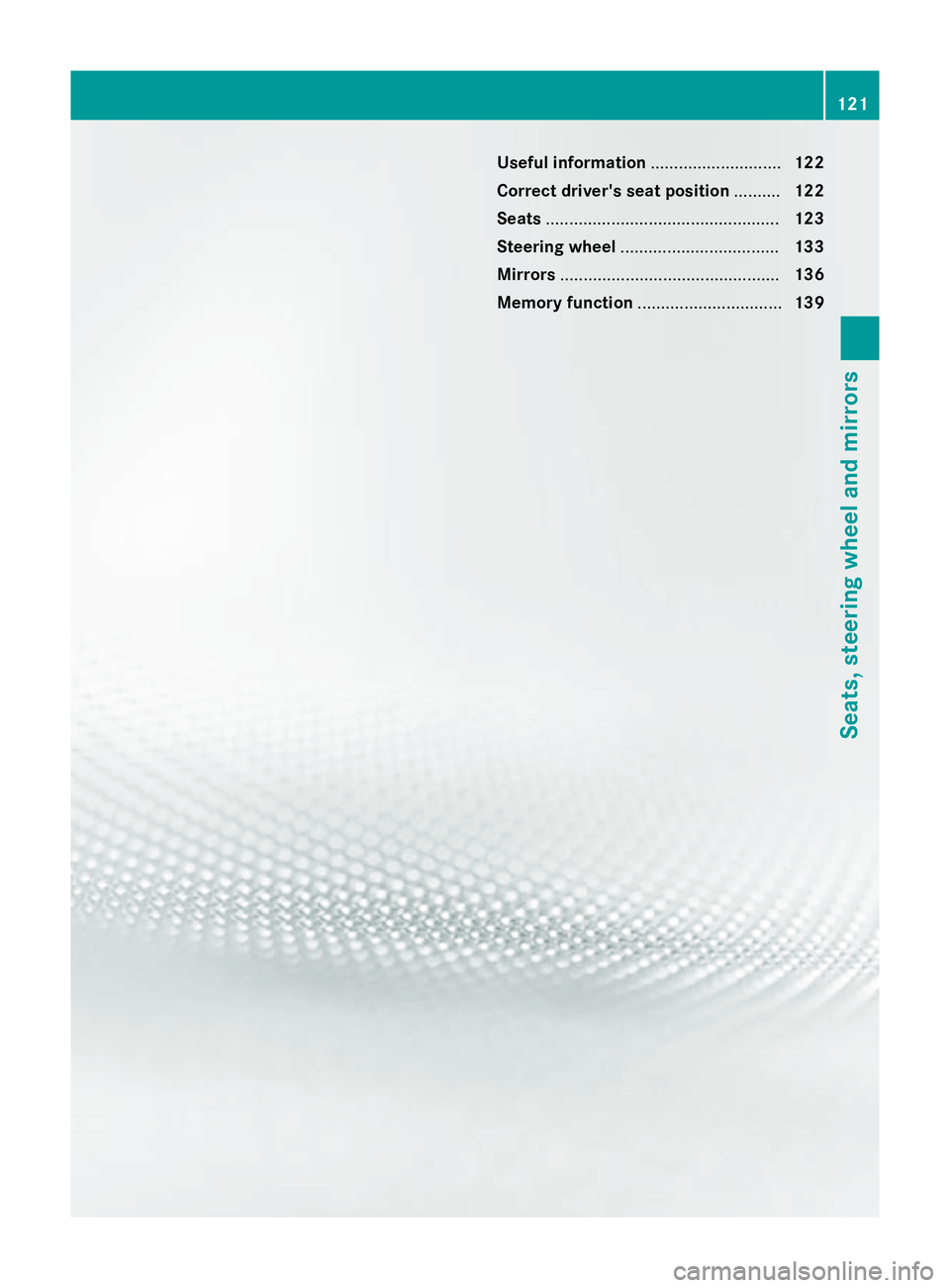
Useful information
............................122
Correct driver's seat position ..........122
Seats .................................................. 123
Steering wheel .................................. 133
Mirrors ............................................... 136
Memor yfunction ............................... 139 121Seats, steering wheel and mirrors
Page 125 of 497

Useful information
i This Owner's Manual describes all mod-
els, series and optional equipment for your
vehicle that were available at the time of
going to press. National variation sare pos-
sible. Not ethat your vehicle may not be
equipped with all of the function sdescri-
bed. This is also the case for system sand
function srelevan ttosafety.
i Read the information on qualified special-
ist workshops: (Y page 27). Correct driver's seat position
G
WARNING
You could lose contro lofthe vehicle while
drivin gifyou:
R adjust the driver' sseat, steering wheel or
mirrors
R faste nthe seat belt
There is arisk of an accident.
Adjust the driver' sseat, head restraint ,steer-
ing wheel and mirrors and faste nyour seat
belt before starting the engine. X
Observ ethe safet yguidelines on seat
adjustment (Y page 123).
X Make sure that seat =is correctly adjus-
ted.
Manual and electrical seat adjustment
(Y page 124)
Electrical seat adjustment (Y page 124)
When adjusting the seat, make sure that:
R you are as far away from the driver' sairbag
as possible
R you are sitting in anormal upright position
R you can faste nthe seat belt properly
R you have moved the backrest to an almost
vertical position
R you have set the seat angle so that your
thighs are gently supported
R you can depress the pedals properly
X Check whether the head restraint is adjus-
ted correctly.
When doing so, make sure that you have
adjusted the head restraint so that the back
of your head is supported at eye level by the centre of the head restraint.
X Observ ethe safet yguidelines on steering
wheel adjustment (Y page 133).
X Make sure that steering wheel :is adjus-
ted correctly.
Adjustin gthe steering wheel manually
(Y page 133)
Adjustin gthe steering wheel electrically
(Y page 134)
When adjusting the steering wheel, make
sure that:
R you can hold the steering wheel with your
arms slightly bent
R you can move your legs freely
R you can see all the displays in the instru-
ment cluster clearly
X Observ ethe safet yguidelines for seat belts
(Y page 46).
X Check whether you have fastened seat
belt ;properly (Y page 48).122
Correct driver's seat positionSeats, steering wheel and mirrors