2015 MERCEDES-BENZ E-CLASS SALOON light
[x] Cancel search: lightPage 392 of 497

Alway
sswitch off the windscree nwiper sand
the ignition before cleaning the windscree nor
wipe rblade s.
! Do not us
edry cloths, abrasive products,
solvents or cleaning agents containing sol-
vents to clean the insid eofthe windows .Do
not touch the insides of the windows with
hard objects, e.g .anice scrape rorring.
There is otherwise ariskofd amagin gthe
windows.
! Clea
nthe water drainage channel softhe
windscree nand the rea rwindo watr egular
intervals .Deposits such as leaves, petals
and pollen ma yunder certain circumstan-
ces prevent water from draining away .This
can lead to corrosion damage and damage to electronic components.
X Clea nthe insid eand outsid eofthe win-
dows with adam pcloth and acleaning
agent tha tisr ecommende dand approved
by Mercedes-Benz.
Cleanin gthe wiper blades G
WARNING
If the windscree nwiper sareset in motion
when cleaning the windscree norwiper
blades, yo ucould become trapped. There is a
dange rofinjury.
Alway sswitch off the windscree nwiper sand
the ignition before cleaning the windscree nor
wipe rblade s.
! Do not pull on the wipe
rblade .Otherwise,
the wipe rblade could be damaged.
! Do not clean wipe
rblade stoo ofte nand
do not ru bthem too hard. Otherwise, the
graphite coating could be damaged. This
could cause wipe rnoise.
! Hol
dthe wipe rarm securel ywhenf olding
back. The windscree ncould be damage dif
the wipe rarm hits against it suddenly. X
Fol dthe wipe rarm sa wayfrom the wind-
screen.
X Clea nthe wipe rblade scarefull yusing a
damp cloth.
X Fol dthe windscree nwiper sbacka gain
before switching on the ignition.
Cleanin gthe exterior lighting !
Onl
yusecleaning agents or cleaning
cloths tha tare suitabl efor plastic lenses.
Unsuitabl ecleaning agents or cleaning
cloths could scratch or damage the plastic lenses of the exterio rlighting.
X Clea nthe plastic lenses of the exterior
lighting using awetsponge and amild
cleaning agent, e.g .Mercedes-Benz car
shampo oorcleaning cloths.
Mirro rturn signals !
Onl
yusecleaning agents or cleaning
cloths tha tare suitabl efor plastic lenses.
Unsuitabl ecleaning agents or cleaning
cloths could scratch or damage the plastic lenses of the mirror turn signals.
X Clea nthe plastic lenses of the mirror turn
signals in the exterio rmirror housing using
aw etsponge and mil dcleaning agent, e.g.
Mercedes-Benz car shampo oorcleaning
cloths.
Cleanin gthe sensors !
If yo
uclean the sensors with ahigh-pres-
sure cleaner, make sure tha tyou kee pa
distance of at leas t30cmbetween the
vehicl eand the high-pressure cleane rnoz-
zle .Informatio nabout the correct distance
is availabl efrom the equipment manufac-
turer. Care
389Maintenance and care Z
Page 394 of 497
!
Please note the care instructions in the
trailer coupling manufacturer's operating
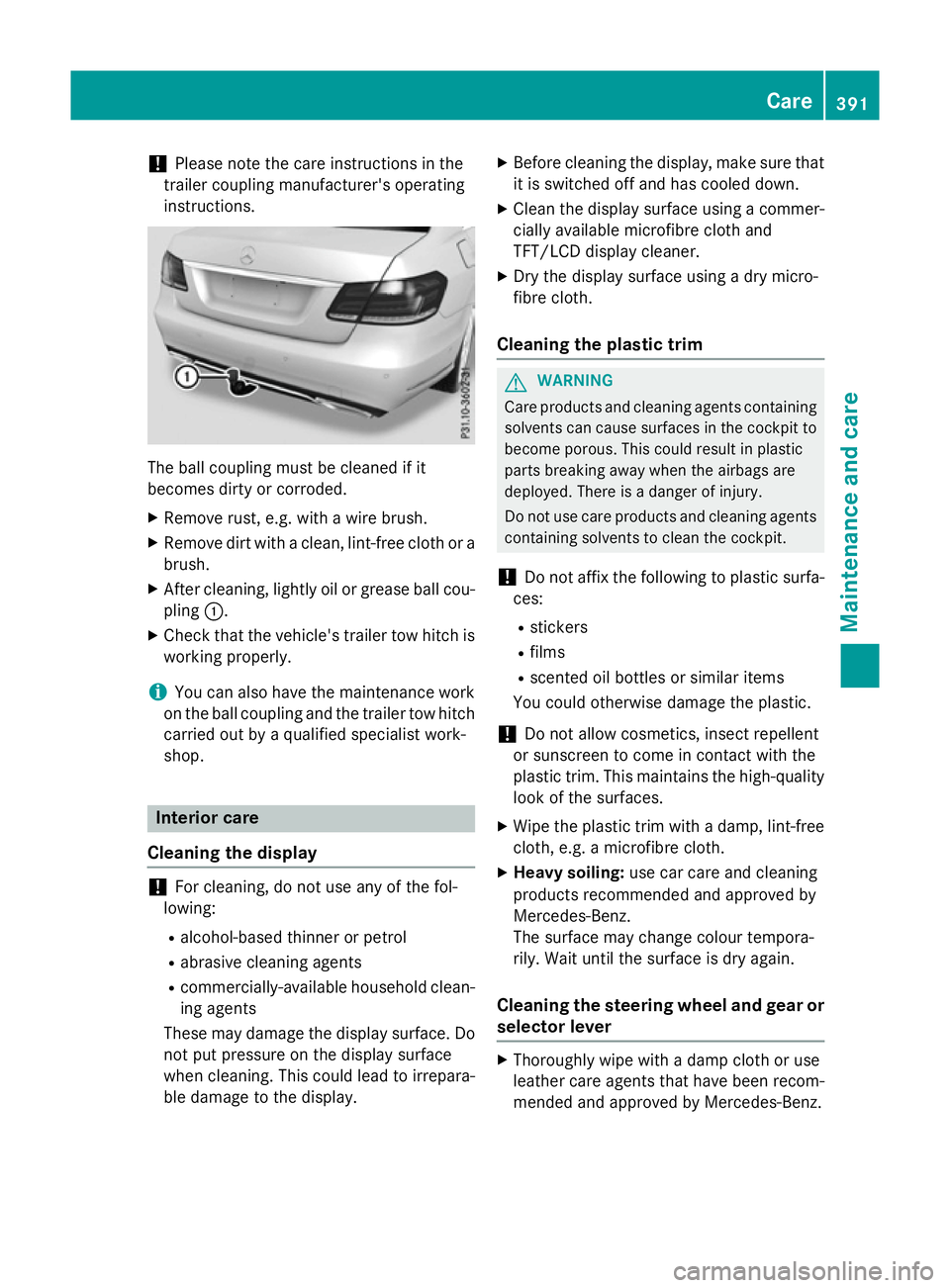
instructions. The ball coupling must be cleaned if it
becomes dirty or corroded.
X Remove rust, e.g. with awire brush.
X Remove dirt with aclean, lint-free cloth or a
brush.
X After cleaning, lightly oil or grease ball cou-
pling :.
X Check that the vehicle's trailer tow hitch is
working properly.
i You can also have the maintenance work
on the ball coupling and the trailer tow hitch
carried out by aqualified specialist work-
shop. Interior care
Cleaning the display !
For cleaning, do not use any of the fol-
lowing:
R alcohol-based thinner or petrol
R abrasive cleaning agents
R commercially-available householdc lean-
ing agents
These may damage the displays urface. Do
not put pressure on the displays urface
when cleaning. This could lead to irrepara-
ble damage to the display. X
Before cleaning the display, make sure that
it is switched off and has cooled down.
X Cleant he displays urface using acommer-
cially available microfibre cloth and
TFT/LCD displayc leaner.
X Dry the displays urface usingadry micro-
fibre cloth.
Cleaning the plastic trim G
WARNING
Care products and cleaning agents containing solvents can cause surfaces in the cockpit to
become porous. This could result in plastic
parts breaking awayw hen the airbags are
deployed. There is adanger of injury.
Do not use care products and cleaning agents containing solvents to clean the cockpit.
! Do not affix the following to plastic surfa-
ces:
R stickers
R films
R scented oil bottles or similari tems
You could otherwise damage the plastic.
! Do not allowc
osmetics, insect repellent
or sunscreen to come in contact with the
plastic trim. This maintains the high-quality look of the surfaces.
X Wipe the plastic trim with adamp, lint-free
cloth, e.g. amicrofibre cloth.
X Heavy soiling: use car care and cleaning
products recommended and approved by
Mercedes-Benz.
The surface may change colour tempora-
rily. Wait until the surface is dry again.
Cleaning the steering wheela nd gear or
selector lever X
Thoroughlyw ipe withadamp cloth or use
leather care agents that have been recom-
mended and approved by Mercedes-Benz. Care
391Maintenance and care Z
Page 395 of 497
Cleaning wooden trim and trim ele-
ments !
Do no
tuse solvent-based cleanin gagents
suc hast ar remover, wheel cleaners, pol-
ishe sorw axes. Ther eisotherwise ariskof
damaging th esurface.
X Wipe th ewoode ntrima nd trim elements
wit had amp, lint-free cloth ,e.g.am icrofi-
bre cloth.
X Heavy soiling: use car careand cleaning
product srecommended and approved by
Mercedes-Benz.
Cleaning th eseat covers General notes
! Do no
tuse microfibre cloth stoclean gen-
uine leather ,artificial leather or DINAMICA
covers. If used often ,the se can damag ethe
cover.
i Not
ethatregular car eisessential to
mak esure that th eappearanc eand com-
for toft hecover sare retaine dovertime.
Genuine leather seat covers
Leather is anatural product.
It has natural surface properties, e.g.: R unevenness in structure
R marks caused by growth and injury
R subtle colour differences
Thes eare characteristic sofleather and not
material faults.
! To retain th
enatural appearanc eofthe
leather ,observ ethe followin gcleaning
instructions:
R Clean genuine leather cover scarefully
wit had amp cloth and then wipe th ecov-
ers down wit hadry cloth.
R Mak esure that th eleather does not
become soaked. It may otherwise
become roug hand cracked.
R Only use leather car eagents that have
been tested and approved by Mercedes- Benz. You can obtain these from
aquali-
fied specialist workshop.
Seat cover sfromo ther materials
! Observ
ethe followin gwhen cleaning:
R clean artificial leather cover swithac loth
moistene dwithas olution containing 1%
detergen t(e.g. washing-up liquid).
R clean cloth cover switham icrofibre cloth
moistene dwithas olution containing 1%
detergen t(e.g. washing-up liquid). Rub
carefully, and always wipe entir eseat
sections to avoid leavin gvisible lines.
Leav ethe seat to dry afterwards. Clean-
ing results depen donthetype of dirt and
how lon githas been there.
R Clean DINAMICA cover swithad amp
cloth .Makes ure that you wipe entire
seat sections to avoid leavin gvisible
lines.
Cleaning th eseat belts G
WARNING
Seat belt smay be severely weakened if
bleached or coloured. This may lead to the
seat belts, for example ,tea rin gorf ailinginan
accident. Ther eisanincreased ris kofinjury,
possibly eve nfatal.
Never bleac horcolour seat belts.
! Do no
tclean th eseat belt susin gchemical
cleanin gagents .Donotdry th eseat belt sat
temperatures abov e80†or in direct sun-
light.
X Use clean, lukewarm wate rand soap solu-
tion.
Cleaning th eroof lining and carpets X
Roof lining: if it is verydirty, use asoft
brus hord ry shampoo.
X Carpets: use thecarpet and textile clean-
ing agents recommended and approved by
Mercedes-Benz. 392
CareMaintenance and care
Page 405 of 497
lead to function restrictions applying to
safety-relevant systems, e.g the lighting sys-
tem ,the AB S(anti-loc kbraking system) or the
ESP ®
(Electronic Stability Program). The oper-
atin gsafet yofy our vehicle may be restricted.
You could lose control of the vehicle, for
example:
R when braking
R in the even tofabrupt steerin gmanoeuvres
and/or when the vehicle's speed is not
adapted to the road conditions
There is arisk of an accident.
In the even tofashortcircuit or asimilar inci-
dent ,contac taqualified specialist workshop
immediately. Do not drive any further. Always have work on the battery carried out at a
qualified specialist workshop.
Further information about AB S(Ypage 77)
and ESP ®
(Y page 83). G
WARNING
Electrostatic build-up can lead to the creation of sparks, which could ignit ethe highly explo-
sive gases of abattery. There is arisk of an
explosion.
Before handlin gthe battery, touc hthe vehicle
body to remove any existin gelectrostatic
build-up.
The highly flammable gas mixture is created
while the battery is charging and when jump-
starting.
Always make sure that neither you nor the
battery is electrostatically charged. Electro-
static charge is created, for example:
R by wearing synthetic fibre clothing
R due to friction betwee nclothing and the
seat
R when you pull or push the battery across
carpe torother synthetic materials
R when you rub the battery with acloth G
WARNING
Durin gthe charging process, abattery produ-
ces hydroge ngas. If ashor tcircuit occurs or spark
sare created, the hydroge ngas can
ignite. There is arisk of an explosion.
R Make sure that the positive terminal of a
connected battery does not com eintoc on-
tac twith vehicle parts.
R Never place metal object sortools on abat-
tery.
R It is importan tthat you observe the descri-
bed order of the battery terminals when
connectin gand disconnecting abattery.
R When jump-starting, make sure that the
battery poles with identical polarit yare
connected.
R It is particularly importan ttoobserve the
described order when connectin gand dis-
connectin gthe jump leads.
R Never connec tordisconnect the battery
terminals while the engin eisrunning. G
WARNING
Batter yacid is caustic. There is arisk of injury.
Avoid contac twith the skin ,eyes or clothing.
Do not breathe in any battery gases. Do not
lean over the battery. Keep the batteries out
of the reach of children. Immediately rinse off
battery acid thoroughly with plent yofclean
water and seek medical attention at once. H
Environmental note Batteries contain pollutants.
It is illegal to dispose of them
with the household rubbish.
They must be collected sep-
arately and dispose dofinan
environmentally responsible
recyclin gsystem. Dispose of batteries in an
environmentally responsible
manner. Take discharged
batteries to
aqualified spe-
cialist workshop or to acol-
lection point for used batter-
ies.
! Have the battery checked regularly at a
qualified specialist workshop. 402
Battery (vehicle)Breakdown assistance
Page 407 of 497
Charging th
ebattery G
WARNING
During chargin gand jump-starting, explosive
gases can escape from th ebattery. Ther eisa
ris kofane xplosion.
Particularly avoid fire, naked flames, creating
sparks and smoking. Ensure there is sufficient
ventilatio nwhile chargin gand jump-starting.
Do no tlean ove rabattery. G
WARNING
Battery acid is caustic .Ther eisar iskofi njury.
Avoid contac twitht he skin, eyes or clothing.
Do no tbreath eina ny battery gases .Donot
lean ove rthe battery. Keep th ebatteries out
of th ereac hofc hildren. Immediately rinse off
battery acid thoroughly wit hplenty of clean
wate rand seek medical attentio natonce. G
WARNING
Ad ischarged battery can freez eattempera-
tures below freezing point. When jump-start-
ing th evehicle or chargin gthe battery, gases
can escape from th ebattery. Ther eisariskof
an explosion.
Allow th efroze nbattery to thaw out before
chargin gitorjump-starting.
! Only use battery chargers wit
hamaxi-
mum chargin gvoltage of 14.8 V.
! Only charge th
ebattery usin gthe jump-
start connection point.
The jump-startin gconnectio npointisint he
engin ecom partmen t(Ypage 405).
X Open th ebonnet.
X Connect th ebattery charge rtothepositive
terminal and eart hpointint hesame order
as when connecting th edonor battery in
th ej ump-startin gprocedure (Y page 405).
If th eindicator/warning lamps do no tlight up
at low temperatures, it is ver ylikely that the
discharged battery has frozen .Inthisc ase,
you may neither charge th ebattery no rjump-
start th evehicle .The servic elife of abattery that has been thawed may be reduced. The
starting characteristic smay be impaired,
especiall yatlow temperatures. Hav ethe
thawed battery checked at aqualified spe-
cialist workshop.
Never charge abattery still installed in the
vehicle unless abattery charge runit
approved by Mercedes-Ben zisbeingu sed. A
battery charge runit specially adapted for
Mercedes-Ben zvehicle sand tested and
approved by Mercedes-Ben zisavailabl easan
accessory. This device permits chargin gof
th eb attery in position. Contac taMercedes-
Ben zServic eCentr efor informatio nand avail-
ability. Read th ebattery charger's operating
instruction sbefore chargin gthe battery. 404
Battery (vehicle)Breakdown assistance
Page 409 of 497
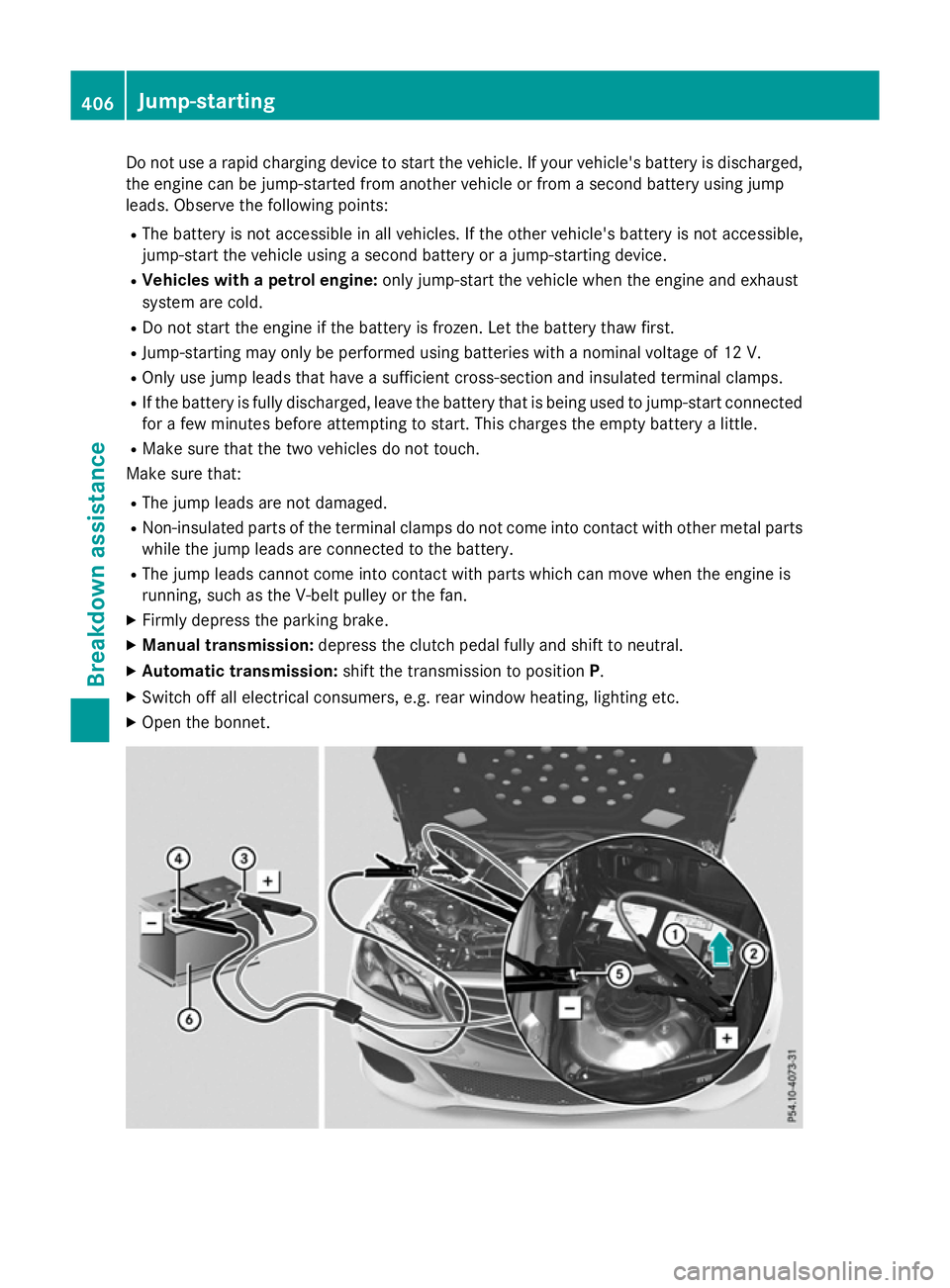
Do not us
earapid charging device to start the vehicle. If your vehicle' sbattery is discharged,
the engine can be jump-started fro manothe rvehicl eorf romas econd battery using jump
leads. Observe the following points:
R Th eb attery is not accessibl einallvehicles .Ifthe other vehicle' sbattery is not accessible,
jump-star tthe vehicl eusing asecond battery or ajump-starting device.
R Vehicle swithap etrolengine: onlyjump-star tthe vehicl ewhent he engine and exhaust
syste marecold.
R Do not start the engine if the battery is frozen. Let the battery tha wfirst.
R Jump-starting ma yonlybep erforme dusing batteries with anominal voltag eof12V.
R Onl yusejum pleads thathaveas ufficient cross-sectio nand insulate dtermina lclamps.
R If the battery is full ydischarged, leav ethe battery tha tisb eing used to jump-star tconnected
for afew minute sbefor ea ttempting to start. This charge sthe empty battery alittle.
R Make sure tha tthe two vehicles do not touch.
Make sure that:
R Th ej um pleads aren ot damaged.
R Non-insulate dparts of the termina lclamps do not come into contact with other meta lparts
whil ethe jum pleads arec onnected to the battery.
R Th ej um pleads cannot come into contact with parts which can mov ewhent he engine is
running ,suc hast he V-bel tpulle yort he fan.
X Firml ydepress the parking brake.
X Manual transmission: depress the clutch peda lfully and shift to neutral.
X Automatic transmission: shift the transmission to position P.
X Switch off al lelectrica lconsumers ,e.g.r ea rw indo wh eating, lighting etc.
X Open the bonnet. 406
Jump-startingBreakdow
nassistance
Page 424 of 497
If
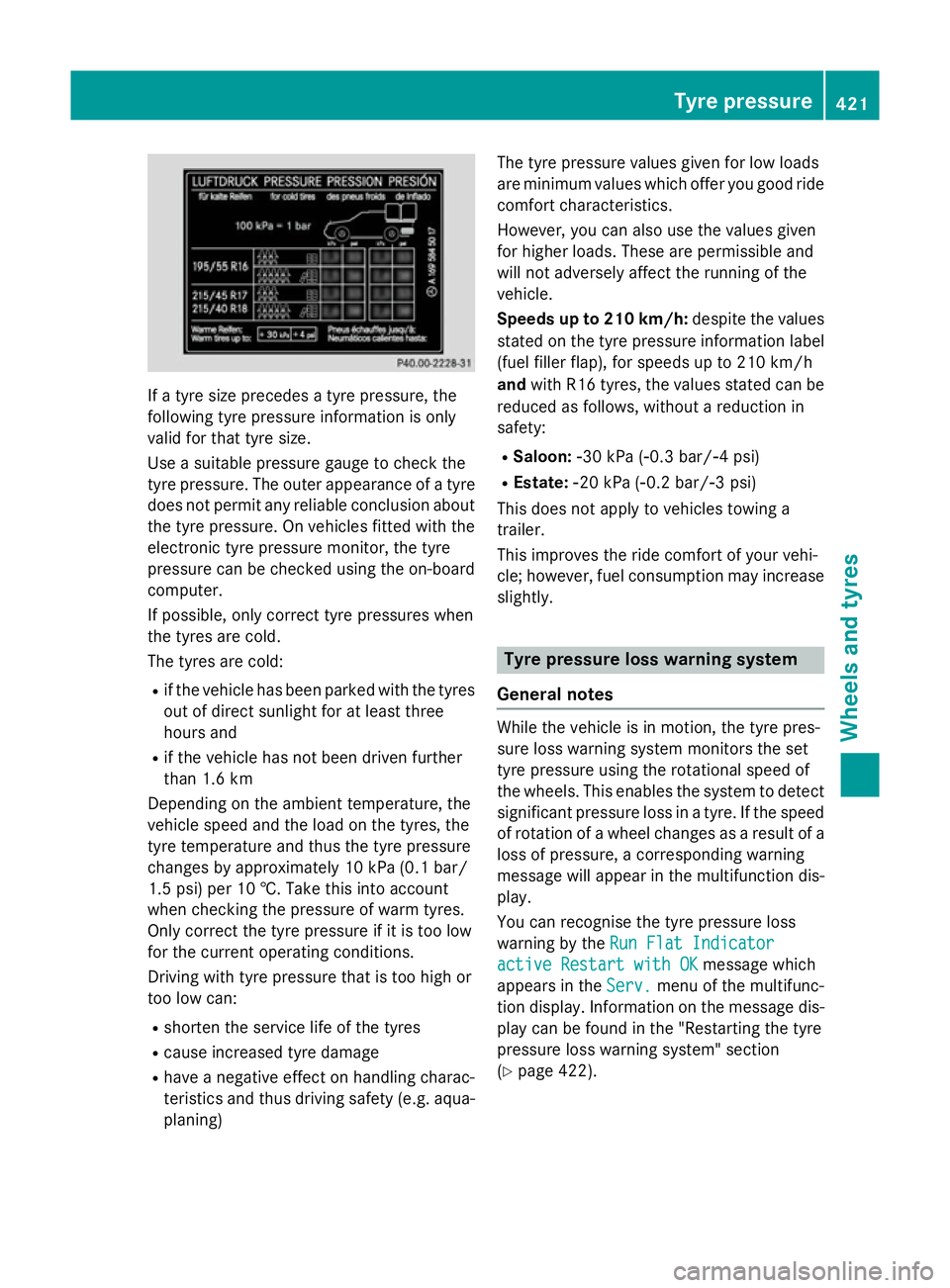
at yre size precedes atyre pressure, the
following tyre pressure information is only
validf or that tyre size.
Use asuitable pressure gauge to check the
tyre pressure. The outer appearance of atyre
does not permit any reliable conclusion about the tyre pressure. On vehicle sfitted with the
electronic tyre pressure monitor, the tyre
pressure can be checked using the on-board
computer.
If possible, only correct tyre pressures when
the tyres are cold.
The tyres are cold:
R if the vehicle has been parked with the tyres
out of direct sunlight for at least three
hours and
R if the vehicle has not been driven further
than 1.6 km
Depending on the ambient temperature ,the
vehicle speed and the loadont he tyres, the
tyre temperature and thus the tyre pressure
changes by approximately 10 kPa (0. 1bar/
1.5 psi )per 10 †. Take this into account
when checking the pressure of warm tyres.
Only correct the tyre pressure if it is too low
for the current operating conditions.
Driving with tyre pressure that is too high or
too low can:
R shorten the service life of the tyres
R cause increased tyre damage
R have anegative effect on handling charac-
teristics and thus driving safety (e.g. aqua-
planing) The tyre pressure values given for low loads
are minimum values which offer you good ride
comfort characteristics.
However, you can also use the values given
for higherl oads. These are permissible and
willn ot adversely affect the running of the
vehicle.
Speeds up to 210 km/h: despite the values
stated on the tyre pressure information label (fuel filler flap), for speedsupt o210 km/h
and with R16 tyres, the values stated can be
reduced as follows, withou tareduction in
safety:
R Saloon: Ò30 kPa (Ò0.3 bar/Ò4p si)
R Estate: Ò20 kPa (Ò0.2 bar/Ò3p si)
This does not apply to vehicle stowing a
trailer.
This improves the ride comfort of yourv ehi-
cle; however, fuel consumption may increase slightly. Tyre pressure lossw
arning system
General notes Whilet
he vehicle is in motion, the tyre pres-
sure loss warning system monitors the set
tyre pressure using the rotational speed of
the wheels. This enables the system to detect significant pressure loss in atyre. If the speed
of rotation of awhee lchanges as aresultofa
loss of pressure, acorresponding warning
messag ewilla ppear in the multifunction dis-
play.
You can recognise the tyre pressure loss
warning by the Run Flat Indicator Run Flat Indicator
active Restart with OK
active Restart with OK messagewhich
appears in the Serv.
Serv.menu of the multifunc-
tion display.I nformation on the messag edis-
playc an be found in the "Restarting the tyre
pressure loss warning system" section
(Y page 422). Tyre pressure
421Wheelsand tyres Z
Page 426 of 497

Tyre pressure monitor
General notes If
at yrep ressure monitor system is fitted, the
vehicle's wheels have sensor sfitte dthat
monitor the tyr epressures in al lfou rtyres.
The tyr epressure monitor warns yo uifthe
pressure drops in one or mor eofthe tyres.
The tyr epressure monitor onl yfun ctions if
the corresponding sensor sarefitte dtoa ll
wheels.
Informatio nontyrep ressures is shown in the
multifunctio ndisplay .After afew minute sof
driving ,the current tyr epressure of each tyre
is shown in the Service
Service menu of the multi-
functio ndisplay ,see illustratio n(example). Example: Saloon
,current tyr epressure display
For furthe rinformatio nondisplaying this
message ,refer to the "Checking the tyr epres-
sure electronically" sectio n(Ypage 424).
Important safety notes It is the driver's responsibility to set the tyre
pressure to the recommende
dcoldt yrep res-
sure suitabl efor the operating situation
(Y page 420). Note tha tthe correct tyr epres-
sure for the current operating situatio nmust
first be taught-i ntothe tyr epressure monitor.
If ther eisas ubstantial loss of pressure, the
warnin gthreshold for the warnin gmessage is
aligned to the reference values taught-in.
Restart the tyr epressure monitor after
adjusting to the col dtyrep ressure
(Y page 424). The current pressures are
saved as new reference values. Thi swill
ensur ethataw arnin gm essage will only
appear if the tyr epressure drops significantly.
The tyr epressure monitor does not warn you
of an incorrectly set tyr epressure. Observe the note
sonthe recommende dtyrep ressure
(Y page 420).
The tyr epressure monitor is not able to warn
yo uofas uddenlossofp ressure, e.g .ifthe
tyr eisp enetrated by aforeign object. In the
event of asudde nlossofp ressure, bring the
vehicl etoah altbyb raking carefully. Avoid
abrupt steering manoeuvres.
The tyr epressure monitor ha sayelloww arn-
ing lamp in the instrument cluster for indicat- ing apressure loss or malfunction. Depending
on how the warning lamp flashe sorlights up,
at yrep ressure tha tist oo lo woram alfunc-
tio nint he tyr epressure monitor is indicated:
R if the warnin glam pisl itcontinuously ,the
tyr ep ressure on one or mor etyres is sig-
nificantl ytoo low. The tyr epressure moni-
tor is not malfunctioning.
R if the warnin glam pflashe sfor around a
minute and the nremains li tconstantly, the
tyr ep ressure monitor is malfunctioning.
In additio ntothe warning lamp, amessage
appear sinthe multifunctio ndisplay .Obser ve
the informatio nondisplay messages
(Y page 322).
It ma ytake up to ten minute sfor am alfunc-
tio noft he tyr epressure monitor to be indi-
cated. Amalfunctio nwillbei ndicated by the
tyr ep ressure warnin glam pflashing for
approximately one minute and the nremain-
ing lit. When the faul thas been rectified, the
tyr ep ressure warning lamp goes ou tafter you
have driven for afew minutes.
The tyr epressure values indicated by the on-
boar dcompute rmaydiffe rfromt hos em eas-
ured at afilling statio nusing apressure
gauge. The tyr epressures shown by the on-
boar dcompute rrefer to thos emeasured at
se al evel.Ath igha ltitudes, the tyr epressure
values indicated by apressure gaug eare
highe rtha nt hos eshown by the on-board
computer. In thi scase, do not reduce the tyre
pressures.
The operatio nofthe tyr epressure monitor
can be affecte dbyinterference fro mradio
transmitting equipment (e.g. radi ohead- Tyre pressure
423Wheelsand tyres Z