2015 MERCEDES-BENZ E-CLASS SALOON fuel consumption
[x] Cancel search: fuel consumptionPage 424 of 497
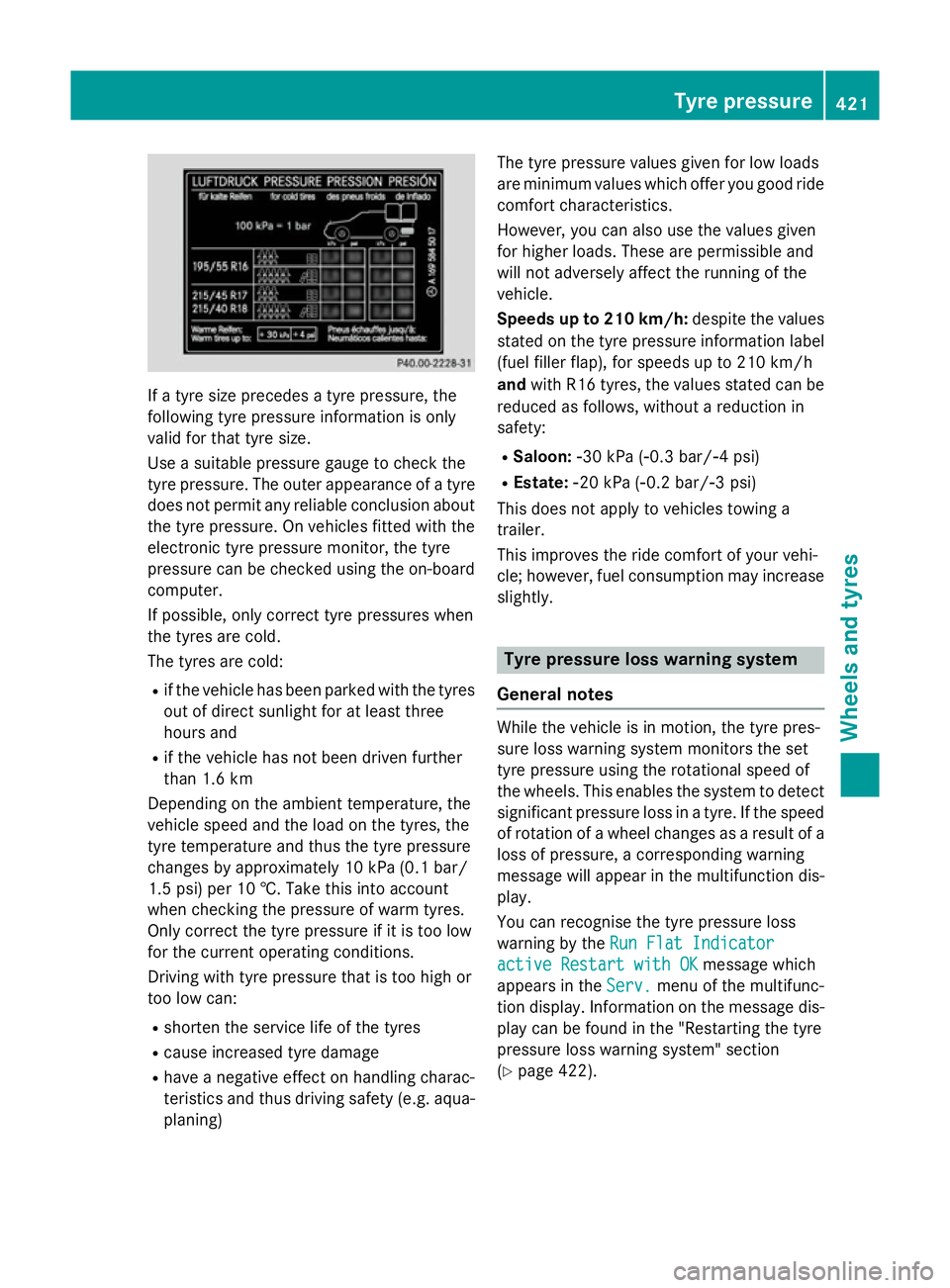
If
at yre size precedes atyre pressure, the
following tyre pressure information is only
validf or that tyre size.
Use asuitable pressure gauge to check the
tyre pressure. The outer appearance of atyre
does not permit any reliable conclusion about the tyre pressure. On vehicle sfitted with the
electronic tyre pressure monitor, the tyre
pressure can be checked using the on-board
computer.
If possible, only correct tyre pressures when
the tyres are cold.
The tyres are cold:
R if the vehicle has been parked with the tyres
out of direct sunlight for at least three
hours and
R if the vehicle has not been driven further
than 1.6 km
Depending on the ambient temperature ,the
vehicle speed and the loadont he tyres, the
tyre temperature and thus the tyre pressure
changes by approximately 10 kPa (0. 1bar/
1.5 psi )per 10 †. Take this into account
when checking the pressure of warm tyres.
Only correct the tyre pressure if it is too low
for the current operating conditions.
Driving with tyre pressure that is too high or
too low can:
R shorten the service life of the tyres
R cause increased tyre damage
R have anegative effect on handling charac-
teristics and thus driving safety (e.g. aqua-
planing) The tyre pressure values given for low loads
are minimum values which offer you good ride
comfort characteristics.
However, you can also use the values given
for higherl oads. These are permissible and
willn ot adversely affect the running of the
vehicle.
Speeds up to 210 km/h: despite the values
stated on the tyre pressure information label (fuel filler flap), for speedsupt o210 km/h
and with R16 tyres, the values stated can be
reduced as follows, withou tareduction in
safety:
R Saloon: Ò30 kPa (Ò0.3 bar/Ò4p si)
R Estate: Ò20 kPa (Ò0.2 bar/Ò3p si)
This does not apply to vehicle stowing a
trailer.
This improves the ride comfort of yourv ehi-
cle; however, fuel consumption may increase slightly. Tyre pressure lossw
arning system
General notes Whilet
he vehicle is in motion, the tyre pres-
sure loss warning system monitors the set
tyre pressure using the rotational speed of
the wheels. This enables the system to detect significant pressure loss in atyre. If the speed
of rotation of awhee lchanges as aresultofa
loss of pressure, acorresponding warning
messag ewilla ppear in the multifunction dis-
play.
You can recognise the tyre pressure loss
warning by the Run Flat Indicator Run Flat Indicator
active Restart with OK
active Restart with OK messagewhich
appears in the Serv.
Serv.menu of the multifunc-
tion display.I nformation on the messag edis-
playc an be found in the "Restarting the tyre
pressure loss warning system" section
(Y page 422). Tyre pressure
421Wheelsand tyres Z
Page 434 of 497

X
Tighten the wheel bolts evenly in across-
wise pattern in the sequence indicated ( :
to A). The specified tightening torque is
130 Nm.
X Turn the jack back to its initial position.
X Stow the jack and the rest of the tyre-
change tool kit in the boot/luggage com-
partmen tagain.
X AMG vehicles and vehicles with AMG
equipment: insert the cover into the outer
sill.
X Check the air pressure of the newly fitted
wheel and adjust accordingly.
Observe the recommended tyre pressure
(Y page 420).
i Vehicles with
atyre pressure control sys-
tem: all fitted wheels must be equipped
with functioning sensors. Wheel and tyrec
ombinations General notes
! For safety reasons, Mercedes-Benz rec-
ommends that you only use tyres and
wheels which have been approved by
Mercedes-Benz specifically for your vehi-
cle. These are specially adapted to the control
systems, such as ABS or ESP
®
and are
marked as follows:
R MO =Mercedes-Benz Original
R MOE =Mercedes-Benz Original Extended
(tyres featuring run-flat characteristics)
R MO1 =Mercedes-Benz Original (only cer-
tain AMG tyres)
Mercedes-Benz Original Extended tyres
may only be used on wheels that have been
specifically approved by Mercedes-Benz.
Only use tyres, wheels or accessories tes-
ted and approved by Mercedes-Benz.C er-
tain characteristics, e.g. handling, vehicle
noise emissions or fuel consumption, may
otherwise be adversely affected. In addi-
tion, when driving with aload, tyre dimen-
sion variations could cause the tyres to
come into contact with the bodywork and
axle components. This could result in dam- age to the tyres or the vehicle.
Mercedes-Benz accepts no liability for
damage resulting from the use of tyres,
wheels or accessories other than those tes-
ted and approved.
Further information about wheels, tyres
and approved combinations can be
obtained from any qualified specialist
workshop.
! Retreaded tyres are neither tested nor
recommended by Mercedes-Benz,s ince
previous damage cannot alway sbedetec-
ted on retreaded tyres. As aresult,
Mercedes-Benz cannot guarantee vehicle
safety if retreaded tyres are fitted. Do not fit
used tyres if you have no information about their previous usage.
! Large wheels: the lower the section width
for acertain wheel size, the lower the ride
comfor tisonp oor road surfaces. Roll com-
fort and suspension comfor tare reduced
and the risk of damage to the wheels and
tyres as aresult of driving over obstacles
increases. Wheel and tyrec
ombinations
431Wheels and tyres Z
Page 478 of 497

the
rinformation fro many Mercedes-Benz
Service Centre.
Usually yo uwillf indi nformation abou tthe
fuel grade on the pump. If yo ucannot find the
labe lont he petrol pump, as kthe filling sta-
tio ns taff.
i E10 fuel contains up to 10% bioethanol.
Your vehicl eissuitabl efor us ewithE 10
fuel .You ma yrefue lyou rvehicl eusing E10
fuel.
E1 80,E2 50:asatemporary measure, if the
recommended fuel is not available, yo umay
also us eregular unleade dpetrol with an
octane rating of 93 RON/83 MON.
Al lo ther models: asatemporary measure, if
the recommended fuel is not available, you
ma yalsou seregular unleade dpetrol with an
octane rating of 91 RON/82 MON .Thism ay
reduc eengine performance and increase fuel
consumption. Avoi ddriving at full throttle and
sudden acceleration. Never refue lusing fuel
with alower RON/MON.
i In some countries
,the availabl epetrol
ma ynot be sufficiently lo winsulphur .This
fuel can temporarily produce unpleasant
odours, especiall yonshort journeys. As
soon as sulphur-fre efuel(sulphu rcontent
<10p pm)isu sedf or refuelling, the odours
are reduced.
Information on refuelling (Y page201).
AMG vehicles ! Only refuel using super unleade
dpetrol
with at least 98 RON/88 MON that con-
forms to European standard EN 228 or an
equivalent specification.
You can otherwise impair engine output or
damage the engine.
! Premium-grade unleade
dpetrol with an
octane rating of 95 RON/85 MON may be
use dasat emporary measure if the recom-
mended fuel is not available .Thism ay
reduce engine performance and increase
fuel consumption. As much as possible,
avoi ddriving at ful lthrottle. !
Regular unleade
dpetrol with an octane
rating of 91 RON/82.5 MON may also be
use dasat emporary measure if the recom-
mended fuel is not available.
Doing so results in noticeably higher fuel
consumption, and the engine power output is noticeably reduced. Avoid driving at full
throttle.
If only regularu nleadedpetrol with an
octane rating of 91 RON/82.5 MON or
lower is available ,you must have the vehi-
cle adapted to this fuel at aqualified spe-
cialist workshop.
i E10 fuel contains up to 10% bioethanol.
You rvehicle is suitabl efor use with E10
fuel .You may refuel you rvehicle using E10
fuel.
E2 00,E2 50,E4 00,E4 00 4MATIC (only
for certain countries)
! Only refuel using unleaded, sulphur-free
unleade dpetrol with at least 95 RON/
85 MON that conforms to European stand-
ard EN 228 or an equivalent specification.
You coul dotherwise impair engine output
or damage the emission control system.
i In some countries, the available petrol
may not be sufficiently low in sulphur. This
fuel can temporaril yproduce unpleasant
odours, especially on short journeys. As
soon as sulphur-free fuel (sulphur content
<10p pm)isu sedf or refuelling, the odours
are reduced.
Additives ! Operating the engine with fuel additives
added later can lea dtoengine failure. Do
not mix fuel additive swithf uel .Thisd oes
not include additive sfor the remova land
prevention of residue build-up. Petrol must
only be mixed with additive srecommended
by Mercedes-Benz. Observe the instruc-
tions for use in the product description.
More information about recommended
additive scan be obtained from any
Mercedes-Benz Service Centre. Service products and capacities
475Technical data Z
Page 479 of 497

Mercedes-Ben
zrecommends that you use
fuel brands that have additives.
The quality of the fuel available in some coun- tries may not be sufficient. Residuec ould
build up in the injection system as aresult. In
this case, in consultation with aMercedes-
Benz Service Centre, the petrol may be mixed with the cleaning additive recommended by
Mercedes-Benz. Always observe the notes
and mixing ratios specified on the container.
Diesel Fuel grade
G
WARNING
If you mix diesel fuel with petrol, the flash
point of this fuel mixture is lower than that of pure diesel fuel. When the engine is running,
components in the exhaust system may over-
heat unnoticed. There is arisk of fire.
Never refuel with petrol. Never add petrol to
diesel fuel.
! When refuelling, only use diesel fuel that
conforms to the European standard EN 590
or is of equivalent quality. Fuel that does
not conformtoEN5 90 can lead to
increased wear as well as damage to the
engine and exhaust system.
! Do not use the following:
R marine diesel
R heating oil
R bio-diesel
R vegetable oil
R petrol
R paraffin
R kerosene
Do not mix such fuels with diesel fuel and
do not use any special additives. Other-
wise, engine damage may occur.
! Vehicles with diesel particle filters:
in
countries outside the EU, only use low sul-
phur Euro diesel with asulphurc ontent of under 50 ppm
.Otherwise, the emission
control system could be damaged.
! Vehicles without
adiesel particle fil-
ter: in countries where only diesel fuel with
ah igh sulphurc ontent is available, you will
need to carry out your vehicle's oil change
at shorter intervals. More information
about the interval for oil change can be
obtained from any qualified specialist
workshop.
Usuallyy ou will find information about the
fuel grade on the pump. If you cannot find the
label on the petrol pump, ask the filling sta-
tion staff.
Information on refuelling (Y page 201).
Low outside temperatures
In winter months, diesel fuel with an improved
cold flow quality is available. In Europe, the
EN 590 standard defines various climate-
dependent temperature categories. Malfunc- tions can be avoided by refuelling with diesel
fuel that corresponds to the climatic specifi-
cations outlined in EN 590. At unusually low
outside temperatures, it is possible that the
flow characteristics of the diesel fuel could be insufficient .Accordingly, diesel fuel from
warmer areas may not be suitable for opera-
tion in colder climatic conditions.
i Further information on country-specific
fuel properties and fuel types with low-tem-
perature resistance can be obtained from
oil companies, e.g. at filling stations.
Fuel consumption information H
Environmental note
CO 2(carbon dioxide) is the gas which scien-
tists believe to be principally responsible for
global warming (the greenhouse effect). Your vehicle's CO 2emissions are directly related to
fuel consumption and therefore depend on: 476
Service products and capacitiesTechnical data
Page 480 of 497

R
efficien tuse of the fuel by the engine
R driving style
R other non-technical factors, such as envi-
ronmental influences, road conditions or
traffic flow
You can minimise your vehicle's CO 2emis-
sions by driving carefully and having it serv-
iced regularly.
The vehicle will use more fuel than usual in the following situations:
R at very low outside temperatures
R in urban traffic
R on short journeys
R in mountainous terrain
R when towing atrailer
i Only for certain countries: you can find
the curren tconsumption and emission val-
ues of your vehicle in the COC documents
(EU CERTIFICATE OF CONFORMITY). These documents are delivered with your vehicle.
The consumption figures were, in each
case, based on the currently applicable ver- sion:
R for vehicles that comply with standards
up to and including the EURO 4standard,
in accordance with EU Directive
80/1268/EEC
R for vehicles that comply with or exceed
the EURO 5standard, in accordance with
Regulation (EC) No. 715/2007
Deviations from these values may occur
under normal operatin gconditions. AdBlue
®
Important safety notes Comply with the important safety notes for
servic
eproduct swhen handling AdBlue ®
(Y page 473). AdBlue
®
is aw ater-soluble fluid for the
exhaust gas aftertreatmen tofdiesel engines.
It is:
R non-toxic
R colourless and odourless
R non-flammable
If you open the AdBlue ®
tank ,small amounts
of ammonia vapour may be released.
Ammonia vapours have apungent odour and
are particularly irritating to the skin ,to
mucous membranes and to the eyes. You may experience aburning sensation in your eyes,
nose and throat. You may also experience
coughing and watery eyes.
Do not inhale any ammonia vapours that may
be released. Only fill the AdBlue ®
tank in well-
ventilated areas.
Low outsid etemperatures AdBlue
®
freezes at atemperature of approx-
imately -11 †. The vehicle is delivered from
the factory equipped with an AdBlue ®
pre-
heating system. Winter operation can thus be guaranteed even at temperatures below
-11 †.
Additives !
Only use AdBlue ®
in accordance with ISO
22241. Do not use additives with AdBlue ®
and do not dilute AdBlue ®
with water. This
may destro ythe BlueTEC exhaust gas after-
treatment system.
Purity !
Impurities in AdBlue ®
(e.g. due to other
servic eproducts, cleanin gagents or dust)
lead to:
R increased emission values
R damage to the catalytic converter
R engine damage
R malfunctions in the BlueTEC ®
exhaust
gas aftertreatmen tsystem Service products and capacities
477Technical data Z