2015 MERCEDES-BENZ E-CLASS SALOON airbag
[x] Cancel search: airbagPage 53 of 497
You can also cancel the rear seat belt status
indicator immediately (Y page 299).Airbags
Introduction The installation location of an airbag is iden-
tified by the AIRBA Gsymbol.
An airbag supplements acorrectly worn seat
belt. It is not areplacemen tfor the seat belt.
The airbag offers additional protection in
applicable accident situations.
Not all airbags are deployed in an accident.
The differen tairbag systems work independ-
ently of each other (Y page 53).
However, no system available today can com- pletely eliminate injuries and fatalities.
It is also not possible to completely rule out a
risk of injury caused by an airbag due to the
speed at which the airbag must be deployed.
Important safet ynotes G
WARNING
If you deviat efromt he correc tseat position,
the airbag cannot perform its intended pro-
tectiv efunction and can even cause addi-
tional injuries when deployed. There is an
increased risk of serious or even fatal injuries.
In order to avoid such risks, always ensure
that all vehicle occupants:
R fasten their seatbelts correctly, including
pregnant women
R are seate dcorrectly and maintain the fur-
thest possible distanc efromt he airbags
R observe the followin gnotes
Always ensure that there are no object sloca-
ted betwee nthe airbag and the vehicle occu-
pant.
R Adjust the seats properly befor ebeginning
your journey. Always make sure that the
seat is in an almost upright position. The centr
eofthe head restraint must support
the head at about eye level.
R Move the driver's and front-passenger
seats as far back as possible. The driver's
seat position must allow the vehicle to be
drive nsafely.
R Only hold the steerin gwheel on the out-
side. This allows the airbag to be fully
deployed.
R Always lean against the backrest while driv-
ing. Do not lean forwards or lean against
the door or side window. You may other-
wise be in the deploymen tarea of the air-
bags.
R Always keep your feet in the footwell in
front of the seat. Do not put your feet on the
dashboard ,for example. Your feet may oth-
erwise be in the deploymen tarea of the
airbag.
R Always secur epersons less than 1.50 mtall
in suitable restraint systems .Uptothis
height ,the seat belt canno tbeworn cor-
rectly.
If ac hild is travelling in you rvehicle, also
observe th efollowing notes:
R Always secure childre nunde rtwelve years
of age and less than 1.50 mtall in suitable
child restraint systems.
R Child restraint systems should be fitte dto
th er ear seats.
R Only secure achild to th efront-pa ssenger
seat when th efront-pa ssenger fron tairbag
is disabled, and only then in arearward-
facing child restraint system. If the
PASSENGER AI RBAG OFFindicator lamp is
permanently lit ,the front-passenger front
airbag is disabled (Y page 45).
R Always observ ethe instruction sand safety
note son" Children in th evehicle"
(Y page 58) and on th e"Child restraint
system on th efront-pa ssenger seat"
(Y page 67 )inaddition to th echild
restraint system manufacturer' sinstalla-
tio ninstructions. 50
Occupant safetySafety
Page 54 of 497

Objects in the vehicle interior may pre-
vent the airba gfrom functioning cor-
rectly. Beforestarting your journey and to
avoid risks resulting from the speed of the
airbag as it deploys, make sure that:
R there are no people, animals or objects
between the vehicle occupant sand an air-
bag.
R there are no objects between the seat, door
and B-pillar.
R no hard objects, e.g. coat hangers, are
hanging on the grab handles or coat hooks.
R no accessories, such as cup holders, are
attached to the vehicle within the deploy-
ment area of an airbag, e.g. to doors, side
windows, rear side trim or side walls.
R no heavy, sharp-edged or fragile objects
are in the pockets of your clothing. Store
such objects in asuitable place. G
WARNING
If you modify an airbag cover or affix objects
such as stickers to it, the airbag can no longer function correctly. There is an increased risk
of injury.
Never modify an airbag cover or affix objects
to it. G
WARNING
Sensors to control the airbags are located in
the doors. Modification sorwork not per-
formed correctly to the doors or door panel-
ling, as well as damaged doors, can lead to the function of the sensor sbeing impaired. The
airbags might therefore not function properly any more. Consequently, the airbags cannot
protec tvehicle occupant sasthey are
designed to do. This poses an increased risk
of injury.
Never modify the doors or parts of the doors.
Always have work on the doors or door pan-
elling carried out at aqualified specialist
workshop. Front airbags
Driver's airbag
:deploys in fron tofthe
steerin gwheel. Front-passenger fron tair-
bag ;deploys in fron tofand above the glove
compartment.
When deployed, the fron tairbags offer addi-
tional head and thorax protection for the
occupant sinthe fron tseats.
Ap ermanently lit PASSENGER AIR BAG OFF
indicator lamp informs you that the front-
passenger fron tairbag is disabled
(Y page 45).
Driver's kneebag Driver's kneebag
:deploys under the steer-
ing column. The driver's kneebag is triggered
together with the fron tairbag.
The driver's kneebag offers additional thigh,
knee and lower leg protection for the occu-
pant in the driver's seat.
i The driver's kneebag is only available in
certain countries. Occupant safety
51Safety Z
Page 55 of 497
Sidebags
G
WARNING
Unsuitable seat covers may obstruct or even
prevent deployment of the airbags integrated into the seats. The airbags may then fail to
protect the vehicle occupants as intended.
Operation of the automatic child seat recog-
nition may also be impaired. There is an
increased risk of injury, possibly even fatal.
Use only seat covers which have been specif-
ically approved for the respective seat by
Mercedes-Benz. Example: Saloon
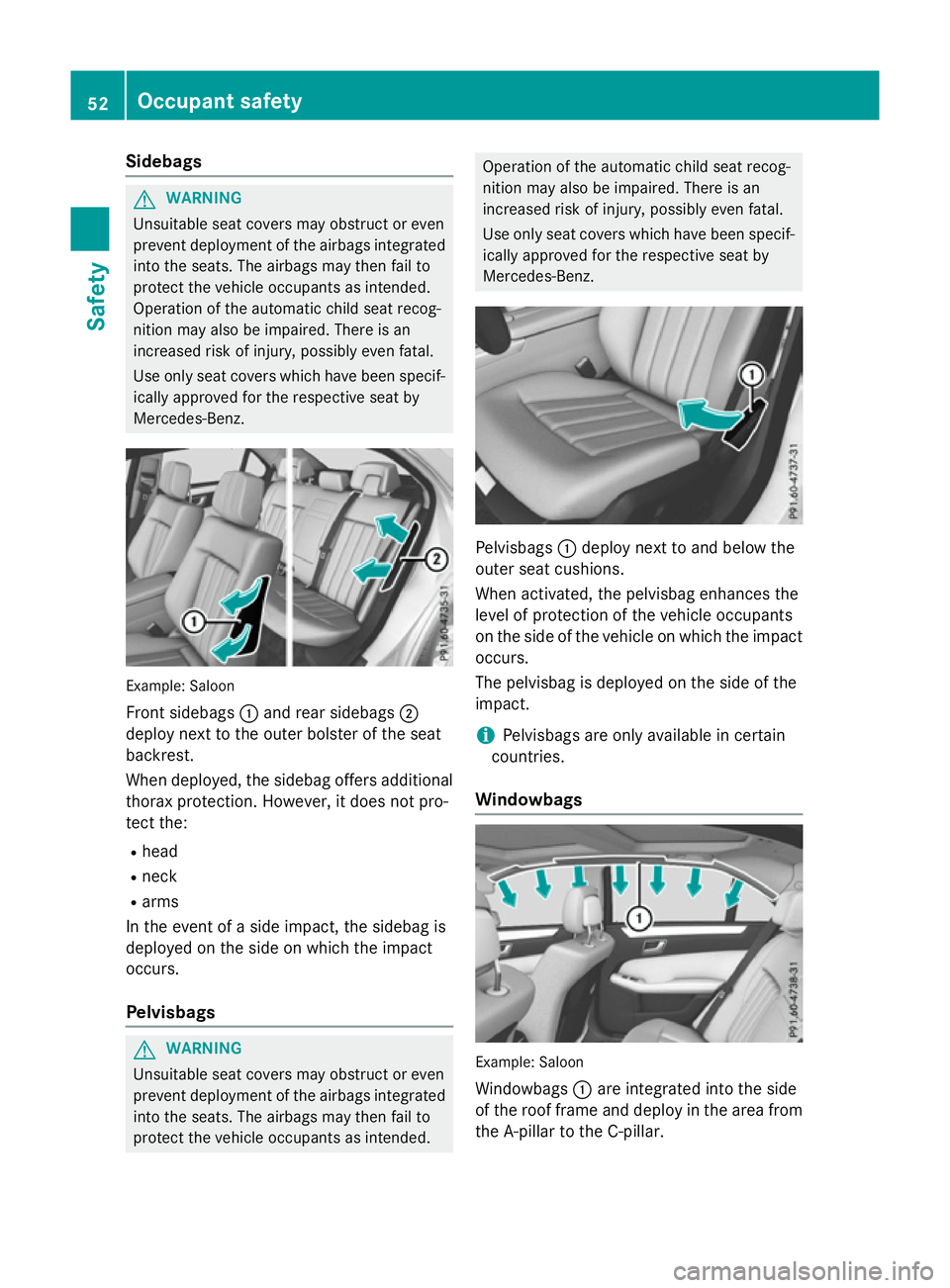
Front sidebags :and rear sidebags ;
deploy next to the outer bolster of the seat
backrest.
When deployed, the sidebag offers additional thorax protection. However, it does not pro-
tect the:
R head
R neck
R arms
In the event of aside impact, the sidebag is
deployed on the side on which the impact
occurs.
Pelvisbags G
WARNING
Unsuitable seat covers may obstruct or even
prevent deployment of the airbags integrated into the seats. The airbags may then fail to
protect the vehicle occupants as intended. Operation of the automatic child seat recog-
nition may also be impaired. There is an
increased risk of injury, possibly even fatal.
Use only seat covers which have been specif- ically approved for the respective seat by
Mercedes-Benz. Pelvisbags
:deploy next to and below the
outer seat cushions.
When activated, the pelvisbag enhances the
level of protection of the vehicle occupants
on the side of the vehicle on which the impact
occurs.
The pelvisbag is deployed on the side of the
impact.
i Pelvisbags are only available in certain
countries.
Windowbags Example: Saloon
Windowbags :are integrated into the side
of the roof frame and deploy in the area from the A-pillar to the C-pillar. 52
Occupant safetySafety
Page 56 of 497
When deployed, the windowbag enhances the
level of protection for the head. However, it
does not protec tthe chest or arms.
In the event of aside impact, the windowbag
is deployed on the side on which the impact
occurs.
If the system determines that they can offer
additional protection to that provided by the
seat belt, awindowbag may be deployed in
other accident situation s(Ypage 53). Deployment of belt tensioners and air-
bags
Important safety notes G
WARNING
After the airbag deploys, the airbag parts are
hot. There is arisk of injury.
Do not touch the airbag parts. Have a
deployed airbag replaced at aqualified spe-
cialist workshop as soon as possible. G
WARNING
Pyrotechnic seat belt tensioners that have
been deployed are no longer operational and
are unable to perform their intended protec-
tive function. This poses an increased risk of
injury or even fatal injury.
Therefore, have pyrotechnic belt tensioners
which have been triggered immediately
replaced at aqualified specialist workshop.
Mercedes-Benz recommends that you have
the vehicle towed to aqualified specialist
workshop after an accident .Take this into
account ,particularly if aseat belt tensioner
was triggered or an airbag was deployed.
An electric motor is used by PRE-SAFE ®
to
trigger the tightening of the seat belt in haz-
ardous situations. This procedure is reversi-
ble.
If the belt tensioners are triggered or an air-
bag is deployed, you will hear abang, and a
small amount of powder may also be released. The
6restraint system warning
lamp lights up.
Only in rare cases will the bang affect your
hearing. In general, the powder released is
not hazardous to health but may cause short- term breathin gdifficulties to persons suffer-
ing from asthma or other pulmonary condi-
tions. Provided it is safe to do so, you should
leave the vehicle immediately or open the
window in order to preven tbreathin gdifficul-
ties.
Operation During the first stage of
acollision, the
restraint system control unit evaluates impor-
tant physical data relating to vehicle deceler- ation or acceleration, such as:
R duration
R direction
R intensity
Based on the evaluation of this data, the
restraint system control unit trigger sthe seat
belt tensioners in the event of ahead-on or
rear collision.
As eat belt tensioner can only be triggered if:
R the ignition is switched on
R the componentsoft he restraint system are
operational; see "Restraint system warning lamp" (Y page 45)
R the belt tongue has engaged in the belt
buckle of the respective fron tseat
The seat belt tensioners in the rear compart-
ment are triggered independently of the lock
status of the seat belts.
If the restraint system control unit detect sa
high severit yofanaccident,incertain head-
on collisions, additional componentsoft he
restraint system are deployed independently
of each another:
R Fron tairbags and driver's kneebag
R Windowbag, if the system determines that
deployment can offer additional protection
to that provided by the seat belt Occupant safety
53Safety Z
Page 57 of 497
Depending on the perso
ninthe front-
passenge rsea t, the front-passenge rfront air-
ba gise ithe rd isable dorenabled .The front-
passenge rfront airba gcan onl ybedeployed
in an accident if the PASSENGER AIR BAG OFF indicator lamp is off .Obser ve the information
on the PASSENGER AIR BAG OFF indicator
lamp (Y page 45).
Your vehicl ehastwo-stage front airbags. In
the first deployment stage ,the front airba gis
fille dwithp ropellant ga storeduce the risk of
injuries .The front airba gisfullydeployed if
the second deployment stage is activated
withi nafew milliseconds.
Th ea ctivatio nthreshold for the seat belt ten-
sioners and airbags is determine dbased on
the evaluation of the vehicle' srateofd ecel-
eratio noracceleratio natvarious points in the
vehicle. This proces sispre-emptiv einnature.
Th et riggering/deployment proces sshould
take place in good tim eatthe start of the
collision.
Th er ateofv ehicledeceleratio noraccelera-
tio na nd the directio nofthe force ar eessen-
tiall ydetermine dby:
R the distributio nofforces during the colli-
sion
R the collision angle
R the deformatio ncharacteristics of the vehi-
cle
R the characteristics of the object with which
the vehicl ehascollided
Factors which can onl ybeseena nd measured
after acollision ha soccurre ddonot play a
decisiv eroleint he deployment of an airbag,
nor do the yprovide an indicatio nofairbag
deployment.
Th ev ehicl emaybe deformed significantly
without an airba gbeing deployed .Thisist he
cas eifo nlyp arts which ar erelativel yeasily
deformed ar eaffecte dand the rate of decel-
eratio nisn ot high .Conversely ,anairba gm ay
be deployed eve nthoug hthe vehicl esuffers
onl ym inor deformation. This is the cas eif, for
example, ver yrigid vehicl eparts such as lon- gitudina
lbod ym embers ar ehit,a nd sufficient
deceleratio noccurs as aresult.
If the restraint syste mcontro lunitd etects a
side impact or if the vehicl eoverturns, the
applicabl ecomponents of the restraint sys-
tem ar eactivated independentl yofeach
other depending on the apparent typ eofacci-
dent.
R Sidebag sand pelvisba gonthe side on
which an impact occurs, independent from the seat belt tensioner and seat belt usage
Vehicle switht he automatic child seat rec-
ognition on the front-passenge rseat: the
sideba gand pelvisba gonthe front-
passenge rside( front) deploy under the fol-
lowing conditions:
- an occupant is detecte donthe front-
passenge rseator
- the belt tongue is engaged in the belt
buckle of the front-passenge rseat
R Windowbag on the side on which an impact
occurs, independent of seat belt usag eand
regardles sofwhether the front-passenger
seat is occupied
R Sea tbeltt ensioners ,ifthe syste mdeter-
mines tha tdeployme nt can offer additional
protection for the vehicl eoccupants in this
situation
R Windowbag sonthe driver's and front-
passenge rsideinc ertainsituations if the
vehicl eoverturns and if the syste mdeter-
mines tha tdeployme nt can offer additional
protection to tha tprovide dbythe seat belt
i Not al
lairbags ar edeployed in an acci-
dent. Th edifferent airba gsystems work
independentl yofeacho ther.
How the airba gsystemw orks is deter-
mined by the severity of the accident detec- ted ,especially the vehicl edeceleratio nor
acceleration, and the apparent typ eofacci-
dent:
R frontal collision
R side impact
R overturn 54
Occupant safetySafety
Page 62 of 497
Child restraint system
Do no tfitar earward-facing child restraint
system on th ecentr erear seat.
Be sure to observ ethe correct use of th echild
restraint system (Y page 70).
For safety reasons, Mercedes-Ben zrecom-
mends that you only use achild restraint sys-
te mr ecommended by Mercedes-Benz
(Y page 74). G
WARNING
If th echild restraint system is incorrectly fit-
te dont heseat positio nsuitable for this pur-
pose ,itcanno tperform its intended protec-
tiv ef unction .Intheevent of an accident,
shar pbraking or asudde nchang eind irection,
th ec hild may no tbeheld securely. Ther eisan
increased ris kofserious or eve nfatal injuries.
Observ ethe manufacturer' sinstallation
instruction sand th ecorrec tuse for th echild
restraint system. Mak esure that th eentire
surface of th echild restraint system is resting
on th eseat surface. Never plac eobjects
unde rorb ehindthe child restraint system,
e.g .cushions. Only use child restraint sys-
tems wit hthe original cover designe dfor
them. Only replace damaged covers wit hgen-
uine covers. G
WARNING
If th echild restraint system is fitte dincor-
rectly or is no tsecured, it can com eloos ein
th ee vent of an accident, heav ybraking or a
sudde nchang eind irection .The child
restraint system coul dbethrown about ,strik-
ing vehicle occupants .Ther eisani ncreased
ris kofi njury, possibly eve nfatal.
Always fit child restraint systems properly,
eve nift heya re no tbein gu sed. Mak esure
that you observ ethe child restraint system
manufacturer' sinstallatio ninstructions.
You will fin dfurther informatio nonstowing
objects, luggage and loads securely under
"Loading guidelines" (Y page 342). G
WARNING
Child restraint systems or their securin gsys-
tems that have been damaged or subjected to al oad in an acciden tcanno tperform their
intended protective function .Intheevent of
an accident, shar pbraking or asudden
chang eindirection ,the child may no tbeheld
securely. Ther eisanincreased ris kofserious
or eve nfatal injuries.
Immediately replace child restraint systems
that have been damaged or subjected to a
load in an accident. Hav ethe child restraint
securin gsystems checked in aqualified spe-
cialist worksho pbefore fittin gachild restraint
system again.
Securin gsystems for child restraint systems
include:
R thes eat belt system
R theI SOFI Xsecurin grings
R Top Tether anchorage points
If it is absolutely necessary to carry achild on
th ec o-driver's seat ,besure to observ ethe
note son" Child restraint systems on th eco-
driver' sseat "(Ypage 67). Information
about deactivatin gthe co-driver's fron tairbag
can also be foun dthere.
Observ ethe warning labels in th evehicle inte-
rior and on th echild restraint system.
i It is advisable to use Mercedes-Ben
zcare
product stoclean child restraint systems
recommended by Mercedes-Benz. You can obtain informatio nfroma ny Mercedes-
Ben zServic eCentre. ISOFIX child seat securing system
G
WARNING
ISOFIX child restraint systems do no toffer
sufficient protective effect for childre nwhose
weigh tisgreate rtha n2 2k gw ho are secured
usin gthe safety belt integrate dinthechild
restraint system. The child could, for example, no tber estraine dcorrectly in th eevent of an Children in th
evehicle
59Safety
Z
Page 69 of 497
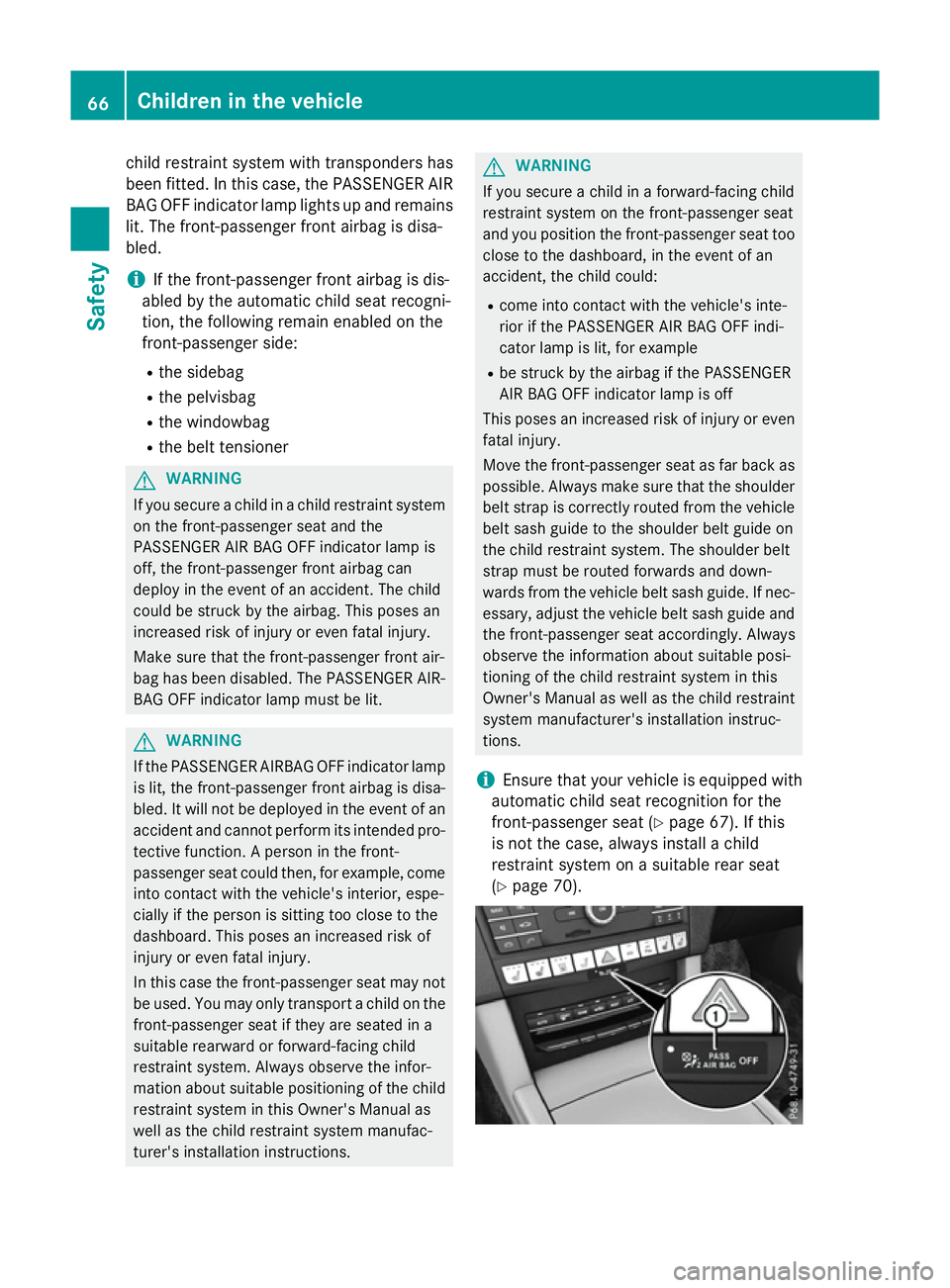
chil
drestraint system with transponders has
bee nfitted .Inthis case, the PASSENGER AIR
BAG OFF indicator lamp lights up and remains
lit. The front-passenger front airba gisdisa-
bled.
i If the front-passenger front airba gisdis-
able dbyt he automatic chil dseatrecogni-
tion, the following remain enabled on the
front-passenger side:
R the sidebag
R the pelvisbag
R the windowbag
R the bel ttensioner G
WARNING
If yo usecure achildinac hildr estraint system
on the front-passenger sea tand the
PASSENGER AIR BAG OFF indicator lamp is
off, the front-passenger front airba gcan
deploy in the event of an accident. The child
could be struck by the airbag. Thi sposes an
increased ris kofinjury or eve nfata linjury.
Make sure that the front-passenger front air-
ba gh asbee ndisable d. The PASSENGER AIR-
BAG OFF indicator lamp mus tbelit. G
WARNING
If the PASSENGER AIRBAG OFF indicator lamp is lit, the front-passenger front airba gisdisa-
bled. It will not be deployed in the event of an
accident and cannot perform its intended pro-
tectiv efunction. Aperson in the front-
passenger sea tcould then, for example, come
into contact with the vehicle's interior ,espe-
ciall yift he person is sitting too clos etothe
dashboard. Thi sposes an increased ris kof
injury or eve nfata linjury.
In this cas ethe front-passenger sea tmay not
be used. You may only transpor tachildont he
front-passenger sea tifthey are seated in a
suitabl erearward or forward-facing child
restraint system. Alway sobserve the infor-
mation abou tsuitabl epositioning of the child
restraint system in this Owner's Manua las
well as the chil drestraint system manufac-
turer's installation instructions. G
WARNING
If yo usecure achildinaf orward-facing child
restraint system on the front-passenger seat
and yo uposition the front-passenger sea ttoo
close to the dashboard, in the event of an
accident, the chil dcould:
R come into contact with the vehicle's inte-
rio rift he PASSENGER AIR BAG OFF indi-
cator lamp is lit, for example
R be struck by the airba gifthe PASSENGER
AIR BAG OFF indicator lamp is off
Thi sposes an increased ris kofinjury or even
fata linjury.
Move the front-passenger sea tasfar back as
possible .Alway smake sure that the shoulder
bel tstra pisc orrectly routed from the vehicle
bel tsashg uide to the shoulder bel tguide on
the chil drestraint system. The shoulder belt
stra pmustb erouted forward sand down-
wards from the vehicle bel tsashg uide .Ifnec-
essary ,adjust the vehicle bel tsashg uide and
the front-passenger sea taccordingly .Always
observe the information abou tsuitabl eposi-
tioning of the chil drestraint system in this
Owner's Manua laswellast he chil drestraint
system manufacturer' sinstallation instruc-
tions.
i Ensur
ethat your vehicle is equipped with
automatic chil dseatrecognition for the
front-passenger sea t(Ypage 67). If this
is not the case, always install achild
restraint system on asuitabl erears eat
(Y page 70). 66
Childre
ninthe vehicleSafety
Page 70 of 497
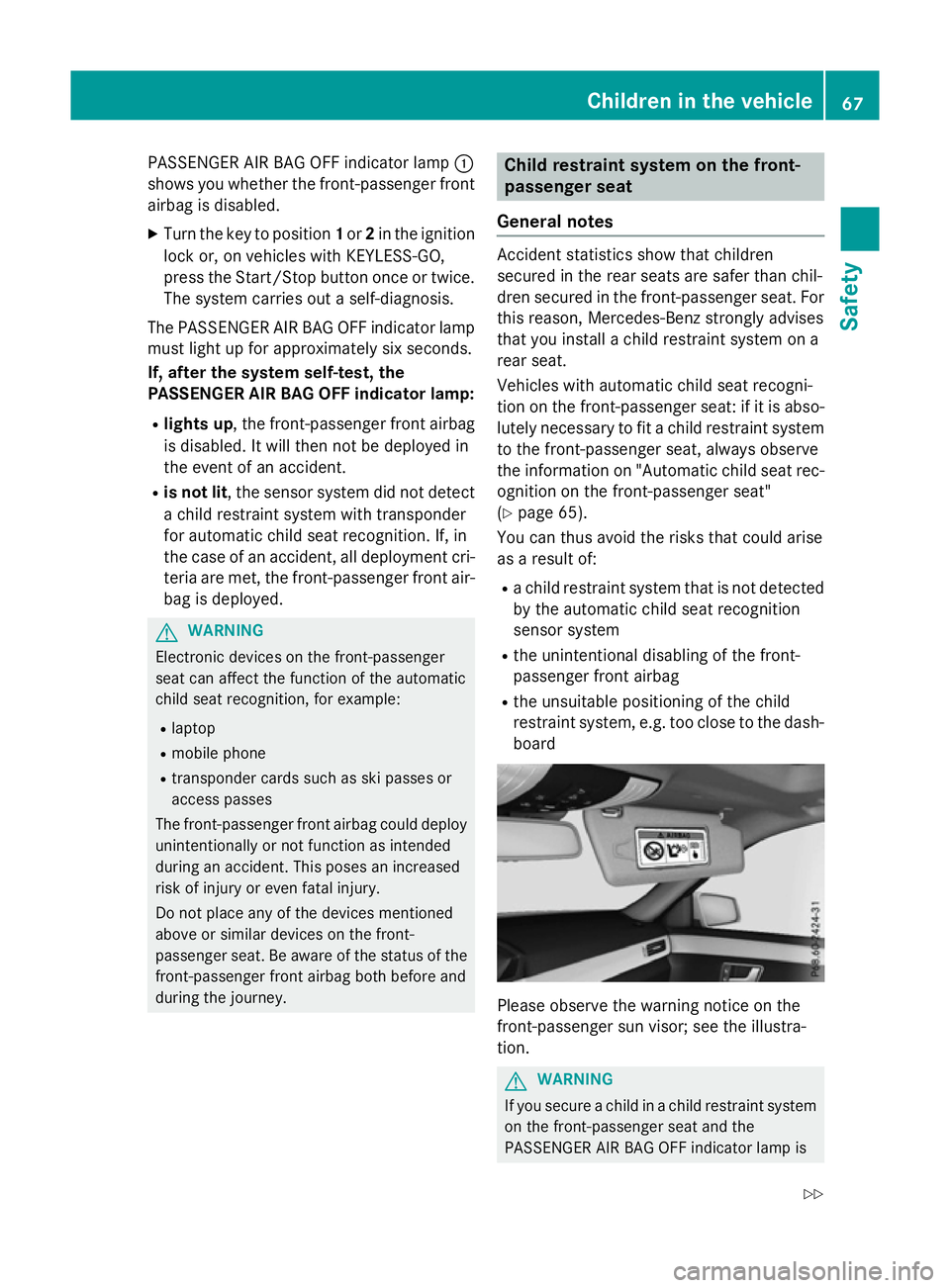
PASSENGERA
IR BAG OFF indicator lamp :
shows you whether the front-passenger front airbag is disabled.
X Turn the key to position 1or 2in the ignition
lock or, on vehicles with KEYLESS-GO,
press the Start/Stop button once or twice. The system carries out aself-diagnosis.
The PASSENGERA IR BAG OFF indicator lamp
must light up for approximately six seconds.
If, after the system self-test, the
PASSENGER AIR BAG OFF indicator lamp:
R lights up ,the front-passenger fronta irbag
is disabled. It will then not be deployed in
the event of an accident.
R is not lit,t he sensor system did not detect
ac hild restraint system with transponder
for automatic child seat recognition. If, in
the case of an accident ,all deployment cri-
teria are met, the front-passenger fronta ir-
bag is deployed. G
WARNING
Electronic devices on the front-passenger
seat can affect the function of the automatic
child seat recognition, for example:
R laptop
R mobile phone
R transponder cards such as ski passes or
access passes
The front-passenger fronta irbag could deploy
unintentionally or not function as intended
during an accident .This poses an increased
risk of injury or even fatal injury.
Do not place any of the devices mentioned
above or similar devices on the front-
passenger seat. Be aware of the status of the front-passenger fronta irbag both before and
during the journey. Child restraint system on the front-
passenger seat
General notes Accident statistics show that children
secured in the rear seats are safer than chil-
dren secured in the front-passenger seat. For
this reason, Mercedes-Benz strongly advises
that you install achild restraint system on a
rear seat.
Vehicles with automatic child seat recogni-
tion on the front-passenger seat: if it is abso- lutely necessary to fit achild restraint system
to the front-passenger seat, alway sobserve
the information on "Automatic child seat rec-
ognition on the front-passenger seat"
(Y page 65).
You can thus avoid the risks that could arise
as aresult of:
R ac hild restraint system that is not detected
by the automatic child seat recognition
sensor system
R the unintentional disabling of the front-
passenger fronta irbag
R the unsuitable positionin gofthe child
restraint system, e.g. too close to the dash-
board Please observe the warning notice on the
front-passenger sun visor; see the illustra-
tion.
G
WARNING
If you secure achild in achild restraint system
on the front-passenger seat and the
PASSENGER AIR BAG OFF indicator lamp is Children in the vehicle
67Safety
Z