2015 MERCEDES-BENZ C-CLASS COUPE keyless
[x] Cancel search: keylessPage 149 of 385

To start the vehicle without actively using the
key:
R the Start/Stop button must be inserted in the
ignition lock
R the key must be in the vehicle
R the vehicle must not be locked with the key or
KEYLESS-GO (Y page 81)
Do not keep the key:
R with electronic devices, e.g. amobile phone
or another key
R with metallic objects, e.g. coins or metal film
R inside metallic objects, e.g. ametal case
This can affect the key's functionality.
If you lock the vehicle with the key's remote
control or with KEYLESS-GO, after ashort time:
R you will not be able to switch on the ignition
with the Start/Stop button
R you will not be able to start the engine with the
Start/Stop button until the vehicle is
unlocked again
If you lock the vehicle centrally using the button
on the front door (Y page 87), you can continue
to start the engine with the Start/Stop button.
The engine can be switched off while the vehicle
is in motion by pressing and holding the Start/
Stop button for three seconds. This function
operates independently of the ECO start/stop
automatic engine switch-off function.
Key positions with the Start/Stop button :
Start/Stop button
; Ignition lock
When you switch on the ignition, all of the indi-
cator lamps in the instrument cluster light up.
Further information on situations where an indi-
cator lamp either fails to go out after starting the engine or lights up while driving (Y page 286).If Start/Stop button
:has not yet been
pressed, this corresponds to the key being
removed from the ignition.
X To switch on the power supply: press
Start/Stop button :once.
The power supply is switched on. You can now activate the windscreen wipers, for example.
The power supply is switched off again if:
R the driver's door is opened and
R you press Start/Stop button :twice when in
this position
X To switch on the ignition: press Start/Stop
button :twice.
The ignition is switched on.
The ignition is switched off again if:
R you do not start the engine from this position
within 15 minutes
R you press Start/Stop button :twice when in
this position
The power supply is switched off again if:
R the driver's door is opened and
R you press Start/Stop button :twice when in
this position
Removing the Start/Stop button You can remove the Start/Stop button from the
ignition lock and start the vehicle as normal
using the key.
It is only possible to switch between Start/Stop
button mode and key operation when the trans-
mission is in position P.
X Remove Start/Stop button :from ignition
lock ;.
You do not have to remove the Start/Stop but-
ton from the ignition lock when you leave the
vehicle. You should, however, alway stake the
key with you when leaving the vehicle. As long as
the key is in the vehicle:
R the vehicle can be started using the Start/
Stop button
R the electrically powered equipment can be
operated 146
DrivingDriving and parking
Page 151 of 385

Starting procedureu
sing the Start/
Stop button The Start/Stop button is only available on vehi-
cles with KEYLESS-GO or the KEYLESS-GO start
function.
The Start/Stop button can be used to start the
vehicle manually without insertin gthe key into
the ignition lock. The key must be in the vehicle and the Start/Stop button must be inserted in
the ignition lock. This mode for startingt he
engine operates independently of the ECO
start/stop automatic engine start function.
You can start the engine if avalid key is in the
vehicle. Switch off the engine and always take
the key with you when leaving the vehicle, even
if you only leave it for ashort time. Pay attention
to the important safety notes.
X Depress the brake pedal and keep it
depressed.
X Press the Start/Stop button once
(Y page 145).
Vehicles with apetrol engine: the engine
starts.
Vehicles with adiesel engine: preglow is
activated and the engine starts. Pulling away
General notes G
WARNING
Vehicles with automatic transmission:
If the engine speed is above the engine idling speed and you then engage transmission
position Dor R,t he vehicle may accelerate
suddenly. There is arisk of an accident.
When engaging transmission position Dor R,
always keep the brake pedal firmly depressed
and do not depress the accelerator pedal at
the same time.
! Vehicles with manualt
ransmission:
change gear in good time and avoid spinning
the wheels. You could otherwise damage the
vehicle.
Depress the accelerator carefully when pulling
away.
The vehicle locks centrally once you have pulled
away.T he locking knobs in the doors drop down. You can open the doors from the inside at any
time.
You can also deactivate the automatic locking
feature; see the Digital Owner's Manual.
Vehicles with automatic transmission: it is
only possible to shift the transmission from posi- tion Pto the desired position if you depress the
brake pedal. If you do not depress the brake
pedal, the DIRECT SELECT lever can still be
moved but the parking lock remains engaged.
i Vehicles with automatic transmission:
upshifts take place at higher engine speeds
after acold start. This helps the catalytic con-
verter to reach its operating temperature
more quickly.
Information on automatically releasing the elec- trical parking brake (Y page 175).
Pulling away with atrailer To ensure that you do not roll backwards when
pulling away on an uphill slope, apply the electric
parking brake.
X Press and hold handle :.
The electric parking brake continues to brake
and prevent the vehicle from rolling back-
wards.
The red !indicator lamp in the instrument
cluster remains lit.
X Depress the accelerator pedal.
X As soon as the vehicle/trailer combination is
held by the driving force of the engine, release lever :.
The electric parking brake is released.
The red !indicator lamp in the instrument
cluster goes out.
For further information on the electric parking
brake, see (Y page 174).148
DrivingDriving and parking
Page 170 of 385

If you mix dieself
uel with petrol, the flash
point of this fuel mixture is lowert han that of
pure dieself uel. When the engine is running,
components in the exhaust system may over-
heat unnoticed. There is arisk of fire.
Never refuel with petrol. Never add petrol to
dieself uel.
! Do not use dieseltor
efuel vehicleswith a
petrol engine. Do not switch on the ignition if you accidentally refuel with the wrong fuel.
Otherwise ,the fuel wille nter the fuel system.
Even small amounts of the wrong fuel can
resultind amage to the fuel system and the
engine. Notify aqualifieds pecialist workshop
and have the fuel tank and fuel lines drained
completely.
! Do not use petrol to refuel vehicle
swith a
diesele ngine. Do not switch on the ignition if
you accidentally refuel with the wrong fuel.
Otherwise ,fuel can enter the fuel system.
Even small amounts of the wrong fuel could
resultind amage to the fuel system and the
engine. The repairc osts are high. Notify a
qualifieds pecialist workshop and have the
fuel tank and fuel lines drained completely.
! Overfilling the fuel tank could damage the
fuel system.
! Take care not to spilla
ny fuel on painted
surfaces .You could otherwise damage the
paintwork.
! Use
afilter when adding fuel from afuel can.
The fuel lines and/or the fuel injection system could otherwise be blocked by particle sfrom
the fuel can.
If you overfill the fuel tank, some fuel may spray
out when you remove the fuel pump nozzle.
Further information on fuel and fuel quality
(Y page 371). Refuelling
General notes Observe the important safety notes
(Y
page 166).
If you unlock/lock the vehicle from the outside,
the fuel fillerf lap also unlocks/locks. The positio
nofthe8 fuel fillerc ap is dis-
played in the instrument cluster. The arrow next to the filling pump indicates the side of the vehi-
cle.
Openin gthe fuel fillerf lap :
To open the fuel fillerf lap
; To insert the fuel fillerc ap
= Tyre pressure table
? Instruction label on the fuel type to be refu-
elled
X Switch off the engine.
X Remove the key from the ignition lock.
or, on vehicle swith KEYLESS-GO start function
or KEYLESS‑GO:
X Open the driver's door.
The on-board electronics now have status 0.
This is the same as the key having been
removed.
X Press the fuel fillerf lap in the direction of
arrow :.
The fuel fillerf lap swings up.
X Turn the fuel fillerc ap anti-clockwise and
remove it.
X Insert the fuel fillerc ap into the holderont he
inside of fuel fillerf lap;.
X Completely insert the fillern eck of the fuel
pump nozzle into the tank, hook in place and refuel.
X Only fill the tank until the pump nozzle
switches off.
Do not add any more fuel after the pump stops
filling for the first time. Otherwise ,fuel may leak
out.
Vehicle swithadiese lengine: the fillern eck is
designed for refuelling at dieself illing pumps. Refuelling
167Driving and parking Z
Page 172 of 385

Problems with the fuel and fuel tank
Problem
Possible causes/consequences and
M
MSolutions Fuel is leaking from the
vehicle.
G
WARNING
The fuel line or the fuel tank is faulty.
There is arisk of fire or explosion.
X Apply the electric parking brake.
X Switch off the engine.
X Remove the key from the ignition lock.
or, on vehicles with KEYLESS-GO start function or KEYLESS ‑GO:
X Open the driver's door.
The on-board electronics now have status 0.This is the same as the
key having been removed.
X Do not restart the engine under any circumstances.
X Consult aqualified specialist workshop. The engine does not
start. The fuel tank of
avehicle with adiesel engine has been run completely
dry.
X Refuel the vehicle with at least 5litres of diesel.
X Turn the ignition on for approximately ten seconds (Y page 145).
X Start the engine continuously for amaximum of ten seconds until it
runs smoothly.
If the engine does not start: X Turn the ignition on again for amaximum of ten seconds
(Y page 145).
X Start the engine again continuously for amaximum of ten seconds
until it runs smoothly.
If the engine does not start after three attempts:
X Consult aqualified specialist workshop. The fuel filler flap cannot
be opened. The fuel filler flap is not unlocked.
X Unlock the vehicle (Y page 81). The key battery is discharged or nearly discharged.
X Unlock the vehicle using the emergency key element (Y page 82).The fuel filler flap is unlocked, but the opening mechanism is jammed.
X Consult aqualified specialist workshop. AdBlue
®
(BlueTEC vehicleso nly)
General notes To function properly, BlueTEC exhaust gas after-
treatmen tmust be operated with the reducing
agent AdBlue ®
. On vehicles with an 8.5
lAdBlue ®
tank ,topping
up AdBlue ®
is not part of the maintenanc ework.
Under normal operatin gconditions, afull tank of
AdBlue ®
should last until the nex tservic edue
date.
When the supply of AdBlue ®
is down to approx-
imately 3.0 litres, the Refill AdBlue See Refill AdBlue See Refuelling
169Driving and parking Z
Page 327 of 385

engine or to the catalytic converter. Have
exces
sengine oil siphoned off. Example
X Turn cap :anti-clockwise and remove it.
X Top up the engine oil.
If the oil level is at or below the MIN mark on
the oil dipstick ,top up with 1.0 lofe ngine oil.
X Replace cap :on the filler neck and turn
clockwise.
Make sure that the cap locks securely into
place.
X Check the oil leve lagain with the oil dipstick
(Y pag e323).
For further information on engine oil ,see
(Y pag e375). Other service products
Important safety notes G
WARNING
Certain components in the engine compart-
ment coul dbevery hot, e.g. the engine, the
radiator and parts of the exhaust system.
There is arisk of injury when accessing the
engine compartment.
As far as possible ,allow the engine to cool
dow nand only touch the components descri-
bed in the following. G
WARNING
The cooling system is pressurised, particu-
larl yw hen the engine is warm. If you open the
cap, you coul dbescalded if hot coolant
sprays out. There is arisk of injury. Let the engine cool dow
nbefore you open the
cap. Wea rglove sand eye protection. Open
the cap slowly to release the pressure. G
WARNING
If windscreen washer concentrate comes into contact with hot components of the engine or
the exhaust system, it can ignite. There is a
risk of fire and injury.
Make sure the windscreen washer concen-
trate does not come into contact with the filler neck.
Checking the coolan tlevel X
Park the vehicl eonalevelsurface.
Only check the coolant leve lifthe vehicl eis
on aleve lsurface and the engine has cooled
down.
X Turn the key to position 2in the ignition lock
(Y pag e145).
or
X On vehicles with KEYLESS-GO, press the
Start/Stop button twice (Y page145).
X Check the coolant temperature display in the
instrument cluster (Y page233).
The coolant temperature must be below
70 †.
X Turn the key to position 0(Y pag e145).
or
X On vehicles with KEYLESS-GO, pul lthe Start/
Stop button from the ignition lock
(Y pag e145).
X Slowl yturn cap :halfat urn anti-clockwise
to allow excess pressure to escape. 324
Engine compartmentMaintenance and care
Page 330 of 385

Washing the vehiclea
nd cleaning the
paintwork
Automatic car wash G
WARNING
Braking efficiency is reduced after the vehicle has been washed .There is arisk of an acci-
dent.
After washing the vehicle, brake carefully
while paying attention to the traffic conditions in order to restore full braking efficiency.
! When DISTRONIC PLUS or the HOLD func-
tion is activated, the vehicl ebrakes automat-
ically in certain situations.
To avoi ddamage to the vehicle, deactivate
DISTRONIC PLUS and the HOLD function in
the following or similar situations:
R when towing away
R in ac ar wash
! Make sure:
R the side windows and sliding sunroo fare
close dcompletely.
R the blower for the ventilation/heating is
switched off (OFF button is depressed).
R the windscreen wiper switch is at position
0
R the 360° camera or reversing camera is
switched off.
The vehicl ecouldo therwise be damaged.
! If the key is withi
nthe rear detection range
of KEYLESS-GO, the following situations, for
example, coul dleadtot he boot lid opening
unintentionally:
R using acar wash
R using ahigh-pressure cleaner
Make sure that the key is at least 3maway
from the vehicle.
! Make sure that the automatic transmission
is in neutral position Nwhen washing your
vehicl einat ow-through car wash. The vehicle
may otherwise be damaged.
R Operating with the key:
Do not remove the key from the ignition
lock. Do not open the driver's door when
the engine is switched off or at very low
speeds. Otherwise, whe nintransmission position
Dor Rthe automatic transmission
wil lautomatically switch to park position P
and block the wheels.
R Operating with the Start/Stop button:
Do not open the driver's door whe nthe
engine is switched off or at very low
speeds. Otherwise, whe nintransmission
position Dor Rthe automatic transmission
wil lautomatically switch to park position P
and block the wheels.
Observe the following to make sure that the
automatic transmission stay sinneutral position
N:
Operating with the key and Start/Stop button:
X Make sure the ignition is switched on.
X Make sure that the vehicl eisstationary.
X Depress the brake peda land keep it
depressed.
Operating with the Start/Stop button only: X Engage park position P.
X Releas ethe brake pedal.
X Remove the Start/Stop button from the igni-
tion lock (Y page145).
X Insert the key into the ignition lock.
X Switch on the ignition.
X Depress the brake peda land keep it
depressed.
Operating with the key and Start/Stop button:
X Select neutral N.
X Releas ethe brake pedal.
X Releas ethe electric parking brake, if neces-
sary.
X Switch off the ignition and leave the key in the
ignition lock.
You can wash the vehicl einanautomatic car
wash from the very start.
Was hoff excess dirt before cleaning the vehicle
in an automatic car wash.
After using an automatic car wash, wip eoff wax
from the windscreen and the wiper blades. This
wil lprevent smears and reduce wiping noises
caused by residue on the windscreen.
Washing by hand In some countries
,washing by hand is only
allowe datspeciall yequipped washing bays. Care
327Maintenance and care Z
Page 331 of 385

Observe the legal requirements for each indi-
vidualc ountry.
X Do not use hot water and do not wash the
vehicle in direct sunlight.
X Use asoft sponge to clean.
X Use amild cleaning agent, such as acar
shampoo approved by Mercedes-Benz.
X Thoroughly hose down the vehicle with agen-
tle jet of water.
X Do not point the water jet directly towards the
air inlet.
X Use plenty of water and rinse out the sponge
frequently.
X Rinse the vehicle with clean water and dry
thoroughly with achamois.
X Do not let the cleaning agent dry on the paint-
work.
When using the vehicle in winter, remove all
traces of road salt deposits carefully and as
soon as possible.
High-pressure cleaning equipment G
WARNING
The water jet of circular-jet nozzles (dirt grind- ers) can cause damage not visible from the
outside to tyres or chassis components. Com-
ponents damaged in this way can unexpect-
edly fail. There is arisk of an accident.
Do not use high-pressure cleaners with circu-
lar-jet nozzles to clean the vehicle. Have dam- aged tyres or chassis componentsr eplaced
immediately.
! Alwaysm
aintainadistance of at least 30 cm
between the vehicle and the high-pressure
cleaner nozzle. Information aboutt he correct
distance is available from the equipment
manufacturer.
Move the high-pressure cleaner nozzle
around when cleaning your vehicle.
Do not aim directly at any of the following:
R tyres
R door gaps, roof gaps, joints etc.
R electrical components
R battery
R connectors
R lights
R seals R
trim elements
R ventilation slots
Damaged seals or electrical componentsc an
lead to leaks or failures.
! If the key is within the rear detection range
of KEYLESS-GO, the following situations, for
example, could lead to the boot lid opening
unintentionally:
R using acar wash
R using ahigh-pressure cleaner
Make sure that the key is at least 3maway
from the vehicle.
! Edition
1special model: parts of your vehi-
cle are covered with adecorative foil. Main-
tain adistance of at least 70 cm between the
foil-wrappedp arts of the vehicle and the noz-
zle of the high pressure cleaner.
Information aboutt he correct distance is
available from the equipment manufacturer.
Move the high-pressure cleaner nozzle
around when cleaning your vehicle.
Cleaning the paintwork !
Do not affix:
R stickers
R films
R magnetic plates or similari tems
to painted surfaces. You could otherwise
damage the paintwork.
Scratches, corrosive deposits, areas affected by
corrosion and damage caused by inadequate
care cannot always be completely repaired. In
such cases, visit aqualified specialist workshop.
X Remove impurities immediately,w here pos-
sible, whilst avoiding rubbing too hard.
X Soak insect remains with insect remover and
rinse off the treated areas afterwards.
X Soak bird droppings with water and rinse off
the treated areas afterwards.
X Remove coolant, brake fluid, tree resins, oils,
fuels and greases by rubbing gently with a
cloth soaked in petroleum ether or lighter
fluid.
X Use tar remover to remove tar stains.
X Use silicone remover to remove wax. 328
CareMaintenance and care
Page 340 of 385
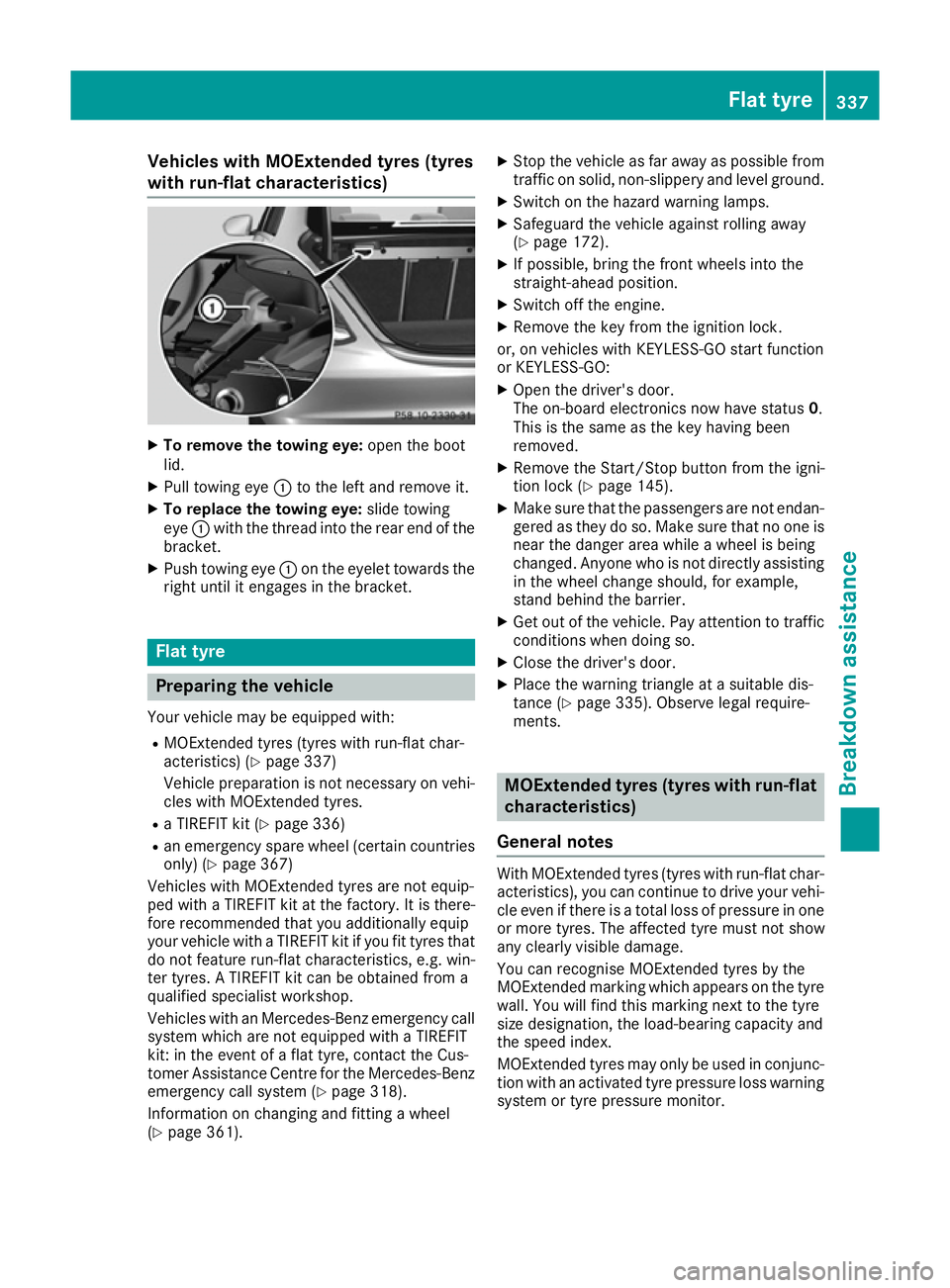
Vehicles with MOExtende
dtyres (tyres
with run-flat characteristics) X
To remove the towin geye: open the boot
lid.
X Pull towing eye :to the left and remove it.
X To replace the towin geye: slidetowing
eye :with the thread into the rea rend of the
bracket.
X Push towing eye :on the eyelet toward sthe
right unti litengages in the bracket. Flat tyre
Preparin
gthe vehicle
Your vehicl emay be equipped with:
R MOExtende dtyres (tyres with run-fla tchar-
acteristics )(Ypage 337)
Vehicl epreparation is not necessary on vehi-
cle sw ithM OExtende dtyres.
R aT IREFIT kit (Y page 336)
R an emergency spare whee l(certai ncountries
only) (Y page 367)
Vehicles with MOExtende dtyres are not equip-
pe dw ithaT IREFIT kit at the factory .Itisthere-
fore recommende dthaty ou additionally equip
your vehicl ewithaT IREFIT kit if yo ufit tyres that
do not feature run-fla tcharacteristics, e.g .win-
ter tyres. ATIREFIT kit can be obtained from a
qualified specialist workshop.
Vehicles with an Mercedes-Benz emergency call
system which are not equipped with aTIREFIT
kit: in the event of aflatt yre, contact the Cus-
tome rAssistance Centre for the Mercedes-Benz
emergency cal lsystem (Y page 318).
Informatio nonchanging and fitting awheel
( Y page 361). X
Stop the vehicl easfar away as possibl efrom
traffic on solid ,non-slippery and level ground.
X Switch on the hazard warning lamps.
X Safeguard the vehicl eagain st rolling away
(Y page 172).
X If possible, bring the front wheels into the
straight-ahea dposition.
X Switch off the engine.
X Remove the key from the ignition lock.
or, on vehicles with KEYLESS-GO start function
or KEYLESS ‑GO:
X Ope nthe driver' sdoor.
The on-board electronics now have status 0.
Thi sist he same as the key having been
removed.
X Remove the Start/Stop button from the igni-
tio nlock( Ypage 145).
X Make sure tha tthe passenger sare not endan-
gered as they do so. Make sure tha tnoone is
nea rthe danger are awhile awheel is being
changed .Anyone wh oisnot directl yassis ting
in the whee lchange should, for example,
stand behind the barrier.
X Ge toutof the vehicle. Pa yattentio ntotraffic
conditions when doing so.
X Close the driver' sdoor.
X Place the warning triangl eatasuitabl edis-
tance (Y page 335). Observe lega lrequire-
ments. MOExtende
dtyres (tyres with run-flat
characteristics)
General notes With MOExtende
dtyres (tyres with run-fla tchar-
acteristics), yo ucan continue to drive your vehi-
cle eve nifthereisat otallos sofp ressure in one
or more tyres. The affecte dtyrem ustn ot show
any clearl yvisible damage.
Yo uc an recognise MOExtende dtyres by the
MOExtende dmarking which appears on the tyre
wall .You will find thi smarking next to the tyre
size designation, the load-bearing capacity and
the speed index.
MOExtende dtyres ma yonlybeu sedinc onjunc-
tio nw ithana ctivate dtyrep ressure loss warning
system or tyr epressure monitor. Flat tyre
337Breakdown assis tance