2015 MERCEDES-BENZ C-CLASS COUPE steering
[x] Cancel search: steeringPage 33 of 385

Cockpit
Function Page
:
Steering wheel gearshif
tpad-
dles 163
;
Combination switch 120
=
Horn
?
Instrumen
tcluster 32
A
DIRECT SELECT lever 158
B
Climat
econtrol systems 129
C
Overhead control panel 37
D
Control panel for multimedia
system and vehicle functions
34
E
Ignition lock 145
Start/Sto
pbutton 145
F
Adjust
sthe steering wheel 110
G
Cruis
econtrol lever 181 Function Page
H
Electric parking brake 174
I
Diagnostics connection 27
J
Open
sthe bonnet 322
K
Ligh
tswitch 118
L
Control panel for:
Activatin
gSteering Assist 191
Activatin
gActiveL aneK eep-
ing Assist 223
Deactivating PARKTRONIC 197
Activatin
gthe 360° camera 210
Switching on th
ehead-up
display 235
Vehicle
swithout adriver
assistance system: card/
coi nh older 30
CockpitAt
ag lance
Page 34 of 385

Function Page
:
Overhead control panel 37
;
Climat
econtrol systems 129
=
Combination switch 120
?
Instrument cluster 32
A
Horn
B
DIRECT SELECT lever 158
C
Steering wheel gearshif
tpad-
dles 163
D
Control pane
lfor: Activatin
gSteering Assist 191
Activatin
gActiveL aneK eep-
ing Assist 223
Deactivating PARKTRONIC 197
Activatin
gthe 360° camera 210
Switching on th
ehead-up
display 235
Vehicle
swithout adriver
assistance systems :card/
coi nh older Function Page
E
Ligh
tswitch 118
F
Open
sthe bonnet 322
G
Diagnostics connection 27
H
Electric parking brake 174
I
Ignition lock 145
Start/Sto
pbutton 145
J
Adjust
sthe steering wheel 110
K
Cruise control lever 181
L
Control pane
lfor multimedia
system and vehicle functions 34Cockpit
31Atag lance
Page 35 of 385

Instrumen
tcluster i
Instrumen
tcluste rwiths peedometer
(km/h) Function Page
:
Speedometer
Speedometer segments 232
Warning and indicator lamps:
å
ESP®
OFF 287
÷
ESP® 287
·
Distanc ewarning 293
Ð
Powersteering 295
6
Restrain tsystem 40
ü
Seat belts 285
K
Main-beam headlamps 120
L
Dipped-beam head-
lamps 119
8
Reserve fuel level with
fuel filler flap location indica-
to r( right) 290
T
Sidelamps 119
R
Rear fog lamp 119
h
Tyre pressur emonitor 294 Function Page
;
#!
Turn signals 120
=
Multifunction display 234
?
Rev counter 233
Warning and indicator lamps:
!
Electric parking brake
(yellow) 290
!
ABS 287
;
Enginediagnostics 290
%
Diesel engine: preglow 147
!
Electric parking brake
(red) 290
J
Brakes(red) 286
M
SPORT handlin gmode
in Mercedes-AM Gvehicles 289
?
Coolant 291
J
Brakes(yellow) 286
A
Coolan
ttem perature gauge 233
B
8
Fuellevel indicator 290
i
Information on displayin
gthe outside tem-
peratur einthemultifunction display can be
foun dunder "Outside temperature display"
(Y page 233). 32
Instrumen
tclusterAt ag lance
Page 36 of 385

Multifunction steering wheel
Function Page
:
Multifunction display 234
;
Multimedi
asystem display =
~
Rejects or ends acall 6
Makes or accepts acall Further telephone functions 242
WXAdjusts the vol-
ume 8
Mute ó
Switche sonvoice-
operated contro lfor naviga-
tio norL INGUATRONIC Function Page
?
ò
Opens the menu list 9:Selects
amenu a
Confirm sthe selection %
Back Operating the on-board com-
puter 233
ñ
Switches off voice-
operate dnavigation or LIN-
GUATRONIC i
In vehicles with multimedi asystem
COMAND Online yo ucan find further infor-
mation:
R on the multimedi asystem in the Digital
Owner's Manual
R on the DVD changer or single DVD drive in
the Digital Owner's Manual
R on LINGUATRONIC in the separate operat-
ing instructions
i You can find further information in vehicle
with an Audio 20 multimedi asystem:
R on the multimedi asystem in the Digital
Owner's Manual
R on voice-controlled navigation in the man-
ufacturer's operating instructions Multifunctio
nsteering wheel
33Atag lance
Page 41 of 385

Door contro
lpanel Function Page
:
r
45=
Stores settings for the seat,
exterior mirrors and steering
column 116
;
Adjusts the seats electrically 104
=
c
Seatheating 108
?
s
Seatventilation 108
A
Opens the door 87
B
%&Unlocks/locks
the vehicle
87 Function Page
C
W
Opens/closes the left
side window 93
D
7Zª\
Adjusts and folds the exterior
mirrors out/in electrically 113
E
W
Opens/closes the right
side window 93
F
p
Opens/closes the boot
lid 9238
Door control panelAt
ag lance
Page 42 of 385
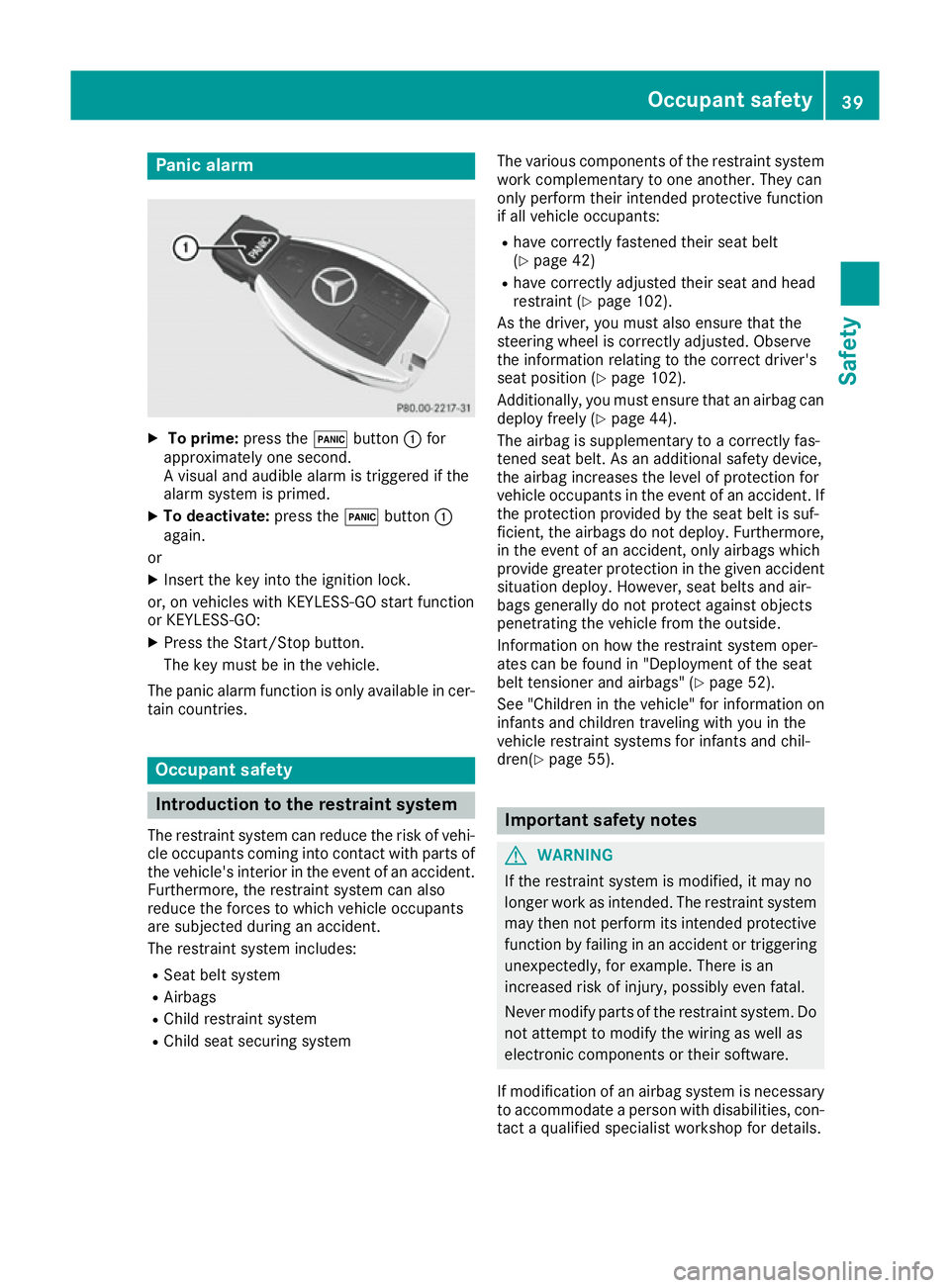
Panic alarm
X
To prime: press the!button :for
approximately one second.
Av isual and audible alarm is triggered if the
alarm system is primed.
X To deactivate: press the!button :
again.
or
X Insert the key into the ignition lock.
or, on vehicles with KEYLESS-GO start function
or KEYLESS ‑GO:
X Press the Start/Stop button.
The key must be in the vehicle.
The panic alarm function is only available in cer-
tain countries. Occupant safety
Introduction to the restraint system
The restraint system can reduce the risk of vehi-
cle occupants coming into contact with parts of
the vehicle's interior in the event of an accident. Furthermore, the restraint system can also
reduce the forces to which vehicle occupants
are subjected during an accident.
The restraint system includes:
R Seat belt system
R Airbags
R Child restraint system
R Child seat securing system The various components of the restraint system
work complementary to one another. They can
only perform their intended protective function
if all vehicle occupants:
R have correctly fastened their seat belt
(Y page 42)
R have correctly adjusted their seat and head
restraint (Y page 102).
As the driver, you must also ensure that the
steering wheel is correctly adjusted. Observe
the information relating to the correct driver's
seat position (Y page 102).
Additionally, you must ensure that an airbag can
deploy freely (Y page 44).
The airbag is supplementary to acorrectly fas-
tened seat belt. As an additional safety device,
the airbag increases the level of protection for
vehicle occupants in the event of an accident. If
the protection provided by the seat belt is suf-
ficient, the airbags do not deploy. Furthermore, in the event of an accident, only airbags which
provide greater protection in the given accident
situation deploy. However, seat belts and air-
bags generally do not protect against objects
penetrating the vehicle from the outside.
Information on how the restraint system oper-
ates can be found in "Deployment of the seat
belt tensioner and airbags" (Y page 52).
See "Children in the vehicle" for information on
infantsa nd children traveling with you in the
vehicle restraint systems for infantsa nd chil-
dren(Y page 55). Important safety notes
G
WARNING
If the restraint system is modified, it may no
longer work as intended. The restraint system
may then not perform its intended protective function by failing in an accident or triggering
unexpectedly, for example. There is an
increased risk of injury, possibly even fatal.
Never modify parts of the restraint system. Do not attempt to modify the wiring as well as
electronic components or their software.
If modification of an airbag system is necessary to accommodate aperson with disabilities, con-
tact aqualified specialist workshop for details. Occupant safety
39Safety Z
Page 48 of 385

In order to avoid such risks, always ensure
that all vehicle occupants:
R fasten their seatbelts correctly, including
pregnant women
R are seated correctly and maintain the fur-
thest possible distance from the airbags
R observe the following notes
Alwayse nsure that there are no objects loca-
ted betwee nthe airbag and the vehicle occu-
pant.
R Adjust the seats properl ybefore beginning
yourj ourney. Alwaysm ake sure that the seat
is in an almostu pright position. The centre of
the head restraint must support the head at
aboute ye level.
R Move the driver's and front-passenger seats
as far back as possible. The driver's seat posi- tion must allow the vehicle to be driven safely.
R Only hold the steering wheel on the outside.
This allows the airbag to be fullyd eployed.
R Alwaysl eana gainst the backrest whiled riv-
ing. Do not leanf orwardsorleana gainst the
door or side window .You may otherwise be in
the deployment area of the airbags.
R Alwaysk eep yourf eet in the footwell in front
of the seat. Do not put yourf eet on the dash-
board,f or example .Your feet may otherwise
be in the deployment area of the airbag.
R Alwayss ecure persons less than 1.50 mtall in
suitable restraint systems .Uptothish eight,
th es eat belt canno tbeworn correctly.
If ac hild is travelling in your vehicle, also
observe th efollowin gnotes:
R Always secure childre nunde rtwelve years old
and less than 1.50 mtall in suitable child
restraint systems.
R Child restraint systems shoul dbefittedtot he
rear seats.
R Only secure achild to th efront-pa ssenger
seat when th efront-pa ssenger fron tairbag is
disabled, and only then in arearward-facing
child restraint system. If th ePASSENG ER AIR
BA GO FFindicator lamp is permanently lit ,the
front-passenger fron tairbag is disabled
(Y page 40).
R Always observ ethe instruction sand safety
note sont heautomatic front-passenger front
airbag deactivatio nsystem (Y page 47) and
on "Children in th evehicle "(Ypage 55) in addition to th
echild restraint system manu-
facturer' sinstallatio nand operatin ginstruc-
tions.
Objects in th evehicle interio rmayprevent
th ea irbag from functioning correctly. Before
starting your journey and to avoid risk sresulting
from th espee doft heairbag as it deploys, make
sure that:
R there are no people, animals or objects
between th evehicle occupant sand an airbag.
R there are no object sbetween th eseat ,door
and B-pillar.
R no hard objects, e.g .coat hangers, are hang-
ing on th egrab handles or coat hooks.
R no accessories ,suc hasc up holders, are
attached to th evehicle within th edeployment
area of an airbag ,e.g.tod oors, side windows,
rear side trim or side walls.
R no heavy, sharp-edged or fragile object sare in
th ep ockets of your clothing .Store such
object sinas uitable place. G
WARNING
If you modify an airbag cover or affix objects
suc hass tickers to it, th eairbag can no longer
function correctly. Ther eisanincreased risk
of injury.
Never modify an airbag cover or affix objects
to it. G
WARNING
Sensor stocontrol th eairbag sare locate din
th ed oors. Modification sorwork no tper-
formed correctly to th edoor sord oor panel-
ling ,asw ell as damage ddoors, can lead to the
function of th esensor sbein gimpaired. The
airbag smightthe refore no tfunction properly
any more. Consequently, th eairbag scannot
protect vehicle occupant sastheya re
designed to do. This pose sanincreased risk
of injury.
Never modify th edoor sorp artsoft hedoors.
Always have work on th edoor sord oor pan-
ellin gcarried out at aqualified specialist
workshop. Occupant safety
45Safety Z
Page 49 of 385

Fron
tairbags !
Do no
tplac eh eav yobject sont hefront-
passenger seat .This could caus ethe system
to identify th eseat as bein goccupied. In the
event of an accident, th erestrain tsystems on
th ef ront-pa ssenger side may be triggered
and have to be replaced. Driver's airbag
:deploys in fron tofthesteer-
ing wheel. Front-passenger fron tairbag ;
deploys in fron tofand abov ethe glov ecom-
partment.
When deployed, th efront airbags offer addi-
tional head and thorax protection for th eoccu-
pants in th efront seats.
The PASSENGER AI RBAG OFFa nd PASSENGER
AI RB AG ON indicator lamp sinform you about
th es tatus of th efront-pa ssenger fron tairbag
(Y page 40).
The front-passenger fron tairbag will only deploy
if:
R thea utomatic front-passenger fron tairbag
deactivation system has detected that the
front-passenger seat is occupied
(Y page 47) .The PASSENGER AI RBAG ON
indicator lamp is lit (Y page 48)
R ther estrain tsystem control unit predicts a
high acciden tseverity Driver'
skneebag Driver's kneebag
:deploys under th esteering
column .The driver' skneebag is triggered
together wit hthe fron tairbags.
The driver' skneebag offers additional thigh,
knee and lower leg protection for th eoccupant
in th edriver' sseat.
i The driver'
skneebag is only available in cer-
tai nc ountries.
Sidebags G
WARNING
Unsuitable seat cover scan obstruc torpre-
ven tthe deploymen toftheairbags integrated
int othe seats. Consequently, th eairbags can-
no tp rotect vehicl eoccupant sastheya re
designed to do. In addition ,the function of the
automatic front-passenger fron tairbag deac-
tivation system could be restricted. This
poses an increased ris kofinjury or eve nfatal
injury.
You should only use seat cover sthath ave
been approve dfor th ecorre sponding seat sby
Mercedes-Benz. 46
Occupant safetySafety