2015 MAZDA MODEL 6 sd card
[x] Cancel search: sd cardPage 33 of 576

Black plate (33,1)
Do not use an improper extender:
Using a seat belt extender that is for
another person or a different vehicle
or seat is dangerous. The seat belt
will not provide adequate protection
and the user could be seriously
injured in an accident. Only use the
extender provided for you and for the
particular vehicle and seat. NEVER
use the extender in a different vehicle
or seat. If you sell your Mazda, do
not leave your seat belt extender in
the vehicle. It could be used
accidentally by the new owner of the
vehicle. After removing the seat belt
extender, discard it. Never use the
seat belt extender in any other
vehicle you may own in the future.
Do not use an extender that is too
long:
Using an extender that is too long is
dangerous. The seat belt will not fit
properly. In an accident, the seat belt
will not provide adequate protection
and you could be seriously injured.
Do not use the extender or choose
one shorter in length if the distance
between the extender's buckle and
the center of the user's body is less
than 15 cm (6 in).Do not leave a seat belt extender
connected to the buckle:
Leaving a seat belt extender
connected to the buckle without
using the seat belt is dangerous.
When the seat belt extender is
connected to the driver's seat belt
buckle (or front passenger) seat, the
SRS driver's (or front passenger's) air
bag system will determine that the
driver (or front passenger) is wearing
the seat belt even if the driver (or
front passenger) is not wearing it.
This condition could cause the
driver's (or front passenger's) air bag
to not activate correctly and result in
death or serious injury in the event of
collision. Always wear the seat belt
with the seat belt extender.
Do not use the seat belt extender when
installing a child-restraint system on
the front or rear passenger seat:
Using a seat belt extender to fasten a
child-restraint system on any seat is
dangerous. Always follow the child-
restraint system manufacturer's
installation instructions and never
use a seat belt extender.
NOTE
When not in use, remove the seat belt extender
and store it in the vehicle. If the seat belt
extender is left connected, the seat belt
extender might get damaged as it will not
retract with the rest of the seat belt and can
easily fall out of the door when not in use and
be damaged. In addition, the seat belt warning
light will not illuminate and function properly.
Essential Safety Equipment
Seat Belt Systems
2-21
Mazda6_8DQ8-EA-13L_Edition3 Page33
Friday, June 13 2014 6:20 PM
Form No.8DQ8-EA-13L
Page 220 of 576
Black plate (220,1)
i-ELOOPí
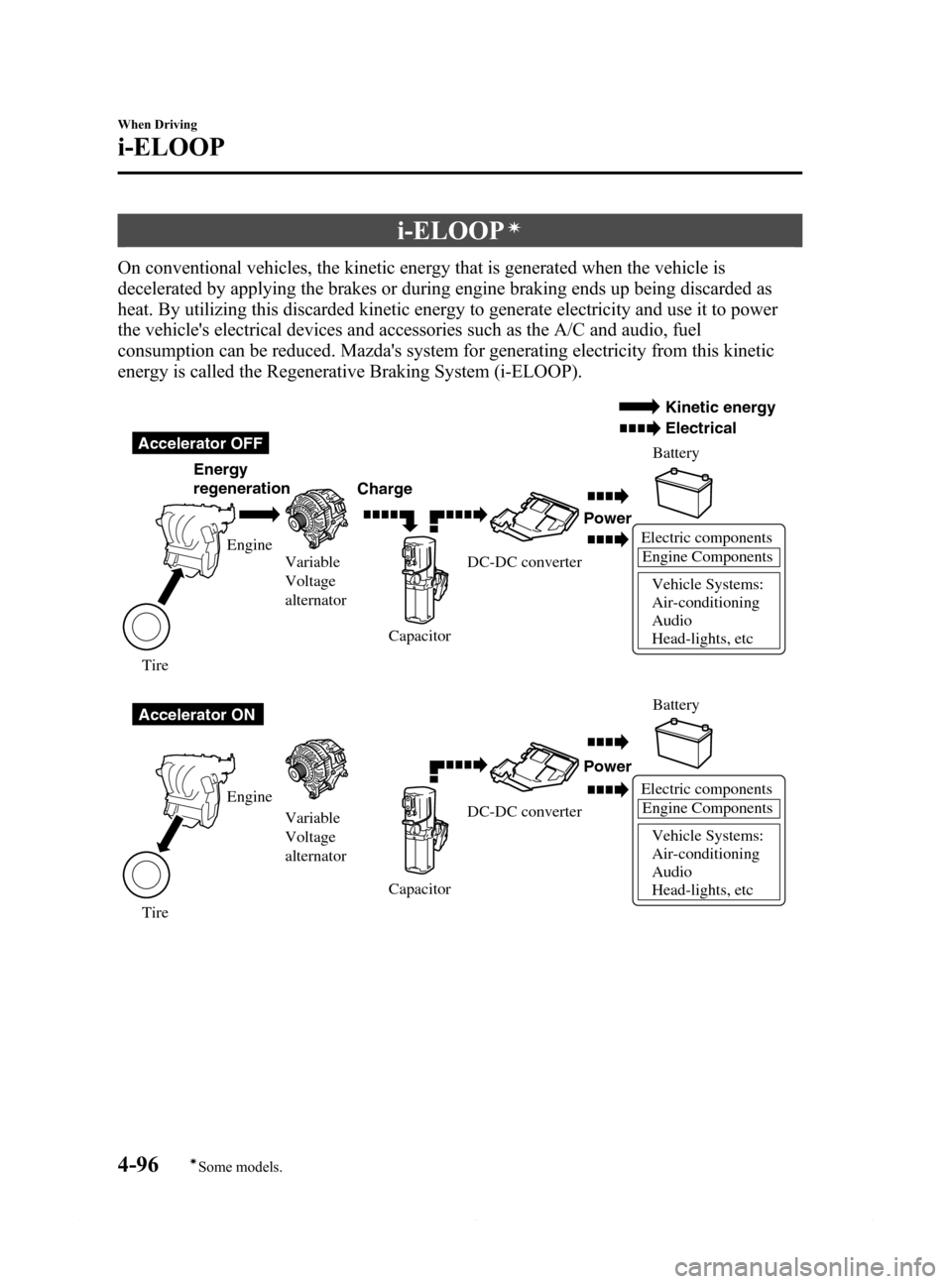
On conventional vehicles, the kinetic energy that is generated when the vehicle is
decelerated by applying the brakes or during engine braking ends up being discarded as
heat. By utilizing this discarded kinetic energy to generate electricity and use it to power
the vehicle's electrical devices and accessories such as the A/C and audio, fuel
consumption can be reduced. Mazda's system for generating electricity from this kinetic
energy is called the Regenerative Braking System (i-ELOOP).
Electric components
Engine Components
Vehicle Systems:
Air-conditioning
Audio
Head-lights, etc
Accelerator OFF
Accelerator ONEnergy
regeneration
ChargeBattery
Battery Power
Power
Electric components
Engine Components
Vehicle Systems:
Air-conditioning
Audio
Head-lights, etc
Engine
Variable
Voltage
alternator
Variable
Voltage
alternator Engine
Tire TireCapacitor
CapacitorDC-DC converter
DC-DC converter
Kinetic energy
Electrical
4-96
When Driving
íSome models.
i-ELOOP
Mazda6_8DQ8-EA-13L_Edition3 Page220
Friday, June 13 2014 6:21 PM
Form No.8DQ8-EA-13L
Page 242 of 576

Black plate (242,1)
CAUTION
Each tire, including the spare (if provided), should be checked monthly when cold
and inflated to the inflation pressure recommended by the vehicle manufacturer on
the vehicle placard or tire inflation pressure label. (If your vehicle has tires of a
different size than the size indicated on the vehicle placard or tire inflation pressure
label, you should determine the proper tire inflation pressure for those tires.)
As an added safety feature, your vehicle has been equipped with a tire pressure
monitoring system (TPMS) that illuminates a low tire pressure telltale when one or
more of your tires is significantly under-inflated. Accordingly, when the low tire
pressure telltale illuminates, you should stop and check your tires as soon as
possible, and inflate them to the proper pressure. Driving on a significantly under-
inflated tire causes the tire to overheat and can lead to tire failure. Under-inflation
also reduces fuel efficiency and tire tread life, and may affect the vehicle's handling
and stopping ability.
Please note that the TPMS is not a substitute for proper tire maintenance, and it is
the driver's responsibility to maintain correct tire pressure, even if under-inflation
has not reached the level to trigger illumination of the TPMS low tire pressure
telltale.
Your vehicle has also been equipped with a TPMS malfunction indicator to indicate
when the system is not operating properly.
The TPMS malfunction indicator is combined with the low tire pressure telltale.
When the system detects a malfunction, the telltale will flash for approximately one
minute and then remain continuously illuminated. This sequence will continue upon
subsequent vehicle start-ups as long as the malfunction exists. When the
malfunction indicator is illuminated, the system may not be able to detect or signal
low tire pressure as intended. TPMS malfunctions may occur for a variety of reasons,
including the installation of replacement or alternate tires or wheels on the vehicle
that prevent the TPMS from functioning properly. Always check the TPMS
malfunction telltale after replacing one or more tires or wheels on your vehicle to
ensure that the replacement or alternate tires and wheels allow the TPMS to
continue to function properly.
To avoid false readings, the system samples for a little while before indicating a
problem. As a result it will not instantaneously register a rapid tire deflation or blow
out.
4-118
When Driving
Tire Pressure Monitoring System
Mazda6_8DQ8-EA-13L_Edition3 Page242
Friday, June 13 2014 6:21 PM
Form No.8DQ8-EA-13L
Page 316 of 576

Black plate (316,1)
qOperating the Satellite Radioí
Seek tuning buttons
Manual tuning dial Audio button
What is satellite radio?
With over 130 channels, SIRIUS Satellite
Radio brings you more of what you love.
Get channels and channels of commercial-
free music, plus sports, news, talk,
entertainment and more.
Commercial-free music from nearly
every genre―rock to pop, hip-hop to
country, jazz, classical and more. Plus live
performances and artist-dedicated
channels.
Live sports Play-by-Play & Expert Talk
―every NFL game, every NASCAR
®
race, 24/7 sports talk, college sports and
more.
Exclusive entertainment, comedy and
talk―The biggest names, compelling
talk, hilarious comedy.
World-class news plus local traffic and
weather.
Sign up for SIRIUS Satellite Radio today!NOTE
Exclusive to Sirius. If your vehicle is equipped
with Sirius, your new Mazda includes a free
introductory subscription with a limited term
trial offer. Call 888-539-7474 to activate. For
more information, visit www.siriusxm.com.
Satellite radio is only available in regions
providing satellite radio service (some areas of
the United States and Canada). Contact
Authorized Mazda Dealer for details.
How to Activate Satellite Radio
You must call SIRIUS to activate your
service. Activation is free and takes only a
few minutes.
SIRIUS service uses an ID code to
identify your radio. This code is needed to
activate SIRIUS service, and report any
problems.
Please have the following information
ready:
lSIRIUS ID (12-digit electronic serial
no, or ESN*1)lValid credit card information (may not
be required at initial sign-up)
*1 ESN: Electronic Serial Number
5-44
Interior Features
íSome models.
Audio System
Mazda6_8DQ8-EA-13L_Edition3 Page316
Friday, June 13 2014 6:22 PM
Form No.8DQ8-EA-13L
Page 422 of 576

Black plate (422,1)
3. Tilt the blade assembly and remove it
from the arm.
CAUTION
To prevent damage to the windshield
let the wiper arm down easily, do not
let it slap down on the windshield.
4. Pull down the blade rubber and slide it
out of blade holder.
5. Remove the metal stiffeners from each
blade rubber and install them in the
new blade.
CAUTION
ØDo not bend or discard the
stiffeners. You need to use them
again.
ØIf the metal stiffeners are
switched, the blade's wiping
efficiency could be reduced.
So do not use the driver's side
metal stiffeners on the passenger's
side, or vice versa.
ØBe sure to reinstall the metal
stiffeners in the new blade rubber
so that the curve is the same as it
was in the old blade rubber.
6-28
Maintenance and Care
Owner Maintenance
Mazda6_8DQ8-EA-13L_Edition3 Page422
Friday, June 13 2014 6:23 PM
Form No.8DQ8-EA-13L
Page 476 of 576

Black plate (476,1)
WARNING
Do not jack up the vehicle higher than
is necessary:
Jacking up the vehicle higher than is
necessary is dangerous as it could
destabilize the vehicle resulting in an
accident.
Do not start the engine or shake the
vehicle while it is jacked up:
Starting the engine or shaking the
vehicle while it is jacked up is
dangerous as it could cause the
vehicle to fall off the jack resulting in
an accident.
Never go under the vehicle while it is
jacked up:
Going under the vehicle while it is
jacked up is dangerous as it could
result in death or serious injury if the
vehicle were to fall off the jack.
8. Remove the lug nuts by turning them
counterclockwise; then remove the
wheel and center cap.
qLocking Lug Nuts
If your vehicle has Mazda optional
antitheft wheel lug nuts, one on each
wheel will lock the tires and you must use
a special key to unlock them. This key
will attach to the lug wrench and can be
stored with the spare tire. Register them
with the lock manufacturer by filling out
the card provided in the glove
compartment and mailing it in the
accompanying envelope. If you lose this
key, consult an Authorized Mazda Dealer
or use the lock manufacturer's order form,
which is with the registration card.
Special key Antitheft lug nut
To remove an antitheft lug nut
1. Obtain the special key for the antitheft
lug nut.
2. Place the special key on top of the
antitheft lug nut, and be sure to hold
the key square to it. If you hold the key
at an angle, you may damage both key
and nut. Do not use a power impact
wrench.
3. Place the lug wrench on top of the key
and apply pressure. Turn the wrench
counterclockwise.
7-16
If Trouble Arises
Flat Tire
Mazda6_8DQ8-EA-13L_Edition3 Page476
Friday, June 13 2014 6:23 PM
Form No.8DQ8-EA-13L
Page 503 of 576

Black plate (503,1)
8
Customer Information and Reporting
Safety Defects
Important consumer information including warranties and add-on equipment.
Customer Assistance ............................... 8-2
Customer Assistance (U.S.A.) ............ 8-2
Customer Assistance (Canada) ........... 8-7
Customer Assistance (Puerto Rico) ... 8-10
Customer Assistance (Mexico) ......... 8-11
Mazda Importer/Distributors ............... 8-13
Importer/Distributor .......................... 8-13
Reporting Safety Defects ....................... 8-14
Reporting Safety Defects (U.S.A.) .... 8-14
Reporting Safety Defects (Canada) ... 8-15
Warranty ................................................ 8-16
Warranties for Your Mazda ............... 8-16
Outside the United States/Canada ..... 8-17
Registering Your Vehicle in A Foreign
Country (Except United States and
Canada) ............................................. 8-18
Add-On Non-Genuine Parts and
Accessories ....................................... 8-19
Cell Phones ............................................. 8-20
Cell Phones Warning ......................... 8-20
Event Data Recorder ............................. 8-21
Event Data Recorder (U.S.A. and
Canada) ............................................. 8-21
Recording of Vehicle Data .................... 8-22
Recording of Vehicle Data ................ 8-22
Uniform Tire Quality Grading System
(UTQGS) ................................................ 8-23
Uniform Tire Quality Grading System
(UTQGS) .......................................... 8-23Tire Information (U.S.A.) ..................... 8-25
Tire Labeling ..................................... 8-25
Location of the Tire Label
(Placard) ............................................ 8-31
Tire Maintenance .............................. 8-34
Vehicle Loading ................................ 8-37
Steps for Determining the Correct Load
Limit ................................................. 8-43
Declaration of Conformity .................... 8-44
Declaration of Conformity ................ 8-44
Service Publications .............................. 8-51
Service Publications .......................... 8-51
8-1
Mazda6_8DQ8-EA-13L_Edition3 Page503
Friday, June 13 2014 6:23 PM
Form No.8DQ8-EA-13L
Page 530 of 576

Black plate (530,1)
Tread Wear, Traction and Temperature Grades
Tread wear:The tread wear grade is a comparative rating based on the wear rate of the tire
when tested under controlled conditions on a specified government test course. For
example, a tire graded 150 would wear one and one-half (1 1/2) times as well on the
government course as a tire graded 100.
Traction:The traction grades, from highest to lowest are AA, A, B, and C. The grades
represent the tire's ability to stop on wet pavement as measured under controlled conditions
on specified government test surfaces of asphalt and concrete. A tire marked C may have
poor traction performance.
Temperature:The temperature grades are A (the highest), B and C, representing the tire's
resistance to the generation of heat and its ability to dissipate heat when tested under
controlled conditions on a specified indoor laboratory test wheel.
Snow Tires
In some heavy snow areas, local governments may require true snow tires, those with very
deeply cut tread. These tires should only be used in pairs or placed on all four wheels.
Make sure you purchase snow tires that are the same size and construction type as the other
tires on your vehicle.
SAFETY WARNING
The following safety warning appears on the tire's sidewall.
SERIOUS INJURY MAY RESULT FROM:
lEXPLOSION OF TIRE/RIM ASSEMBLY DUE TO IMPROPER MOUNTING-
MATCH TIRE DIAMETER TO RIM DIAMETER; NEVER EXCEED 40 psi (275 kPa)
TO SEAT BEADS-ONLY SPECIALLY TRAINED PERSONS SHOULD MOUNT
TIRES.
lTIRE FAILURE DUE TO UNDER-INFLATION/OVERLOADING/DAMAGE-
FOLLOW OWNER'S MANUAL AND PLACARD IN VEHICLE-FREQUENTLY
CHECK INFLATION PRESSURE AND INSPECT FOR DAMAGE.
8-28
Customer Information and Reporting Safety Defects
Tire Information (U.S.A.)
Mazda6_8DQ8-EA-13L_Edition3 Page530
Friday, June 13 2014 6:23 PM
Form No.8DQ8-EA-13L