2015 LINCOLN MKT child seat
[x] Cancel search: child seatPage 56 of 500
The front passenger sensing system is designed to disable (will not
inflate) the front passenger’s frontal airbag when the front passenger
seat is unoccupied, or a rear facing infant seat, a forward-facing child
restraint, or a booster seat is detected. Even with this technology,
parents arestronglyencouraged to always properly restrain children in
the rear seat. The front passenger sensing system also turns off the
passenger front airbag and seat-mounted side airbag when the passenger
seat is empty.
•When the front passenger sensing system disables (will not inflate)
the front passenger frontal airbag, the passenger airbag status
indicator will illuminate the OFF lamp and stay lit to remind you that
the front passenger frontal airbag is disabled.
•If the child restraint has been installed and the passenger airbag
status indicator illuminates the ON lamp, then turn the vehicle off,
remove the child restraint from the vehicle and reinstall the restraint
following the child restraint manufacturer’s instructions.
The front passenger sensing system is designed to enable (may inflate)
the front passenger frontal airbag anytime the system senses that a
person of adult size is sitting properly in the front passenger seat.
•When the front passenger sensing system enables the front passenger
frontal airbag (may inflate), the passenger airbag status indicator will
illuminate the ON lamp and remain illuminated.
If a person of adult size is sitting in the front passenger seat, but the
passenger airbag status indicator OFF lamp is lit, it is possible that the
person is not sitting properly in the seat. If this happens:
•Turn the vehicle off and ask the person to place the seat back in the
full upright position.
•Have the person sit upright in the seat, centered on the seat cushion,
with the person’s legs comfortably extended.
•Restart the vehicle and have the person remain in this position for
about two minutes. This will allow the system to detect that person
and enable the passenger’s frontal airbag.
•If the indicator OFF lamp remains lit even after this, the person
should be advised to ride in the rear seat.
OccupantPassenger airbag
status indicatorPassenger airbag
EmptyOFF: Lit
Disabled
ON: Unlit
Supplementary Restraints System55
2015 MKT(mkt)
Owners Guide gf, 1st Printing, October 2014
USA(fus)
Page 57 of 500

OccupantPassenger airbag
status indicatorPassenger airbag
ChildOFF: Lit
Disabled
ON: Unlit
AdultOFF: Unlit
Enabled
ON: Lit
Note:When the passenger airbag status indicator OFF lamp is
illuminated, the passenger side airbag (seat mounted) may be disabled to
avoid the risk of airbag deployment injuries.
After all occupants have adjusted their seats and put on safety belts, it is
very important that they continue to sit properly. A properly seated
occupant sits upright, leaning against the seatback, and centered on the
seat cushion, with their feet comfortably extended on the floor. Sitting
improperly can increase the chance of injury in a crash event. For
example, if an occupant slouches, lies down, turns sideways, sits forward,
leans forward or sideways, or puts one or both feet up, the chance of
injury during a crash is greatly increased.
If you think that the state of the passenger airbag status indicator lamp
is incorrect, check for the following:
•Objects lodged underneath the seat.
•Objects between the seat cushion and the center console.
•Objects hanging off the seatback.
•Objects stowed in the seatback map pocket.
•Objects placed on the occupant’s lap.
•Cargo interference with the seat.
•Other passengers pushing or pulling on the seat.
•Rear passenger feet and knees resting or pushing on the seat.
The conditions listed above may cause the weight of a properly seated
occupant to be incorrectly interpreted by the front passenger sensing
system. The person in the front passenger seat may appear heavier or
lighter due to the conditions described in the previous list.
Make sure the front passenger sensing system is operating
properly. SeeCrash Sensors and Airbag Indicatorlater in this
chapter.
If the airbag readiness light is lit, do the following:
The driver and adult passengers should check for objects lodged
underneath the front passenger seat, or cargo interfering with the seat.
56Supplementary Restraints System
2015 MKT(mkt)
Owners Guide gf, 1st Printing, October 2014
USA(fus)
Page 61 of 500

The Safety Canopy will deploy during significant side crashes or when a
certain likelihood of a rollover event is detected by the rollover sensor.
The Safety Canopy is mounted to the roof side-rail sheet metal, behind
the headliner, above each row of seats. In certain sideways crashes or
rollover events, the Safety Canopy will be activated, regardless of which
seats are occupied. The Safety Canopy is designed to inflate between the
side window area and occupants to further enhance protection provided
in side impact crashes and rollover events.
The system consists of:
•Safety canopy curtain airbags
fitted above the trim panels over
the front and rear side windows
identified by a label or wording
on the headliner or roof-pillar
trim.
•A flexible headliner which opens above the side doors to allow air
curtain deployment.
•Crash sensors and monitoring system with readiness
indicator. SeeCrash Sensors and Airbag Indicatorin this
chapter.
Children 12 years old and under should always be properly restrained in
the rear seats. The Safety Canopy will not interfere with children
restrained using a properly installed child or booster seat because it is
designed to inflate downward from the headliner above the doors along
the side window opening.
The design and development of the Safety Canopy included
recommended testing procedures that were developed by a group of
automotive safety experts known as the Side Airbag Technical Working
Group. These recommended testing procedures help reduce the risk of
injuries related to the deployment of side airbags (including the Safety
Canopy).
60Supplementary Restraints System
2015 MKT(mkt)
Owners Guide gf, 1st Printing, October 2014
USA(fus)
Page 78 of 500

LIFTGATE
WARNING:Do not allow people to travel in any area of your
vehicle that does not have seats and safety belts. Riding in a
cargo area, inside or outside of the vehicle, is extremely dangerous. In a
crash, people riding in these areas are more likely to be seriously
injured or killed. Make sure everyone in your vehicle is in a seat and
using a safety belt correctly. Failure to follow this warning could result
in serious personal injury or death.
Power Liftgate
WARNING:Make sure all persons are clear of the power liftgate
area before using the power liftgate control.
WARNING:Keep keys out of reach of children. Do not allow
children to play near an open or moving power liftgate.
Note:Cycling the ignition while the liftgate is power closing and is
6–10 inches (15–24 cm) from being latched may cause the liftgate to
reverse to full open position. Make sure that the liftgate is closed before
operating or moving the vehicle, especially in an enclosure, like a garage
or a parking structure. The liftgate or its components could be damaged.
Note:Do not drive with the liftgate open without first disabling the
power function and securing the liftgate to the vehicle.
Note:In case of operation in extreme cold -40°F (-40°C), or on extreme
inclines, manual operation of the liftgate is suggested.
The power liftgate can be enabled or disabled using the information
display. The remote control and instrument panel button will still operate
the liftgate regardless of the setting.
Opening and Closing the Power Liftgate
Note:The liftgate movement direction can be reversed with a second
press of the instrument panel, or the control button on the liftgate, or a
second double press of the transmitter button.
The liftgate will only operate with the vehicle in P (Park).
A chime will sound three times as the liftgate begins to power close. A
single chime indicates a problem with the close request, caused by:
•the ignition is on and the transmission is not in P (Park);
Locks77
2015 MKT(mkt)
Owners Guide gf, 1st Printing, October 2014
USA(fus)
Page 328 of 500
GENERAL INFORMATION
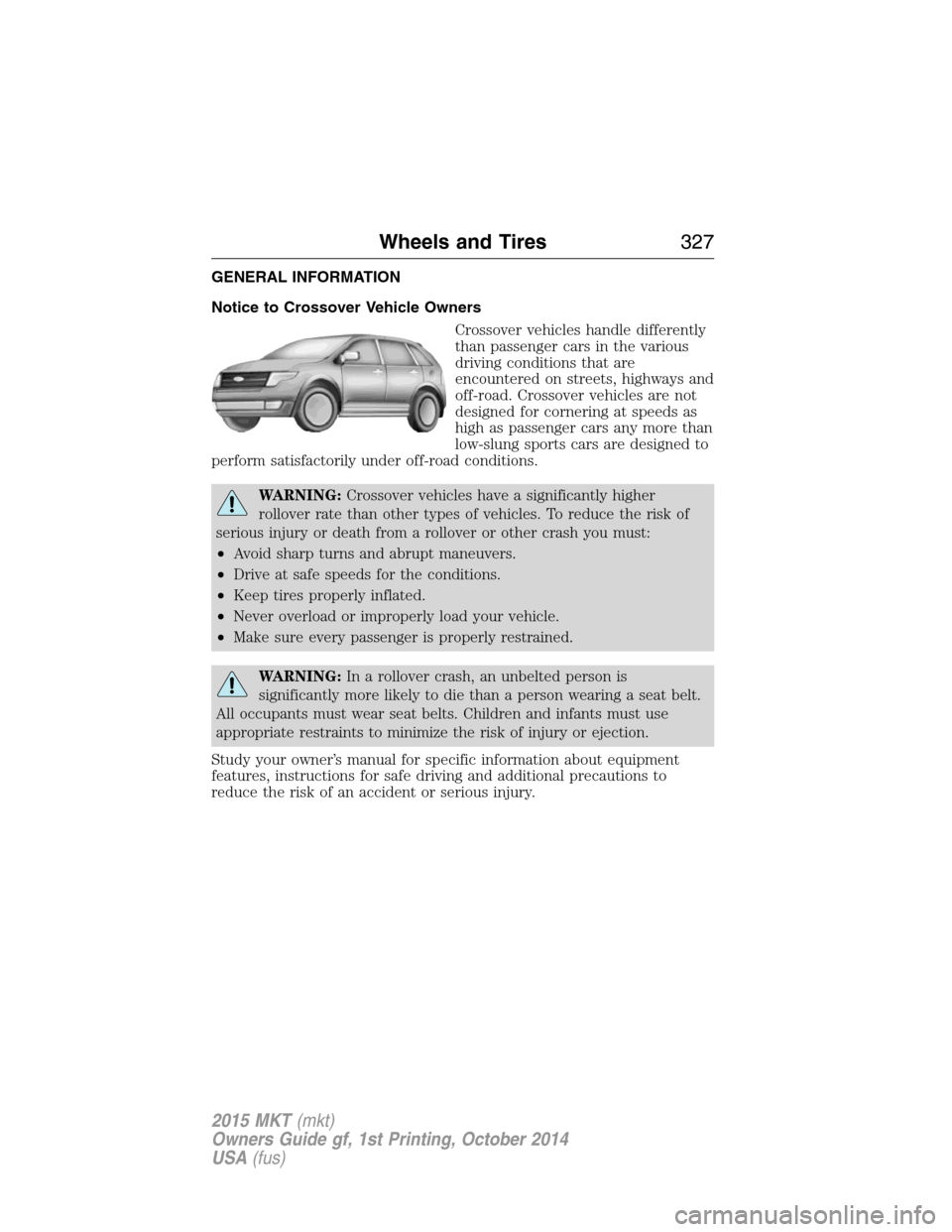
Notice to Crossover Vehicle Owners
Crossover vehicles handle differently
than passenger cars in the various
driving conditions that are
encountered on streets, highways and
off-road. Crossover vehicles are not
designed for cornering at speeds as
high as passenger cars any more than
low-slung sports cars are designed to
perform satisfactorily under off-road conditions.
WARNING:Crossover vehicles have a significantly higher
rollover rate than other types of vehicles. To reduce the risk of
serious injury or death from a rollover or other crash you must:
•Avoid sharp turns and abrupt maneuvers.
•Drive at safe speeds for the conditions.
•Keep tires properly inflated.
•Never overload or improperly load your vehicle.
•Make sure every passenger is properly restrained.
WARNING:In a rollover crash, an unbelted person is
significantly more likely to die than a person wearing a seat belt.
All occupants must wear seat belts. Children and infants must use
appropriate restraints to minimize the risk of injury or ejection.
Study your owner’s manual for specific information about equipment
features, instructions for safe driving and additional precautions to
reduce the risk of an accident or serious injury.
Wheels and Tires327
2015 MKT(mkt)
Owners Guide gf, 1st Printing, October 2014
USA(fus)
Page 494 of 500

911 Assist™ ..............................427
A
ABS (see Brakes) .....................200
Accessing and using your
USB port ....................................405
Accessing your calendar ..........426
Accessory delay ........................103
Active Park Assist .....................206
Adaptive Cruise Control ...........216
Adding (pairing) a phone ........413
Airbag supplemental restraint
system ..........................................52
and child safety seats ..............53
description ................................52
disposal ......................................62
driver airbag ..............................52
passenger airbag .......................52
side airbag ...........................52, 57
Air cleaner filter .......310–311, 365
Air filter, cabin ..........................136
All Wheel Drive (AWD),
driving off road .........................192
Ambient mood/lighting .............433
AM/FM .......................................392
Antifreeze
(see Engine coolant) ................296
Anti-lock brake system
(see Brakes) ..............................200
Anti-theft system ..................83, 85
arming the system ..............83, 85
disarming a triggered system ..85
Audio system
Single CD ................................375
Audio system (see Radio) .......375Automatic transmission
driving an automatic
overdrive .................................187
fluid, adding ....................301–302
fluid, checking ................301–302
fluid, refill capacities ..............361
fluid, specification ..................361
Selectshift (SST) ....................188
Auxiliary Input Jack .................401
Auxiliary powerpoint ................165
A/V inputs ..........................377, 409
B
Battery .......................................307
acid, treating emergencies .....307
jumping a disabled battery ....268
maintenance-free ....................307
replacement, specifications ...365
servicing ..................................307
Blind Spot Information
System .......................................231
Booster seats ...............................32
Brakes ........................................199
anti-lock ...................................200
anti-lock brake system (ABS)
warning light ...........................200
brake warning light ................200
fluid, checking and adding ....306
fluid, refill capacities ..............361
fluid, specifications .................361
lubricant specifications ..........361
parking ....................................200
shift interlock ..........................190
trailer .......................................256
C
Capacities for refilling fluids ....361
Cargo area shade ......................243
Index493
2015 MKT(mkt)
Owners Guide gf, 1st Printing, October 2014
USA(fus)
Page 495 of 500

Cargo net ...................................243
CD ..............................................375
CD player ..........................373, 403
CD voice commands .................404
Cell phone use ............................15
Changing a tire .........................350
Child safety restraints ..........24, 27
Child safety seats
automatic locking mode
(retractor) .................................41
LATCH .......................................24
Child safety seats -
booster seats ...............................32
Cleaning the touchscreen ........381
Cleaning your vehicle ...............317
engine compartment ..............319
instrument panel ....................321
interior .....................................321
plastic parts ............................318
washing ....................................317
waxing .....................................319
wheels ......................................323
wiper blades ............................320
Climate voice commands .........445
Clock ..................................375, 431
Collision Warning System .........236
Console ......................................168
overhead ..................................170
rear ..........................................168
Coolant ......................................296
checking and adding ..............296
refill capacities ........................361
specifications ..........................361
Cooler ........................................169
Cross Traffic Alert ....................231
Cruise control ...........................215Cupholder(s) .............................151
Customer Assistance ................265
Ford Extended Service
Plan ..........................................370
Getting roadside assistance ...265
Getting the service you
need .........................................271
Ordering additional owner’s
literature .................................277
Utilizing the
Mediation/Arbitration
Program ...................................275
D
Defrost .......................................132
rear window ............................136
Dipstick
automatic transmission
fluid ..................................301–302
engine oil .................................295
Display settings .........................432
Drivebelt ....................................360
Driver alert ................................225
Driving under special
conditions ..................191, 193, 196
sand .........................................194
snow and ice ...........................197
through water .................195, 263
Dual automatic temperature
control (DATC) .........................132
E
Electronic message center .......116
Electronic stability control ......203
Emergencies, roadside
jump-starting ..........................268
running out of fuel .................179
494Index
2015 MKT(mkt)
Owners Guide gf, 1st Printing, October 2014
USA(fus)
Page 498 of 500

P
Pairing other phones ................413
Pairing your phone ...................412
Pairing your phone for the
first time ....................................412
Parental MyKey programming ...69
Park Assist ................................206
Parking brake ............................200
Parts
(see Motorcraft® parts) ..........365
Passenger Occupant
Classification Sensor ...................54
Phone settings ..................416, 439
Phone voice commands ............417
POI categories ...........................448
Point of Interest (POI) .............448
Power distribution box
(see Fuses) ...............................280
Power door locks ........................73
Power liftgate ..............................77
Power mirrors ...........................104
Powerpoint ................................165
Power steering ..........................241
fluid, checking and adding ....306
fluid, refill capacity ................361
fluid, specifications .................361
Power Windows .........................102
Privacy information ..................384
Push button start system .........171
Q
Quick touch buttons .................455R
Radio ..........................................375
AM/FM .....................................392
Single CD ................................375
Radio reception .........................373
Radio voice commands .............397
Rear heated/cooled seats .........146
Rear seat controls
(if equipped) .............................376
Rear view camera
display ................................210, 434
Rear window defroster .............132
Receiving a text message .........416
Recommendations for
attaching safety restraints for
children ........................................19
Refrigerator ...............................169
Relays ................................279–280
Remote entry system
illuminated entry ......................76
locking/unlocking doors ...........73
replacing the batteries .............64
Remote start climate
operation ...................................137
Reverse sensing system ...........205
Roadside assistance ..................265
Route preferences ....................450
S
Safety Belt Maintenance ............48
Safety belts
(see Safety restraints) .........39, 43
Safety defects, reporting ..........278
Safety information ....................382
Index497
2015 MKT(mkt)
Owners Guide gf, 1st Printing, October 2014
USA(fus)