Page 445 of 500
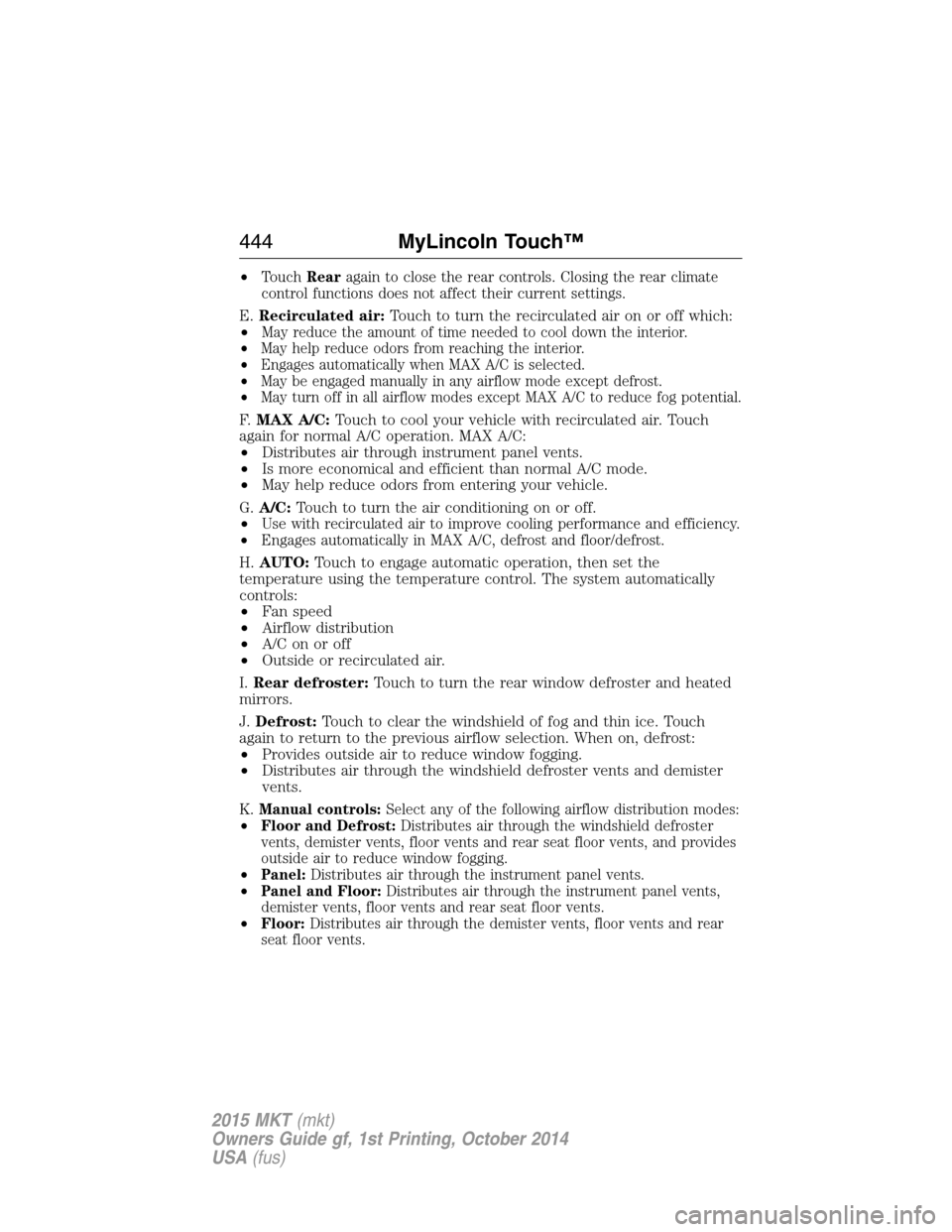
•TouchRearagain to close the rear controls. Closing the rear climate
control functions does not affect their current settings.
E.Recirculated air:Touch to turn the recirculated air on or off which:
•
May reduce the amount of time needed to cool down the interior.
•May help reduce odors from reaching the interior.
•Engages automatically when MAX A/C is selected.
•May be engaged manually in any airflow mode except defrost.
•May turn off in all airflow modes except MAX A/C to reduce fog potential.
F.MAX A/C:Touch to cool your vehicle with recirculated air. Touch
again for normal A/C operation. MAX A/C:
•Distributes air through instrument panel vents.
•Is more economical and efficient than normal A/C mode.
•May help reduce odors from entering your vehicle.
G.A/C:Touch to turn the air conditioning on or off.
•
Use with recirculated air to improve cooling performance and efficiency.
•Engages automatically in MAX A/C, defrost and floor/defrost.
H.AUTO:Touch to engage automatic operation, then set the
temperature using the temperature control. The system automatically
controls:
•Fan speed
•Airflow distribution
•A/Conoroff
•Outside or recirculated air.
I.Rear defroster:Touch to turn the rear window defroster and heated
mirrors.
J.Defrost:Touch to clear the windshield of fog and thin ice. Touch
again to return to the previous airflow selection. When on, defrost:
•Provides outside air to reduce window fogging.
•Distributes air through the windshield defroster vents and demister
vents.
K.
Manual controls:Select any of the following airflow distribution modes:
•Floor and Defrost:Distributes air through the windshield defroster
vents, demister vents, floor vents and rear seat floor vents, and provides
outside air to reduce window fogging.
•Panel:Distributes air through the instrument panel vents.
•Panel and Floor:Distributes air through the instrument panel vents,
demister vents, floor vents and rear seat floor vents.
•Floor:Distributes air through the demister vents, floor vents and rear
seat floor vents.
444MyLincoln Touch™
2015 MKT(mkt)
Owners Guide gf, 1st Printing, October 2014
USA(fus)
Page 479 of 500

Oils, Fluids and Flushing
In many cases, fluid discoloration is a normal operating characteristic
and, by itself, does not necessarily indicate a concern or that the fluid
needs to be changed. However, discolored fluids that also show signs of
overheating and foreign material contamination should be inspected
immediately by a qualified expert, such as the factory-trained technicians
at your dealership. Your vehicle’s oils and fluids should be changed at the
specified intervals or in conjunction with a repair. Flushing is a viable
way to change fluid for many vehicle sub-systems during scheduled
maintenance. It is critical that systems are flushed only with new fluid
that is the same as that required to fill and operate the system, or using
a Ford-approved flushing chemical.
Owner Checks and Services
Certain basic maintenance checks and inspections should be performed
every month or at six month intervals.
Check every month
Engine oil level.
Function of all interior and exterior lights.
Tires (including spare) for wear and proper pressure.
Windshield washer fluid level.
Check every six months
Battery connections. Clean if necessary.
Body and door drain holes for obstructions. Clean if necessary.
Cooling system fluid level and coolant strength.
Door weatherstrips for wear. Lubricate if necessary.
Hinges, latches and outside locks for proper operation. Lubricate if
necessary.
Parking brake for proper operation.
Safety belts and seat latches for wear and function.
Safety warning lamps (brake, ABS, airbag, safety belt) for operation.
Washer spray and wiper operation. Clean or replace blades as
necessary.
478Scheduled Maintenance
2015 MKT(mkt)
Owners Guide gf, 1st Printing, October 2014
USA(fus)
Page 483 of 500
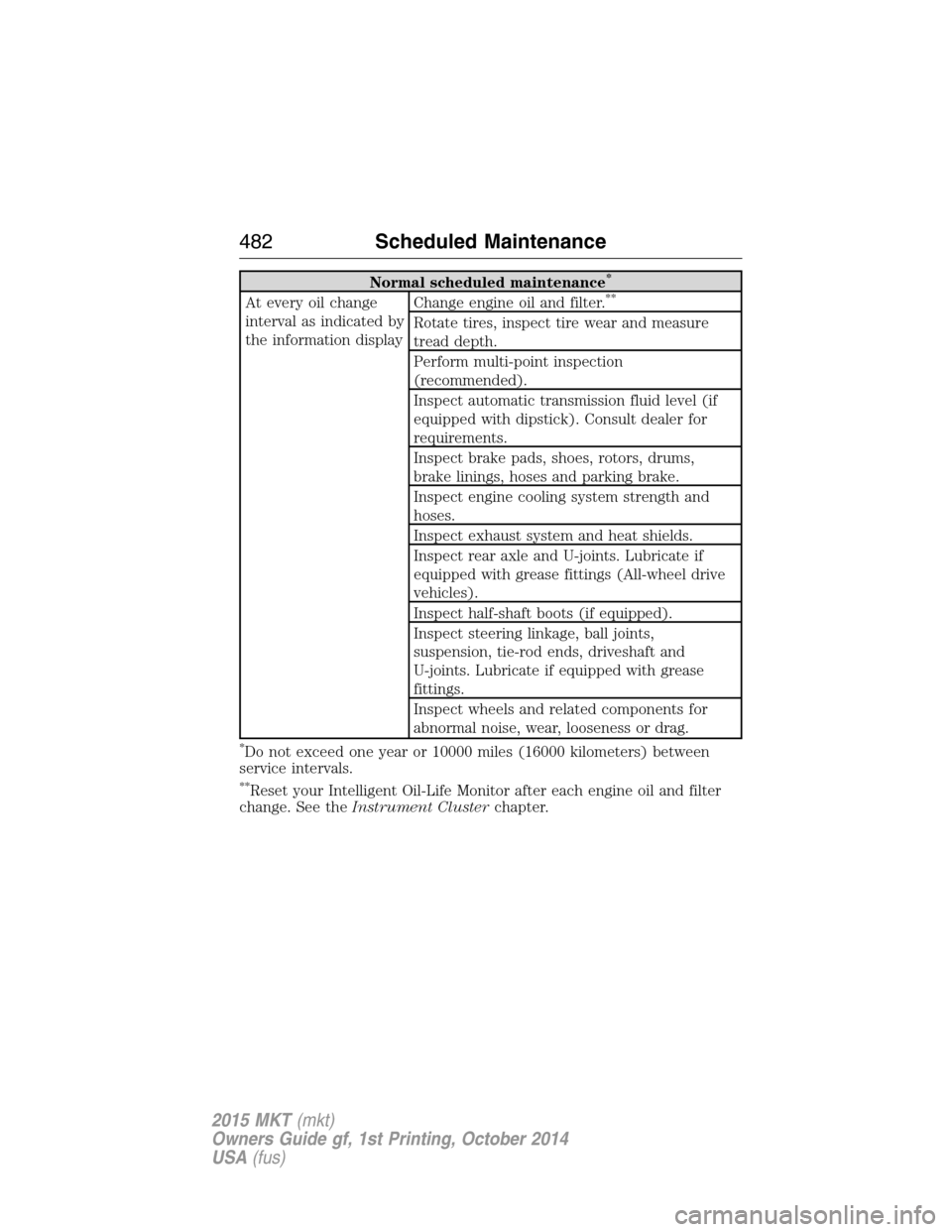
Normal scheduled maintenance*
At every oil change
interval as indicated by
the information displayChange engine oil and filter.**
Rotate tires, inspect tire wear and measure
tread depth.
Perform multi-point inspection
(recommended).
Inspect automatic transmission fluid level (if
equipped with dipstick). Consult dealer for
requirements.
Inspect brake pads, shoes, rotors, drums,
brake linings, hoses and parking brake.
Inspect engine cooling system strength and
hoses.
Inspect exhaust system and heat shields.
Inspect rear axle and U-joints. Lubricate if
equipped with grease fittings (All-wheel drive
vehicles).
Inspect half-shaft boots (if equipped).
Inspect steering linkage, ball joints,
suspension, tie-rod ends, driveshaft and
U-joints. Lubricate if equipped with grease
fittings.
Inspect wheels and related components for
abnormal noise, wear, looseness or drag.
*Do not exceed one year or 10000 miles (16000 kilometers) between
service intervals.
**Reset your Intelligent Oil-Life Monitor after each engine oil and filter
change. See theInstrument Clusterchapter.
482Scheduled Maintenance
2015 MKT(mkt)
Owners Guide gf, 1st Printing, October 2014
USA(fus)
Page 496 of 500

Emergency brake
(see Parking brake) ..................200
Emission control system ..........183
End user license agreement ....458
Engine ................................359–360
cleaning ...................................319
coolant .....................................296
fail-safe cooling .......................300
idle speed control ...................307
lubrication specifications .......361
refill capacities ........................361
service points ..................292, 294
Engine block heater .................175
Engine oil
checking and adding ..............295
dipstick ....................................295
filter, specifications ................365
refill capacities ........................361
specifications ..........................361
Event data recording ..................12
Exhaust fumes ..........................175
F
Fail safe cooling ........................300
Fleet MyKey programming ........69
Floor mats .................................263
Fluid capacities .........................361
Four-Wheel Drive vehicles
driving off road .......................193
Freezer ......................................169
Fuel
cap ...........................................181
capacity ...................................361
choosing the right fuel ...........178
filler funnel .............................179
filling your vehicle with fuel ..181
filter, specifications ........306, 365fuel pump shut-off ..................267
octane rating ...........179, 359–360
quality ......................................178
running out of fuel .................179
safety information relating to
automotive fuels .....................177
Fuses ..................................279–280
G
Garage door opener ..................160
Gas cap (see Fuel cap) ............181
Gauges .......................................110
H
Hazard flashers .........................267
HD Radio™ ...............................393
Headlamps
aiming ......................................312
bulb specifications ..................315
flash to pass ..............................93
high beam ...........................93, 96
replacing bulbs .......................314
Head restraints .........................139
Heated steering wheel ..............443
Heating ......................................132
Help ............................................442
Homelink wireless control
system ........................................160
Hood ..........................................290
How to use voice commands ...387
I
Ignition ...............................359–360
Illuminated visor mirror ...........107
Information displays .................116
Index495
2015 MKT(mkt)
Owners Guide gf, 1st Printing, October 2014
USA(fus)
Page:
< prev 1-8 9-16 17-24