2015 LINCOLN MKS engine oil
[x] Cancel search: engine oilPage 298 of 424

Ford part number / Ford specification
Recommended fluids and
lubricants
Capacity
Item
XO-5W20-QSP or XO-5W20-QFS (U.S.)/ WSS-M2C945-A
Motorcraft SAE 5W-20
Premium Synthetic Blend Motor Oil or Motorcraft SAE 5W-20 Full Synthetic Motor Oil
6.0 qt (5.7 L)
3.7L engine oil
CXO-5W20-LSP12 or CXO-5W20-LFS12
(Canada) / WSS-M2C945-A
VC-3DIL-B (U.S.) / WSS-M97B44-D2
Motorcraft Orange Antifreeze/
Coolant Prediluted
11.4 qt (10.8 L)
3.5L EcoBoost engine coolant 2
CVC-3DIL-B (Canada) / WSS-M97B44-
D2
VC-3DIL-B (U.S.) / WSS-M97B44-D2
Motorcraft Orange Antifreeze/
Coolant Prediluted
11.1 qt (10.5 L)
3.7L engine coolant 2
CVC-3DIL-B (Canada) / WSS-M97B44-
D2
XY-80W90-QL (U.S.) / WSP-M2C197-A
Motorcraft SAE 80W-90
Premium Rear Axle Lubricant
2.4 pt (1.15L)
Rear differential (AWD) fluid
CXY-80W90-1L (Canada) / WSP-M2C197-
A
XY-75W140-QL / WSP-M2C197-A
Motorcraft SAE 75W-140
Synthetic Rear Axle Lubricant
18 fl oz (0.53 L)
Power Transfer Unit (PTU)
fluid (AWD) 3
XT-10-QLVC (U.S.);
Motorcraft MERCON LV
11.6 qt (11 L)
3.5L EcoBoost engine
CXT-10-LV12 (Canada) / MERCON LV
Automatic transmission fluid
4,5
10.9 qt (10.3 L)
3.7L engine
295
MKS (), enUSA Capacities and Specifications
Page 299 of 424

Ford part number / Ford specification
Recommended fluids and
lubricants
Capacity
Item
Automatic transmission fluid 4,5
ZC-32-B2 (U.S.) / WSS-M14P19-A
Motorcraft Premium Windshield
Wash Concentrate with Bitterant (U.S.)
Fill as required
Windshield washer fluid
CXC-37-(A, B, D, and F) (Canada) / WSS-M14P19-A
Premium Quality Windshield
Washer Fluid (Canada)
—
—
19.0 gal (71.9 L)
Fuel tank
YN-19 (U.S.) / WSH-M17B19-A
Motorcraft R-134a Refrigerant
1.63 lb (0.74 kg)
3.5L EcoBoost Engine A/C
refrigerant CYN-16-R (Canada) / WSH-M17B19-A
YN-19 (U.S.) / WSH-M17B19-A
Motorcraft R-134a Refrigerant
1.43 lb (0.65 kg)
3.7L Engine A/C refrigerant
CYN-16-R (Canada) / WSH-M17B19-A
YN-12-D /
Motorcraft PAG Refrigerant
Compressor Oil
5.2 fl oz (153.8 ml)
A/C refrigerant compressor oil
296
MKS (), enUSA Capacities and Specifications
Page 300 of 424

Ford part number / Ford specification
Recommended fluids and
lubricants
Capacity
Item
WSH-M1C231-B
1 Ford recommends using DOT 4 Low Viscosity (LV) High Performance Brake Fluid or equivalent meeting WSS-M6C65-A2. Use of any fluid
other than the recommended fluid may cause degraded brake performance and not meet the Ford performance standards. Keep brake fluid
clean and dry. Contamination with dirt, water, petroleum products or other materials may result in brake system damage and possible failure.
2 Add the coolant type originally equipped in your vehicle.
3 Contact an authorized dealer for fluid level checking or filling.
4 Make sure the correct automatic transmission fluid is used. Transmission fluid requirements are indicated on the dipstick blade or the dipstick
handle. Before adding, check the container to verify the fluid is of the correct type. Refer to your scheduled maintenance information to
determine the correct service interval.
Note: Automatic transmissions that require MERCON LV should only use MERCON LV fluid. Use of any fluid other than the recommended fluid
may cause transmission damage.
5 Indicates only approximate dry-fill capacity. Some applications may vary based on cooler size and if equipped with an in-tank cooler. Use the
indication on the dipstick, showing the normal operating range, to determine the amount of transmission fluid and the fluid level.
Use of synthetic or synthetic blend motor oil is not mandatory. Only use fluid that meets Ford specifications. Motor oils of the recommended
viscosity grade that meet API SN requirements and display the API Certification Mark for gasoline engines are also acceptable. Do not use oil
labeled with API SN service category unless the label also displays the API certification mark.
Do not use supplemental engine oil additives because they are unnecessary and could lead to engine damage that may not be covered by
your vehicle warranty.
An oil that displays this symbol conforms to current engine, emission system and fuel economy performance standards of the International
Lubricant Standardization and Approval Committee (ILSAC):
297
MKS (), enUSA Capacities and Specifications
Page 396 of 424

When the oil change message appears in the
information display, it is time for an oil
change. Make sure you perform the oil change
within two weeks or 500 miles (800
kilometers) of the message appearing. Make
sure you reset the Intelligent Oil-Life Monitor
after each oil change. See General
Information (page 88).
If your information display resets prematurely
or becomes inoperative, you should perform
the oil change interval at six months or 5000
miles (8000 kilometers) from your last oil
change. Never exceed one year or 10000
miles (16000 kilometers) between oil change
intervals.
Your vehicle is very sophisticated and built
with multiple, complex, performance
systems. Every manufacturer develops these
systems using different specifications and
performance features. That is why it is
important to rely upon your dealership to
properly diagnose and repair your vehicle. Ford Motor Company has recommended
maintenance intervals for various parts and
component systems based upon engineering
testing. Ford Motor Company relies upon this
testing to determine the most appropriate
mileage for replacement of oils and fluids to
protect your vehicle at the lowest overall cost
to you and recommends against
maintenance schedules that deviate from
the scheduled maintenance information.
We strongly recommend the use of only
genuine Ford, Motorcraft or Ford-authorized
re-manufactured replacement parts
engineered for your vehicle.
Additives and Chemicals
This owner's manual and the Ford Workshop
Manual list the recommended additives and
chemicals for your vehicle. We do not
recommend using chemicals or additives not
approved by us as part of your vehicle
’s
normal maintenance. Please consult your
warranty information. Oils, Fluids and Flushing
In many cases, fluid discoloration is a normal
operating characteristic and, by itself, does
not necessarily indicate a concern or that the
fluid needs to be changed. However, a
qualified expert, such as the factory-trained
technicians at your dealership, should inspect
discolored fluids that also show signs of
overheating or foreign material
contamination immediately.
Make sure to change your vehicle
’s oils and
fluids at the specified intervals or in
conjunction with a repair. Flushing is a viable
way to change fluid for many vehicle
sub-systems during scheduled maintenance.
It is critical that systems are flushed only with
new fluid that is the same as that required to
fill and operate the system or using a
Ford-approved flushing chemical.
Owner Checks and Services
Make sure you perform the following basic
maintenance checks and inspections every
month or at six-month intervals.
393
MKS (), enUSA Scheduled Maintenance
Page 397 of 424

Check every month
Engine oil level.
Function of all interior and exterior lights.
Tires (including spare) for wear and proper pressure. Windshield washer fluid level. Check every six months
Battery connections. Clean if necessary.
Body and door drain holes for obstructions. Clean if necessary. Cooling system fluid level and coolant strength.
Door weatherstrips for wear. Lubricate if necessary.
Hinges, latches and outside locks for proper operation. Lubricate if necessary. Parking brake for proper operation.
Safety belts and seat latches for wear and function.
Safety warning lamps (brake, ABS, airbag and safety belt) for operation.
Washer spray and wiper operation. Clean or replace blades as necessary.
394
MKS (), enUSA Scheduled Maintenance
Page 398 of 424
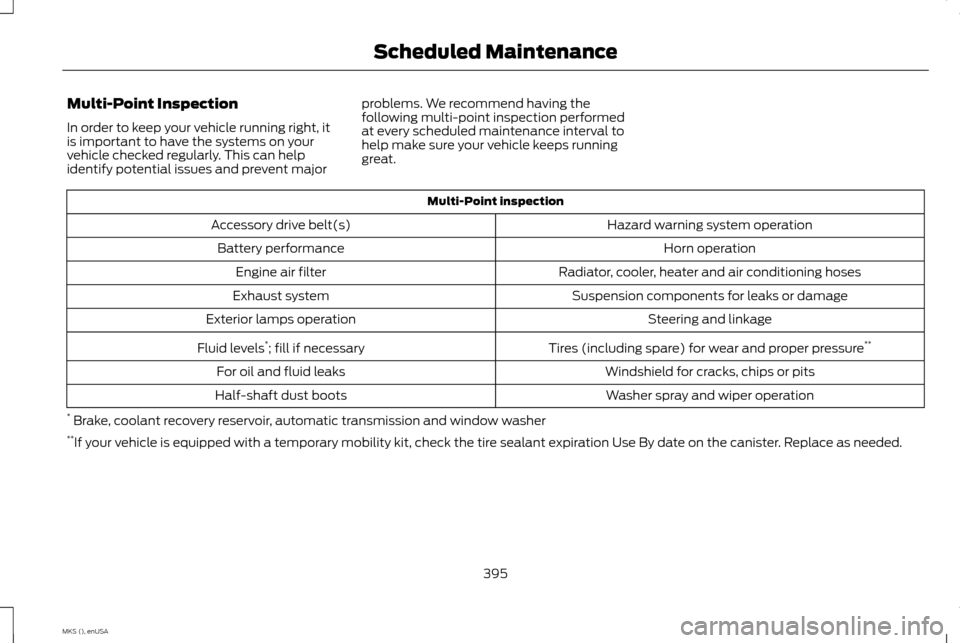
Multi-Point Inspection
In order to keep your vehicle running right, it
is important to have the systems on your
vehicle checked regularly. This can help
identify potential issues and prevent major
problems. We recommend having the
following multi-point inspection performed
at every scheduled maintenance interval to
help make sure your vehicle keeps running
great. Multi-Point inspection
Hazard warning system operation
Accessory drive belt(s)
Horn operation
Battery performance
Radiator, cooler, heater and air conditioning hoses
Engine air filter
Suspension components for leaks or damage
Exhaust system
Steering and linkage
Exterior lamps operation
Tires (including spare) for wear and proper pressure**
Fluid levels *
; fill if necessary
Windshield for cracks, chips or pits
For oil and fluid leaks
Washer spray and wiper operation
Half-shaft dust boots
* Brake, coolant recovery reservoir, automatic transmission and window washer
** If your vehicle is equipped with a temporary mobility kit, check the tire sealant expiration Use By date on the canister. Replace as needed.
395
MKS (), enUSA Scheduled Maintenance
Page 399 of 424

Be sure to ask your dealership service advisor
or technician about the multi-point vehicle
inspection. It is a comprehensive way to
perform a thorough inspection of your vehicle.
Your checklist gives you immediate feedback
on the overall condition of your vehicle.
NORMAL SCHEDULED
MAINTENANCE
Intelligent Oil-Life Monitor®
Your vehicle is equipped with an Intelligent
Oil-Life Monitor that determines when you
should change the engine oil based on how
your vehicle is used. By using several
important factors in its calculations, the
monitor helps reduce the cost of owning your
vehicle and reduces environmental waste at
the same time.This means you do not have to remember to
change the oil on a mileage-based schedule.
Your vehicle lets you know when an oil
change is due by displaying ENGINE OIL
CHANGE DUE or OIL CHANGE REQUIRED
in the information display.
The following table provides examples of
vehicle use and its impact on oil change
intervals. It is a guideline only. Actual oil
change intervals depend on several factors
and generally decrease with severity of use. When to expect the OIL CHANGE REQUIRED message
Vehicle use and example
Interval
Normal
7500-10000 miles
(12000-16000 km) Normal commuting with highway driving
No, or moderate, load or towing
Flat to moderately hilly roads
No extended idling
Severe
5000-7499 miles
(8000-11999 km) Moderate to heavy load or towing
Mountainous or off-road conditions
Extended idling
396
MKS (), enUSA Scheduled Maintenance
Page 400 of 424

When to expect the OIL CHANGE REQUIRED message
Vehicle use and example
Interval
Extended hot or cold operation Extreme
3000-4999 miles
(4800-7999 km) Maximum load or towing
Extreme hot or cold operation
Maintenance Intervals At every oil change interval as indicated by the information display
*
Change engine oil and filter. **
Rotate the tires.
Perform a multi-point inspection (recommended).
Inspect the automatic transmission fluid level. Consult your dealer for requirements.
Inspect the brake pads, shoes, rotors, drums, brake linings, hoses and parking brake.
Inspect the engine cooling system strength and hoses.
Inspect the exhaust system and heat shields.
Inspect the rear axle and U-joints. Lubricate any areas with grease fittings (All-wheel drive vehicles).
Inspect the half-shaft boots.
397
MKS (), enUSA Scheduled Maintenance