Page 279 of 424

U.S. DOT Tire Identification
Number
Both U.S. and Canada Federal
regulations require tire
manufacturers to place
standardized information on the
sidewall of all tires. This information
identifies and describes the
fundamental characteristics of the
tire and also provides a U.S. DOT
Tire Identification Number for safety
standard certification and in case of
a recall.
This begins with the letters DOT and
indicates that the tire meets all
federal standards. The next two
numbers or letters are the plant
code designating where it was
manufactured, the next two are the
tire size code and the last four
numbers represent the week and
year the tire was built. For example,
the numbers 317 mean the 31st week
of 1997. After 2000 the numbers go
to four digits. For example, 2501
means the 25th week of 2001. The
numbers in between are
identification codes used for
traceability. This information is used
to contact customers if a tire defect
requires a recall.
Tire Replacement Requirements
Your vehicle is equipped with tires
designed to provide a safe ride and
handling capability.
WARNINGS
Only use replacement tires and
wheels that are the same size,
load index, speed rating and type
(such as P-metric versus LT-metric
or all-season versus all-terrain) as
those originally provided by Ford.
The recommended tire and wheel
size may be found on either the
Safety Compliance Certification
Label (affixed to either the door
hinge pillar, door-latch post, or the
door edge that meets the door-latch
post, next to the driver's seating
position), or the Tire Label which is WARNINGS
located on the B-Pillar or edge of
the driver ’s door. If this information
is not found on these labels then
you should contact your authorized
dealer as soon as possible. Use of
any tire or wheel not recommended
by Ford can affect the safety and
performance of your vehicle, which
could result in an increased risk of
loss of vehicle control, vehicle
rollover, personal injury and death.
Additionally the use of
non-recommended tires and wheels
could cause steering, suspension,
axle, transfer case or power transfer
unit failure. If you have questions
regarding tire replacement, contact
your authorized dealer as soon as
possible.
276
MKS (), enUSA Wheels and Tires
Page 281 of 424

WARNINGS
Do not spin the wheels at over
35 mph (56 km/h). The tires
may fail and injure a passenger or
bystander. Driving habits have a great deal to
do with your tire mileage and safety.
•
Observe posted speed limits
• Avoid fast starts, stops and turns
• Avoid potholes and objects on
the road
• Do not run over curbs or hit the
tire against a curb when parking
Highway Hazards
No matter how carefully you drive
there is always the possibility that
you may eventually have a flat tire
on the highway. Drive slowly to the
closest safe area out of traffic. This
may further damage the flat tire, but
your safety is more important. If you feel a sudden vibration or ride
disturbance while driving, or you
suspect your tire or vehicle has been
damaged, immediately reduce your
speed. Drive with caution until you
can safely pull off the road. Stop
and inspect the tires for damage. If
a tire is under-inflated or damaged,
deflate it, remove the wheel and
replace it with your spare tire and
wheel (if provided). If you cannot
detect a cause, have the vehicle
towed to the nearest repair facility
or tire dealer to have the vehicle
inspected.
Tire and Wheel Alignment
A bad jolt from hitting a curb or
pothole can cause the front end of
your vehicle to become misaligned
or cause damage to your tires. If
your vehicle seems to pull to one
side when you’re driving, the wheels
may be out of alignment. Have an
authorized dealer check the wheel
alignment periodically.Wheel misalignment in the front or
the rear can cause uneven and rapid
treadwear of your tires and should
be corrected by an authorized
dealer. Front-wheel drive vehicles
and those with an independent rear
suspension (if equipped) may
require alignment of all four wheels.
The tires should also be balanced
periodically. An unbalanced tire and
wheel assembly may result in
irregular tire wear.
Tire Rotation
Note:
If your tires show uneven wear
ask an authorized dealer to check for
and correct any wheel misalignment,
tire imbalance or mechanical
problem involved before tire rotation.
278
MKS (), enUSA Wheels and Tires
Page 398 of 424
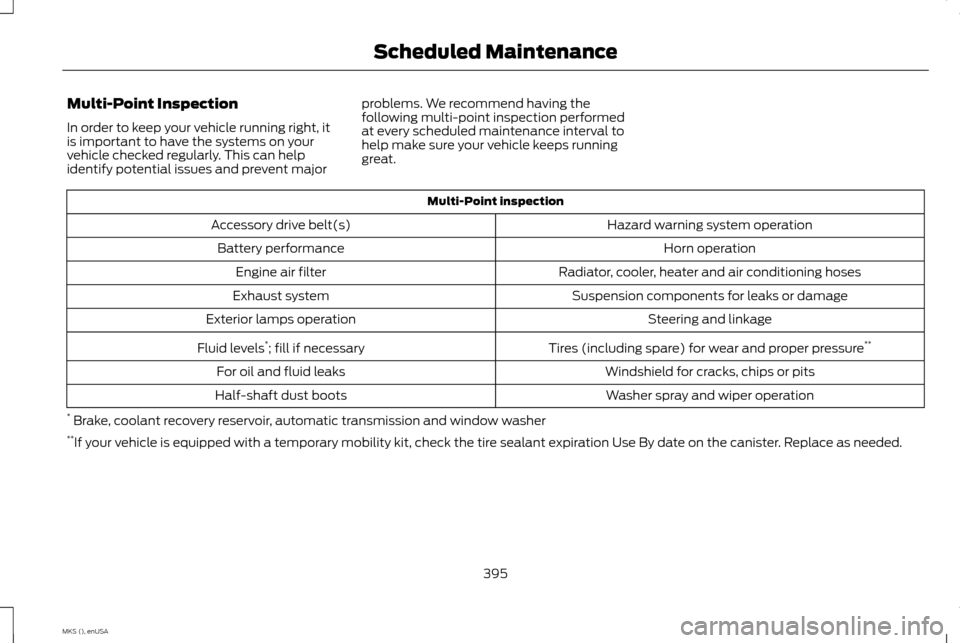
Multi-Point Inspection
In order to keep your vehicle running right, it
is important to have the systems on your
vehicle checked regularly. This can help
identify potential issues and prevent major
problems. We recommend having the
following multi-point inspection performed
at every scheduled maintenance interval to
help make sure your vehicle keeps running
great. Multi-Point inspection
Hazard warning system operation
Accessory drive belt(s)
Horn operation
Battery performance
Radiator, cooler, heater and air conditioning hoses
Engine air filter
Suspension components for leaks or damage
Exhaust system
Steering and linkage
Exterior lamps operation
Tires (including spare) for wear and proper pressure**
Fluid levels *
; fill if necessary
Windshield for cracks, chips or pits
For oil and fluid leaks
Washer spray and wiper operation
Half-shaft dust boots
* Brake, coolant recovery reservoir, automatic transmission and window washer
** If your vehicle is equipped with a temporary mobility kit, check the tire sealant expiration Use By date on the canister. Replace as needed.
395
MKS (), enUSA Scheduled Maintenance
Page 401 of 424
At every oil change interval as indicated by the information display
*
Inspect the steering linkage, ball joints, suspension, tire-rod ends, driveshaft and U-joints. Lubricate any areas with grease fittings (All-wheel
drive vehicles).
Inspect the tires, tire wear and measure the tread depth.
Inspect the wheels and related components for abnormal noise, wear, looseness or drag.
* Do not exceed one year or 10000 miles (16000 kilometers) between service intervals.
** Reset the Intelligent Oil-Life Monitor after engine oil and filter changes. See Engine Oil Check (page 239). Other maintenance items
1
Replace cabin air filter.
Every 20000 miles (32000
km)
Replace engine air filter.
Every 30000 miles (48000
km)
Change engine coolant.2
At 100000 miles (160000
km)
Replace spark plugs.
Every 100000 miles
(160000 km) Inspect accessory drive belt(s). 3
398
MKS (), enUSA Scheduled Maintenance
