Page 311 of 878

3112-5. Driving information
2
When driving Trailer Tongue Weight
● A recommended tongue weight varies in accordance with the types of
trailers or towing as described below.
● To ensure the recommended values shown below, the trailer must be
loaded by referring to the following instructions.
• Tongue Weight
The gross trailer weight should be distributed so that the tongue
weight is 9% to 11%. (Tongue weight /Gross trailer weight x 100 =
9% to 11%)
Gross trailer weight
Tongue weight
If using a weight distri buting hitch when towing , return the front axle
to the same weight as before the trailer connection.
If front axle weight cannot be mea sured directly, measure the front
fender height above the front axle before connection. Adjust weight
distributing hitch torque until fr ont fender is returned to the same
height as before connection.
The gross trailer weight, gross axle weight and tongue weight can be
measured with platform scales foun d at a highway weighing station,
building supply company, truck ing company, junk yard, etc.
Page 319 of 878
3192-5. Driving information
2
When driving ■
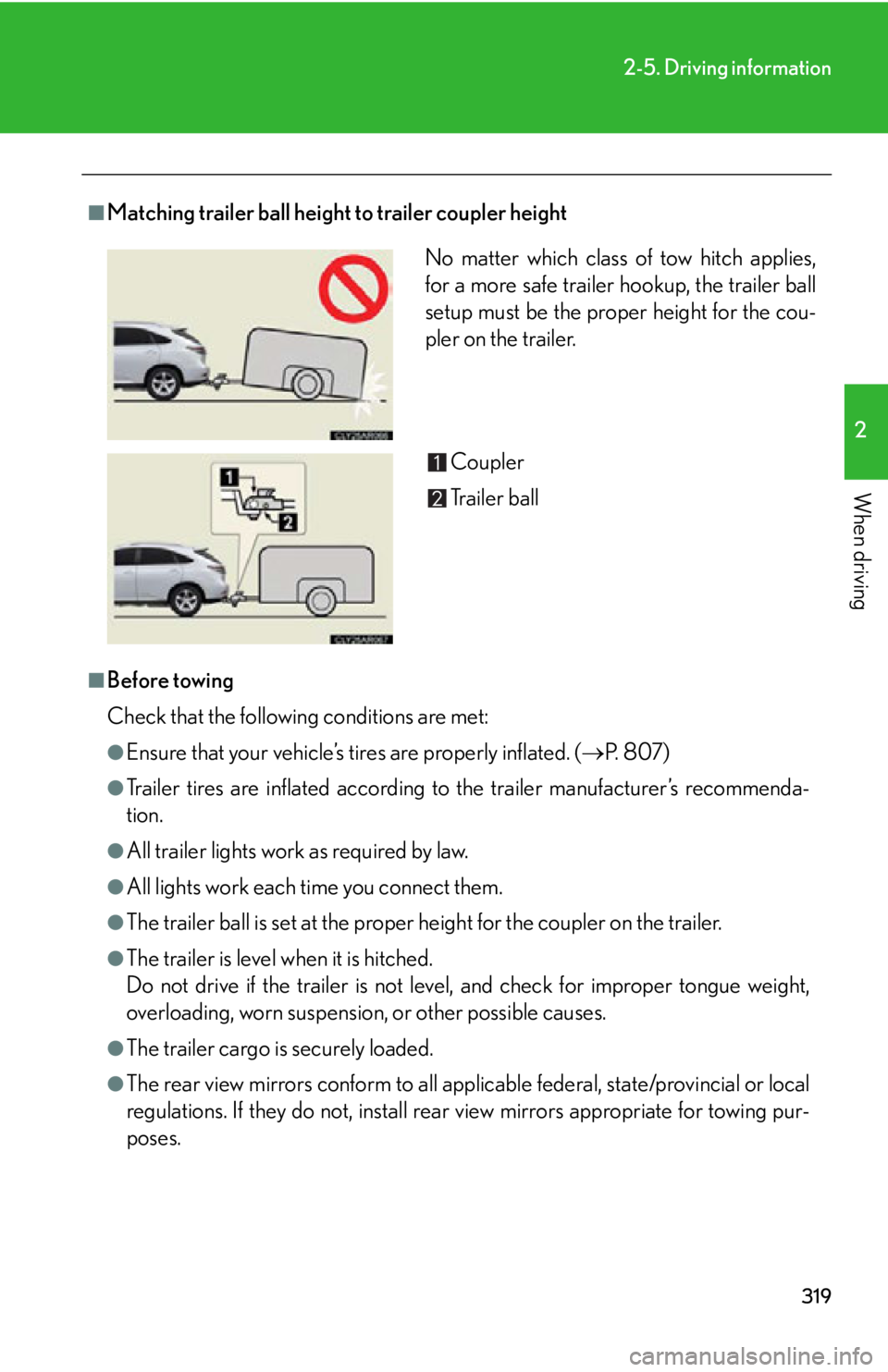
Matching trailer ball height to trailer coupler height
■
Before towing
Check that the following conditions are met: ●
Ensure that your vehicle’s ti res are properly inflated. ( P. 8 0 7 )●
Trailer tires are inflated according to the trailer manufacturer’s recommenda-
tion.●
All trailer lights work as required by law.●
All lights work each time you connect them.●
The trailer ball is set at the proper height for the coupler on the trailer.●
The trailer is level when it is hitched.
Do not drive if the trailer is not level, and check for improper tongue weight,
overloading, worn suspension , or other possible causes.
●
The trailer cargo is securely loaded.
●
The rear view mirrors conform to all applicable federal, state/provincial or local
regulations. If they do not, install rear view mirrors appropriate for towing pur-
poses. No matter which class of tow hitch applies,
for a more safe trailer hookup, the trailer ball
setup must be the proper height for the cou-
pler on the trailer.
Coupler
Trailer ball
Page 591 of 878
5913-6. Using the storage features
3
Interior features ■
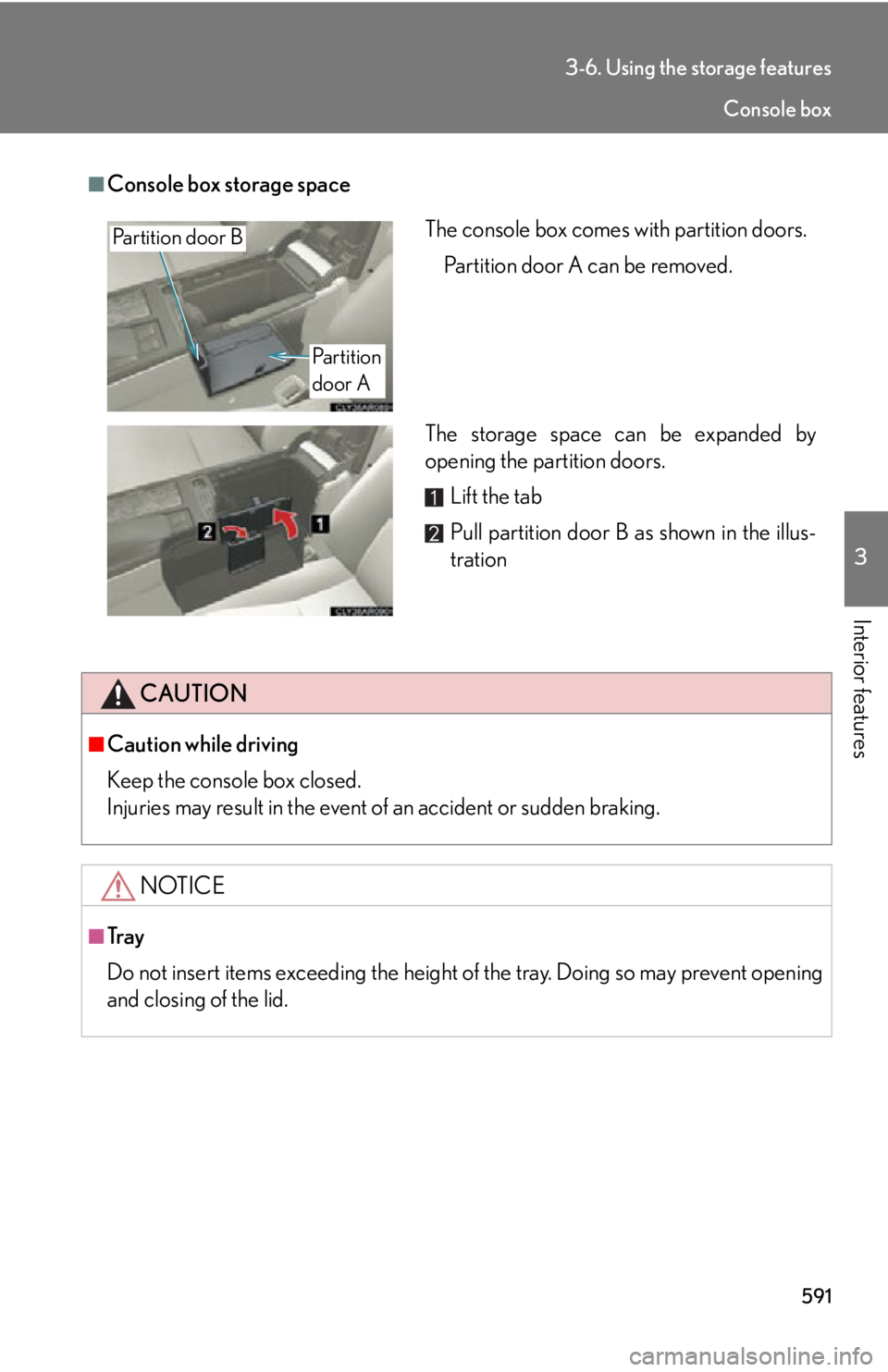
Console box storage space
CAUTION■
Caution while driving
Keep the console box closed.
Injuries may result in the event of an accident or sudden braking.
NOTICE■
Tr a y
Do not insert items exceeding the height of the tray. Doing so may prevent opening
and closing of the lid. The console box comes with partition doors.
Partition door A can be removed.
The storage space can be expanded by
opening the partition doors.
Lift the tab
Pull partition door B as shown in the illus-
trationPartition door B
Pa r t i t i o n
door A Console box
Page 774 of 878

5
When trouble arises
7735-2. Steps to take in an emergency
■
If you have a flat front tire on a road covered with snow or ice (vehicles with a
compact spare tire)
Install the compact spare tire on one of the rear wheels of the vehicle. Perform the
following steps and fit tire chains to the front tires:
Replace a rear tire with the compact spare tire.
Replace the flat front tire with the tire removed from the rear of the vehi-
cle.
Fit tire chains to the front tires.■
After completing the tire change
The tire pressure warning system must be reset. ( P. 6 7 1 )
CAUTION■
Using the tire jack
Improper use of the tire jack may cause the vehicle to suddenly fall off the jack,
leading to death or serious injury. ●
Do not use the tire jack for any purpose other than replacing tires or installing and
removing tire chains.●
Only use the tire jack that comes with this vehicle for replacing a flat tire.
Do not use it on other vehicles, and do no t use other tire jacks for replacing tires
on this vehicle.●
Always check that the tire jack is securely set to the jack point.●
Do not put any part of your body under the vehicle while it is supported by the
jack.●
Do not start or run the hybrid system while your vehicle is supported by the jack.●
Do not raise the vehicle while someone is inside.●
When raising the vehicle, do not put an object on or under the jack.
●
Do not raise the vehicle to a height greate r than that required to replace the tire.
●
Use a jack stand if it is necessary to get under the vehicle.
Take particular care when lowering the vehicle to ensure that no one working on or
near the vehicle may be injured. STEP 1
STEP 2
STEP 3
Page 799 of 878
7986-1. Specifications
Maintenance data (fue l, oil level, etc.)Dimensions and weight
* 1
: Unladen vehicles
* 2
: Vehicles without roof antenna and roof rails
* 3
: Vehicles with roof antenna but without roof rails
* 4
: Vehicles with roof rails
* 5
: AWD models with towing package onlyOverall length 187.8 in. (4770 mm)
Overall width 74.2 in. (1885 mm)
Overall height
* 1
66.3 in. (1685 mm)
* 2
66.7 in. (1695 mm)
* 3
67.9 in. (1725 mm)
* 4
Wheelbase 107.9 in. (2740 mm)
Tr e a d Front 64.2 in. (1630 mm)
Rear 64.0 in. (1625 mm)
Vehicle capacity weight
(Occupants + luggage) 2WD
825 lb. (370 kg)
AW D
885 lb. (400 kg)
Trailer Weight Rating
(trailer weight + cargo weight)
* 5
3500 lb. (1588 kg)
Page 816 of 878
8156-1. Specifications
6
Vehicle specifications Typical DOT and tire identification number (TIN)
DOT symbol
*Tire Identificat ion Number (TIN)
Tire manufacturer's identifica-
tion mark
Tire size code
Manufacturer's optional tire
type code (3 or 4 letters)
Manufacturing week
Manufacturing year
* : The DOT symbol certifies that
the tire conforms to applicable
Federal Motor Vehicle Safety
Standards.
Tire size
■ Typical tire size information
The illustration indicates typical
tire size.
Ti r e u s e
(P = Passenger car,
T = Temporary use)
Section width (millimeters)
Aspect ratio
(tire height to section width)
Tire construction code
(R = Radial, D = Diagonal)
Wheel diameter (inches)
Load index (2 digits or 3 digits)
Speed symbol
(alphabet with one letter)