Page 74 of 878

741-3. Opening, closing and locking the doors
■
Impact detection door lock release system
In the event that the vehicle is subject to a strong impact, all the doors are unlocked.
Depending on the force of the impact or the type of accident, however, the system
may not operate.■
Using the mechanical key
The doors can also be locked and unlocked with the mechanical key. ( P. 7 8 1 )■
If a wrong key is used
The key cylinder rotates freely to protect the inside mechanism.■
Customization
Settings (e.g. unlocking function using a key) can be changed.
(Customizable features P. 825)
CAUTION■
To prevent an accident
Observe the following precautions while driving the vehicle.
Failure to do so may result in a door opening and an occupant falling out, resulting
in death or serious injury. ●
Always use a seat belt.●
Always lock all the doors.●
Ensure that all the doors are properly closed.●
Do not pull the inside handle of the doors while driving.
The doors may be opened and the passengers are thrown out of the vehicle and it
may result in serious injury or death.
Be especially careful with the front doors, as the doors may be opened even if the
inside lock buttons are in the locked position.
●
Set the rear door child-protector locks when children are seated in the rear seats.
■
When opening or closing a door
Check the surroundings of the vehicle such as whether the vehicle is on an incline,
whether there is enough space for a door to open and whether a strong wind is
blowing. When opening or closing the door, hold the door handle tightly to prepare
for any unpredictable movement.
Page 88 of 878
881-4. Adjustable components (s eats, mirrors, steering wheel)
■
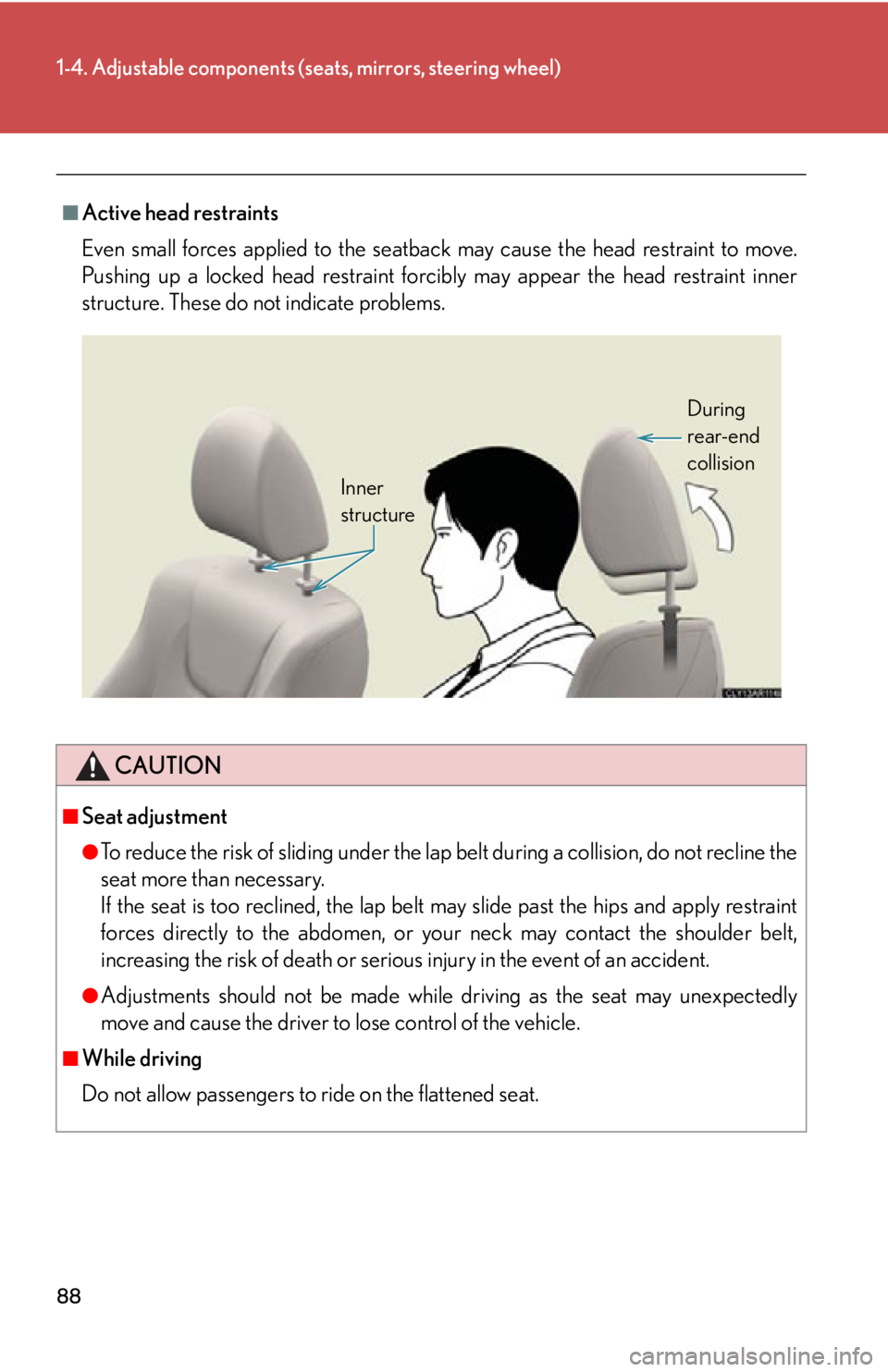
Active head restraints
Even small forces applied to the seatback may cause the head restraint to move.
Pushing up a locked head restraint forcibly may appear the head restraint inner
structure. These do not indicate problems.
CAUTION■
Seat adjustment ●
To reduce the risk of sliding under the lap belt during a collision, do not recline the
seat more than necessary.
If the seat is too reclined, the lap belt may slide past the hips and apply restraint
forces directly to the abdomen, or yo ur neck may contact the shoulder belt,
increasing the risk of death or seriou s injury in the event of an accident.●
Adjustments should not be made while driving as the seat may unexpectedly
move and cause the driver to lose control of the vehicle.
■
While driving
Do not allow passengers to ride on the flattened seat. Inner
structure During
rear-end
collision
Page 89 of 878
8911-4. Adjustable components (s eats, mirrors, steering wheel)
Before driving Rear seats
Folding down the rear seatbacks
■ Before folding down the rear seatbacks
Stow all the head restraints and the
rear center seat belt buckle.Seat position adjustment lever
Seatback angle adjustment lever
Page 91 of 878
911-4. Adjustable components (seats, mirrors, steering wheel)
1
Before driving CAUTION■
When folding the rear seatbacks down
Observe the following precautions. Failure to do so may result in death or serious
injury. ●
Do not fold the seatbacks down while driving.●
Do not fold seatbacks down while passenge rs are seated or luggage is placed on
the seats.●
Stop the vehicle on level ground, set the parking brake and shift the shift lever to
P.●
After folding the seatback, lightly move the seat back and forth to lock it in place.●
Do not allow anyone to sit on a folded seatback or in the luggage compartment
while driving.●
Do not allow children to en ter the luggage compartment.■
Seat adjustment ●
To reduce the risk of sliding under the lap belt during a collision, do not recline the
seat more than necessary.
If the seat is too reclined, the lap belt may slide past the hips and apply restraint
forces directly to the abdomen, or yo ur neck may contact the shoulder belt,
increasing the risk of death or seriou s injury in the event of an accident.●
Adjustments should not be made while driving as the seat may unexpectedly
move and cause the driver to lose control of the vehicle.■
After returning the rear seatback to the upright position
Observe the following precautions. Failure to do so may result in death or serious
injury. ●
Make sure the seatback is securely locked by pushing it forward and rearward on
the top.
●
Check that the seat belts are not tw isted or caught in the seatback.
Page 92 of 878
921-4. Adjustable components (s eats, mirrors, steering wheel)
NOTICE■
Stowing the center seat belt buckle
Before folding down the rear seatbacks, stow the center seat belt buckle to prevent
it from becoming caught in the seatbacks.
Page 95 of 878

951-4. Adjustable components (seats, mirrors, steering wheel)
1
Before driving Power easy access system
When the driver enters and exits the vehicle, the driver's seat and steer-
ing wheel will automatically perf orm the following operations:
Exiting the vehicle: When all of the
following actions have been per-
formed, the steering wheel will
move up and back to the point far-
thest away from the driver and the
seat will move backward (auto
away function): • The shift lever has been shifted to P
• The “POWER” switch has been
turned off
• The driver’s seat belt has been
unfastened
Entering the vehi cle: When either
of the following actions has been
performed, the steering wheel will
move toward the driver and seat
will move forward (auto return
function):
• The “POWER” switch has been
turned to ACCESSORY mode
• The driver’s seat belt has been fas-
tened
■
When driving position memory is li nked with door unlock operation
If the driver’s door is opened, the driver’s seat will move toward the memorized
position but stop slightly beforehand to allow easy access to the vehicle.
Turning the “POWER” switch to ACCESSORY mode or fastening the driver’s seat
belt moves the seat fully into the memorized position.
Page 99 of 878
9911-4. Adjustable components (s eats, mirrors, steering wheel)
Before driving Seat belts Make sure that all occupants are wearing their seat belts before driving the
vehicle.
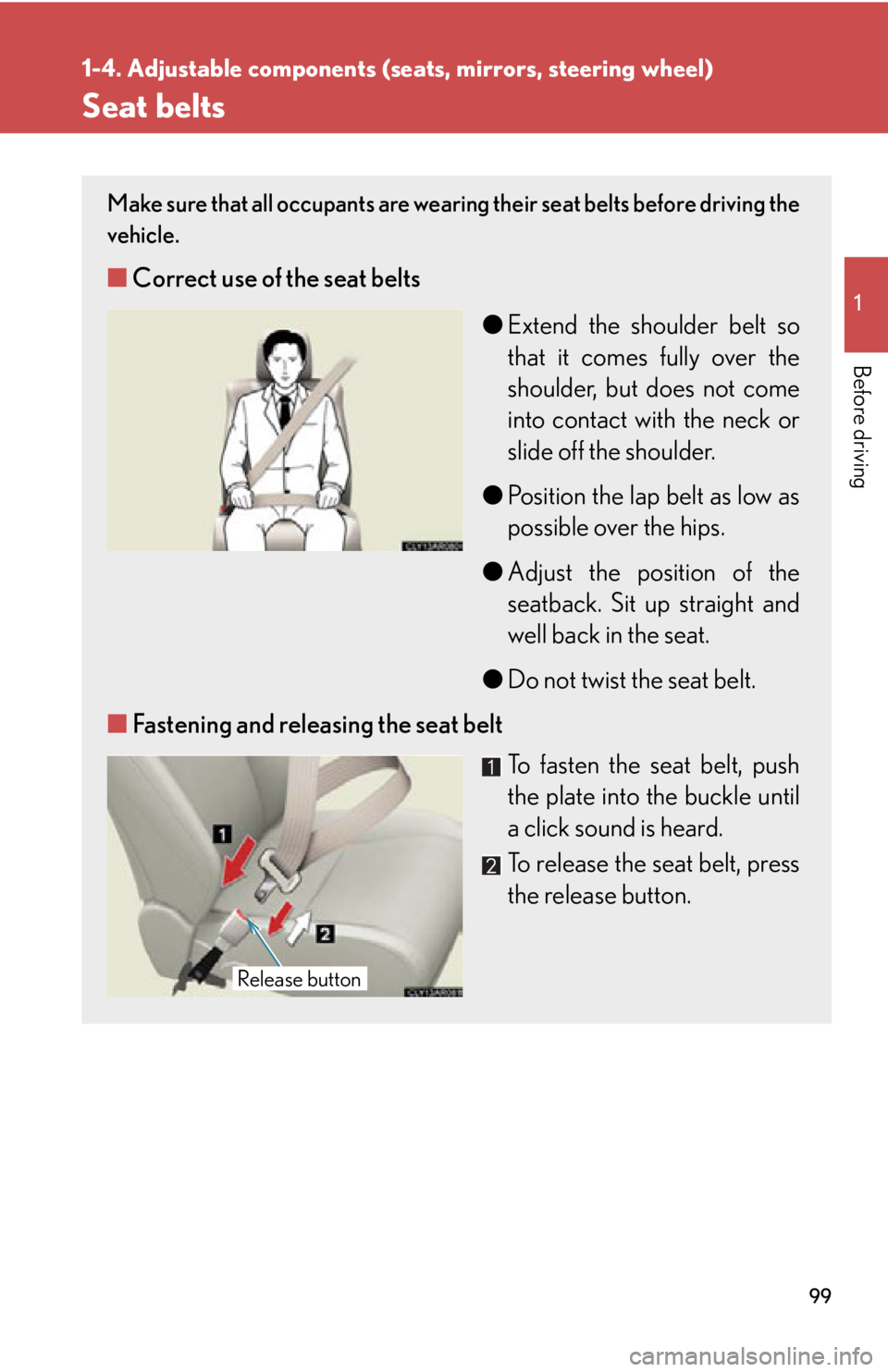
■ Correct use of the seat belts
● Extend the shoulder belt so
that it comes fully over the
shoulder, but does not come
into contact with the neck or
slide off the shoulder.
● Position the lap belt as low as
possible over the hips.
● Adjust the position of the
seatback. Sit up straight and
well back in the seat.
● Do not twist the seat belt.
■ Fastening and releasing the seat belt
To fasten the seat belt, push
the plate into the buckle until
a click sound is heard.
To release the seat belt, press
the release button.
Release button
Page 100 of 878
1001-4. Adjustable components (s eats, mirrors, steering wheel)
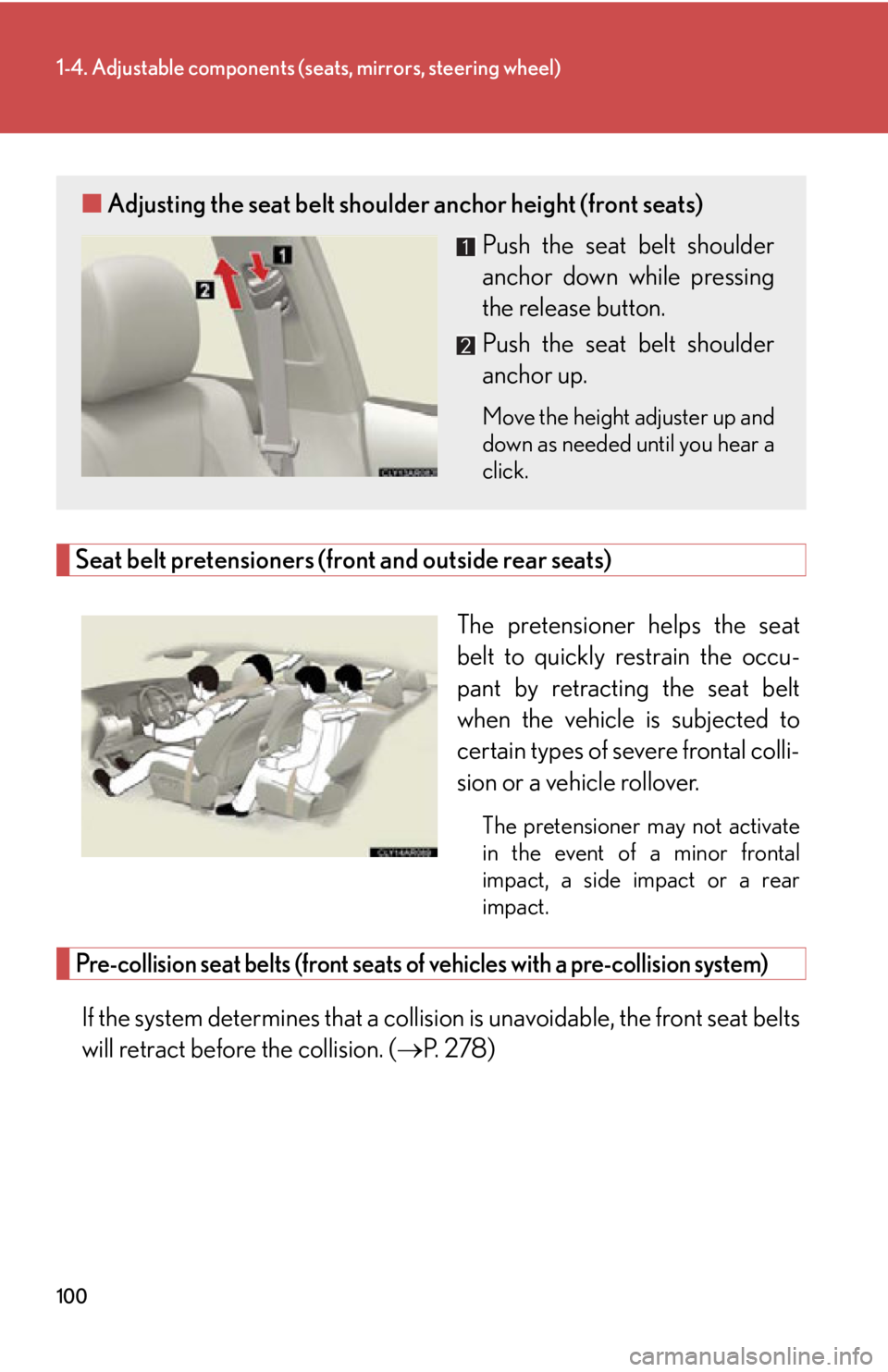
Seat belt pretensioners (front and outside rear seats)
The pretensioner helps the seat
belt to quickly restrain the occu-
pant by retracting the seat belt
when the vehicl e is subjected to
certain types of severe frontal colli-
sion or a vehicle rollover. The pretensioner may not activate
in the event of a minor frontal
impact, a side impact or a rear
impact.
Pre-collision seat belts (front seats of vehicles with a pre-collision system)
If the system determines that a collision is unavoidable, the front seat belts
will retract before the collision. ( P. 2 7 8 )■ Adjusting the seat belt shoulder anchor height (front seats)
Push the seat belt shoulder
anchor down while pressing
the release button.
Push the seat belt shoulder
anchor up. Move the height adjuster up and
down as needed until you hear a
click.