2015 LEXUS RX450h ECU
[x] Cancel search: ECUPage 82 of 878
821-3. Opening, closing and locking the doors
CAUTION■
Back door closer
●
Use caution when using the back door clos er as it still operates when the power
back door system is cancelled.■
Power back door
Observe the following precautions when operating the power back door.
Failure to do so may cause death or serious injury. ●
Check the safety of the surrounding area to make sure there are no obstacles or
anything that could cause any of your belongings to get caught. ●
If anyone is in the vicinity, make sure th ey are safe and let them know that the back
door is about to open or close.●
If the power back door system is turned off with the main switch while the back
door is operating automatically, the automatic operation is stopped. The back
door then has to be operated manually. Take extra care when on an incline, as the
back door may open or close unexpectedly.●
If the operating conditions of the power back door are no longer met, a buzzer
may sound and the back door may stop opening or closing. The back door then
has to be operated manually. Take extra ca re when on an incline, as the back door
may open or close abruptly.
●
On an incline, the back door may suddenl y shut after it opens. Make sure the
back door is fully open and secure. ●
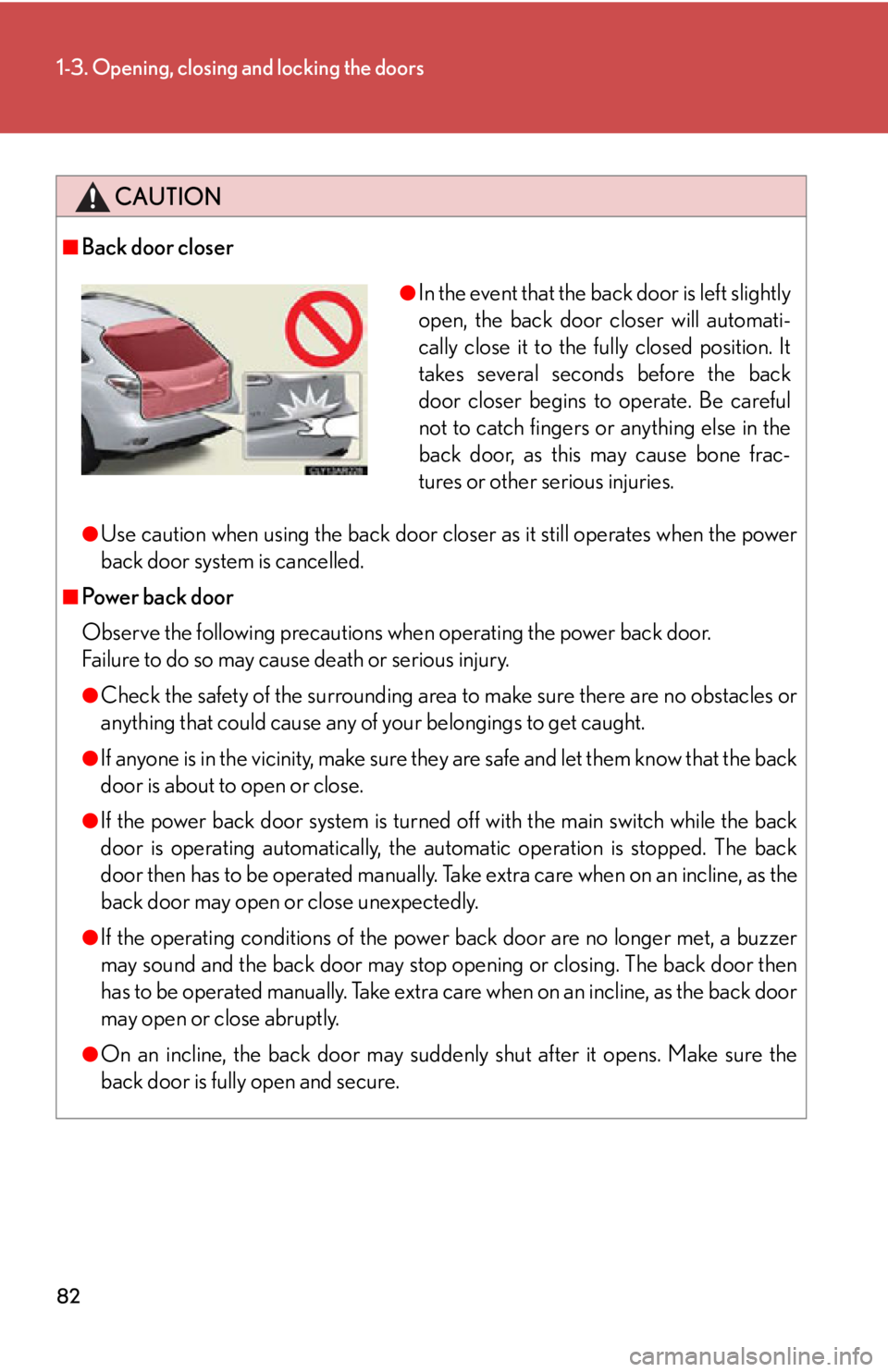
In the event that the back door is left slightly
open, the back door closer will automati-
cally close it to the fully closed position. It
takes several seconds before the back
door closer begins to operate. Be careful
not to catch fingers or anything else in the
back door, as this may cause bone frac-
tures or other serious injuries.
Page 91 of 878
911-4. Adjustable components (seats, mirrors, steering wheel)
1
Before driving CAUTION■
When folding the rear seatbacks down
Observe the following precautions. Failure to do so may result in death or serious
injury. ●
Do not fold the seatbacks down while driving.●
Do not fold seatbacks down while passenge rs are seated or luggage is placed on
the seats.●
Stop the vehicle on level ground, set the parking brake and shift the shift lever to
P.●
After folding the seatback, lightly move the seat back and forth to lock it in place.●
Do not allow anyone to sit on a folded seatback or in the luggage compartment
while driving.●
Do not allow children to en ter the luggage compartment.■
Seat adjustment ●
To reduce the risk of sliding under the lap belt during a collision, do not recline the
seat more than necessary.
If the seat is too reclined, the lap belt may slide past the hips and apply restraint
forces directly to the abdomen, or yo ur neck may contact the shoulder belt,
increasing the risk of death or seriou s injury in the event of an accident.●
Adjustments should not be made while driving as the seat may unexpectedly
move and cause the driver to lose control of the vehicle.■
After returning the rear seatback to the upright position
Observe the following precautions. Failure to do so may result in death or serious
injury. ●
Make sure the seatback is securely locked by pushing it forward and rearward on
the top.
●
Check that the seat belts are not tw isted or caught in the seatback.
Page 101 of 878
1011-4. Adjustable components (seats, mirrors, steering wheel)
1
Before driving ■
Emergency locking retractor (ELR)
The retractor will lock the belt during a sudd en stop or on impact. It may also lock if
you lean forward too quickly. To allow the belt to extend, retract the belt and then
pull it slowly.■
Automatic locking retractor (ALR)
When a passenger's shoulder belt is completely extended and then retracted even
slightly, the belt is locked in that position and cannot be extended. This feature is
used to hold the child restraint system (CRS) firmly. To free the belt again, fully
retract the belt and then pull the belt out once more. ( P. 1 5 4 )■
Child seat belt usage
The seat belts of your vehicle were princi pally designed for persons of adult size. ●
Use a child restraint system appropriate for the child, until the child becomes
large enough to properly wear the vehicle's seat belt. ( P. 1 5 0 )●
When the child becomes large enough to properly wear the vehicle's seat belt,
follow the instructions on P. 99 regarding seat belt usage.■
Replacing the belt after the pretensioner has been activated
If the vehicle is involved in multiple collisions, the pretensioner will activate for the
first collision, but will not activate for the second or subsequent collisions.■
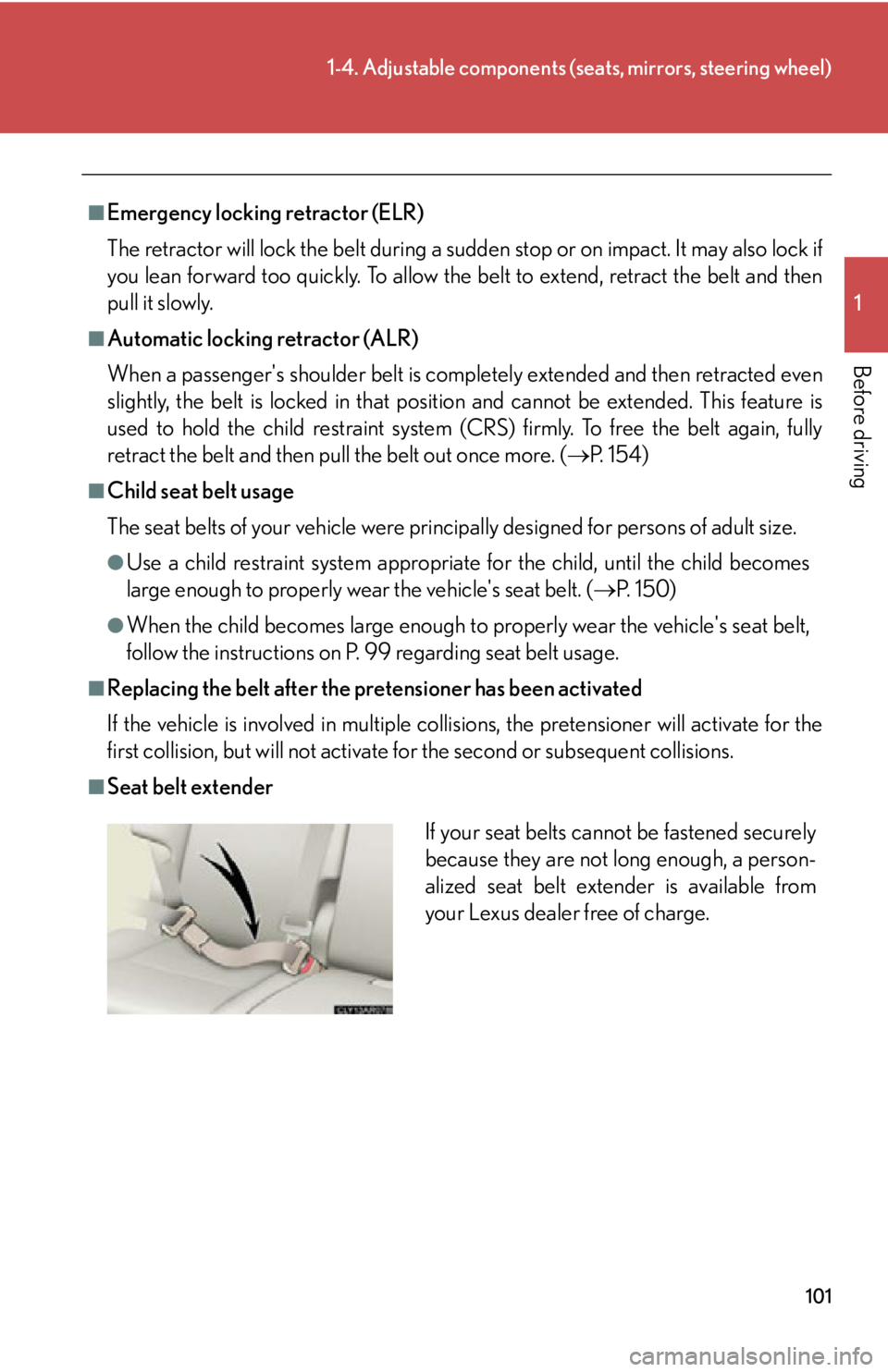
Seat belt extender
If your seat belts cann ot be fastened securely
because they are not long enough, a person-
alized seat belt extender is available from
your Lexus dealer free of charge.
Page 104 of 878
1041-4. Adjustable components (s eats, mirrors, steering wheel)
CAUTION■
Seat belt damage and wear ●
Do not damage the seat belts by allowing the belt, plate, or buckle to be jammed
in the door.●
Inspect the seat belt system periodically. Check for cuts, fraying, and loose parts.
Do not use a damaged seat belt until it is replaced. Damaged seat belts cannot
protect an occupant from death or serious injury.●
Ensure that the belt and tab are lo cked and the belt is not twisted.
If the seat belt does not function co rrectly, immediately contact your Lexus
dealer.●
Replace the seat assembly, including the belt s, if your vehicle has been involved in
a serious accident, even if there is no obvious damage.●
Do not attempt to install, remove, modify, disassemble or dispose of the seat belts.
Have any necessary repairs carried out by your Lexus dealer. Inappropriate han-
dling of the pretensioner may prevent it from operating properly, resulting in
death or serious injury.■
Using a seat belt extender ●
Do not wear the seat belt extender if you can fasten the seat belt without the
extender.●
Do not use the seat belt extender when installing a child restraint system because
the belt will not securely hold the chil d restraint system, increasing the risk of
death or serious injury in the event of an accident.●
The personalized extender may not be safe on another vehicle, when used by
another person, or at a different seatin g position other than the one originally
intended.
NOTICE
■
When using a seat belt extender
When releasing the seat belt, press on the buckle release button on the extender,
not on the seat belt.
This helps prevent damage to the vehi cle interior and the extender itself.
Page 122 of 878
1221-6. Refueling
CAUTION■
When refueling the vehicle
Observe the following precautions while refueling the vehicle. Failure to do so may
result in death or serious injury. ●
After exiting the vehicle and before opening the fuel door, touch an unpainted
metal surface to discharge any static electricity. It is important to discharge static
electricity before refueling because sparks resulting from static electricity can
cause fuel vapors to ignite while refueling.●
Always hold the grips on the fuel tank cap and turn it slowly to remove it.
A whooshing sound may be heard when the fuel tank cap is loosened. Wait until
the sound cannot be heard before fully re moving the cap. In hot weather, pressur-
ized fuel may spray out of the filler neck and cause injury.●
Do not allow anyone that has not discharged static electricity from their body to
come close to an open fuel tank.●
Do not inhale vaporized fuel.
Fuel contains substances that are harmful if inhaled.●
Do not smoke while refueling the vehicle.
Doing so may cause the fuel to ignite and cause a fire.●
Do not return to the vehicle or touch an y person or object that is statically
charged.
This may cause static electricity to build up , resulting in a possible ignition hazard.■
When refueling
Observe the following precautions to prevent fuel overflowing from the fuel tank: ●
Securely insert the fuel nozzle into the fuel filler neck●
Stop filling the tank after the fuel nozzle automatically clicks off●
Do not top off the fuel tank
■
When replacing the fuel cap
Do not use anything but a genuine Lexus fuel tank cap designed for your vehicle.
Doing so may cause a fire or other incident which may result in death or serious
injury.
Page 124 of 878

1241-7. Theft deterrent system
Immobilizer system The vehicle's keys have built-in tran sponder chips that prevent the hybrid
system from starting if the key has not been previously registered in the
vehicle's on-board computer.
Never leave the keys inside the vehicle when you leave the vehicle.
This system is designed to help prev ent vehicle theft but does not guaran-
tee absolute security ag ainst all vehicle thefts.
Vehicles with a navigation system or the Lexus Display Audio sys-
tem
The indicator light flashes after
the “POWER” switch has been
turned off to indicate that the
system is operating.
The indicator light stops flashing
after the “POWER” switch has
been turned to ACCESSORY
or ON mode to indicate that the
system has been canceled.
Vehicles without a navigation sy stem or the Lexus Display Audio
system
The indicator light flashes after
the “POWER” switch has been
turned off to indicate that the
system is operating.
The indicator light stops flashing
after the “POWER” switch has
been turned to ACCESSORY
or ON mode to indicate that the
system has been canceled.
Page 134 of 878

1341-8. Safety information
SRS airbag system components
Knee airbags
Front passenger airbag
Curtain shield airbags
Front side airbags
Front passenger occupant
classification system
(ECU and sensors)
“AIR BAG ON” and “AIR BAG
OFF” indicator lights
Rear side airbags
SRS warning light
Driver airbag Curtain shield and rear side
airbag sensors
Driver's seat belt buckle
switch
Driver's seat position sensor
Airbag sensor assembly
Front airbag sensors
Front passenger’s seat belt
buckle switch
Door sensors
Seat belt pretensioners and
force limiters
Page 135 of 878

1351-8. Safety information
1
Before driving Your vehicle is equipped with AD VANCED AIRBAGS designed based
on the US motor vehicle safety st andards (FMVSS208). The airbag sen-
sor assembly (ECU) controls airbag deployment based on information
obtained from the sensors etc. show n in the system components diagram
above. This information includes cras h severity and occupant informa-
tion. As the airbags deploy, a chemica l reaction in the inflators quickly fills
the airbags with non-toxic gas to he lp restrain the motion of the occu-
pants. ■
If the SRS airbags deploy (inflate) ●
Bruising and slight abrasions may result from contact with a deploying (inflating)
SRS airbag.●
A loud noise and white powder will be emitted.●
Parts of the airbag module (steering wheel hub, airbag cover and inflator) as
well as the seats, parts of the front and rear pillars, and roof side rails, may be hot
for several minutes. The airbag itself may also be hot.●
The windshield may crack.●
For Safety Connect subscriber s, if the SRS airbags deploy or in the event of a
severe rear-end collision, the system is designed to send an emergency call to
the response center, notifying them of the vehicle’s location (without needing to
push the “SOS” button) and an agent will attempt to speak with the occupants
to ascertain the level of emergency and assistance required. If the occupants
are unable to communicate, the agent automatically treats the call as an emer-
gency and helps to dispatch the necessary emergency services. ( P. 6 2 6 )■
SRS airbag deployment conditions (SRS front airbags) ●
The SRS front airbags will deploy in the event of an impact that exceeds the
set threshold level (the level of force corresponding to an approximately 12 -
18 mph [20 - 30 km/h] frontal collision with a fixed wall that does not move or
deform).
However, this threshold velocity will be considerably higher in the following situa-
tions:
• If the vehicle strikes an object, such as a parked vehicle or sign pole, which
can move or deform on impact
• If the vehicle is involved in an underride collision, such as a collision in which
the front of the vehicle “underrides”, or goes under, the bed of a truck