2015 LEXUS RX350 service
[x] Cancel search: servicePage 6 of 886

TABLE OF CONTENTS Index
64-1. Maintenance and care
Cleaning and protecting
the vehicle exterior.................. 650
Cleaning and protecting
the vehicle interior ................... 653
4-2. Maintenance
Maintenance requ irements ..... 656
General maintenance ............... 659
Emission inspection and
maintenance (I/M)
programs ....................................... 663
4-3. Do-it-yourself maintenance
Do-it-yourself service
precautions .................................. 664
Hood.................................................. 667
Positioning a floor jack.............. 668
Engine compartment.................. 670
Tires .................................................. 684
Tire inflation pressure ................. 693
Wheels.............................................. 697
Air conditioning filter .................. 699
Electronic key battery ................. 701
Checking and replacing
fuses ................................................ 703
Headlight aim.................................. 716
Light bulbs ........................................ 719 5-1. Essential information
Emergency flashers..................... 734
If your vehicle needs to be
towed.............................................. 735
If you think something is
wrong ............................................. 742
Fuel pump shut off system ........ 743
5-2. Steps to take in an emergency
If a warning light turns on
or a warning buzzer
sounds... ........................................ 744
If a warning message is
displayed ....................................... 754
If you have a flat tire..................... 774
If the engine will not start .......... 789
If the shift lever cannot be
shifted from P ............................... 791
If you lose your keys .................... 792
If the electronic key does
not operate properly ............... 793
If the vehicle battery is
discharged ................................... 796
If your vehicle ov erheats ........... 799
If the vehicle becomes
stuck............................................... 802
If your vehicle has to
be stopped in an
emergency .................................. 8044
Maintenance and care 5
When trouble arises
Page 25 of 886

25● Data usage
Lexus may use the data recorded in these computers to diagnose malfunctions,
conduct research and development, and improve quality.
Lexus will not disclose the recorded data to a third party except:
• With the consent of the vehicle owner or with the consent of the lessee if the
vehicle is leased
• In response to an official request by the police, a court of law or a government
agency
• For use by Lexus in a law suit
• For research purposes where the data is not tied to a specific vehicle or vehicle
owner
● Usage of data collected through Safety Connect /Lexus Enform (U.S. mainland
only)
If your Lexus has Safety Connect or Lexus Enform and if you have subscribed to
those services, please refer to the Safety Connect /Lexus Enform Telematics Sub-
scription Service Agreement for informat ion on data collected and its usage.
Page 27 of 886

27Scrapping of your Lexus The SRS airbag and seat belt pretensioner devices in your Lexus contain explosive
chemicals. If the vehicle is scrapped with the airbags and seat belt pretensioners left
as they are, this may cause an accident such as fire. Be sure to have the systems of
the SRS airbag and seat belt pretensioner removed and disposed of by a qualified
service shop or by your Lexus deal er before you scrap your vehicle.
Perchlorate Material Special handling may apply, See www.d tsc.ca.gov/hazardouswaste/perchlorate.
Your vehicle has components that may contain perchlorate. These components may
include airbag, seat belt pretensioners, and wireless remote control batteries.
CAUTION■
General precautions while driving
Driving under the influence: Never drive your vehicle when under the influence of
alcohol or drugs that have impaired your ability to operate your vehicle. Alcohol
and certain drugs delay reaction time, impair judgment and reduce coordination,
which could lead to an accident that co uld result in death or serious injury.
Defensive driving: Always drive defensively. Anticipate mistakes that other drivers
or pedestrians might make and be ready to avoid accidents.
Driver distraction: Always give your full at tention to driving. Anything that distracts
the driver, such as adjusting controls, ta lking on a cellular phone or reading can
result in a collision with resulting death or serious injury to you, your occupants or
others.■
General precaution regarding children’s safety
Never leave children unattended in the vehi cle, and never allow children to have or
use the key.
Children may be able to start the vehicle or shift the vehicle into neutral. There is
also a danger that children may injure themselves by playing with the windows, the
moon roof, or other features of the vehicle. In addition, heat build-up or extremely
cold temperatures inside the vehicle can be fatal to children.
Page 122 of 886

1221-7. Safety information
Your vehicle is equipped with AD VANCED AIRBAGS designed based
on the US motor vehicl e safety standards (FMV SS208). The airbag sen-
sor assembly (ECU) controls airbag deployment based on information
obtained from the sensors etc. show n in the system components diagram
above. This information includes cras h severity and occupant informa-
tion. As the airbags deploy, a chemica l reaction in the infla tors quic kly fills
the airbags with non-toxi c gas to help restrain th e motion of the occu-
pants.■
If the SRS airbags deploy (inflate) ●
Bruising and slight abrasion s may result from contact with a deploying (inflating)
SRS airbag.●
A loud noise and white powder will be emitted.●
Parts of the airbag module (steering wheel hub, airbag cover and inflator) as
well as the seats, parts of the front and rear pillars, and roof side rails, may be hot
for several minutes. The airbag itself may also be hot.●
The windshield may crack.●
For Safety Connect subscribers, if the SR S airbags deploy or in the event of a
severe rear-end collision, the system is designed to send an emergency call to
the response center, notifying them of the vehicle’s location (without needing to
push the “SOS” button) and an agent will attempt to speak with the occupants
to ascertain the level of emergency and assistance required. If the occupants
are unable to communicate, the agent automatically treats the call as an emer-
gency and helps to dispatch the necessary emergency services. ( P. 6 4 2 )■
SRS airbag deployment conditions (SRS front airbags) ●
The SRS front airbags will deploy in the event of an impact that exceeds the
set threshold level (the level of force corresponding to an approximately 12 -
18 mph [20 - 30 km/h] frontal collision with a fixed wall that does not move or
deform).
However, this threshold velocity will be considerably higher in the following situa-
tions:
• If the vehicle strikes an object, such as a parked vehicle or sign pole, which
can move or deform on impact
• If the vehicle is involved in an underride collision, such as a collision in which
the front of the vehicle “underrides”, or goes under, the bed of a truck
Page 293 of 886

2932-5. Driving information
2
When driving
Off-road driving
When driving your vehicle off-road, please observe the following precau-
tions to ensure your driving enjoyment and to help prevent the closure of
areas to off-road vehicles.
● Drive your vehicle only in areas wh ere off-road vehicles are permitted
to travel.
● Respect private property. Get owne r’s permission before entering pri-
vate property.
● Do not enter areas that are closed . Honor gates, barriers and signs
that restrict travel.
● Stay on established roads. When conditions are w et, driving tech-
niques should be changed or travel delayed to prevent damage to
roads. CAUTION●
Always slow down in gusty crosswinds. Because of its profile and higher center of
gravity, your vehicle is more sensitive to side winds than an ordinary passenger
car. Slowing down will allow you to have better control.●
Do not drive horizontally across steep slop es. Driving straight up or straight down
is preferred. Your vehicle (or any similar off-road vehicle) can tip over sideways
much more easily than forward or backward.
■
Additional information for off-road driving
For owners in U.S. mainland, Hawaii and Puerto Rico:
To obtain additional information pertaining to driving your vehicle off-road, consult
the following organizations.
●
State and Local Parks and Recreation Departments
●
State Motor Vehicle Bureau
●
Recreational Vehicle Clubs
●
U.S. Forest Service and Bureau of Land Management
Page 295 of 886

2952-5. Driving information
2
When driving NOTICE■
When you drive through water
If driving through water, such as when crossing shallow streams, first check the
depth of the water and the bottom of the stream for firmness. Drive slowly and avoid
deep water.■
Inspection after off-road driving ●
Sand and mud that has accumulated around brake discs may affect braking effi-
ciency and may damage brake system components.●
Always perform a maintenance inspection after each day of off-road driving that
has taken you through rough terrain, sand, mud, or water. For scheduled mainte-
nance information, refer to the “Warra nty and Services Guide/Owner’s Manual
Supplement/Schedul ed Maintenance”.
Page 302 of 886

3022-5. Driving information
Winter driving tips Carry out the necessary preparations and inspections before driving the
vehicle in winter. Always drive the ve hicle in a manner appropriate to the
prevailing weather conditions.
■ Pre-winter preparations
● Use fluids that are appropria te to the prevailing outside tempera-
tures.
• Engine oil
• Engine coolant
• Washer fluid
● Have a service technician inspec t the condition of the battery.
● Have the vehicle fitted with four snow tires or purchase a set of
tire chains for the front tires. Ensure that all tires are the same size and brand, and that chains match
the size of the tires.
■ Before driving the vehicle
Perform the following accord ing to the driving conditions:
● Do not try to forcibly open a w indow or move a wiper that is fro-
zen. Pour warm water over the frozen area to melt the ice. Wipe
away the water immediately to prevent it from freezing.
● To ensure proper operation of the climate control system fan,
remove any snow that has accumu lated on the air inlet vents in
front of the windshield.
● Check for and remove any exce ss ice or snow that may have
accumulated on the exterior lights, vehicle's roof, chassis, around
the tires or on the brakes.
● Remove any snow or mud from the bottom of your shoes before
getting in the vehicle.
Page 308 of 886
3082-5. Driving information
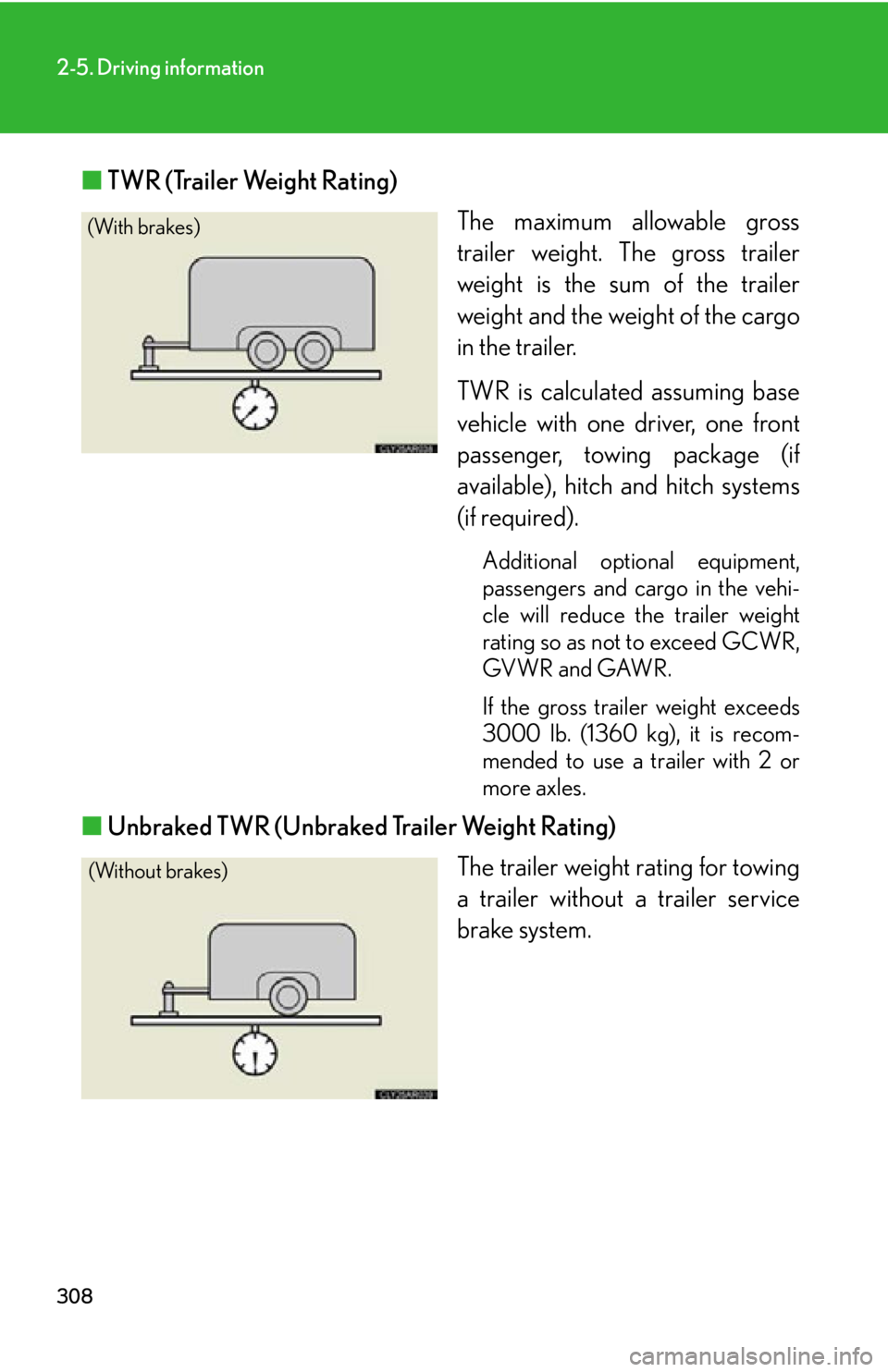
■ TWR (Trailer Weight Rating)
The maximum allowable gross
trailer weight. The gross trailer
weight is the sum of the trailer
weight and the weight of the cargo
in the trailer.
TWR is calculated assuming base
vehicle with one driver, one front
passenger, towing package (if
available), hitch and hitch systems
(if required). Additional optional equipment,
passengers and cargo in the vehi-
cle will reduce the trailer weight
rating so as not to exceed GCWR,
GVWR and GAWR.
If the gross trailer weight exceeds
3000 lb. (1360 kg), it is recom-
mended to use a trailer with 2 or
more axles.
■ Unbraked TWR (Unbraked Trailer Weight Rating)
The trailer weight rating for towing
a trailer without a trailer service
brake system.(With brakes)
(Without brakes)