Page 571 of 681

5718-2. Steps to take in an emergency
8
When trouble arises
NX300h_U_OM78007U WA R N I N G ■
Maintenance of the tires
Each tire, including the spare (if provided), should be checked monthly when cold and
inflated to the inflation pressure recomm ended by the vehicle manufacturer on the
vehicle placard or tire inflation pressure la bel (tire and load information label). (If your
vehicle has tires of a different size than the size indicated on the vehicle placard or tire
inflation pressure label [tire and load in formation label], you should determine the
proper tire inflation pressure for those tires.)
As an added safety feature, your vehicle ha s been equipped with a tire pressure moni-
toring system (TPMS-tire pressure warning system) that illuminates a low tire pressure
telltale (tire pressure warning light) when on e or more of your tires is significantly
under-inflated. Accordingly, when the low ti re pressure telltale (tire pressure warning
light) illuminates, you should stop and check your tires as soon as possible, and inflate
them to the proper pressure. Driving on a significantly under-inflated tire causes the
tire to overheat and can lead to tire failure. Under-inflation also reduces fuel efficiency
and tire tread life, and ma y affect the vehicle’s handling and stopping ability.
Please note that the TPMS (tire pressure wa rning system) is not a substitute for proper
tire maintenance, and it is the driver’s resp onsibility to maintain correct tire pressure,
even if under-inflation has no t reached the level to trigger illumination of the TPMS low
tire pressure telltale (tire pressure warning light).
Your vehicle has also been equipped with a TPMS (tire pressure warning system) mal-
function indicator to indicate when the system is not operating properly. The TPMS
(tire pressure warning system) malfunction indi cator is combined with the low tire pres-
sure telltale (tire pressure warning light). When the system detects a malfunction, the
telltale will flash for approximately one minu te and then remain continuously illumi-
nated. This sequence will cont inue upon subsequent vehicl e start-ups as long as the
malfunction exists. When the malfunction indicator is illuminated, the system may not
be able to detect or signal low tire pressure as intended.
TPMS (tire pressure warning system) malfun ctions may occur for a variety of reasons,
including the installation of replacement or alternate tires or wheels on the vehicle that
prevent the TPMS (tire pressure warning system) from functioning properly. Always
check the TPMS (tire pressure warning syst em) malfunction telltale after replacing one
or more tires or wheels on your vehicle to ensure that the replacement or alternate
tires and wheels allow the TPMS (tire pressure warning system) to continue to function
properly.
NOTICE ■
To ensure the tire pressure warning system operates properly
Do not install tires with different specificatio ns or makers, as the tire pressure warning
system may not operate properly.
Page 586 of 681

586 8-2. Steps to take in an emergency
NX300h_U_OM78007U Lower the vehicle.
Firmly tighten each wheel nut two or
three times in the order shown in the
illustration. Tightening torque:
76 ft•lbf (103 N•m, 10.5 kgf•m)
Vehicles with a full-size spare tire:
Reinstall the wheel ornament.
Stow the flat tire, tire jack and all tools. ■
The compact spare tire (Vehicle with compact spare tire) ●
The compact spare tire is identified by the label “TEMPORARY USE ONLY” on the
tire sidewall.
Use the compact spare tire temporarily, and only in an emergency. ●
Make sure to check the tire inflation pressure of the compact spare tire. ( P. 6 1 5 )■
After completing the tire change
The tire pressure warning system must be reset. ( P. 5 1 8 )■
When using the compact spare tire (Vehicle with compact spare tire)
As the compact spare tire is not equipped wi th a tire pressure warning valve and trans-
mitter, low inflation pressure of the spare ti re will not be indicated by the tire pressure
warning system. Also, if you replace the compact spare tire after the tire pressure warn-
ing light comes on, th e light remains on.■
When the compact spare tire is equippe d (Vehicle with compact spare tire)
The vehicle becomes lower when driving with the compact spare tire compared to when
driving with standard tires. 4
5
6
7
Page 588 of 681
588 8-2. Steps to take in an emergency
NX300h_U_OM78007U NOTICE ■
Be careful when driving over bumps with the compact spare tire installed on the vehi-
cle
The vehicle becomes lower when driving with the compact spare tire compared to
when driving with standard ti res. Be careful when driving over uneven road surfaces.■
Driving with tire chains and the compact spare tire
Do not fit tire chains to the compact spare tire.
Tire chains may damage the vehicle body and adversely affect driving performance.■
When replacing the tires
When removing or fitting the wheels, tires or the tire pressure warning valve and trans-
mitter, contact your Lexus dealer as the tire pressure warning valve and transmitter
may be damaged if not handled correctly.
Page 615 of 681

6159-1. Specifications
9
Vehicle specifications
NX300h_U_OM78007U
Ty p e A
Ty p e BSteering Free play Less than 1.2 in. (30 mm)
Tires and wheels Ti r e s i z e 225/65R17 102H
Tire inflation pressure
(Recommended cold tire
inflation pressure) Driving under normal conditions
Front
35 psi (240 kPa, 2.4 kgf/cm 2
or bar)
Rear
35 psi (240 kPa, 2.4 kgf/cm 2
or bar)
Driving at high speeds (above 100 mph [160 km/h])
(in countries where such speeds are permitted by
law)
Add 1 psi (10 kPa, 0.1 kgf/cm 2
or bar) to the front
and rear tires. Never exceed the maximum cold
tire inflation pressure in dicated on the tire side-
wall.
Wheel size 17 7 J
Wheel nut torque 76 ft•lbf (103 N•m, 10.5 kgf•m)
Ti r e s i z e 225/60R18 100H
Tire inflation pressure
(Recommended cold tire
inflation pressure) Driving under normal conditions
Front
32 psi (220 kPa, 2.2 kgf/cm 2
or bar)
Rear
32 psi (220 kPa, 2.2 kgf/cm 2
or bar)
Driving at high speeds (above 100 mph [160 km/h])
(in countries where such speeds are permitted by
law)
Add 9 psi (60 kPa, 0.6 kgf/cm 2
or bar) to the
front and rear tires. Never exceed the maximum
cold tire inflation pressure indicated on the tire
sidewall.
Wheel size 18 7 1 /2 J
Wheel nut torque 76 ft•lbf (103 N•m, 10.5 kgf•m)
Page 616 of 681
616 9-1. Specifications
NX300h_U_OM78007U
Compact spare tire Ti r e s i z e T165/80D17 104M
Spare tire inflation pressure
(Recommended cold tire
inflation pressure) 60 psi (420 kPa, 4.2 kgf/cm 2
or bar)
Wheel size 17 4 T
Wheel nut torque 76 f t •
lbf (103 N •
m, 10.5 kgf •
m)
Page 622 of 681

622 9-1. Specifications
NX300h_U_OM78007U Ti r e s i z e ( P. 6 2 4 )
DOT and Tire Identification Number (TIN) ( P. 6 2 3 )
Location of treadwear indicators ( P. 5 1 6 )
Tire ply composition and materials Plies are layers of rubber-coated parallel co rds. Cords are the strands which form the
plies in a tire.
Radial tires or bias-ply tires A radial tire has “RADIAL” on the sidewall. A tire not marked “RADIAL” is a bias-ply
tire.
TUBELESS or TUBE TYPE A tubeless tire does not have a tube and air is directly put into the tire. A tube type tire
has a tube inside the tire and the tube maintains the air pressure.
Load limit at maximum cold tire inflation pressure ( P. 5 2 0 )
Maximum cold tire inflation pressure ( P. 6 1 5 )This means the pressure to which a tire may be inflated.
Uniform tire quality grading For details, see “Uniform Tire Quality Grading” that follows.
Summer tires or all season tires ( P. 5 2 0 )An all season tire has “M+S” on the sidewall. A tire not marked “M+S” is a summer
tire.
“TEMPORARY USE ONLY” A compact spare tire is identified by the phrase “TEMPORARY USE ONLY” molded
on its sidewall. This tire is design ed for temporary emergency use only.1
2
3
4
5
6
7
8
9
10
11
Page 627 of 681
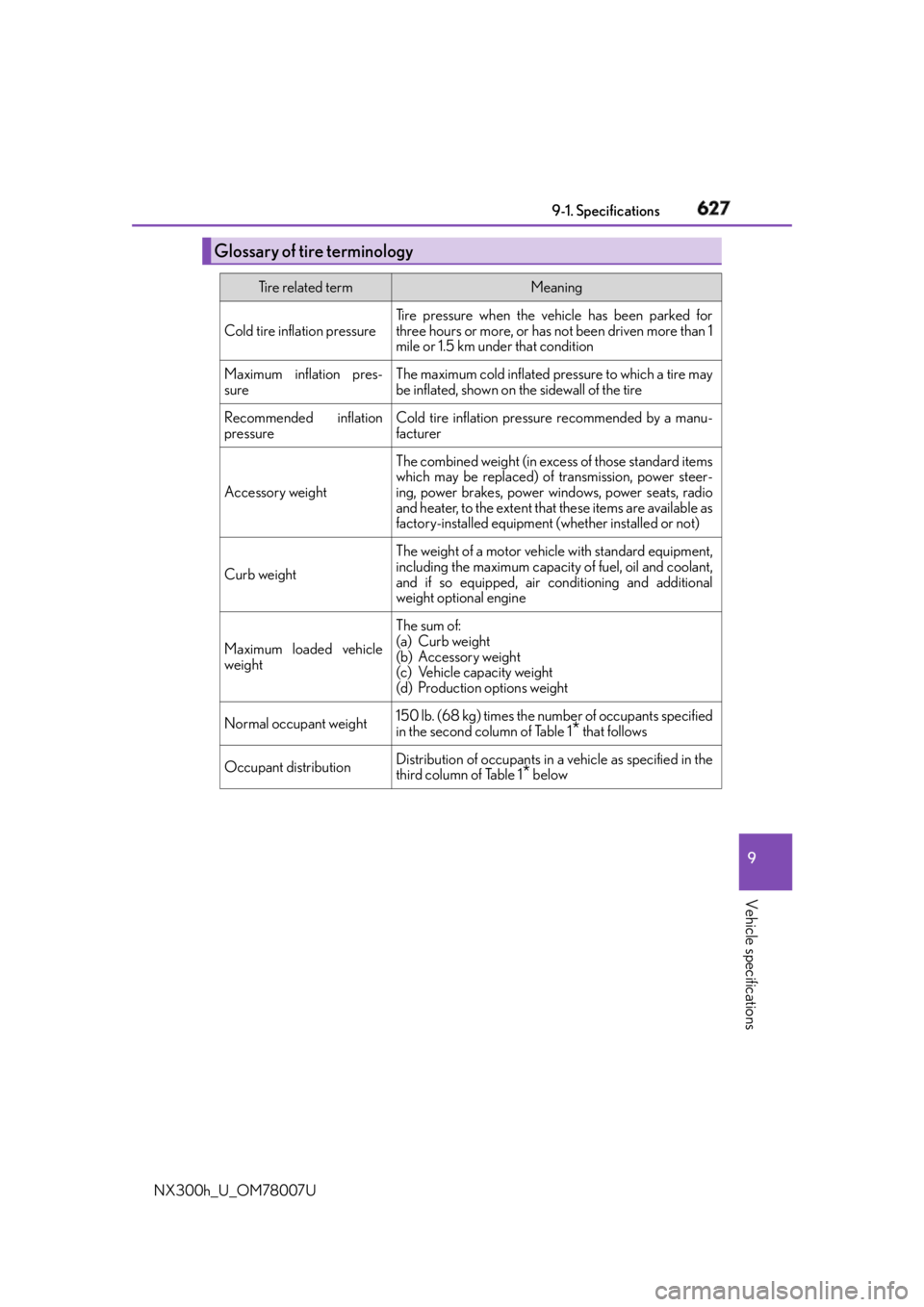
6279-1. Specifications
9
Vehicle specifications
NX300h_U_OM78007U Glossary of tire terminology Tire related term Meaning
Cold tire inflation pressure Tire pressure when the vehicle has been parked for
three hours or more, or has not been driven more than 1
mile or 1.5 km un der that condition
Maximum inflation pres-
sure The maximum cold inflated pressure to which a tire may
be inflated, shown on the sidewall of the tire
Recommended inflation
pressure Cold tire inflation pressure recommended by a manu-
facturer
Accessory weight The combined weight (in excess of those standard items
which may be replaced) of transmission, power steer-
ing, power brakes, power wi ndows, power seats, radio
and heater, to the extent that these items are available as
factory-installed equipment (whether installed or not)
Curb weight The weight of a motor vehicle with standard equipment,
including the maximum capacity of fuel, oil and coolant,
and if so equipped, air co nditioning and additional
weight optional engine
Maximum loaded vehicle
weight The sum of:
(a) Curb weight
(b) Accessory weight
(c) Vehicle capacity weight
(d) Production options weight
Normal occupant weight 150 lb. (68 kg) times the numb er of occupa nts specified
in the second column of Table 1
* that follows
Occupant distribution Distribution of occupants in a vehicle as specified in the
third column of Table 1
* below
Page 629 of 681

6299-1. Specifications
9
Vehicle specifications
NX300h_U_OM78007U Bead separation A breakdown of the bond be tween components in the
bead
Bias ply tire A pneumatic tire in which the ply cords that extend to
the beads are laid at altern ate angles substantially less
than 90 degrees to the centerline of the tread
Carcass The tire structure, except tread and sidewall rubber
which, when inflated, bears the load
Chunking The breaking away of pieces of the tread or sidewall
Cord The strands forming th e plies in the tire
Cord separation The parting of cords from adjacent rubber compounds
Cracking Any parting within the tread, sidewall, or innerliner of
the tire extending to cord material
CT A pneumatic tire with an inverted flange tire and rim
system in which the rim is designed with rim flanges
pointed radially inward and the tire is designed to fit on
the underside of the rim in a manner that encloses the
rim flanges inside the air cavity of the tire
Extra load tire A tire designed to operate at higher loads and at higher
inflation pressures than the corresponding standard tire
Groove The space between two adjacent tread ribs
Innerliner The layer(s) forming the inside surface of a tubeless tire
that contains the inflating medium within the tire
Innerliner separation The parting of the i nnerliner from cord material in the
carcassTire related term Meaning

