Page 208 of 681
208 4-2. Driving procedures
NX300h_U_OM78007UHybrid transmission
While the power switch is in ON mode, move the shift lever with the brake
pedal depressed. When shifting the shift lever between P and D, make sure that the vehicle is com-
pletely stopped.
* 1
: To improve fuel efficiency and reduce noise, shift the shift lever to D for normal driv-
ing.
* 2
: By selecting shift ranges using S mode, yo u can control accelerating force and engine
braking force.Shifting the shift lever
Shift position purpose Shift position Objective or function
P Parking the vehicle/starting the hybrid system
R Reversing
N Neutral
D Normal driving
* 1
S S mode driving
* 2
( P. 2 0 9 )
Page 332 of 681

332 4-6. Driving tips
NX300h_U_OM78007U WA R N I N G ■
Off-road driving precautions
Always observe the following precautions to minimize the risk of death or serious
injury or damage to your vehicle: ●
Drive carefully when off the road. Do not ta ke unnecessary risks by driving in danger-
ous places. ●
Do not grip the steering wheel spokes when driving off-road. A bad bump could jerk
the wheel and injure your hands. Keep both hands and especially your thumbs on the
outside of the rim. ●
Always check your brakes for effectivenes s immediately after driving in sand, mud,
water or snow. ●
After driving through tall grass, mud, rock, sand, water, etc., check that there is no
grass, bush, paper, rags, stone, sand, et c. adhering or trap ped to the underbody.
Clear off any such matter from the underbody. If the vehicle is used with these materi-
als trapped or adhering to the underb ody, a breakdown or fire could occur.●
When driving off-road or in rugged terrai n, do not drive at excessive speeds, jump,
make sharp turns, strike objects, etc. This may cause loss of control or vehicle rollover
causing death or serious injury. You are also risking expensive damage to your vehi-
cle’s suspension and chassis.
NOTICE ■
To prevent water damage
Take all necessary safety measures to ensure that water damage to the hybrid battery
(traction battery), hybrid system or other components does not occur. ●
Water entering the engine compartment may cause severe damage to the hybrid
system. Water entering the interior may cause the hybrid battery stowed under the
rear seats to short circuit. ●
Water entering the hybrid transmission and rear electric motor (traction motor) will
cause deterioration in transmission qualit y. The malfunction indicator may come on,
and the vehicle may not be drivable. ●
Water can wash the grease from wheel be arings, causing rusting and premature fail-
ure, and may also enter the hybrid transmission case, reducing the gear oil’s lubricat-
ing qualities. ■
When you drive through water
If driving through water, such as when crossing shallow streams, first check the depth of
the water and the bottom of the riverbed for firmness. Drive slowly and avoid deep
water. ■
Inspection after off-road driving ●
Sand and mud that has accumulated around brake discs may affect braking efficiency
and may damage brake system components. ●
Always perform a maintenance inspection after each day of off-road driving that has
taken you through rough terr ain, sand, mud, or water. For scheduled maintenance
information, refer to the “Warranty and Services Guide/Owner’s Manual Supple-
ment/Scheduled Maintenance”.
Page 495 of 681

4957-2. Maintenance
7
Maintenance and care
NX300h_U_OM78007U Vehicle interior Items Check points
Accelerator pedal • The accelerator pedal should move smoothly (with-
out uneven pedal effort or catching).
Brake pedal • Does the brake pedal move smoothly?
• Does the brake pedal have appropriate clearance
from the floor? ( P. 6 1 4 )
• Does the brake pedal have the correct amount of
free play? ( P. 6 1 4 )
Brakes • The vehicle should not pull to one side when the
brakes are applied.
• The brakes should work effectively.
• The brake pedal should not feel spongy.
• The brake pedal should not get too close to the floor
when the brakes are applied.
Head restraints • Do the head restraints move smoothly and lock
securely?
Hybrid transmission “Park”
mechanism • When parked on a slope and the shift lever is in P, is
the vehicle securely stopped?
Indicators/buzzers • Do the indicators and buzzers function properly?
Lights • Do all the lights come on?
Parking brake • Does the parking brake switch operate normally?
• When parked on a slope and the parking brake is on,
is the vehicle securely stopped?
Seat belts •Do the seat belt s operate smoothly?
• The seat belts should not be damaged.
Seats • Do the seat controls operate properly?
Steering wheel • Does the steering wheel rotate smoothly?
• Does the steering wheel have the correct amount of
free play?
• There should not be an y strange sounds coming
from the steering wheel.
Page 558 of 681

558 8-2. Steps to take in an emergency
NX300h_U_OM78007UIf your vehicle needs to be towed
The following may indicate a problem with your hybrid transmission. Contact
your Lexus dealer or commercial towing service before towing. ( P. 5 6 2 )●
The hybrid warning message shows on and the vehicle does not move. ●
The vehicle makes an abnormal sound.
Do not tow with a sling-type truck to
prevent body damage.If towing is necessary, we recommend having your vehicle towed by your
Lexus dealer or a commercial towing service, using a lift-type truck or flat bed
truck.
Use a safety chain system for all towing, and abide by all state/provincial and
local laws.
2WD models: If towing your vehicle with a wheel-lift type truck from the front,
the vehicle’s rear wheels and axles must be in good conditions. ( P. 559, 562)
If they are damaged, use a towing dolly or flatbed truck.
AWD models: If towing your vehicle with a wheel-lift type truck, use a towing
dolly. ( P. 559, 562)
Situations needs to contact dealers before towing
Towing with a sling-type truck
Page 563 of 681
5638-2. Steps to take in an emergency
8
When trouble arises
NX300h_U_OM78007U NOTICE ■
To prevent damage to the vehicle when towing using a wheel-lift type truck (2WD
models)
When raising the vehicle, ensure adequate ground clearance for towing at the oppo-
site end of the raised vehicle. Without adequate clearance, the vehicle could be dam-
aged while being towed. ■
To prevent body damage when to wing with a sling-type truck
Do not tow with a sling-type truck, either from the front or rear. ■
Recreational towing (behind motor home, etc)
Never dinghy tow your vehicle to prevent caus-
ing serious damage to the Hybrid AWD system
(AWD models) and transmission. ( P. 2 0 0 )
Page 605 of 681
6058-2. Steps to take in an emergency
8
When trouble arises
NX300h_U_OM78007U WA R N I N G ■
When attempting to free a stuck vehicle
If you choose to push the vehicle back and forth to free it, make sure the surrounding
area is clear to avoid striking other vehicl es, objects or people. The vehicle may also
lunge forward or lunge back suddenly as it becomes free. Use extreme caution. ■
When shifting the shift lever
Be careful not to shift the shift lever with the accelerator pedal depressed.
This may lead to unexpected rapid accelerati on of the vehicle that may cause an acci-
dent resulting in death or serious injury.
NOTICE ■
To avoid damage to the hybrid transmission and other components ●
Avoid spinning the front wheels and depressing the accelerator pedal more than nec-
essary. ●
If the vehicle remains stuck even after th ese procedures are performed, the vehicle
may require towing to be freed.
Page 614 of 681
614 9-1. Specifications
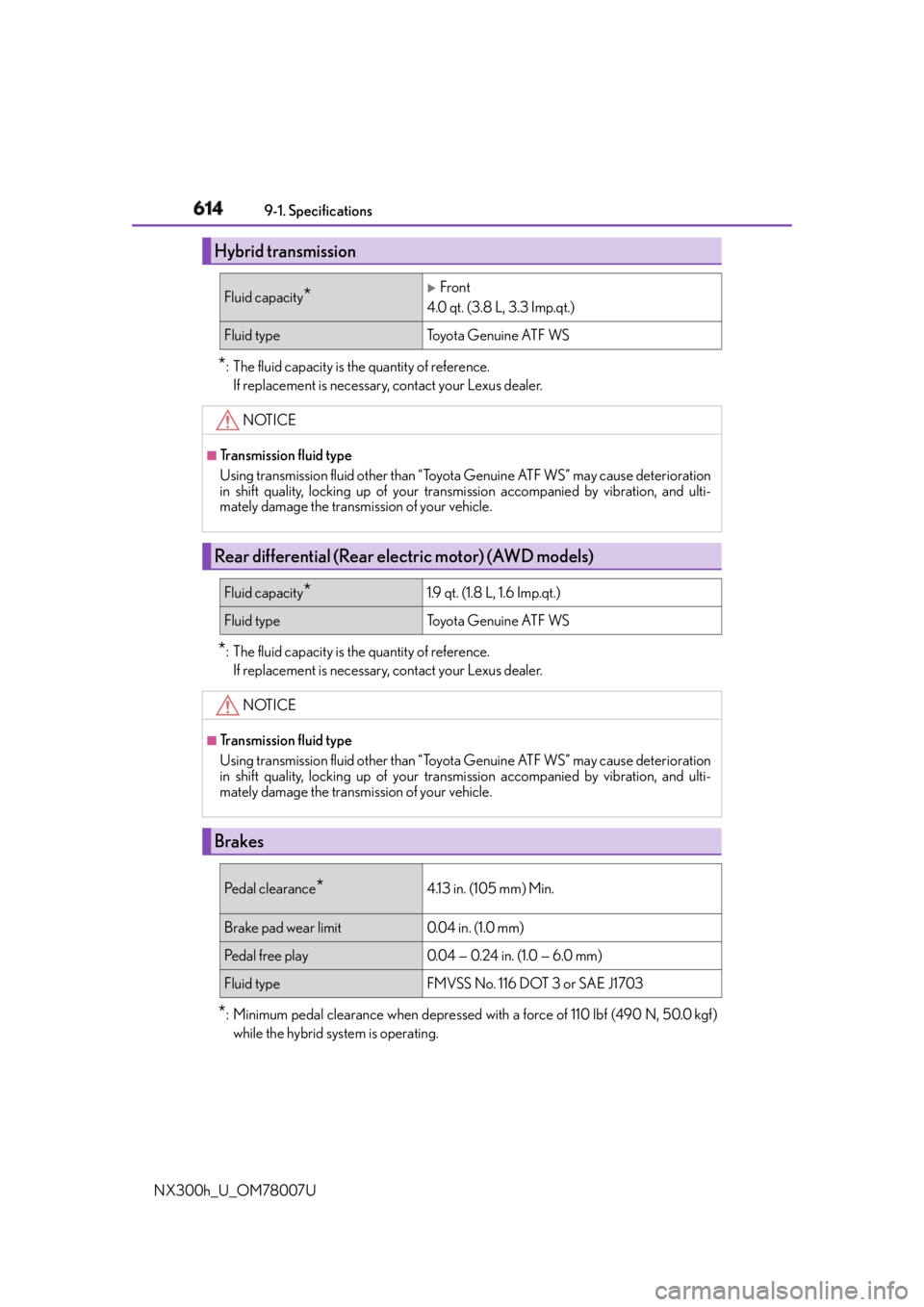
NX300h_U_OM78007U * : The fluid capacity is the quantity of reference.
If replacement is necessary, contact your Lexus dealer.
* : The fluid capacity is the quantity of reference.
If replacement is necessary, contact your Lexus dealer.
* : Minimum pedal clearance when depressed wi th a force of 110 lbf (490 N, 50.0 kgf)
while the hybrid system is operating.Hybrid transmission Fluid capacity
*
Front
4.0 qt. (3.8 L, 3.3 Imp.qt.)
Fluid type To y o t a G e n u i n e AT F W S
NOTICE ■
Transmission fluid type
Using transmission fluid other than “Toyot a Genuine ATF WS” may cause deterioration
in shift quality, locking up of your transm ission accompanied by vibration, and ulti-
mately damage the transmission of your vehicle.
Rear differential (Rear electric motor) (AWD models) Fluid capacity
* 1.9 qt. (1.8 L, 1.6 Imp.qt.)
Fluid type To y o t a G e n u i n e AT F W S
NOTICE ■
Transmission fluid type
Using transmission fluid other than “Toyot a Genuine ATF WS” may cause deterioration
in shift quality, locking up of your transm ission accompanied by vibration, and ulti-
mately damage the transmission of your vehicle.
Brakes Pe d a l c l e a r a n c e
* 4.13 in. (105 mm) Min.
Brake pad wear limit 0.04 in. (1.0 mm)
Pedal free play 0.04 — 0.24 in. (1.0 — 6.0 mm)
Fluid type FMVSS No. 116 DOT 3 or SAE J1703
Page 627 of 681
6279-1. Specifications
9
Vehicle specifications
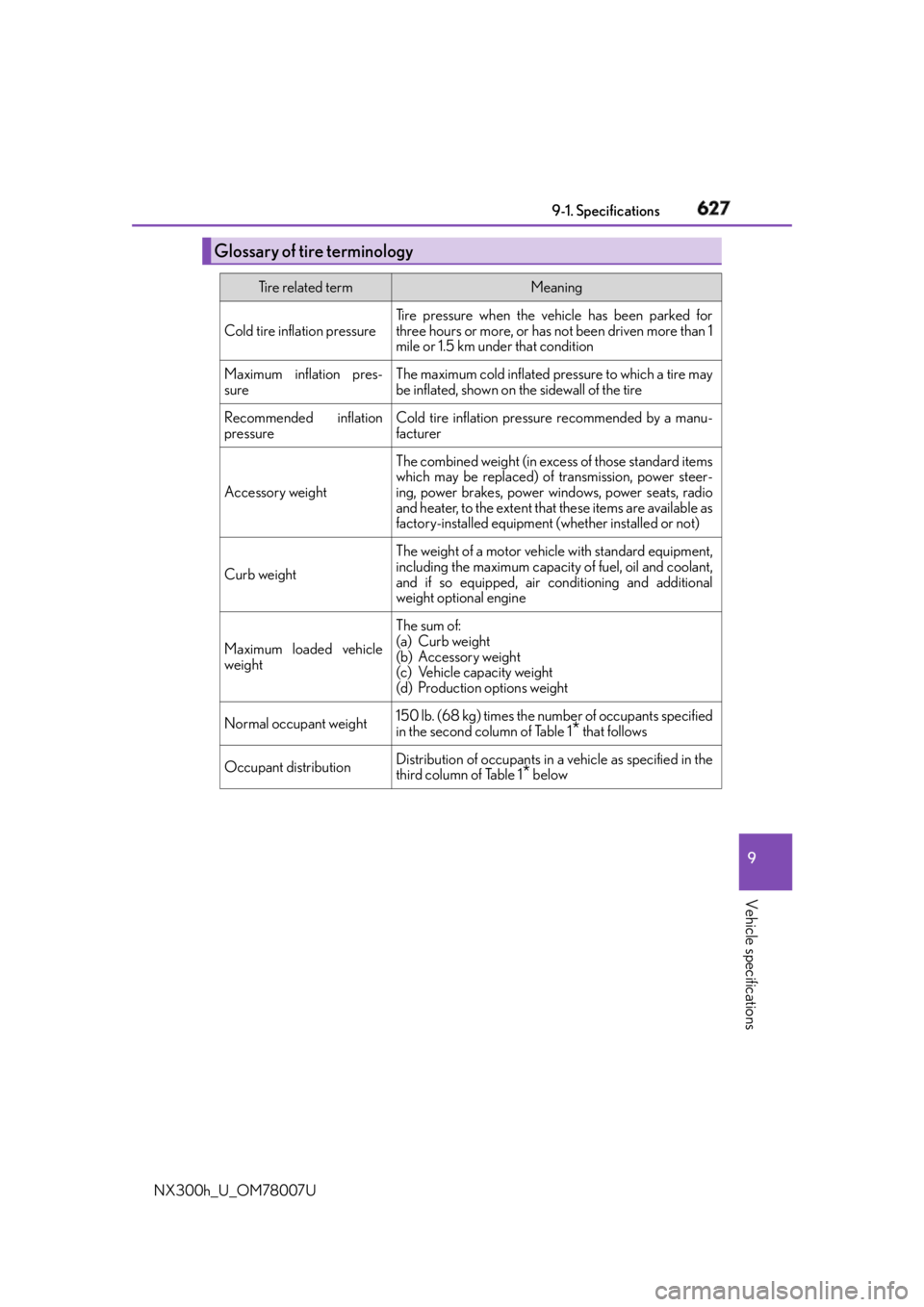
NX300h_U_OM78007U Glossary of tire terminology Tire related term Meaning
Cold tire inflation pressure Tire pressure when the vehicle has been parked for
three hours or more, or has not been driven more than 1
mile or 1.5 km un der that condition
Maximum inflation pres-
sure The maximum cold inflated pressure to which a tire may
be inflated, shown on the sidewall of the tire
Recommended inflation
pressure Cold tire inflation pressure recommended by a manu-
facturer
Accessory weight The combined weight (in excess of those standard items
which may be replaced) of transmission, power steer-
ing, power brakes, power wi ndows, power seats, radio
and heater, to the extent that these items are available as
factory-installed equipment (whether installed or not)
Curb weight The weight of a motor vehicle with standard equipment,
including the maximum capacity of fuel, oil and coolant,
and if so equipped, air co nditioning and additional
weight optional engine
Maximum loaded vehicle
weight The sum of:
(a) Curb weight
(b) Accessory weight
(c) Vehicle capacity weight
(d) Production options weight
Normal occupant weight 150 lb. (68 kg) times the numb er of occupa nts specified
in the second column of Table 1
* that follows
Occupant distribution Distribution of occupants in a vehicle as specified in the
third column of Table 1
* below


