Page 323 of 628

3234-6. Driving tips
4
Driving
IS300h_EE(OM53D56E)
Park the vehicle and move the shift lever to P without setting the parking brake.
The parking brake may freeze up, preventing it from being released. If necessary,
block the wheels to prevent inadvertent sliding or creeping.
XExcept vehicles with 18-inch tires
Use the correct tire chain size when mounting the tire chains.
Chain size is regulated for each tire size.
Side chain
(3 mm [0.12 in.] in diameter)
Cross chain
(4 mm [0.16 in.] in diameter)
XVehicles with 18-inch tires
Tire chains cannot be mounted on the 18-inch tires.
Snow tires should be used instead.
Regulations regarding the use of tire chains vary depending on location and type
of road. Always check local regulations before installing chains.
■Tire chain installation
Observe the following precautions when installing and removing chains:
●Install and remove tire chains in a safe location.
●Install tire chains on the rear tires. Do not install tire chains on the front tires.
●Install tire chains on rear tires as tightly as possible. Retighten chains after driving 0.5
1.0 km (1 /4 1 /2 mile).
●Install tire chains following the instructions provided with the tire chains.
When parking the vehicle
Selecting tire chains
1
2
Regulations on the use of tire chains
Page 324 of 628
3244-6. Driving tips
IS300h_EE(OM53D56E)
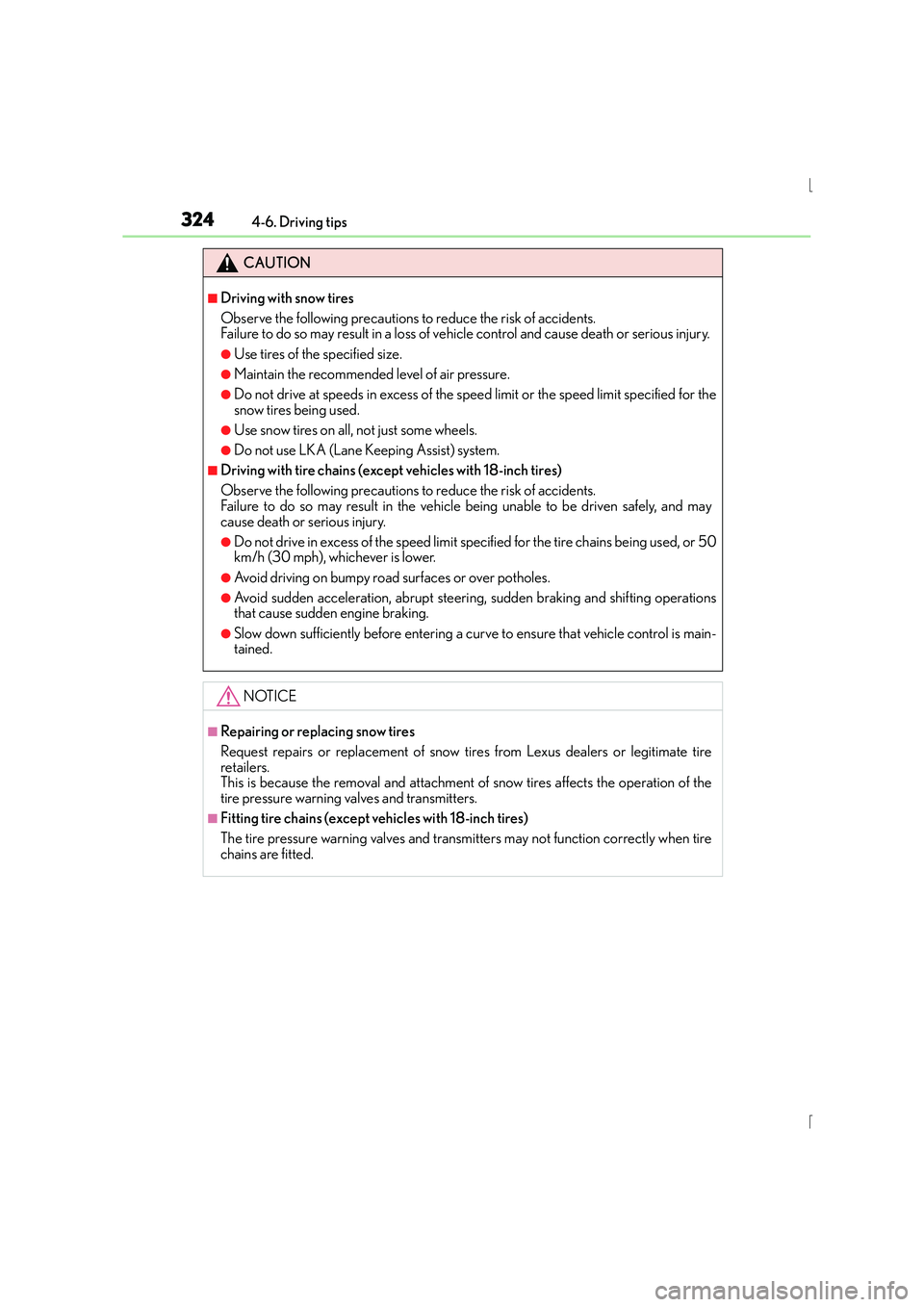
CAUTION
■Driving with snow tires
Observe the following precautions to reduce the risk of accidents.
Failure to do so may result in a loss of vehicle control and cause death or serious injury.
●Use tires of the specified size.
●Maintain the recommended level of air pressure.
●Do not drive at speeds in excess of the speed limit or the speed limit specified for the
snow tires being used.
●Use snow tires on all, not just some wheels.
●Do not use LKA (Lane Keeping Assist) system.
■Driving with tire chains (except vehicles with 18-inch tires)
Observe the following precautions to reduce the risk of accidents.
Failure to do so may result in the vehicle being unable to be driven safely, and may
cause death or serious injury.
●Do not drive in excess of the speed limit sp ecified for the tire chains being used, or 50
km/h (30 mph), whichever is lower.
●Avoid driving on bumpy road surfaces or over potholes.
●Avoid sudden acceleration, abrupt steeri ng, sudden braking and shifting operations
that cause sudden engine braking.
●Slow down sufficiently before entering a curve to ensure that vehicle control is main-
tained.
NOTICE
■Repairing or replacing snow tires
Request repairs or replacement of snow tires from Lexus dealers or legitimate tire
retailers.
This is because the removal and attachment of snow tires affects the operation of the
tire pressure warning valves and transmitters.
■Fitting tire chains (except vehicles with 18-inch tires)
The tire pressure warning valves and transmitters may not function correctly when tire
chains are fitted.
Page 441 of 628
441
7Maintenance and care
IS300h_EE(OM53D56E)
7-1. Maintenance and careCleaning and protecting the vehicle exterior................. 442
Cleaning and protecting the vehicle interior.................. 446
7-2. Maintenance Maintenance requirements............................. 449
7-3. Do-it-yourself maintenance Do-it-yourself service precautions..................................451
Hood ............................................... 453
Positioning a floor jack............. 454
Engine compartment ............... 455
12-volt battery ............................. 463
Tires.................................................. 466
Replacing the tire ........................ 476
Tire inflation pressure ............... 482
Wheels ........................................... 484
Air conditioning filter ............... 486
Electronic key battery ..............488
Checking and replacing fuses................................................491
Light bulbs..................................... 495
Page 450 of 628

4507-2. Maintenance
IS300h_EE(OM53D56E)
■Where to go for maintenance service?
In order to maintain your vehicle in the best possible condition, Lexus recommends that
maintenance service operations as well as other inspections and repairs be carried out
by authorized Lexus dealers or repairers or other duly qualified and equipped profes-
sionals. For repairs and services covered by your warranty, please visit an authorized
Lexus dealer or repairer, who will use genuine Lexus parts in repairing any difficulties you
may encounter. There can also be advantag es in utilizing authorized Lexus dealers or
repairers for non-warranty repairs and services, as members of the Lexus network will be
able to expertly assist you with any difficulties you may encounter.
Your Lexus dealer or repairer, or another duly qualified and equipped professional will
perform all of the scheduled maintenance on your vehicle reliably and economically due
to their experience with Lexus vehicles.
■Does your vehicle need repairs?
Be on the alert for changes in performance and sounds, and visual tip-offs that indicate
service is needed. Some important clues are:
●Engine missing, stumbling or pinging
●Appreciable loss of power
●Strange engine noises
●A fluid leak under the vehicle (However, water dripping from the air conditioning sys-
tem after use is normal.)
●Change in exhaust sound (This may indicate a dangerous carbon monoxide leak. Drive
with the windows open and have the exhaust system checked immediately.)
●Flat-looking tires, excessive tire squeal when cornering, uneven tire wear
●Vehicle pulls to one side when driven straight on a level road
●Strange noises related to suspension movement
●Loss of brake effectiveness, spongy feeling brake pedal, pedal almost touches the floor,
vehicle pulls to one side when braking
●Engine coolant temperature continually higher than normal ( →P. 1 0 9 )
If you notice any of these clues, take your vehicle to any authorized Lexus dealer or
repairer, or another duly qualified and equipp ed professional as soon as possible. Your
vehicle may need adjustment or repair.
CAUTION
■If your vehicle is not properly maintained
Improper maintenance could result in serious damage to the vehicle and possible
death or serious injury.
■Handling of the 12-volt battery
12-volt battery posts, terminals and related accessories contain lead and lead com-
pounds which are known to cause brain damage. Wash your hands after handling.
( → P. 4 6 3 )
Page 451 of 628
451
7
Maintenance and care
IS300h_EE(OM53D56E)7-3. Do-it-yourself maintenance
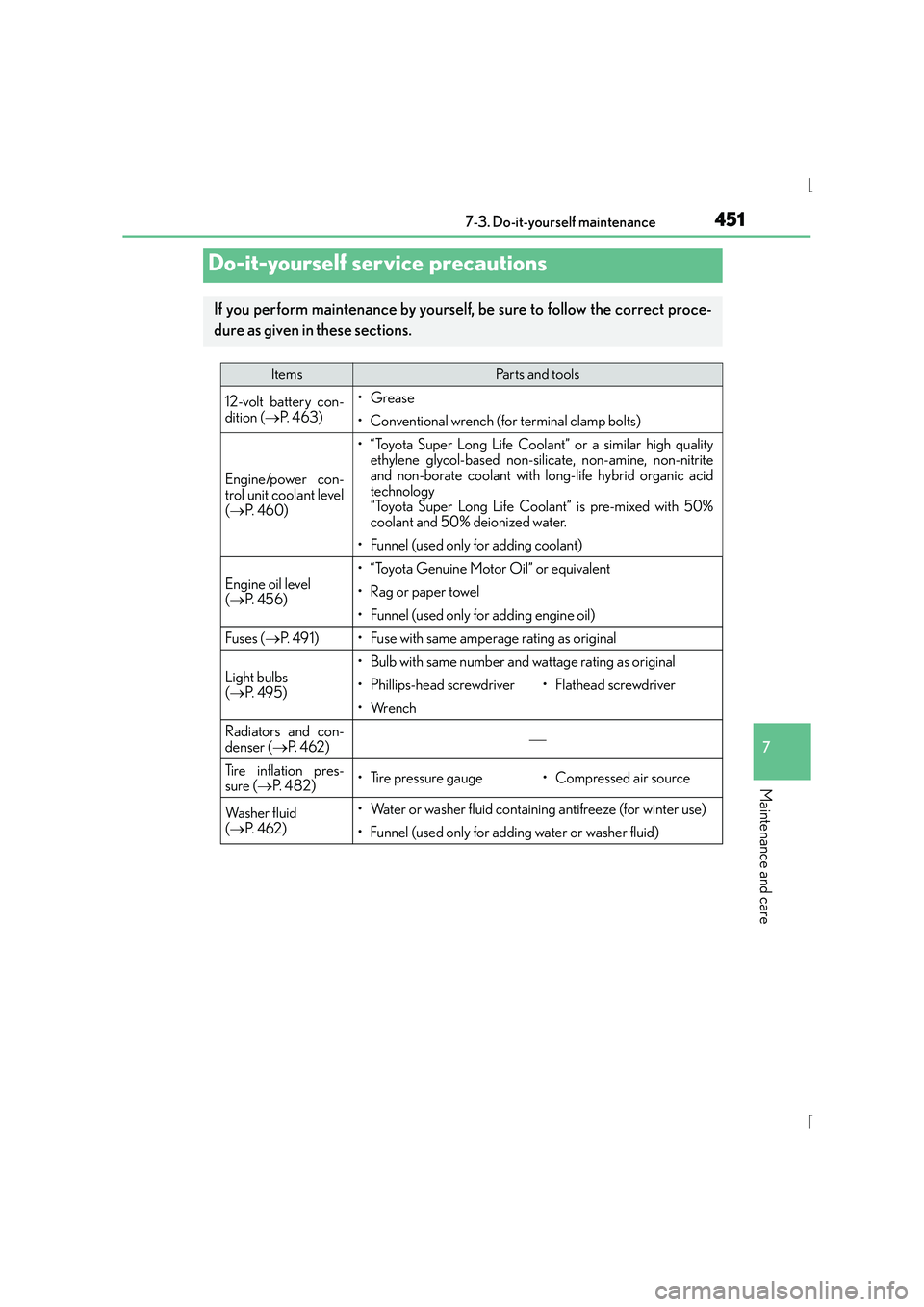
Do-it-yourself service precautions
If you perform maintenance by yourself, be sure to follow the correct proce-
dure as given in these sections.
ItemsParts and tools
12-volt battery con-
dition (
→P. 4 6 3 )•Grease
• Conventional wrench (for terminal clamp bolts)
Engine/power con-
trol unit coolant level
(→ P. 4 6 0 )
• “Toyota Super Long Life Coolant” or a similar high quality
ethylene glycol-based non-silicate, non-amine, non-nitrite
and non-borate coolant with long-life hybrid organic acid
technology
“Toyota Super Long Life Coolant” is pre-mixed with 50%
coolant and 50% deionized water.
• Funnel (used only for adding coolant)
Engine oil level
(→ P. 4 5 6 )
• “Toyota Genuine Motor Oil” or equivalent
• Rag or paper towel
• Funnel (used only for adding engine oil)
Fuses ( →P. 4 9 1 )• Fuse with same amperage rating as original
Light bulbs
(→ P. 4 9 5 )
• Bulb with same number and wattage rating as original
• Phillips-head screwdriver•Flathead screwdriver
•Wrench
Radiators and con-
denser ( →P. 4 6 2 )
Tire inflation pres-
sure ( →P. 4 8 2 )• Tire pressure gauge• Compressed air source
Wa s h e r f l u i d
(→ P. 4 6 2 )• Water or washer fluid containing antifreeze (for winter use)
• Funnel (used only for adding water or washer fluid)
Page 466 of 628
4667-3. Do-it-yourself maintenance
IS300h_EE(OM53D56E)
Check if the treadwear indicators are showing on the tires. Also check the tires
for uneven wear, such as excessive wear on one side of the tread.
Check the spare tire condition and pressure if not rotated.New tread
Wo r n t r e a d
Treadwear indicator
The location of treadwear indicat ors is shown by a “TWI” or “∆” mark, etc., molded
into the sidewall of each tire.
Replace the tires if the treadwear indicators are showing on a tire.
Tires
Replace or rotate tires in accordance with maintenance schedules and tread-
wear.
Checking tires
1
2
3
Page 467 of 628
4677-3. Do-it-yourself maintenance
7
Maintenance and care
IS300h_EE(OM53D56E)
Rotate the tires in the order shown.
To equalize tire wear and help extend tire life, Lexus recommends that tire rota-
tion is carried out approximately every 10000 km (6000 miles).
Do not fail to initialize the tire pressure warning system after tire rotation.
Tire rotation
XVehicles with front and rear tires of
the same sizeXVehicles with front and rear tires of
differing sizes
FrontFront
Page 468 of 628

4687-3. Do-it-yourself maintenance
IS300h_EE(OM53D56E)
Your vehicle is equipped with a tire pressure warning system that uses tire pres-
sure warning valves and transmitters to detect low tire inflation pressure before
serious problems arise.
If the tire pressure drops below a predetermined level, the driver is warned by a
warning light. ( →P. 5 2 3 )
◆Installing tire pressure warning valves and transmitters
When replacing tires or wheels, tire pr essure warning valves and transmitters
must also be installed.
When new tire pressure warning valves and transmitters are installed, new ID
codes must be registered in the tire pressure warning computer and the tire
pressure warning system must be initialized. Have tire pressure warning valve
and transmitter ID codes registered by any authorized Lexus dealer or
repairer, or another duly qualified and equipped professional. ( →P. 4 6 9 )
◆Initializing the tire pressure warning system
■The tire pressure warning system must be initialized in the following circum-
stances:
●When rotating the tires.
●When the tire inflation pressure is changed such as when changing travel-
ing speed or load weight.
●When changing the tire size.
When the tire pressure warning system is initialized, the current tire inflation
pressure is set as the benchmark pressure.
Tire pressure warning system

