Page 359 of 620

359
5Interior features
GS450h_300h_OM_OM30F00E_(EE)
5-1. Remote Touch screenRemote Touch/12.3-inch display ......................................... 360
5-2. Using the air conditioning system and defogger
Front automatic air conditioning system .........366
Rear air conditioning system .......................................... 378
Heated steering wheel/ seat heaters/
seat ventilators .......................... 381 5-3. Using the interior lights
Interior lights list .........................386• Interior lights .......................... 387
• Personal lights ....................... 387
5-4. Using the storage features List of storage features ............389• Glove box ...............................390
• Console box...........................390
• Cup holders ............................ 391
• Auxiliary boxes ..................... 393
Trunk features .............................. 394
5-5. Using the other interior features Other interior features ............ 397• Sun visors ................................ 397
• Vanity mirrors ........................ 397
• Clock ........................................398
• Ashtrays ...................................398
• Power outlets ......................... 399
• Armrest....................................400
• Rear sunshade/
rear door sunshades...........400
• Coat hooks ............................. 402
• Assist grips.............................. 403
Page 381 of 620

381
5
5-2. Using the air conditioning system and defogger
Interior features
GS450h_300h_OM_OM30F00E_(EE)
Heated steering wheel∗/seat heaters∗/seat ventilators∗
∗: If equipped
Heated steering wheel and seat heaters heat the side grips of the steering
wheel and seats, respectively. Seat ventilators maintain good airflow by blow-
ing air from the seats.
WA R N I N G
●Care should be taken to prevent injury if
anyone in the following categories comes in
contact with the steering wheel and seats when the heater is on:
• Babies, small children, the elderly, the sick and the physically challenged
• Persons with sensitive skin
• Persons who are fatigued
• Persons who have taken alcohol or drugs that induce sleep (sleeping drugs, cold
remedies, etc.)
●Observe the following precautions to prevent minor burns or overheating:
• Do not cover the seat with a blanket or cushion when using the seat heater.
• Do not use seat heater more than necessary.
NOTICE
●To prevent damage to the seat heaters/seat ventilators, do not put heavy objects that
have an uneven surface on the seat and do not stick sharp objects (needles, nails, etc.)
into the seat.
●To prevent 12-volt battery discharge, do not use the functions when the hybrid system
is off.
Page 382 of 620
3825-2. Using the air conditioning system and defogger
GS450h_300h_OM_OM30F00E_(EE)
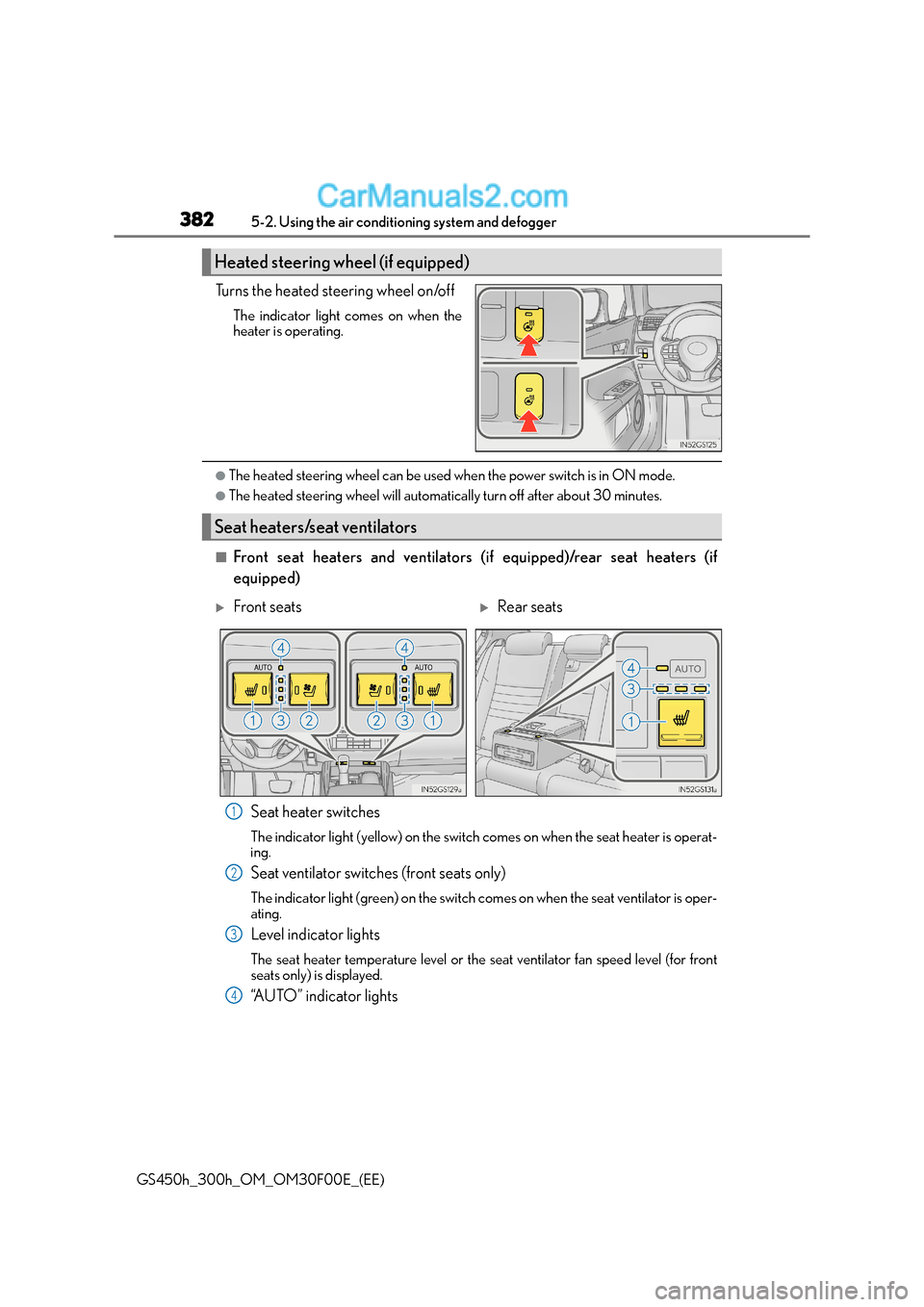
Turns the heated steering wheel on/off
The indicator light comes on when the
heater is operating.
●The heated steering wheel can be used when the power switch is in ON mode.
●The heated steering wheel will automatically turn off after about 30 minutes.
■Front seat heaters and ventilators (i f equipped)/rear seat heaters (if
equipped)
Seat heater switches
The indicator light (yellow) on the switch comes on when the seat heater is operat-
ing.
Seat ventilator switches (front seats only)
The indicator light (green) on the switch comes on when the seat ventilator is oper-
ating.
Level indicator lights
The seat heater temperature level or the seat ventilator fan speed level (for front
seats only) is displayed.
“AUTO” indicator lights
Heated steering wheel (if equipped)
Seat heaters/seat ventilators
XFront seatsXRear seats
1
2
3
4
Page 409 of 620

4096-1. Maintenance and care
6
Maintenance and care
GS450h_300h_OM_OM30F00E_(EE)
NOTICE
■To prevent paint deterioration and corrosion on the body and components (aluminum
wheels etc.)
●Wash the vehicle immediately in the following cases:
• After driving near the sea coast
• After driving on salted roads
• If coal tar, pollen or tree sap is present on the paint surface
• If dead insects, insect droppings or bird droppings are present on the paint surface
• After driving in an area contaminated wi th soot, oily smoke, mine dust, iron pow-
der or chemical substances
• If the vehicle becomes heavily soiled with dust or mud
• If liquids such as benzene and gaso line are spilled on the paint surface
●If the paint is chipped or scratched, have it repaired immediately.
●To prevent the wheels from corroding, remove any dirt and store in a place with low
humidity when storing the wheels.
■Cleaning the exterior lights
●Wash carefully. Do not use organic substances or scrub with a hard brush.
This may damage the surfaces of the lights.
●Do not apply wax to the surfaces of the lights.
Wax may cause damage to the lenses.
■When using an automatic car wash (vehicles with rain-sensing windshield wipers)
Turn off AUTO mode of the wiper to prevent the wiper from operating. ( →P. 2 5 0 )
If AUTO mode is selected, the wipers may operate and the wiper blades may be dam-
aged.
■When using a high-pressure car wash
●When washing the vehicle, do not let water from the high-pressure washer directly hit
the camera or the area around the camera. Due to the shock from high-pressure
water, it is possible that the device may not operate normally.
●Do not bring the nozzle tip close to boots (rubber or resin manufactured cover), con-
nectors or the following parts. The parts may be damaged if they come into contact
with high-pressure water.
• Traction related parts
•Suspension parts •Steering parts
•Brake parts
Page 469 of 620
469
7
7-1. Essential information
When trouble arises
GS450h_300h_OM_OM30F00E_(EE)
If your vehicle has to be stopped in an emergency
Steadily step on the brake pedal with both feet and firmly depress it.
Do not pump the brake pedal repeatedly as this will increase the effort required to
slow the vehicle.
Shift the shift lever to N.
XIf the shift lever is shifted to N
After slowing down, stop the vehicle in a safe place by the road.
Stop the hybrid system.
XIf the shift lever cannot be shifted to N
Keep depressing the brake pedal with both feet to reduce vehicle speed as
much as possible.
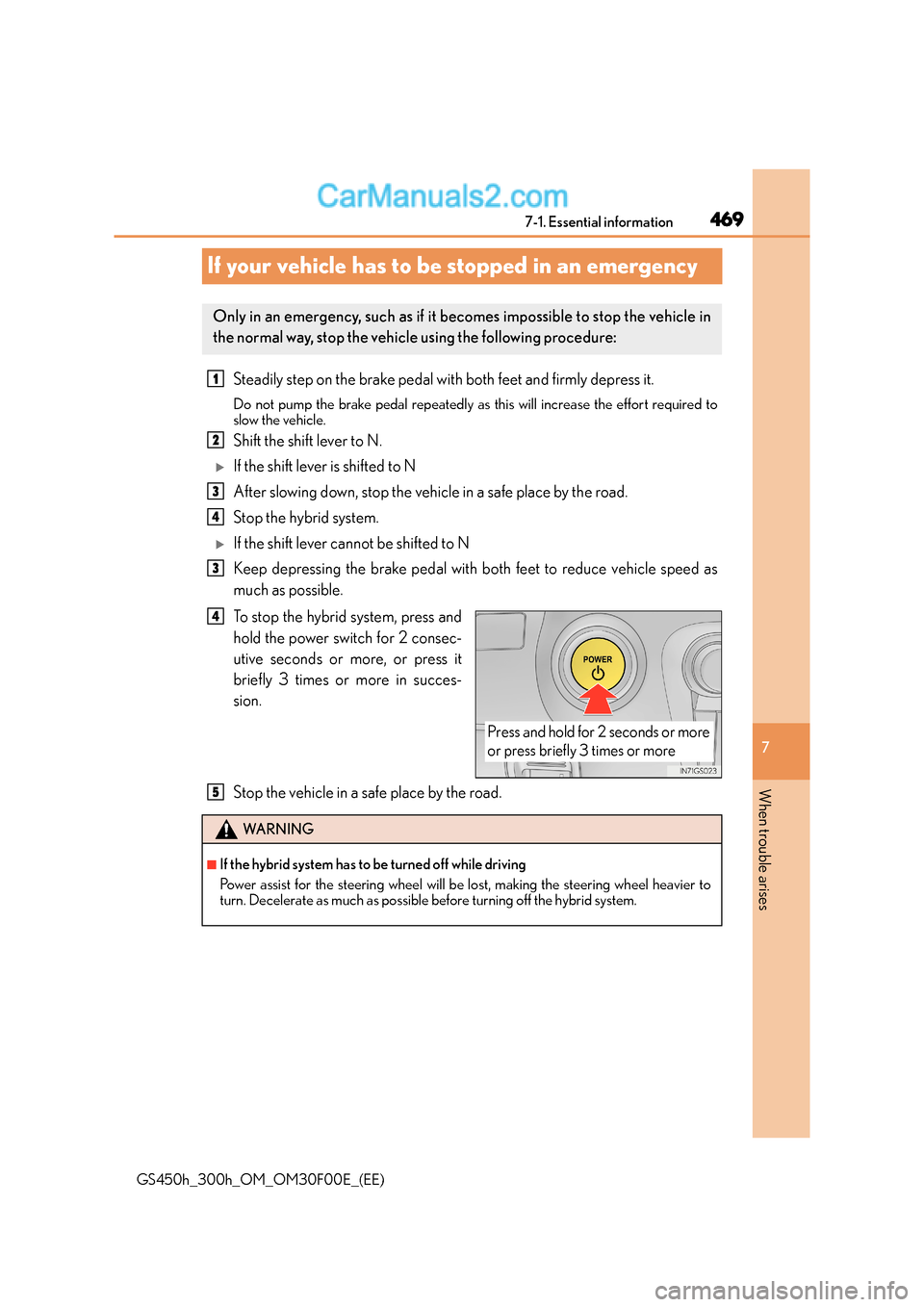
To stop the hybrid system, press and
hold the power switch for 2 consec-
utive seconds or more, or press it
briefly 3 times or more in succes-
sion.
Stop the vehicle in a safe place by the road.
Only in an emergency, such as if it becomes impossible to stop the vehicle in
the normal way, stop the vehicle using the following procedure:
1
2
3
4
3
Press and hold for 2 seconds or more
or press briefly 3 times or more
4
WA R N I N G
■If the hybrid system has to be turned off while driving
Power assist for the steering wheel will be lost, making the steering wheel heavier to
turn. Decelerate as much as possible before turning off the hybrid system.
5
Page 472 of 620
4727-2. Steps to take in an emergency
GS450h_300h_OM_OM30F00E_(EE)
If a tow truck is not available in an emergency, your vehicle may be temporarily
towed using cables or chains secured to the emergency towing eyelets. This
should only be attempted on hard surfaced roads for short distances at under
5 km/h (3 mph).
A driver must be in the vehicle to steer and operate the brakes. The vehicle’s
wheels, drive train, axles, steering and brakes must be in good condition.Take out the towing eyelet. ( →P. 5 1 8 , 5 2 9 )
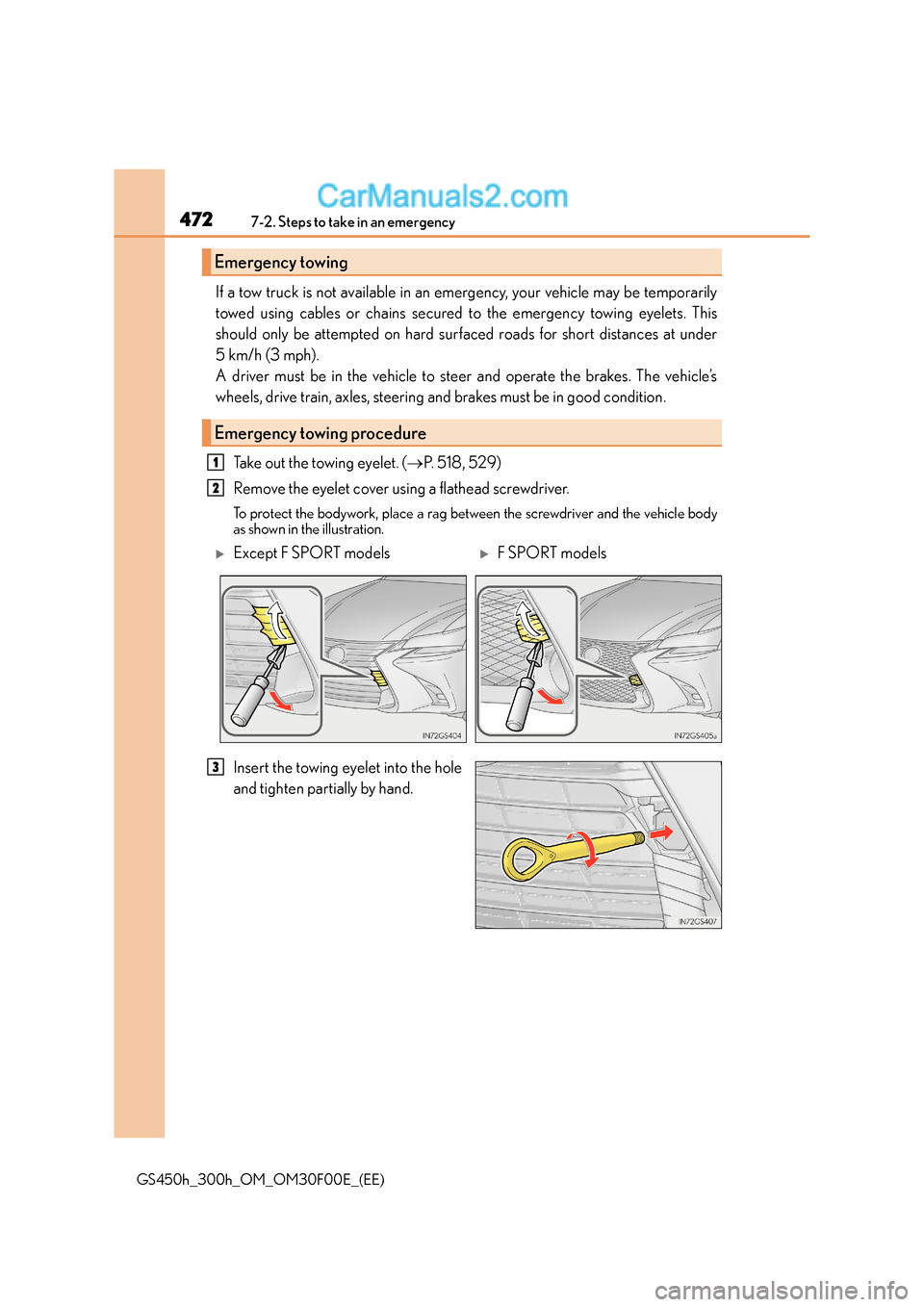
Remove the eyelet cover using a flathead screwdriver.
To protect the bodywork, place a rag between the screwdriver and the vehicle body
as shown in the illustration.
Insert the towing eyelet into the hole
and tighten partially by hand.
Emergency towing
Emergency towing procedure
1
2
XExcept F SPORT modelsXF SPORT models
3
Page 473 of 620
4737-2. Steps to take in an emergency
7
When trouble arises
GS450h_300h_OM_OM30F00E_(EE)
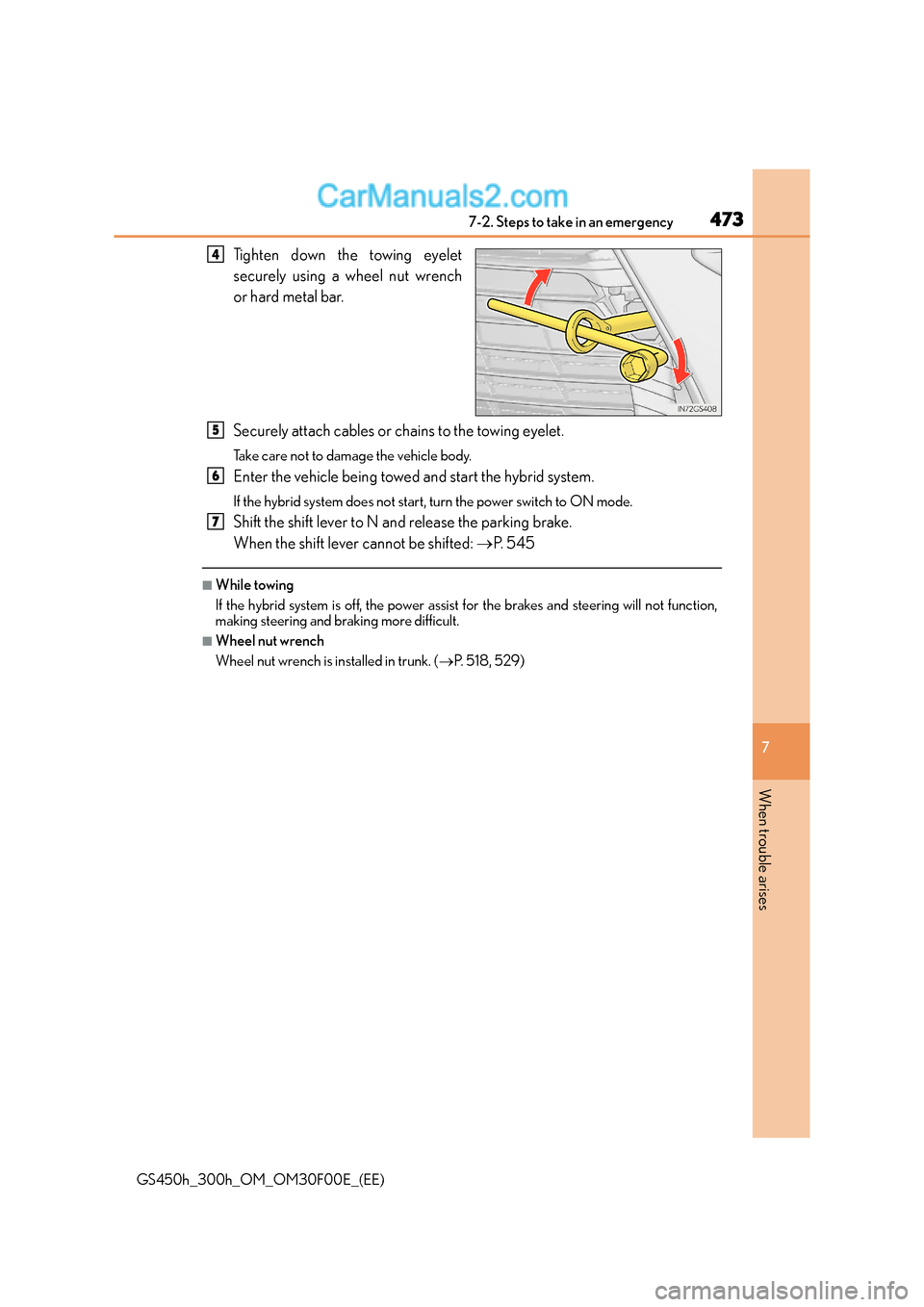
Tighten down the towing eyelet
securely using a wheel nut wrench
or hard metal bar.
Securely attach cables or chains to the towing eyelet.
Take care not to damage the vehicle body.
Enter the vehicle being towed and start the hybrid system.
If the hybrid system does not start, turn the power switch to ON mode.
Shift the shift lever to N and release the parking brake.
When the shift lever cannot be shifted: →P. 5 4 5
■While towing
If the hybrid system is off, the power assist for the brakes and steering will not function,
making steering and braking more difficult.
■Wheel nut wrench
Wheel nut wrench is installed in trunk. ( →P. 5 1 8 , 5 2 9 )
4
5
6
7
Page 474 of 620
4747-2. Steps to take in an emergency
GS450h_300h_OM_OM30F00E_(EE)
WA R N I N G
Observe the following precautions.
Failure to do so may result in death or serious injury.
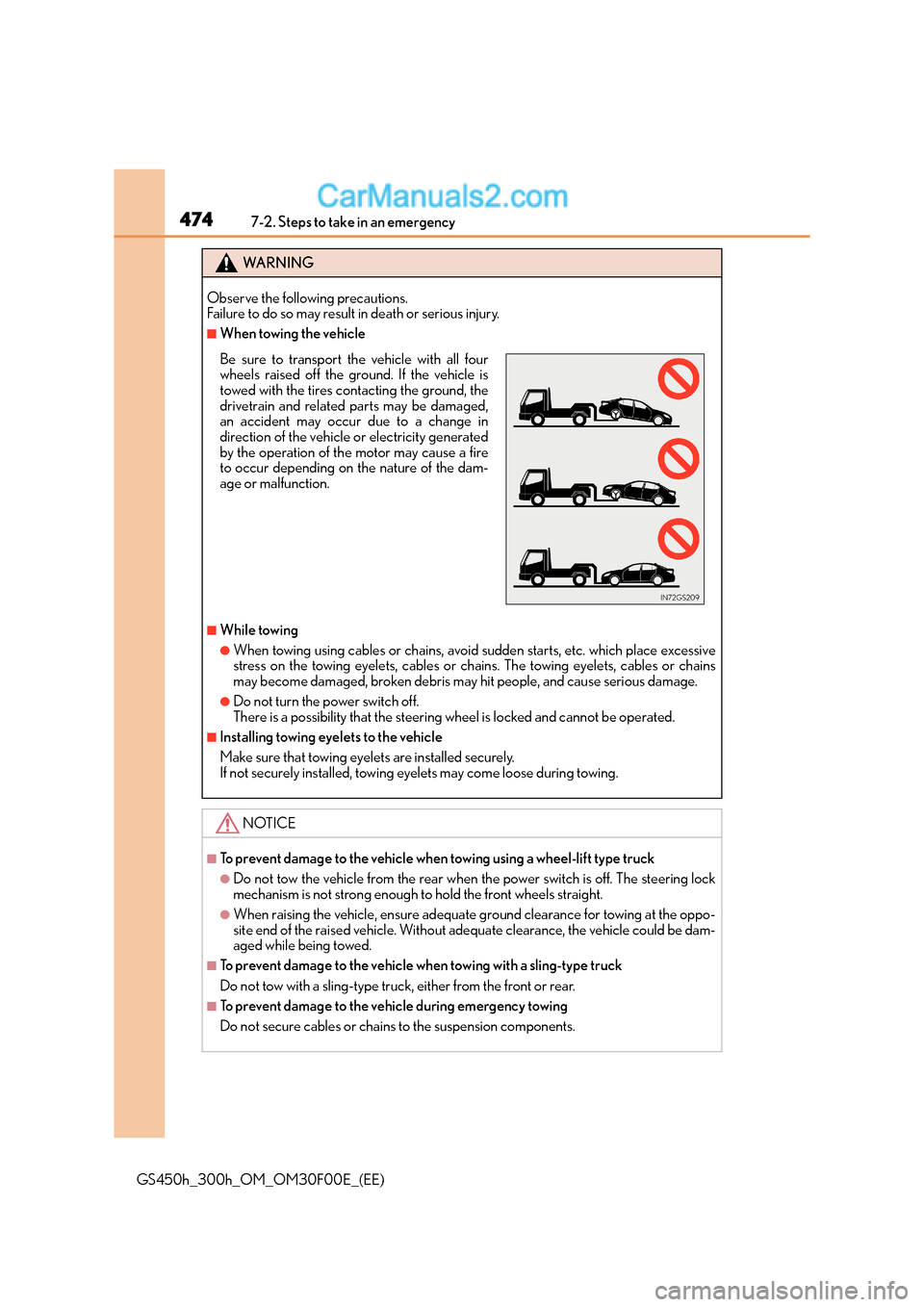
■When towing the vehicle
■While towing
●When towing using cables or chains, avoid sudden starts, etc. which place excessive
stress on the towing eyelets, cables or chains. The towing eyelets, cables or chains
may become damaged, broken debris may hit people, and cause serious damage.
●Do not turn the power switch off.
There is a possibility that the steering wh eel is locked and cannot be operated.
■Installing towing eyelets to the vehicle
Make sure that towing eyelets are installed securely.
If not securely installed, towing eyelets may come loose during towing.
NOTICE
■To prevent damage to the vehicle when towing using a wheel-lift type truck
●Do not tow the vehicle from the rear when the power switch is off. The steering lock
mechanism is not strong enough to hold the front wheels straight.
●When raising the vehicle, ensure adequate ground clearance for towing at the oppo-
site end of the raised vehicle. Without adequate clearance, the vehicle could be dam-
aged while being towed.
■To prevent damage to the vehicle when towing with a sling-type truck
Do not tow with a sling-type truck, either from the front or rear.
■To prevent damage to the vehicle during emergency towing
Do not secure cables or chains to the suspension components.
Be sure to transport the vehicle with all four
wheels raised off the ground. If the vehicle is
towed with the tires contacting the ground, the
drivetrain and related parts may be damaged,
an accident may occur due to a change in
direction of the vehicle or electricity generated
by the operation of the motor may cause a fire
to occur depending on the nature of the dam-
age or malfunction.