2015 Lexus ES300h esp
[x] Cancel search: espPage 574 of 786

ES350_300h_OM_OM33B36U_(U)
5737-3. Do-it-yourself maintenance
7
Maintenance and care
■Tire pressure warning system certification
MODEL/FCC IDs:
Tr a n s m i t t e r : PA X P M V C 0 1 0
Initiator: HYQ22AAA
XFor vehicles sold in the U.S.A.
Note:
This device complies with part 15 of the FCC Rules. Operation is subject to the fol-
lowing two conditions: (1) This device may not cause harmful interference, and (2)
this device must accept any interference received, including interference that may
cause undesired operation.
FCC WARNING:
Changes or modifications not expressly approved by the party responsible for com-
pliance could void the user’s authority to operate the equipment.
XFor vehicles sold in Canada
●Transmitter
NOTE:
Operation is subject to the following two conditions: (1) this device may not cause
interference, and (2) this device must accept any interference, including interfer-
ence that may cause undesired operation of the device.
●Initiator
Note:
This device complies with Industry Canada licence-exempt RSS standard(s).
Operation is subject to the following two conditions: (1) this device may not cause
interference, and (2) this device must accept any interference, including interfer-
ence that may cause undesired operation of the device.
Page 635 of 786

6348-2. Steps to take in an emergency
ES350_300h_OM_OM33B36U_(U)
CAUTION
■Maintenance of the tires
Each tire, including the spare (if provided), should be checked monthly when cold
and inflated to the inflation pressure recommended by the vehicle manufacturer on
the vehicle placard or tire inflation pressure label (tire and load information label).
(If your vehicle has tires of a different size than the size indicated on the vehicle
placard or tire inflation pressure label [tire and load information label], you should
determine the proper tire inflation pressure for those tires.)
As an added safety feature, your vehicle has been equipped with a tire pressure
monitoring system (TPMS-tire pressure warning system) that illuminates a low tire
pressure telltale (tire pressure warning light) when one or more of your tires is sig-
nificantly under-inflated. Accordingly, when the low tire pressure telltale (tire pres-
sure warning light) illuminates, you should stop and check your tires as soon as
possible, and inflate them to the proper pressure. Driving on a significantly under-
inflated tire causes the tire to overheat and can lead to tire failure. Under-inflation
also reduces fuel efficiency and tire tread life, and may affect the vehicle’s handling
and stopping ability.
Please note that the TPMS (tire pressure warning system) is not a substitute for
proper tire maintenance, and it is the driver’s responsibility to maintain correct tire
pressure, even if under-inflation has not reached the level to trigger illumination of
the TPMS low tire pressure telltale (tire pressure warning light).
Your vehicle has also been equipped with a TPMS (tire pressure warning system)
malfunction indicator to indicate when the system is not operating properly. The
TPMS (tire pressure warning system) malfunction indicator is combined with the
low tire pressure telltale (tire pressure warning light). When the system detects a
malfunction, the telltale will flash for approximately one minute and then remain
continuously illuminated. This sequence will continue upon subsequent vehicle
start-ups as long as the malfunction exists. When the malfunction indicator is illumi-
nated, the system may not be able to detect or signal low tire pressure as intended.
Page 651 of 786
6508-2. Steps to take in an emergency
ES350_300h_OM_OM33B36U_(U)
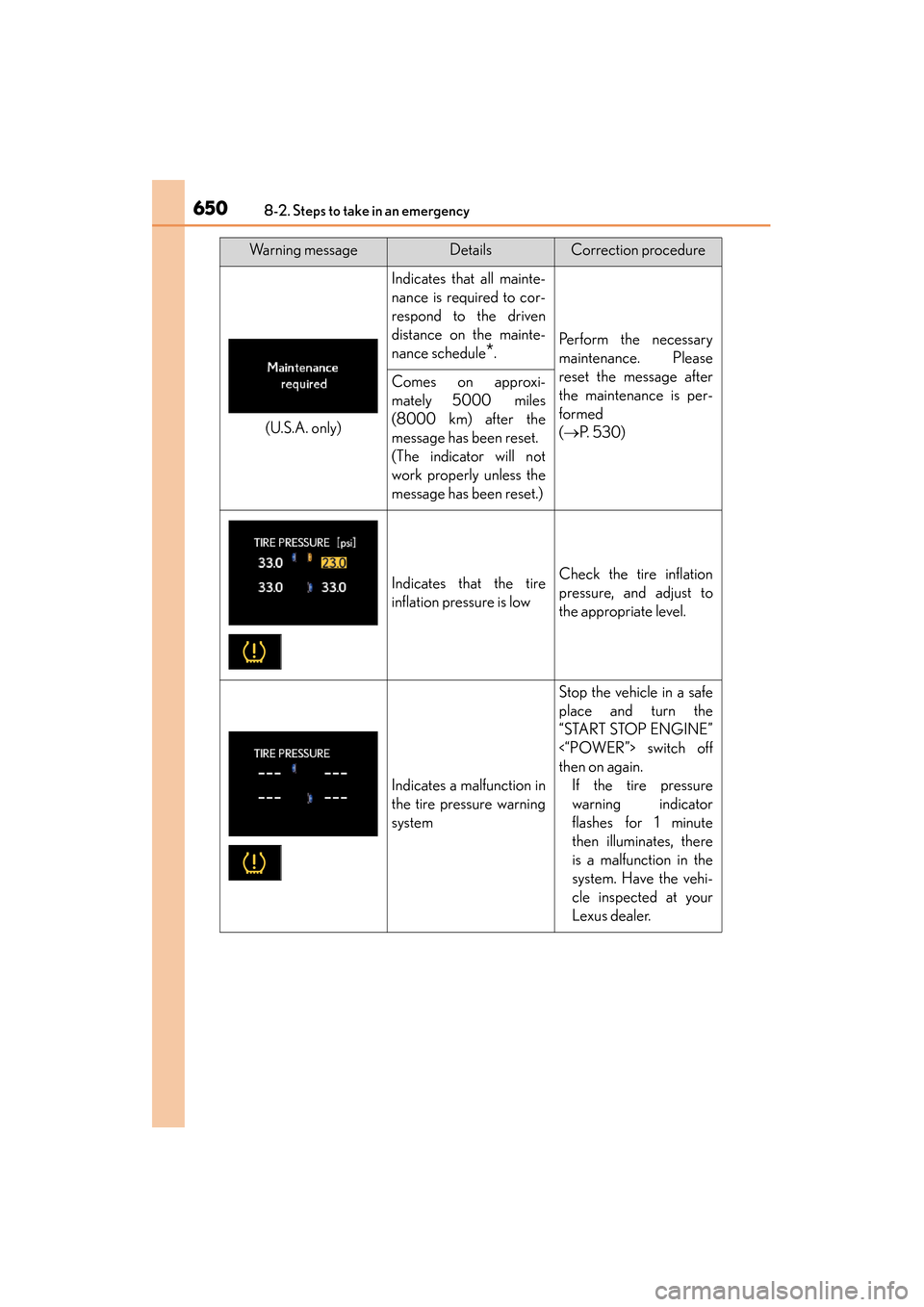
Warning messageDetailsCorrection procedure
Indicates that all mainte-
nance is required to cor-
respond to the driven
distance on the mainte-
nance schedule
*.Perform the necessary
maintenance. Please
reset the message after
the maintenance is per-
formed
(→ P. 5 3 0 )
Comes on approxi-
mately 5000 miles
(8000 km) after the
message has been reset.
(The indicator will not
work properly unless the
message has been reset.)
Indicates that the tire
inflation pressure is lowCheck the tire inflation
pressure, and adjust to
the appropriate level.
Indicates a malfunction in
the tire pressure warning
system
Stop the vehicle in a safe
place and turn the
“START STOP ENGINE”
<“POWER”> switch off
then on again.
If the tire pressure
warning indicator
flashes for 1 minute
then illuminates, there
is a malfunction in the
system. Have the vehi-
cle inspected at your
Lexus dealer.
(U.S.A. only)
Page 683 of 786

6828-2. Steps to take in an emergency
ES350_300h_OM_OM33B36U_(U)
■Charging the 12-volt battery
The electricity stored in the 12-volt battery will discharge gradually even when the
vehicle is not in use, due to natural discharge and the draining effects of certain elec-
trical appliances. If the vehicle is left for a long time, the 12-volt battery may dis-
charge, and the engine may be unable to start. (The 12-volt battery recharges
automatically during driving.)
■When recharging or replacing the 12-volt battery
●Make sure that the key is not inside the vehicle when recharging or replacing the
12-volt battery. The key may be locked in the vehicle if the alarm is activated.
(→ P. 8 9 )
●In some cases, it may not be possible to unlock the doors using the smart access
system with push-button start when the 12-volt battery is discharged. Use the wire-
less remote control or the mechanical key to lock or unlock the doors.
●The engine may not start on the first attempt after the 12-volt battery has recharged
but will start normally after the second attempt. This is not a malfunction.
●The “START STOP ENGINE” switch mode is memorized by the vehicle. When the
12-volt battery is reconnected, the system will return to the mode it was in before
the 12-volt battery was discharged. Before disconnecting the 12-volt battery, turn
the “START STOP ENGINE” switch off.
If you are unsure what mode the “START STOP ENGINE” switch was in before the
12-volt battery discharged, be especially careful when reconnecting the 12-volt
battery.
CAUTION
■Avoiding 12-volt battery fires or explosions
Observe the following precautions to prevent accidentally igniting the flammable
gas that may be emitted from the 12-volt battery:
●Make sure each jumper cable is connected to the correct terminal and that it is
not unintentionally in contact with any other than the intended terminal.
●Do not allow the other end of the jumper cable connected to the “+” terminal to
come into contact with any other parts or metal surfaces in the area, such as
brackets or unpainted metal.
●Do not allow the + and - clamps of the jumper cables to come into contact with
each other.
●Do not smoke, use matches, cigarette lighters or allow open flame near the 12-
volt battery.
Page 687 of 786

6868-2. Steps to take in an emergency
ES350_300h_OM_OM33B36U_(U)
■Starting the hybrid system when the 12-volt battery is discharged
The hybrid system cannot be started by push-starting.
■To prevent 12-volt battery discharge
●Turn off the headlights and the audio system while the hybrid system is off.
●Turn off any unnecessary electrical components when the vehicle is running at a
low speed for an extended period, such as in heavy traffic.
■Charging the 12-volt battery
The electricity stored in the 12-volt battery will discharge gradually even when the
vehicle is not in use, due to natural discharge and the draining effects of certain elec-
trical appliances. If the vehicle is left for a long time, the 12-volt battery may dis-
charge, and the hybrid system may be unable to start. (The 12-volt battery recharges
automatically while the hybrid system is operating.)
■When recharging or replacing the 12-volt battery
●Make sure that the key is not inside the vehicle when recharging or replacing the
12-volt battery. The key may be locked in the vehicle if the alarm is activated.
(→ P. 8 9 )
●In some cases, it may not be possible to unlock the doors using the smart access
system with push-button start when the 12-volt battery is discharged. Use the wire-
less remote control or the mechanical key to lock or unlock the doors.
●The hybrid system may not start on the first attempt after the 12-volt battery has
recharged but will start normally after the second attempt. This is not a malfunction.
●The “POWER” switch mode is memorized by the vehicle. When the 12-volt battery
is reconnected, the system will return to the mode it was in before the 12-volt bat-
tery was discharged. Before disconnecting the 12-volt battery, turn the “POWER”
switch off.
If you are unsure what mode the “POWER” switch was in before the 12-volt battery
discharged, be especially careful when reconnecting the 12-volt battery.
Page 691 of 786

6908-2. Steps to take in an emergency
ES350_300h_OM_OM33B36U_(U)
CAUTION
■When inspecting under the hood of your vehicle
Observe the following precautions.
Failure to do so may result in serious injury such as burns.
●If steam is seen coming from under the hood, do not open the hood until the
steam has subsided. The engine compartment may be very hot.
●Keep hands and clothing (especially a tie, a scarf or a muffler) away from the fans
and belts. Failure to do so may cause the hands or clothing to be caught, resulting
in serious injury.
●Do not loosen the radiator cap or the coolant reservoir cap while the engine and
radiator are hot. High temperature steam or coolant could spray out.
NOTICE
■When adding engine coolant
Add coolant slowly after the engine has cooled down sufficiently. Adding cool
coolant to a hot engine too quickly can cause damage to the engine.
■To prevent damage to the cooling system
Observe the following precautions:
●Avoid contaminating the coolant with foreign matter (such as sand or dust etc.).
●Do not use any coolant additives.
Page 696 of 786

6958-2. Steps to take in an emergency
ES350_300h_OM_OM33B36U_(U)
8
When trouble arises
Start the hybrid system and check for the multi-information display.
If the message does not disappear:
Stop the hybrid system and contact your Lexus dealer.
If the message is not displayed:
Have the vehicle inspected at the nearest Lexus dealer.
CAUTION
■When inspecting under the hood of your vehicle
Observe the following precautions.
Failure to do so may result in serious injury such as burns.
●If steam is seen coming from under the hood, do not open the hood until the
steam has subsided. The engine compartment may be very hot.
●After the hybrid system has been turned off, check that the indicator on the
“POWER” switch and the “READY” indicator are off.
When the hybrid system is operating, the gasoline engine may automatically
start, or the cooling fan may suddenly operate even if the gasoline engine stops.
Do not touch or approach rotating parts such as the fan, which may lead to fin-
gers or clothing (especially a tie, a scarf or a muffler) getting caught, resulting in
serious injury.
●Do not loosen the radiator cap or the coolant reservoir cap while the hybrid sys-
tem and radiator are hot. High temperature steam or coolant could spray out.
6
Page 725 of 786

724
ES350_300h_OM_OM33B36U_(U)
9-1. Specifications
■Temperature A, B, C
The temperature grades are A (the highest), B, and C, representing the
tire’s resistance to the generation of heat and its ability to dissipate heat
when tested under controlled conditions on a specified indoor labora-
tory test wheel.
Sustained high temperature can cause the material of the tire to degenerate
and reduce tire life, and excessive temperature can lead to sudden tire failure.
Grade C corresponds to a level of performance which all passenger car tires
must meet under the Federal Motor Vehicle Safety Standard No. 109.
Grades B and A represent higher levels of performance on the laboratory test
wheel than the minimum required by law.
Warning: The temperature grades of a tire assume that it is properly inflated
and not overloaded.
Excessive speed, underinflation, or excessive loading, either separately or in
combination, can cause heat buildup and possible tire failure.