Page 548 of 784
548
ES350_300h_OM_OM33B99U_(U)
7-3. Do-it-yourself maintenance
With the engine at operating temperature and turned off, check the oil
level on the dipstick.
■Checking the engine oil
Park the vehicle on level ground.
Gasoline vehicles
After warming up the engine and turning it off, wait more than 5 minutes for
the oil to drain back into the bottom of the engine.
Hybrid vehicles
After warming up the engine and turning off the hybrid system, wait more than
5 minutes for the oil to drain back into the bottom of the engine.
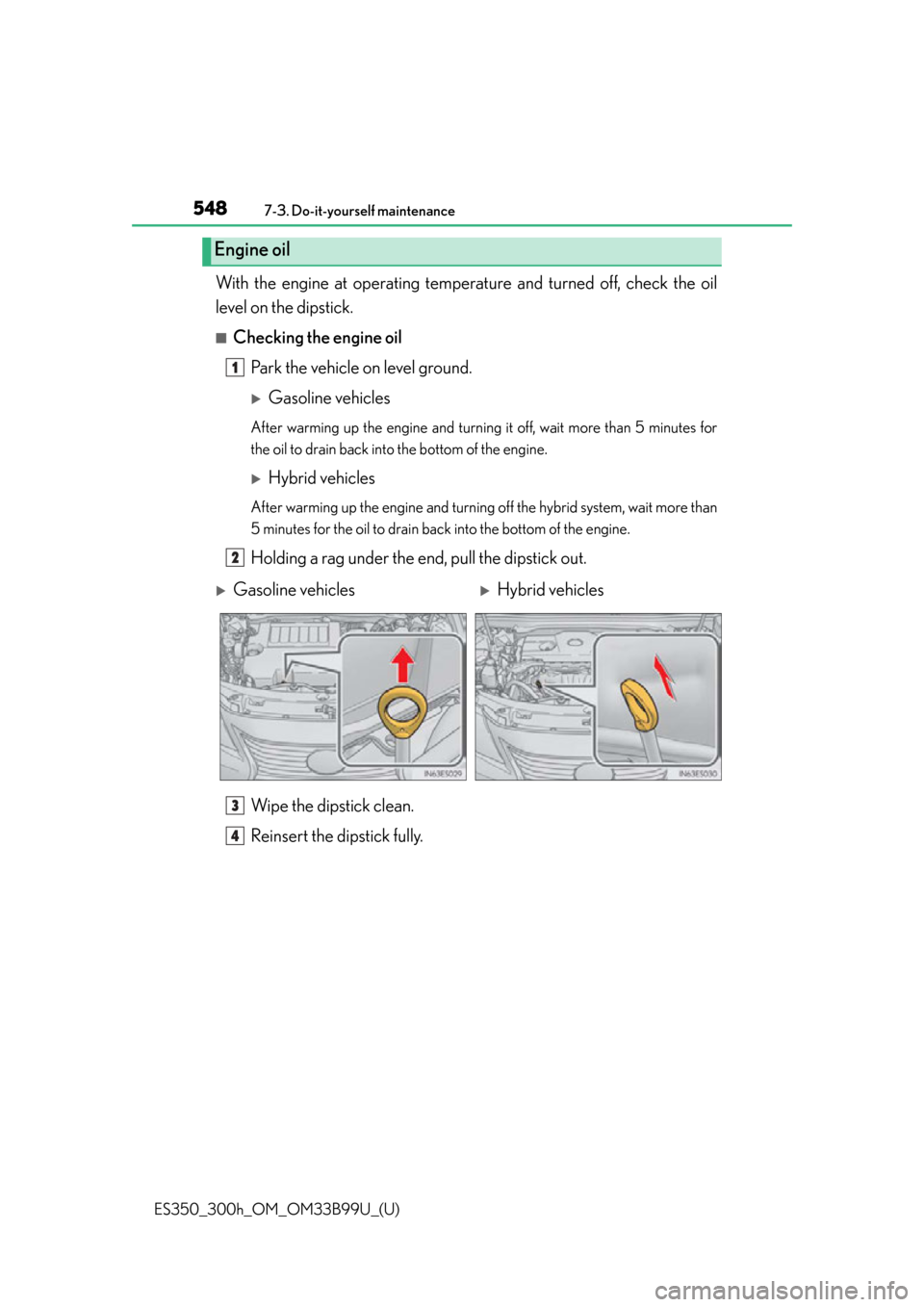
Holding a rag under the end, pull the dipstick out.
Wipe the dipstick clean.
Reinsert the dipstick fully.
Engine oil
1
2
Gasoline vehiclesHybrid vehicles
3
4
Page 554 of 784
554
ES350_300h_OM_OM33B99U_(U)
7-3. Do-it-yourself maintenance
■Coolant selection
Only use “Toyota Super Long Life Coolant” or a similar high quality ethylene glycol
based non-silicate, non-amine, non-nitrite, and non-borate coolant with long-life
hybrid organic acid technology.
U.S.A.:
“Toyota Super Long Life Coolant” is a mixture of 50% coolant and 50% deionized
water. (Minimum temperature: -31 F [-35C])
Canada:
“Toyota Super Long Life Coolant” is a mixture of 55% coolant and 45% deionized
water. (Minimum temperature: -44 F [-42C])
For more details about coolant, contact your Lexus dealer.
■If the coolant level drops within a short time of replenishing
Visually check the radiator, hoses, engine/power control unit coolant reservoir caps,
drain cock and water pump.
If you cannot find a leak, have your Lexus dealer test the cap and check for leaks in
the cooling system.
CAUTION
■When the engine is hot
Do not remove the engine/power control un it coolant reservoir cap or the radiator
cap.
The cooling system may be under pressure and may spray hot coolant if the cap is
removed, causing serious injuries, such as burns.
NOTICE
■When adding coolant
Coolant is neither plain water nor straight antifreeze. The correct mixture of water
and antifreeze must be used to provide proper lubrication, corrosion protection
and cooling. Be sure to read the antifreeze or coolant label.
■If you spill coolant
Be sure to wash it off with water to prevent it from damaging parts or paint.
Page 682 of 784
6828-2. Steps to take in an emergency
ES350_300h_OM_OM33B99U_(U)
■Charging the 12-volt battery
The electricity stored in the 12-volt battery will discharge gradually even when the
vehicle is not in use, due to natural discharge and the draining effects of certain elec-
trical appliances. If the vehicle is left for a long time, the 12-volt battery may dis-
charge, and the engine may be unable to start. (The 12-volt battery recharges
automatically during driving.)
■When recharging or replacing the 12-volt battery
●Make sure that the key is not inside the vehicle when recharging or replacing the
12-volt battery. The key may be locked in the vehicle if the alarm is activated.
( P. 8 9 )
●In some cases, it may not be possible to unlock the doors using the smart access
system with push-button start when the 12-volt battery is discharged. Use the wire-
less remote control or the mechanical key to lock or unlock the doors.
●The engine may not start on the first atte mpt after the 12-volt battery has recharged
but will start normally after the second attempt. This is not a malfunction.
●The “START STOP ENGINE” switch mode is memorized by the vehicle. When the
12-volt battery is reconnected, the system will return to the mode it was in before
the 12-volt battery was discharged. Before disconnecting the 12-volt battery, turn
the “START STOP ENGINE” switch off.
If you are unsure what mode the “START STOP ENGINE” switch was in before the
12-volt battery discharged, be especially careful when reconnecting the 12-volt
battery.
CAUTION
■Avoiding 12-volt battery fires or explosions
Observe the following precautions to prev ent accidentally igniting the flammable
gas that may be emitted from the 12-volt battery:
●Make sure each jumper cable is connected to the correct terminal and that it is
not unintentionally in contact with any other than the intended terminal.
●Do not allow the other end of the jumper cable connected to the “+” terminal to
come into contact with any other parts or metal surfaces in the area, such as
brackets or unpainted metal.
●Do not allow the + and - clamps of the jumper cables to come into contact with
each other.
●Do not smoke, use matches, cigarette lighters or allow open flame near the 12-
volt battery.
Page 686 of 784

6868-2. Steps to take in an emergency
ES350_300h_OM_OM33B99U_(U)
■Starting the hybrid system when the 12-volt battery is discharged
The hybrid system cannot be started by push-starting.
■To prevent 12-volt battery discharge
●Turn off the headlights and the audio system while the hybrid system is off.
●Turn off any unnecessary electrical components when the vehicle is running at a
low speed for an extended period, such as in heavy traffic.
■Charging the 12-volt battery
The electricity stored in the 12-volt battery will discharge gradually even when the
vehicle is not in use, due to natural discharge and the draining effects of certain elec-
trical appliances. If the vehicle is left for a long time, the 12-volt battery may dis-
charge, and the hybrid system may be unable to start. (The 12-volt battery recharges
automatically while the hybrid system is operating.)
■When recharging or replacing the 12-volt battery
●Make sure that the key is not inside the vehicle when recharging or replacing the
12-volt battery. The key may be locked in the vehicle if the alarm is activated.
( P. 8 9 )
●In some cases, it may not be possible to unlock the doors using the smart access
system with push-button start when the 12-volt battery is discharged. Use the wire-
less remote control or the mechanical key to lock or unlock the doors.
●The hybrid system may not start on the fir st attempt after the 12-volt battery has
recharged but will start normally after the second attempt. This is not a malfunction.
●The “POWER” switch mode is memorized by the vehicle. When the 12-volt battery
is reconnected, the system will return to the mode it was in before the 12-volt bat-
tery was discharged. Before disconnectin g the 12-volt battery, turn the “POWER”
switch off.
If you are unsure what mode the “POWER” switch was in before the 12-volt battery
discharged, be especially careful when reconnecting the 12-volt battery.
Page 705 of 784
ES350_300h_OM_OM33B99U_(U)
7059-1. Specifications
9
Vehicle specifications
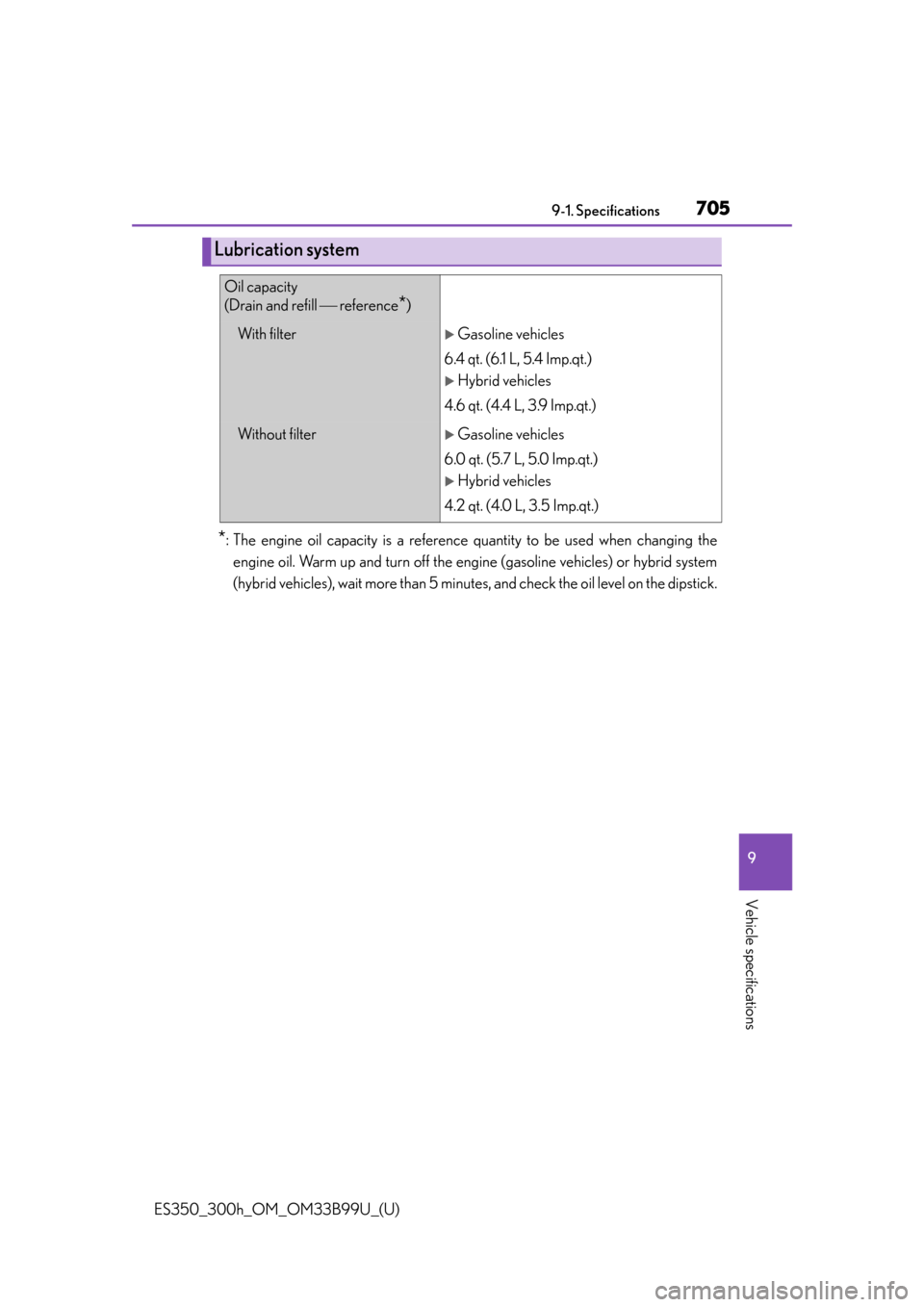
*: The engine oil capacity is a reference quantity to be used when changing the
engine oil. Warm up and turn off the en gine (gasoline vehicles) or hybrid system
(hybrid vehicles), wait more than 5 minute s, and check the oil level on the dipstick.
Lubrication system
Oil capacity
(Drain and refill reference
*)
With filterGasoline vehicles
6.4 qt. (6.1 L, 5.4 Imp.qt.)
Hybrid vehicles
4.6 qt. (4.4 L, 3.9 Imp.qt.)
Without filterGasoline vehicles
6.0 qt. (5.7 L, 5.0 Imp.qt.)
Hybrid vehicles
4.2 qt. (4.0 L, 3.5 Imp.qt.)
Page 784 of 784
784
ES350_300h_OM_OM33B99U_(U)
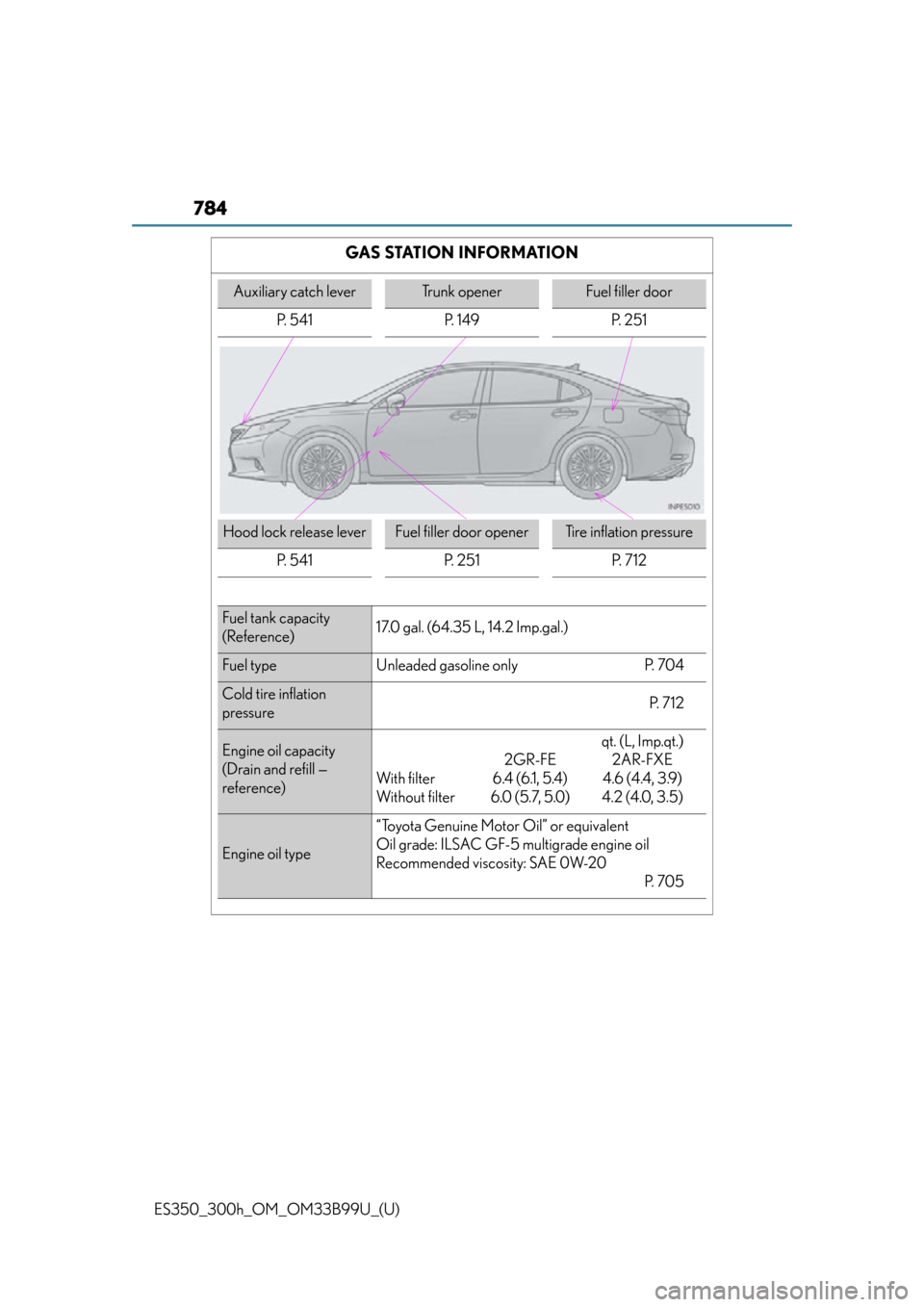
GAS STATION INFORMATION
Auxiliary catch leverTrunk openerFuel filler door
P. 541 P. 149 P. 251
Hood lock release leverFuel filler door openerTire inflation pressure
P. 541 P. 251 P. 712
Fuel tank capacity
(Reference) 17.0 gal. (64.35 L, 14.2 Imp.gal.)
Fuel type
Unleaded gasoline only P. 704
Cold tire inflation
pressure P. 7 1 2
Engine oil capacity
(Drain and refill —
reference)qt. (L, Imp.qt.)
2GR-FE 2AR-FXE
With filter 6.4 (6.1, 5.4) 4.6 (4.4, 3.9)
Without filter 6.0 (5.7, 5.0) 4.2 (4.0, 3.5)
Engine oil type “Toyota Genuine Motor Oil” or equivalent
Oil grade: ILSAC GF-5 multigrade engine oil
Recommended viscosity: SAE 0W-20
P. 7 0 5