2015 KIA VENGA fuel
[x] Cancel search: fuelPage 411 of 480

Maintenance
32
7
FUEL FILTER (FOR DIESEL)
Draining water from the fuel filter
The fuel filter for diesel engine plays an
important role of separating water from
fuel and accumulating the water in itsbottom.
If water accumulates in the fuel filter, the
warning light comes on when the ignition
switch is in the ON position. If this warning light illuminates,
we recommend that you con-
tact an authorised Kia dealer.
Extracting air from the fuel filter
If you drove until you have no fuel left or
if you replaced the fuel filter, be sure to
extract air in the fuel system as it makes
you difficult to start the engine.
1. Press the priming pump (1) severaltimes.
2. Open the air extracting hall after removing the bolt (2) using a screw-
driver to extract air.
✽✽ NOTICE
Repeat the procedure above until all the
air is out. ✽
✽
NOTICE
Use cloths when you extract air so that the fuel is not sprayed around.
Clean the fuel around the fuel filter or
the injection pump before starting the
engine to prevent fire.
Finally, check each part if the fuel is leaking.
Fuel filter cartridge replacement
✽✽ NOTICE
When replacing the fuel filter cartridge,
we recommend that you use parts for
replacement from an authorised Kia
dealer.
CAUTION
If the water accumulated in the fuel filter is not drained at proper times, damages to the major parts such as
the fuel system can be caused bywater permeation in the fuel filter.
OJC070048
YN RHD 7.QXP 11/20/2014 6:44 PM Page 32
Page 421 of 480
Maintenance
42
7
TYRES AND WHEELS
Tyre care
For proper maintenance, safety, and
maximum fuel economy, you must
always maintain recommended tyre
inflation pressures and stay within
the load limits and weight distribution
recommended for your vehicle. Recommended cold tyre inflation pressures All tyre pressures (including the
spare) should be checked when the
tyres are cold. “Cold Tyres” means
the vehicle has not been driven for at
least three hours or driven less than1.6 km (one mile).
Recommended pressures must be
maintained for the best ride, top vehi-
cle handling, and minimum tyre
wear.
For recommended inflation pressure,
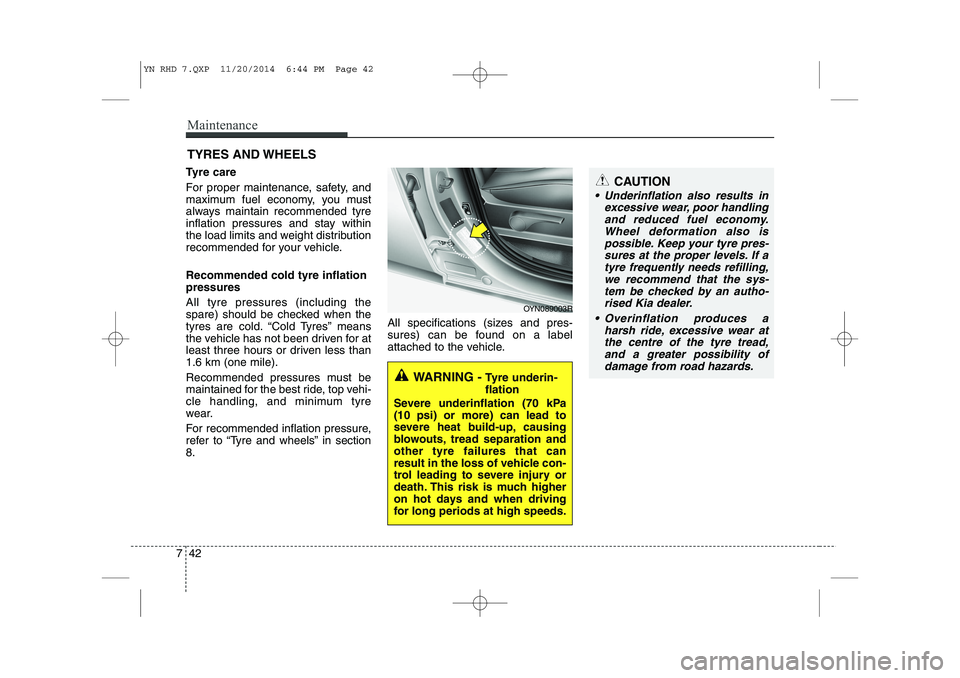
refer to “Tyre and wheels” in section8. All specifications (sizes and pres-
sures) can be found on a label
attached to the vehicle.
WARNING -
Tyre underin- flation
Severe underinflation (70 kPa(10 psi) or more) can lead to
severe heat build-up, causing
blowouts, tread separation andother tyre failures that can
result in the loss of vehicle con-
trol leading to severe injury or
death. This risk is much higher
on hot days and when driving
for long periods at high speeds.
OYN089003R
CAUTION
Underinflation also results in excessive wear, poor handlingand reduced fuel economy. Wheel deformation also ispossible. Keep your tyre pres-sures at the proper levels. If a tyre frequently needs refilling,we recommend that the sys-tem be checked by an autho- rised Kia dealer.
Overinflation produces a harsh ride, excessive wear atthe centre of the tyre tread,and a greater possibility of damage from road hazards.
YN RHD 7.QXP 11/20/2014 6:44 PM Page 42
Page 437 of 480

Maintenance
58
7
DescriptionFuse ratingFuse nameProtected Component
IG210AIG2
Head Lamp Levelling Device Switch, BCM, Head Lamp
LH/RH, Electro Chromic Mirror, Sunroof Control Module,
E/R Fuse & Relay Box (RLY.3), E/R Fuse & Relay Box
(RLY.3 D4FC), Diesel Fuse & Relay Box (PTC2, PTC3)
Rear Parking Assist Sensor RH/LH, A/C Control Module, Rain sensor
15ASTEER'G HTDHeated steering
IG110AIGN1
Centre Facia Switch, ISG Switch, Trip Computer,
DC-DC Converter, Driver/Passenger Seat Warmer,
Fuel Filter Warning Sensor, Tyre Pressure Monitoring Module,
Rear Parking Assist Sensor Centre LH/RH,
Rear Parking Assist Sensor LH/RH
110AMDPSMDPS Unit
CLUSTER10ACLUSTERInstrument Cluster, BCM, Trip Computer
IND10AA/BAG INDInstrument Cluster (Air Bag IND.)
20ADR LOCKI/P Junction Box (Door Lock/Unlock Relay,
Dead unlock Relay (RHD), T/Gate Unlock Relay)
15AHAZARDCentre Facia Switch
125APDM 1Smart Key Control Module
BRAKE
SW10ABRAKE SWSmart Key Control Module, Stop Lamp Switch
10AHTD MIRRPCM, A/C Control Module, Driver/ Passenger Power Outside Mirror
10AABSESP Switch, ABS Control Module, ESP Control Module
Yaw Rate Sensor
YN RHD 7.QXP 11/20/2014 6:45 PM Page 58
Page 440 of 480

761
Maintenance
Engine compartment fuse panel
DescriptionFuse ratingProtected Component
MDPS80AMDPS Unit
140ARLY.3 (Blower Relay)
RR HTD40AI/P Junction Box (RR HTD Relay)
240AABS Control Module, ESP Control Module
140AABS Control Module, ESP Control Module
ALT125A(GSL)150A(DSL)Diesel Fuse & Relay Box (GLOW 80A, PTC 1,2,3 50A), Alternator
E/R Fuse & Relay Box (F1 80A, F2 40A, F3 40A, F4 40A, F5 40A,, F18 10A)
30ARLY.2 (Fuel HTR Relay)
B+150AI/P Junction Box (Tail Relay, Fuse (F12 10A, F13 10A, F14 10A, F15 15A,
Power Connector (F35 10A, F36 20A)), Room 10A, Audio 20A
IG250AIgnition Switch, PDM Relay Box, E/R Fuse & Relay Box (RLY.6)
F8 50A I/P Junction Box (Tail Relay, Fuse (F12 10A, F13 10A, F14 10A, F15))
F/
PUMP( )10A(GSL)RLY.2 (F/Pump Relay)
20ARLY.7 (H/LP Relay)
10ARLY.4 (Horn Relay), RLY.13 (B/A Horn Relay), Battery Sensor
20ARLY.8 (H/LP HI Relay)
B+260AI/P Junction(Hazard 15A, Power Window Relay, Power window LH 25A, Power window RH 25A,
Safety Power window LH 25A, Safety Power window RH 25A, Sunroof 20A, PDM3 10A, Deicer 15A,
Folding 10A, PDM1 25A, Door Lock 20A, DOOR Lock RLY, Power Outlet RR 25A, Power Outlet Relay)
230ARLY.1 (Main Relay), Fuse (F21 10A (G4FA/G4FC))
YN RHD 7.QXP 11/20/2014 6:45 PM Page 61
Page 441 of 480

Maintenance
62
7
DescriptionFuse ratingProtected Component
40ARLY.9 (C/Fan LO Relay), RLY.10 (C/Fan HI Relay)
IG140AIgnition Switch, PDM relay Box
10ARLY.5 (A/CON Relay)
210ARain Sensor, ECM, RLY.11 (Wiper FRT Relay)
4( )10A(GSL)PCM
10A(DSL)ECM, Air Heater #2 (D4FC)
(AIR HTR)10AHead Lamp LH
LH15AInjector #1~#4, WGT Control Solenoid Valve (D4FC), Camshaft Position Sensor,
Electrical EGR Control Valve (D4FC) VGT Control Solenoid Valve (D4FB)
INJECTOR20APCM (G4FA/G4FC), ECM (D4FC)
110ARLY.5 (A/CON Relay), RLY9 (C/Fan LO Relay, RLY10 (C/Fan HI Relay), Stop Lamp Switch, Immobiliser Module
Camshaft Position Sensor, Oxygen Sensor (UP/Down), Lambda Sensor
RH10AHead Lamp RH
B/UP LAMP10ARR COMBI LP, INHIBIT_SW
310APCM (G4FA/G4FC), RLY.6 (Start Relay) (G4FA/G4FC), Diesel Fuse & Relay Box (Glow,PTC1 Relay)
Fuel Pressure Regulator Valve (D4FC/D4FB)
IGN COIL20AIgnition Coil #1 #2 #3 #4, Condenser
40A/50ACooling fan relay(High,Low)(Petrol,Diesel)
10ARain Sensor, ECU
YN RHD 7.QXP 11/20/2014 6:45 PM Page 62
Page 454 of 480

775
Maintenance
Underbody maintenance
Corrosive materials used for ice and
snow removal and dust control may col-
lect on the underbody. If these materials
are not removed, accelerated rusting can
occur on the underbody parts such as
the fuel lines, frame, floor pan and
exhaust system, even though they have
been treated with rust protection.
Thoroughly flush the vehicle underbody
and wheel openings with lukewarm or
cold water once a month, after off-road
driving and at the end of each winter. Payspecial attention to these areas because
it is difficult to see all the mud and dirt. It
will do more harm than good to wet down
the road grime without removing it. The
lower edges of the doors, rocker panels,
and frame members have drain holes
that should not clog with dirt; trapped
water in these areas can cause rusting.
Aluminum wheel maintenance
The aluminum wheels are coated with a
clear protective finish.
Do not use any abrasive cleaner, pol-ishing compound, solvent, or wire
brushes on aluminum wheels. They
may scratch or damage the finish.
Clean the wheel when it has cooled.
Use only a mild soap or neutral deter- gent, and rinse thoroughly with water.
Also, be sure to clean the wheels after
driving on salted roads. This helps pre-
vent corrosion.
Avoid washing the wheels with high- speed car wash brushes.
Do not use any alkaline or acid deter- gent. It may damage and corrode the
aluminum wheels coated with a clear
protective finish.WARNING
After washing the vehicle, test the
brakes whilst driving slowly to see
if they have been affected by water.
If braking performance is impaired,
dry the brakes by applying them
lightly whilst maintaining a slow
forward speed.
YN RHD 7.QXP 11/20/2014 6:46 PM Page 75
Page 458 of 480

779
Maintenance
EMISSION CONTROL SYSTEM
The emission control system of your
vehicle is covered by a written limited
warranty. Please see the warranty infor-
mation contained in the Warranty &
Maintenance booklet in your vehicle.
Your vehicle is equipped with an emis- sion control system to meet all emission
regulations. There are three emission control sys-
tems which are as follows.
(1) Crankcase emission control system
(2) Evaporative emission control system(3) Exhaust emission control system In order to assure the proper function of
the emission control systems, it is rec-
ommended that you have your vehicle
inspected and maintained by an autho-
rised Kia dealer in accordance with the
maintenance schedule in this manual. Caution for the Inspection and
Maintenance Test (With Electronic
Stability Program (ESP) system)
To prevent the vehicle from misfir-
ing during dynamometer testing,
turn the Electronic Stability
Program (ESP) system off by press-
ing the ESP switch.
After dynamometer testing is com- pleted, turn the ESP system back on
by pressing the ESP switch again. 1. Crankcase emission control
system
The positive crankcase ventilation sys-
tem is employed to prevent air pollution
caused by blow-by gases being emitted
from the crankcase. This system supplies
fresh filtered air to the crankcase through
the air intake hose. Inside the crankcase,
the fresh air mixes with blow-by gases,
which then pass through the PCV valveinto the induction system.
2. Evaporative emission control system
The Evaporative Emission Control
System is designed to prevent fuel
vapours from escaping into the atmos-
phere.
YN RHD 7.QXP 11/20/2014 6:46 PM Page 79
Page 459 of 480

Maintenance
80
7
Canister
Fuel vapours generated inside the fuel tank are absorbed and stored in the
onboard canister. When the engine is
running, the fuel vapours absorbed in the
canister are drawn into the surge tank
through the purge control solenoid valve.
Purge Control Solenoid Valve (PCSV)
The purge control solenoid valve is con-
trolled by the Engine Control Module
(ECM); when the engine coolant temper-
ature is low during idling, the PCSV clos-
es so that evaporated fuel is not taken
into the engine. After the engine warms
up during ordinary driving, the PCSV
opens to introduce evaporated fuel to the
engine. 3. Exhaust emission control
system
The Exhaust Emission Control System is
a highly effective system which controls
exhaust emissions whilst maintaining
good vehicle performance.
Vehicle modifications
This vehicle should not be modified. Modification of your vehicle could
affect its performance, safety or dura-
bility and may even violate governmen-
tal safety and emissions regulations.
In addition, damage or performance
problems resulting from any modifica-
tion may not be covered under warran-
ty.
If you use unauthorised electric devices, it may cause the vehicle to
operate abnormally, wire damage, bat-
tery discharge and fire. For your safety,
do not use unauthorised electric
devices.
Engine exhaust gas precautions (car-
bon monoxide)
Carbon monoxide can be present with other exhaust fumes. Therefore, if you
smell exhaust fumes of any kind inside
your vehicle, have it inspected and
repaired immediately. If you ever sus-
pect exhaust fumes are coming into
your vehicle, drive it only with all the
windows fully open. Have your vehicle
checked and repaired immediately.
WARNING - Exhaust
Engine exhaust gases contain car-
bon monoxide (CO). Though
colourless and odourless, it is dan-
gerous and could be lethal if
inhaled. Follow the instructions on
this page to avoid CO poisoning.
YN RHD 7.QXP 11/20/2014 6:46 PM Page 80