2015 KIA SOUL display
[x] Cancel search: displayPage 339 of 544
Driving your vehicle
18
5
For smooth operation, depress the
brake pedal and the lock release but-ton when shifting from N (Neutral) toa forward or reverse gear.
When stopped on an incline, do not
hold the vehicle with the engine
power. Use the service brake or the
parking brake.
Transaxle ranges
The indicator in the instrument clus-
ter displays the shift lever position
when the ignition switch is in the ON
position.
P (Park)
Always come to a complete stop
before shifting into P (Park). This
position locks the transaxle and pre-
vents the drive wheels from rotating.
Shifting into P (Park) while the vehi-
cle is in motion will cause the drive
wheels to lock which will cause you
to lose control of the vehicle.
WARNING- Leaving the
vehicle
Before leaving the driver’s seat,
always make sure the shift lever
is in the P (Park) position; then
set the parking brake fully and
shut the engine off. Do not use
the P position in place of the
parking brake. Always make
sure the shift lever is latched in
the P position and set the park-
ing brake fully. Unexpected and
sudden vehicle movement can
occur if these precautions are
not followed.
CAUTION- Transaxle
To avoid damage to your transaxle, do not accelerate theengine in R (Reverse) or any for-ward gear position with thebrakes on. The transaxle may bedamaged if you shift into P(Park) while the vehicle is inmotion.
Page 352 of 544
531
Driving your vehicle
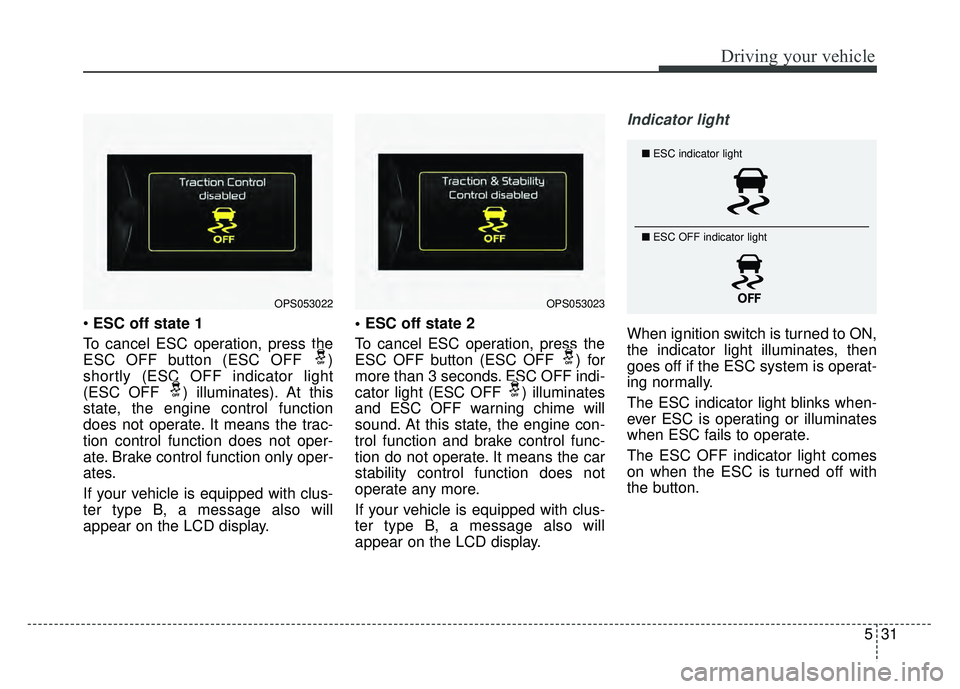
ESC off state 1
To cancel ESC operation, press the
ESC OFF button (ESC OFF )
shortly (ESC OFF indicator light
(ESC OFF ) illuminates). At this
state, the engine control function
does not operate. It means the trac-
tion control function does not oper-
ate. Brake control function only oper-
ates.
If your vehicle is equipped with clus-
ter type B, a message also will
appear on the LCD display.
To cancel ESC operation, press the
ESC OFF button (ESC OFF ) for
more than 3 seconds. ESC OFF indi-
cator light (ESC OFF ) illuminates
and ESC OFF warning chime will
sound. At this state, the engine con-
trol function and brake control func-
tion do not operate. It means the car
stability control function does not
operate any more.
If your vehicle is equipped with clus-
ter type B, a message also will
appear on the LCD display.
Indicator light
When ignition switch is turned to ON,
the indicator light illuminates, then
goes off if the ESC system is operat-
ing normally.
The ESC indicator light blinks when-
ever ESC is operating or illuminates
when ESC fails to operate.
The ESC OFF indicator light comes
on when the ESC is turned off with
the button.
OPS053022OPS053023
■
ESC indicator light
■ ESC OFF indicator light
Page 365 of 544
Driving your vehicle
44
5
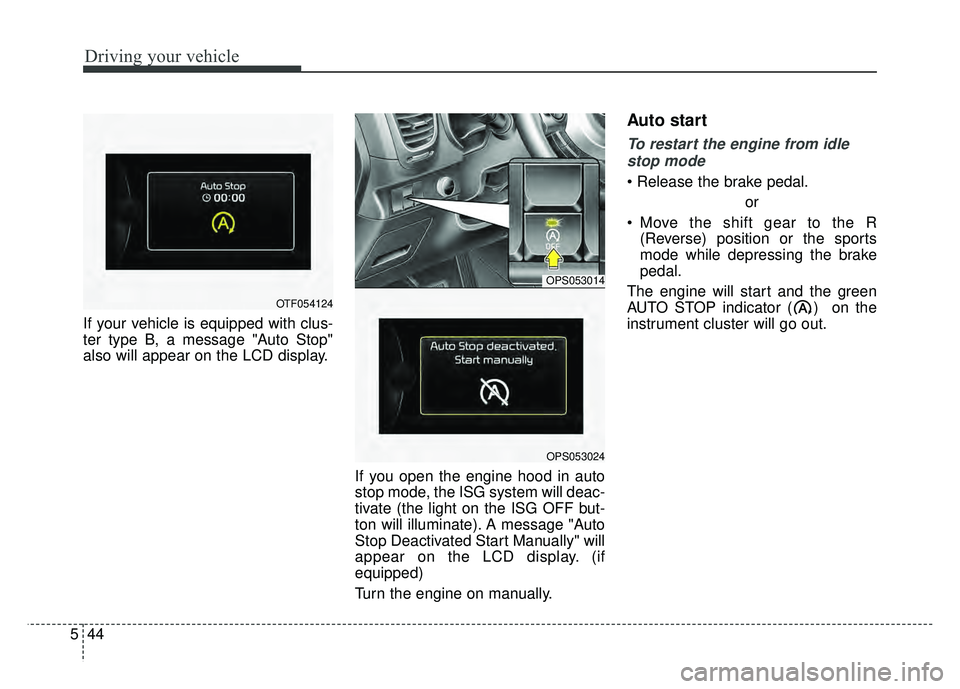
If your vehicle is equipped with clus-
ter type B, a message "Auto Stop"
also will appear on the LCD display.
If you open the engine hood in auto
stop mode, the ISG system will deac-
tivate (the light on the ISG OFF but-
ton will illuminate). A message "Auto
Stop Deactivated Start Manually" will
appear on the LCD display. (if
equipped)
Turn the engine on manually.
Auto start
To restart the engine from idlestop mode
or
Move the shift gear to the R (Reverse) position or the sports
mode while depressing the brake
pedal.
The engine will start and the green
AUTO STOP indicator ( ) on the
instrument cluster will go out.
OPS053014
OPS053024
OTF054124
Page 366 of 544
545
Driving your vehicle
The engine will also restart auto-matically without the driver’s anyactions if the following occurs:
- When a certain amount of time has passed with the climate control sys-
tem on.
- When the front defroster is on.
- The brake vaccum pressure is low.
- The battery charging status is low.
- The vehicle speed exceeds 1 MPH (1 km/h).
- The fan speed is in the highest position when the air conditioning is
on.
- Engine is turned off by Auto Stop for a long time.
- If you unfasten the seat belt or open the driver's door while depressing
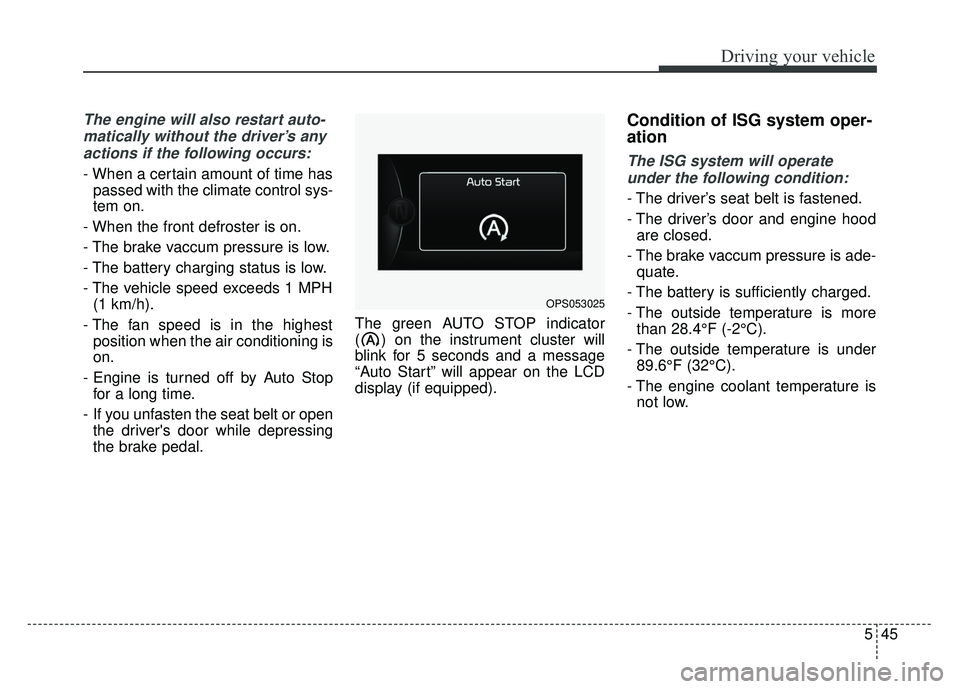
the brake pedal. The green AUTO STOP indicator
( ) on the instrument cluster will
blink for 5 seconds and a message
“Auto Start” will appear on the LCD
display (if equipped).
Condition of ISG system oper-
ation
The ISG system will operate
under the following condition:
- The driver’s seat belt is fastened.
- The driver’s door and engine hood are closed.
- The brake vaccum pressure is ade- quate.
- The battery is sufficiently charged.
- The outside temperature is more than 28.4°F (-2°C).
- The outside temperature is under 89.6°F (32°C).
- The engine coolant temperature is not low.
OPS053025
Page 367 of 544
Driving your vehicle
46
5
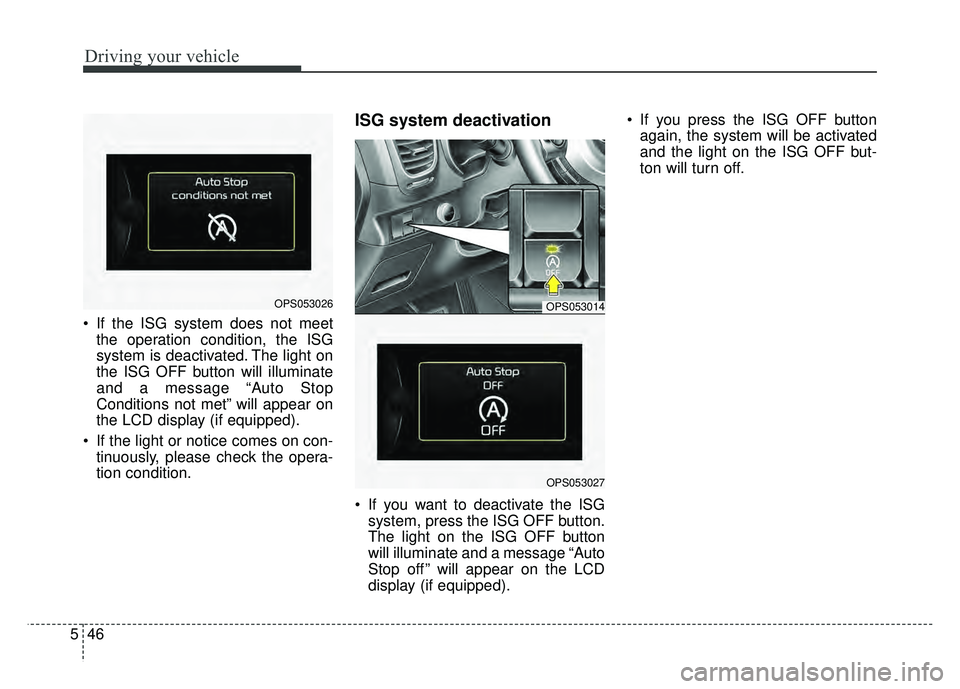
If the ISG system does not meet
the operation condition, the ISG
system is deactivated. The light on
the ISG OFF button will illuminate
and a message “Auto Stop
Conditions not met” will appear on
the LCD display (if equipped).
If the light or notice comes on con- tinuously, please check the opera-
tion condition.
ISG system deactivation
If you want to deactivate the ISGsystem, press the ISG OFF button.
The light on the ISG OFF button
will illuminate and a message “Auto
Stop off ” will appear on the LCD
display (if equipped). If you press the ISG OFF button
again, the system will be activated
and the light on the ISG OFF but-
ton will turn off.
OPS053026OPS053014
OPS053027
Page 411 of 544
625
What to do in an emergency
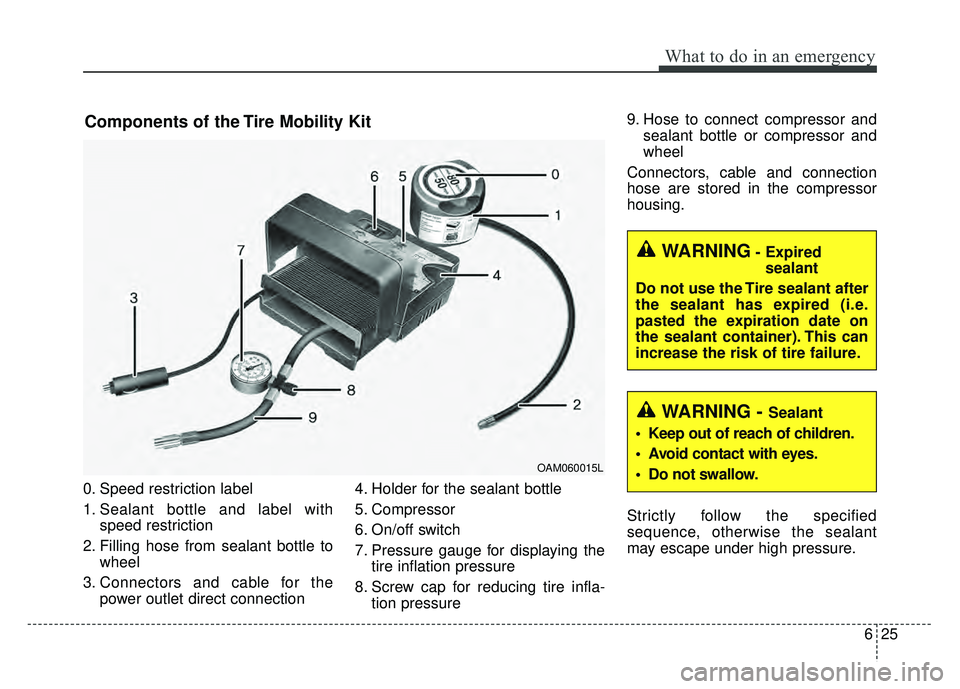
0. Speed restriction label
1. Sealant bottle and label withspeed restriction
2. Filling hose from sealant bottle to wheel
3. Connectors and cable for the power outlet direct connection 4. Holder for the sealant bottle
5. Compressor
6. On/off switch
7. Pressure gauge for displaying the
tire inflation pressure
8. Screw cap for reducing tire infla- tion pressure 9. Hose to connect compressor and
sealant bottle or compressor and
wheel
Connectors, cable and connection
hose are stored in the compressor
housing.
Strictly follow the specified
sequence, otherwise the sealant
may escape under high pressure.
Components of the Tire Mobility Kit
OAM060015L
WARNING- Expired sealant
Do not use the Tire sealant after
the sealant has expired (i.e.
pasted the expiration date on
the sealant container). This can
increase the risk of tire failure.
WARNING - Sealant
Keep out of reach of children.
Avoid contact with eyes.
Do not swallow.
Page 473 of 544
753
Maintenance
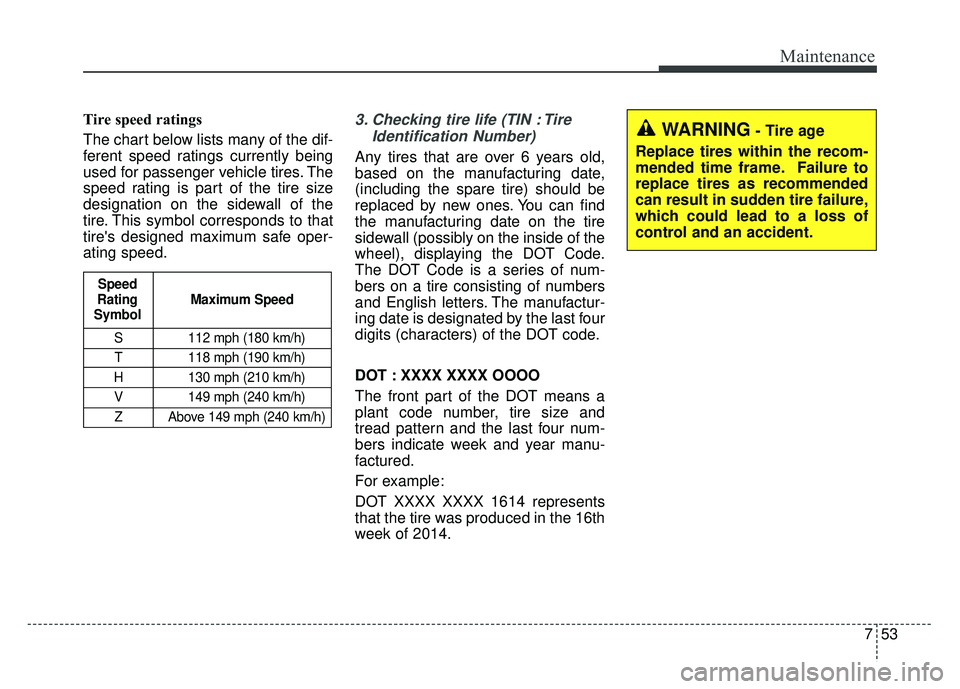
Tire speed ratings
The chart below lists many of the dif-
ferent speed ratings currently being
used for passenger vehicle tires. The
speed rating is part of the tire size
designation on the sidewall of the
tire. This symbol corresponds to that
tire's designed maximum safe oper-
ating speed.3. Checking tire life (TIN : TireIdentification Number)
Any tires that are over 6 years old,
based on the manufacturing date,
(including the spare tire) should be
replaced by new ones. You can find
the manufacturing date on the tire
sidewall (possibly on the inside of the
wheel), displaying the DOT Code.
The DOT Code is a series of num-
bers on a tire consisting of numbers
and English letters. The manufactur-
ing date is designated by the last four
digits (characters) of the DOT code.
DOT : XXXX XXXX OOOO
The front part of the DOT means a
plant code number, tire size and
tread pattern and the last four num-
bers indicate week and year manu-
factured.
For example:
DOT XXXX XXXX 1614 represents
that the tire was produced in the 16th
week of 2014.
S 112 mph (180 km/h)
T 118 mph (190 km/h)
H 130 mph (210 km/h) V 149 mph (240 km/h)Z Above 149 mph (240 km/h)
Maximum Speed
Speed
Rating
Symbol
WARNING- Tire age
Replace tires within the recom-
mended time frame. Failure to
replace tires as recommended
can result in sudden tire failure,
which could lead to a loss of
control and an accident.
Page 535 of 544

Index
4I
Cruise control system . . . . . . . . . . . . . . . . . . . . . . . . . . 5-37Cruise control switch . . . . . . . . . . . . . . . . . . . . . . . . 5-38
To cancel cruise control, do one of the following . . 5-40
To decrease the cruising speed . . . . . . . . . . . . . . . . . 5-39
To increase cruise control set speed . . . . . . . . . . . . . 5-39
To resume cruising speed at more thanapproximately 20 mph (30 km/h) . . . . . . . . . . . . . 5-40
To set cruise control speed . . . . . . . . . . . . . . . . . . . 5-38
To temporarily accelerate with the cruise control on. . 5-39
To turn cruise control off, do one of the following. . 5-41
Cup holder . . . . . . . . . . . . . . . . . . . . . . . . . . . . . . . . . 4-131
Curtain air bag . . . . . . . . . . . . . . . . . . . . . . . . . . . . . . . 3-53
Dashboard illumination, see instrument panel illumination . . . . . . . . . . . . . . . . . . . . . . . . . . . . . . . 4-51
Dashboard, see instrument cluster . . . . . . . . . . . . . . . . 4-50
Day/night rearview mirror . . . . . . . . . . . . . . . . . . . . . . 4-45
Daytime running light. . . . . . . . . . . . . . . . . . . . . . . . . . 4-85
Defogging logic . . . . . . . . . . . . . . . . . . . . . . . . . . . . . 4-125
Defroster . . . . . . . . . . . . . . . . . . . . . . . . . . . . . . . . . . . . \
4-98 Front wiper deicer . . . . . . . . . . . . . . . . . . . . . . . . . . 4-99
Outside rearview mirror defroster . . . . . . . . . . . . . . 4-99
Rear window defroster . . . . . . . . . . . . . . . . . . . . . . . 4-98
Defrosting . . . . . . . . . . . . . . . . . . . . . . . . . . . . . . . . . . 4-12\
3
Dimensions . . . . . . . . . . . . . . . . . . . . . . . . . . . . . . . . . . . 8-\
2
Display illumination, see instrument panel illumination . . 4-51 Displays, see instrument cluster . . . . . . . . . . . . . . . . . . 4-50
Do not install a child restraint on the front
passenger’s seat. . . . . . . . . . . . . . . . . . . . . . . . . . . . . 3-40
Door locks. . . . . . . . . . . . . . . . . . . . . . . . . . . . . . . . . . . 4-\
17 Central door lock switch . . . . . . . . . . . . . . . . . . . . . 4-19
Child-protector rear door lock . . . . . . . . . . . . . . . . . 4-21
Drinks holders, see cup holders . . . . . . . . . . . . . . . . . 4-131
Driver's and passenger's front air bag . . . . . . . . . . . . . . 3-49
Driving at night . . . . . . . . . . . . . . . . . . . . . . . . . . . . . . . 5-52
Driving in flooded areas . . . . . . . . . . . . . . . . . . . . . . . . 5-53
Driving in the rain. . . . . . . . . . . . . . . . . . . . . . . . . . . . . 5-53
Driving off-road . . . . . . . . . . . . . . . . . . . . . . . . . . . . . . 5-54
Economical operation . . . . . . . . . . . . . . . . . . . . . . . . . . 5-48
Electric chromic mirror (ECM) . . . . . . . . . . . . . . . . . . 4-46
Electric power steering . . . . . . . . . . . . . . . . . . . . . . . . . 4-40
Electronic stability control (ESC) . . . . . . . . . . . . . . . . 5-29
Emergency starting . . . . . . . . . . . . . . . . . . . . . . . . . . . . . 6-5 Jump starting . . . . . . . . . . . . . . . . . . . . . . . . . . . . . . . 6-5
Emergency while driving . . . . . . . . . . . . . . . . . . . . . . . . 6-3
Emission control system . . . . . . . . . . . . . . . . . . . . . . . . 7-93 Crankcase emission control system . . . . . . . . . . . . . 7-93
Evaporative emission control System . . . . . . . . . . . 7-93
Exhaust emission control system . . . . . . . . . . . . . . . 7-94
Engine . . . . . . . . . . . . . . . . . . . . . . . . . . . . . . . . . . . . \
. . . 8-2
Engine compartment . . . . . . . . . . . . . . . . . . . . . . . . . . . . 2-6
DE