2015 KIA Sorento ABS
[x] Cancel search: ABSPage 344 of 508

539
Driving your vehicle
Indicator lightWhen ignition switch is turned to ON,
the indicator light illuminates, then
goes off if the ESC system is operat-
ing normally.
The ESC indicator light blinks when-
ever ESC is operating or illuminates
when ESC fails to operate.
The ESC OFF indicator light comes
on when the ESC is turned off with
the button.
ESC OFF usageWhen driving
ESC should be turned on for dailydriving whenever possible.
To turn ESC off while driving, press the ESC OFF button while driving
on a flat road surface.✽ ✽ NOTICE• When operating the vehicle on a
dynamometer, ensure that the
ESC is turned off (ESC OFF light
illuminated). If the ESC is left on,
it may prevent the vehicle speed
from increasing, and result in false
diagnosis.
• Turning the ESC off does not affect ABS or brake system opera-
tion.
■ ESC indicator light
■ ESC OFF indicator light
WARNING
The Electronic Stability Control
system is only a driving aid; use
precautions for safe driving by
slowing down on curved,
snowy, or icy roads. Drive slow-
ly and don’t attempt to acceler-
ate whenever the ESC indicator
light is blinking, or when the
road surface is slippery.
WARNING
Never press the ESC OFF but-
ton while ESC is operating (ESC
indicator light blinks).
If ESC is turned off while ESC is
operating, the vehicle may slip
out of control.
CAUTION
Driving with varying tire or
wheel sizes may cause the ESCsystem to malfunction. Whenreplacing tires, make sure theyare the same size as your origi-nal tires.
XM(FL) CAN(ENG) 5.QXP 1/23/2013 3:30 PM Page 39
Page 362 of 508

557
Driving your vehicle
Hazardous driving conditions When hazardous driving conditions
are encountered such as water,
snow, ice, mud, sand, or similar haz-
ards, follow these suggestions:
Drive cautiously and allow extradistance for braking.
Avoid sudden braking or steering.
When braking with non-ABS brakes pump the brake pedal with
a light up-and-down motion until
the vehicle is stopped. If stalled in snow, mud, or sand,
use second gear. Accelerate slow-
ly to avoid spinning the drive
wheels.
Use sand, rock salt, or other non- slip material under the drive
wheels to provide traction when
stalled in ice, snow, or mud.
Reducing the risk of a rolloverThis multi-purpose passenger vehi-
cle is defined as a Sports Utility
Vehicle (SUV). SUV’s have higher
ground clearance and a narrower
track to make them capable of per-
forming in a wide variety of off-road
applications. Specific design charac-
teristics give them a higher center of
gravity than ordinary vehicles. An
advantage of the higher ground
clearance is a better view of the
road, which allows you to anticipate
problems. They are not designed for
cornering at the same speeds as
conventional passenger vehicles,
any more than low-slung sports vehi-
cles are designed to perform satis-
factorily in off-road conditions. Due to
this risk, driver and passengers are
strongly recommended to buckle
their seat belts. In a rollover crash,
an unbelted person is more likely to
die than a person wearing a seat
belt. There are steps that a driver can
make to reduce the risk of a rollover.
If at all possible, avoid sharp turns or
abrupt maneuvers, do not load your
roof rack with heavy cargo, and
never modify your vehicle in any way.
SPECIAL DRIVING CONDITIONS
WARNING
- ABS
Do not pump the brake pedal on
a vehicle equipped with ABS.
WARNING
- Downshifting
Downshifting with an automatic
transaxle, while driving on slip-
pery surfaces can cause an
accident. The sudden change in
tire speed could cause the tires
to skid. Be careful when down-
shifting on slippery surfaces.
XM(FL) CAN(ENG) 5.QXP 1/23/2013 3:31 PM Page 57
Page 372 of 508

567
Driving your vehicle
Hitches It's important to have the correct
hitch equipment. Crosswinds, large
trucks going by, and rough roads are
a few reasons why you’ll need the
right hitch. Here are some rules to
follow:
Will you have to make any holes inthe body of your vehicle when you
install a trailer hitch? If you do, then
be sure to seal the holes later
when you remove the hitch.
If you don’t seal them, deadly car-
bon monoxide (CO) from your
exhaust can get into your vehicle,
as well as dirt and water.
The bumpers on your vehicle are not intended for hitches. Do not
attach rental hitches or other
bumper-type hitches to them. Use
only a frame-mounted hitch that
does not attach to the bumper.
Kia trailer hitch accessory is avail- able at an authorized Kia dealer.
Safety chains You should always attach chains
between your vehicle and your trail-
er. Cross the safety chains under the
tongue of the trailer so that the
tongue will not drop to the road if it
becomes separated from the hitch.
Instructions about safety chains may
be provided by the hitch manufactur-
er or by the trailer manufacturer.
Follow the manufacturer’s recom-
mendation for attaching safety
chains. Always leave just enough
slack so you can turn with your trail-
er. And, never allow safety chains to
drag on the ground.
Trailer brakes If your trailer is equipped with a brak-
ing system, make sure it conforms to
your state’s regulations and that it is
properly installed and operating cor-
rectly.
If your trailer weight exceeds the
maximum allowed weight without
trailer brakes, then the trailer will also
require its own brakes as well. Be
sure to read and follow the instruc-
tions for the trailer brakes so you’ll be
able to install, adjust and maintain
them properly.
Don’t tap into or modify your vehi-cle's brake system.
WARNING
- Trailerbrakes
Do not use a trailer with its own
brakes unless you are absolute-
ly certain that you have proper-
ly set up the brake system. This
is not a task for amateurs. Use
an experienced, competent
trailer shop for this work.
XM(FL) CAN(ENG) 5.QXP 1/23/2013 3:31 PM Page 67
Page 375 of 508

Driving your vehicle70
5
Parking on hills Generally, if you have a trailer
attached to your vehicle, you should
not park your vehicle on a hill. People
can be seriously or fatally injured,
and both your vehicle and the trailer
can be damaged if they unexpected-
ly roll downhill.
However, if you ever have to park
your trailer on a hill, here's how to do
it:
1.Pull the vehicle into the parking
space. Turn the steering wheel in
the direction of the curb (right if
headed downhill, left if headed up
hill). 2.If the vehicle has a manual
transaxle, place the vehicle in neu-
tral. If the vehicle has an automatic
transaxle, place the vehicle in P
(Park).
3.Set the parking brake and shut off the engine.
4.Place chocks under the trailer wheels on the down hill side of the
wheels.
5.Start the vehicle, hold the brakes, shift to neutral, release the parking
brake and slowly release the
brakes until the trailer chocks
absorb the load.
6.Reapply the brakes, reapply the parking brake and shift the vehicle
to R (Reverse) for manual
transaxle or P (Park) for automatic
transaxle.
7.Shut off the vehicle and release the vehicle brakes but leave the park-
ing brake set.
CAUTION
When towing a trailer on steep grades (in excess of 6%) payclose attention to the enginecoolant temperature gauge toensure the engine does notoverheat.
If the needle of the coolanttemperature gauge movesacross the dial towards “H”(HOT), pull over and stop assoon as it is safe to do so, andallow the engine to idle until itcools down. You may proceedonce the engine has cooledsufficiently.
You must decide driving speed depending on trailerweight and uphill grade toreduce the possibility ofengine and transaxle over-heating.
WARNING
- Parking on a hill
Parking your vehicle on a hill
with a trailer attached could
cause serious injury or death,
should the trailer break loose or
brake stops working.
XM(FL) CAN(ENG) 5.QXP 1/23/2013 3:31 PM Page 70
Page 458 of 508
Maintenance54
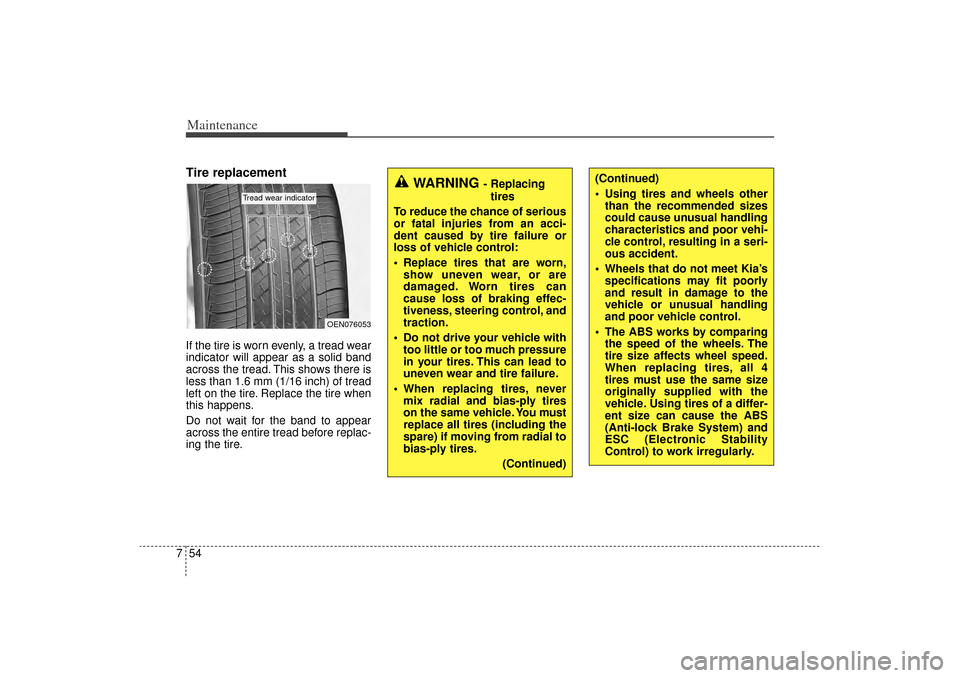
7Tire replacementIf the tire is worn evenly, a tread wear
indicator will appear as a solid band
across the tread. This shows there is
less than 1.6 mm (1/16 inch) of tread
left on the tire. Replace the tire when
this happens.
Do not wait for the band to appear
across the entire tread before replac-
ing the tire.
OEN076053
Tread wear indicator
WARNING
- Replacing
tires
To reduce the chance of serious
or fatal injuries from an acci-
dent caused by tire failure or
loss of vehicle control:
Replace tires that are worn, show uneven wear, or are
damaged. Worn tires can
cause loss of braking effec-
tiveness, steering control, and
traction.
Do not drive your vehicle with too little or too much pressure
in your tires. This can lead to
uneven wear and tire failure.
When replacing tires, never mix radial and bias-ply tires
on the same vehicle. You must
replace all tires (including the
spare) if moving from radial to
bias-ply tires.
(Continued)
(Continued)
Using tires and wheels otherthan the recommended sizes
could cause unusual handling
characteristics and poor vehi-
cle control, resulting in a seri-
ous accident.
Wheels that do not meet Kia’s specifications may fit poorly
and result in damage to the
vehicle or unusual handling
and poor vehicle control.
The ABS works by comparing the speed of the wheels. The
tire size affects wheel speed.
When replacing tires, all 4
tires must use the same size
originally supplied with the
vehicle. Using tires of a differ-
ent size can cause the ABS
(Anti-lock Brake System) and
ESC (Electronic Stability
Control) to work irregularly.
XM(FL) CAN(ENG) 7.QXP 1/23/2013 3:37 PM Page 54
Page 476 of 508

Maintenance72
7Engine compartment fuse panel
Description Fuse rating Protected component
MULTI
FUSE I/P B+2 60A
IPM (Fuse - S/HTR FRT, P/Seat SUN ROOF-1 25A, IPS1 (FOG LH/RH, TAIL LAMP LH), ARISU LH
(HEAD LAMP LOW LH, HEAD LAMP HI LH, TURN SIG RL, TURN SIG FL)
BLOWER 40A Blower Relay
RR HTD 40A Rear Defogger Relay
ABS 1 40A ESC Control Module, Multipurpose Check Connector
ABS 2 40A ESC Control Module, Multipurpose Check Connector
I/P B+3 60ASMART_KEY-1 25A, SMART_KEY-4 10A, MODULE-1 7.5A, SUNROOF-2 25A, (FUSE SW RLY,
INTERIOR LAMP 10A : DR_SCUFF_LP_DRV, DR_SCUFF_LP_PASS, DR_WARNG_SW,
S_VISOR_LP_LH/RH, OHC_LAMP, ROOM_LP, RL/RR_PERSONAL_LAMP, CARGO_LAMP, MULTI-
MEDIA 15A : Audio, A/V & Navigation Head Unit, MTS, MEMORY 10A : OBD_II, Front A/C Control
Module, TPMS, Digital Clock, INSIDE_MIRR, S_WARMER_SW_LH/RH, AIR_VENT_SEAT_SW_LH/
RH, CLUSTER, O_S_MIRR_SW, P_WDW_MAIN_SW, FRT_DRV_SEAT_EXT, P_WDW_PASS_SW)
I/P B+1 50A AMP 30A, P/WDW LH 25A, P/WDW RH 25A, S/HEATER_RR 15A
MDPS
80A
MDPS_ECU
C/FAN
60A
E/R Fuse & Relay Box (C/FAN RLY)
FUSE IGN 2 40A Start Relay, W/O Smart Key - Ignition Switch, With Smart Key - E/R Fuse & Relay Box (IGN2 Relay)
TRAILER 30A Trailer Power Outlet
IGN 1 40A W/O Smart Key - Ignition Switch, With Smart Key - E/R Fuse & Relay Box (IGN1 Relay, ACC Relay )
HORN 15A Horn Relay
DEICER 15A Front Wiper Deicer Relay
I/P B+4 50A
IPM (DR LOCK 20A, BLOWER RR 20A, FUEL LID 15A, IPS3 (TAIL LAMP RH, TAIL INT LAMP),
ARISU RH (HEAD LAMP LOW RH, HEAD LAMP HI RH, TURN SIG RR, TURN SIG FR)
ABS 7.5A ESC Control Module, Multipurpose Check Connector
B/UP LP 7.5A Back-Up Lamp Relay (A/T), Back-Up Lamp Switch (M/T)
4WD 20A 4WD_ECU
XM(FL) CAN(ENG) 7.QXP 1/23/2013 3:37 PM Page 72
Page 486 of 508

Maintenance82
7CanisterFuel vapors generated inside the fuel
tank are absorbed and stored in the
onboard canister. When the engine is
running, the fuel vapors absorbed in
the canister are drawn into the surge
tank through the purge control sole-
noid valve.Purge Control Solenoid Valve
(PCSV)The purge control solenoid valve is
controlled by the Engine Control
Module (ECM); when the engine
coolant temperature is low during
idling, the PCSV closes so that evap-
orated fuel is not taken into the
engine. After the engine warms up
during ordinary driving, the PCSV
opens to introduce evaporated fuel to
the engine.
3. Exhaust emission control
systemThe Exhaust Emission Control
System is a highly effective system
which controls exhaust emissions
while maintaining good vehicle per-
formance.Vehicle modifications This vehicle should not be modified.
Modification of your vehicle could
affect its performance, safety or
durability and may even violate gov-
ernmental safety and emissions reg-
ulations.
In addition, damage or performance
problems resulting from any modifi-
cation may not be covered under
warranty.
If you use unauthorized electronic
devices, it may cause the vehicle to
operate abnormally, wire damage,
battery discharge and fire. For your
safety, do not use unauthorized
electronic devices.
Engine exhaust gas precautions
(carbon monoxide) Carbon monoxide can be present with other exhaust fumes.
Therefore, if you smell exhaust
fumes of any kind inside your vehi-
cle, have it inspected and repaired
immediately. If you ever suspect
exhaust fumes are coming into
your vehicle, drive it only with all
the windows fully open. Have your
vehicle checked and repaired
immediately.
WARNING -
Exhaust
Engine exhaust gases contain
carbon monoxide (CO). Though
colorless and odorless, it is
dangerous and could be lethal if
inhaled. Follow the instructions
on this page to avoid CO poi-
soning.
XM(FL) CAN(ENG) 7.QXP 1/23/2013 3:38 PM Page 82
Page 500 of 508

Index2IA/V Mode ......................................................................4-\
80
AC Inverter ..................................................................4-152
Active eco system ..........................................................5-54Active eco operation ................................................5-54
Air bag warning label ....................................................3-77
Air bag warning light ....................................................3-50
Air bags........................................................................\
..3-47 Operation ..................................................................3-48
Do not install a child restraint on the
Front passenger’s seat ..............................................3-50
Air bag warning light ................................................3-50
SRS components and functions ................................3-51
Driver's and passenger's front air bag ......................3-60
Side air bag................................................................3-66
Curtain air bag ..........................................................3-67
SRS care ....................................................................3-74\
Air bag warning label................................................3-77
Air cleaner ....................................................................7-39\
Airconditioning system................................................4-121 Manual climate control system ..............................4-121
Airconditioning system................................................4-131 Automatic climate control system ..........................4-131 Alarm system ................................................................4-19
All wheel drive ..............................................................5-23
Anti-lock brake system (ABS) ......................................5-34
Appearance care ............................................................7-74
Exterior care ..............................................................7-74
Interior care ..............................................................7-79
Armrest (rear) ................................................................3-24
Ashtray ........................................................................\
4-154
Automatic climate control system ..............................4-131 Automatic heating and air conditioning..................4-133
Manual heating and air conditioning ......................4-134
Air conditioning ......................................................4-139
Automatic transaxle ......................................................5-16 Sports mode ..............................................................5-18
Shift-lock override ....................................................5-20
Battery........................................................................\
....7-47
Battery saver function..................................................4-108
Blind spot detection system ..........................................5-49 Warning type ............................................................5-50
Detecting sensor ........................................................5-51
Warning Message ......................................................5-51
Non operating condition............................................5-53
Bottle holder ................................................................4-150
Brake system..................................................................5-30 Power brakes ............................................................5-30A
B
XM(FL) CAN(ENG) Index.qxp 1/23/2013 3:41 PM Page 2