2015 KIA PICANTO glove box
[x] Cancel search: glove boxPage 485 of 846
347
Safety features of your vehicle
WARNING
Always use seat belts and child
restraints – every trip, every time,
everyone! Air bags inflate with con-
siderable force and in the blink of
an eye. Seat belts help keep occu-
pants in proper position to obtain
maximum benefit from the air bag.
Even with air bags, improperly belt-ed and unbelted occupants can be
severely injured when the air bag
inflates. Always follow the precau-
tions about seat belts, air bags and
occupant safety contained in this
manual.
To reduce the chance of serious or fatal injuries and receive the maxi-
mum safety benefit from yourrestraint system:
Never place a child in any child or booster seat in the front seat.
ABC – Always Buckle Children in the back seat. It is the safest
place for children of any age to
ride.
Front and side air bags can injure occupants improperly positioned
in the front seats.
(Continued)(Continued)
Move your seat as far back aspractical from the front air bags,
whilst still maintaining control of
the vehicle.
You and your passengers should never sit or lean unnecessarily
close to the air bags. Improperly
positioned drivers and passen-
gers can be severely injured by
inflating air bags.
Never lean against the door or centre console – always sit in anupright position.
Do not allow a passenger to ride in the front seat when the pas-
senger’s front air bag OFF indica-
tor is illuminated, because the air
bag will not deploy in the event of
a moderate or severe frontalcrash.
(Continued)(Continued)
No objects should be placed overor near the air bag modules on
the steering wheel, instrument
panel, driver’s side knee bolster,
and the front passenger's panel
above the glove box, because any
such object could cause harm if
the vehicle is in a crash severe
enough to cause the air bags to
deploy.
Do not tamper with or disconnect SRS wiring or other components
of the SRS system. Doing so
could result in injury, due to acci-
dental deployment of the air bags
or by rendering the SRS inopera-
tive.
If the SRS air bag warning light “ ”remains illuminated whilst
the vehicle is being driven, havean authorised Kia dealer inspect
the air bag system as soon as
possible.
Air bags can only be used once – have an authorised Kia dealer
replace the air bag immediately
after deployment.
(Continued)
Page 497 of 846
359
Safety features of your vehicle
SRS Care
The SRS is virtually maintenance-free
and so there are no parts you can safely
service by yourself. If the SRS air bag
warning light does not illuminate
when you turn the ignition ON, or if it con-
tinuously remains on, have your vehicle
immediately inspected by an authorised
Kia dealer.
Any work on the SRS system, such as
removing, installing, repairing, or any
work on the steering wheel must be per-
formed by an authorised Kia dealer.Improper handling of the SRS system
may result in serious personal injury.
WARNING
Modification to SRS components or wiring, including the addition
of any kind of badges to the pad
covers or modifications to the
body structure, can adversely
affect SRS performance and lead
to possible injury.
For cleaning the air bag pad cov- ers, use only a soft, dry cloth or
one which has been moistened
with plain water. Solvents or
cleaners could adversely affect
the air bag covers and proper
deployment of the system.
No objects should be placed over
or near the air bag modules on the
steering wheel, instrument panel,
and the front passenger's panel
above the glove box, because any
such object could cause harm if the
vehicle is in a crash severe enough
to cause the air bags to inflate.
(Continued)
(Continued)
If the air bags inflate, they must be replaced by an authorised Kia
dealer.
Do not tamper with or disconnect SRS wiring, or other components
of the SRS system. Doing so
could result in injury, due to acci-
dental inflation of the air bags or
by rendering the SRS inopera-
tive.
If components of the air bag sys- tem must be discarded, or if the
vehicle must be scrapped, certain
safety precautions must be
observed. An authorised Kia
dealer knows these precautions
and can give you the necessary
information. Failure to follow
these precautions and proce-dures could increase the risk of
personal injury.
If your car was flooded and has soaked carpeting or water on the
flooring, you shouldn't try to start
the engine; have the car towed to
an authorised Kia dealer.
Page 578 of 846
479
Features of your vehicle
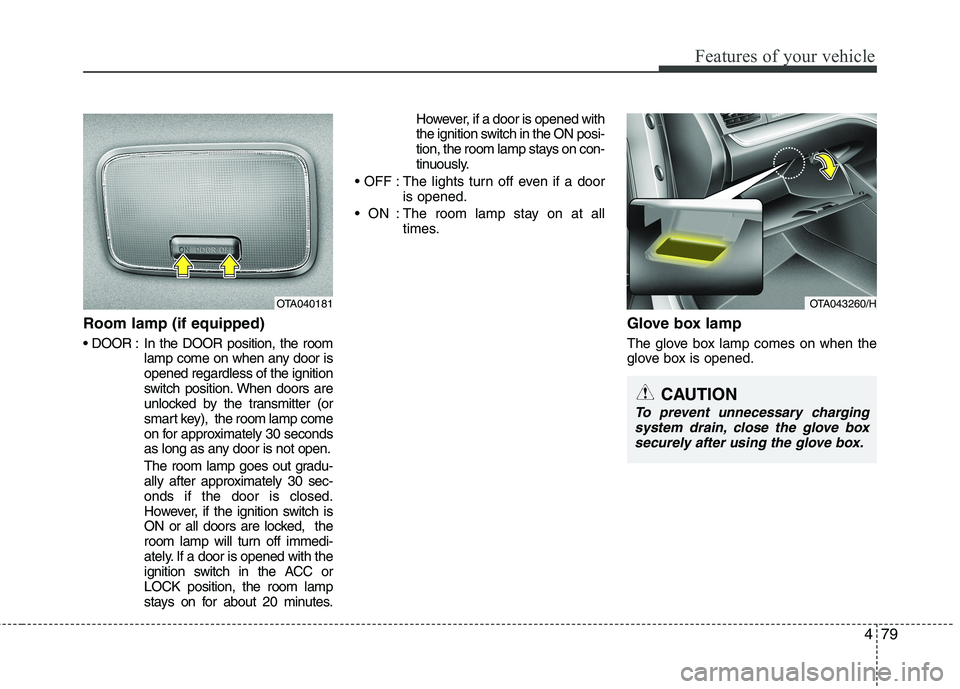
Room lamp (if equipped)
In the DOOR position, the roomlamp come on when any door is opened regardless of the ignition
switch position. When doors are
unlocked by the transmitter (or
smart key), the room lamp come
on for approximately 30 seconds
as long as any door is not open.
The room lamp goes out gradu-
ally after approximately 30 sec-onds if the door is closed.
However, if the ignition switch is
ON or all doors are locked, the
room lamp will turn off immedi-
ately. If a door is opened with the
ignition switch in the ACC orLOCK position, the room lamp
stays on for about 20 minutes. However, if a door is opened with
the ignition switch in the ON posi-
tion, the room lamp stays on con-
tinuously.
: The lights turn off even if a door is opened.
: The room lamp stay on at all times.
Glove box lamp
The glove box lamp comes on when the
glove box is opened.
OTA040181OTA043260/H
CAUTION
To prevent unnecessary chargingsystem drain, close the glove boxsecurely after using the glove box.
Page 588 of 846
489
Features of your vehicle
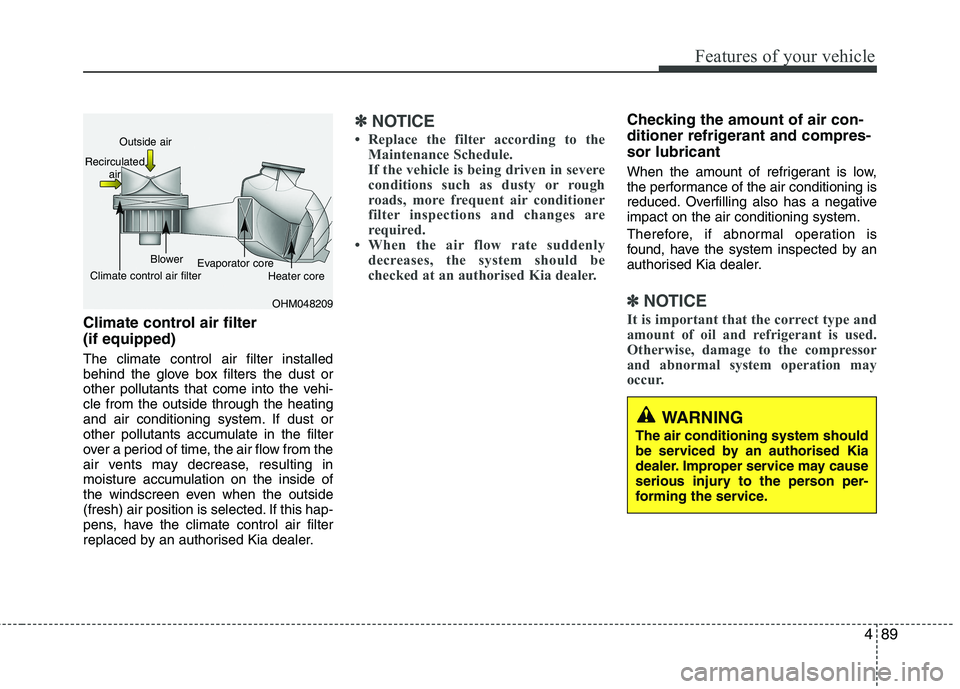
Climate control air filter (if equipped) The climate control air filter installed
behind the glove box filters the dust or
other pollutants that come into the vehi-cle from the outside through the heating
and air conditioning system. If dust or
other pollutants accumulate in the filter
over a period of time, the air flow from the
air vents may decrease, resulting in
moisture accumulation on the inside of
the windscreen even when the outside
(fresh) air position is selected. If this hap-
pens, have the climate control air filter
replaced by an authorised Kia dealer.
✽✽NOTICE
Replace the filter according to the Maintenance Schedule.
If the vehicle is being driven in severe
conditions such as dusty or rough
roads, more frequent air conditioner
filter inspections and changes are
required.
When the air flow rate suddenly
decreases, the system should be
checked at an authorised Kia dealer.Checking the amount of air con-
ditioner refrigerant and compres-sor lubricant
When the amount of refrigerant is low,
the performance of the air conditioning is
reduced. Overfilling also has a negativeimpact on the air conditioning system.
Therefore, if abnormal operation is
found, have the system inspected by an
authorised Kia dealer.
✽✽ NOTICE
It is important that the correct type and
amount of oil and refrigerant is used.
Otherwise, damage to the compressor
and abnormal system operation may
occur.
WARNING
The air conditioning system should
be serviced by an authorised Kia
dealer. Improper service may cause
serious injury to the person per-
forming the service.
OHM048209
Outside air
Recirculated air
Climate control air filter Blower
Evaporator core
Heater core
Page 599 of 846
Features of your vehicle
100
4
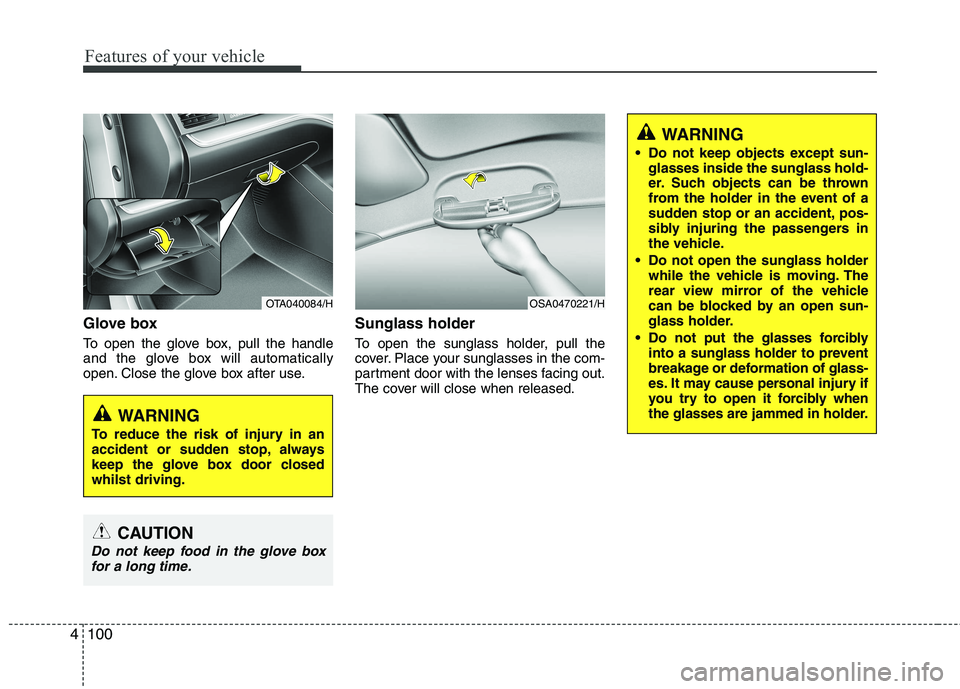
Glove box
To open the glove box, pull the handle
and the glove box will automatically
open. Close the glove box after use. Sunglass holder
To open the sunglass holder, pull the
cover. Place your sunglasses in the com-
partment door with the lenses facing out.
The cover will close when released.
OTA040084/H
WARNING
To reduce the risk of injury in an
accident or sudden stop, always
keep the glove box door closedwhilst driving.
OSA0470221/H
CAUTION
Do not keep food in the glove box for a long time.
WARNING
Do not keep objects except sun- glasses inside the sunglass hold-
er. Such objects can be thrown
from the holder in the event of a
sudden stop or an accident, pos-
sibly injuring the passengers in
the vehicle.
Do not open the sunglass holder while the vehicle is moving. The
rear view mirror of the vehicle
can be blocked by an open sun-
glass holder.
Do not put the glasses forcibly into a sunglass holder to prevent
breakage or deformation of glass-
es. It may cause personal injury if
you try to open it forcibly when
the glasses are jammed in holder.
Page 785 of 846
Maintenance
32
7
CLIMATE CONTROL AIR FILTER
Filter inspection The climate control air filter should be replaced according to the maintenance
schedule. If the vehicle is operated in the
severely air-polluted cities or on dusty
rough roads for a long period, it shouldbe inspected more frequently and
replaced earlier. When you, the owner,
replace the climate control air filter,
replace it performing the following proce-
dure, and be careful to avoid damaging
other components. Replace the filter according to the main-
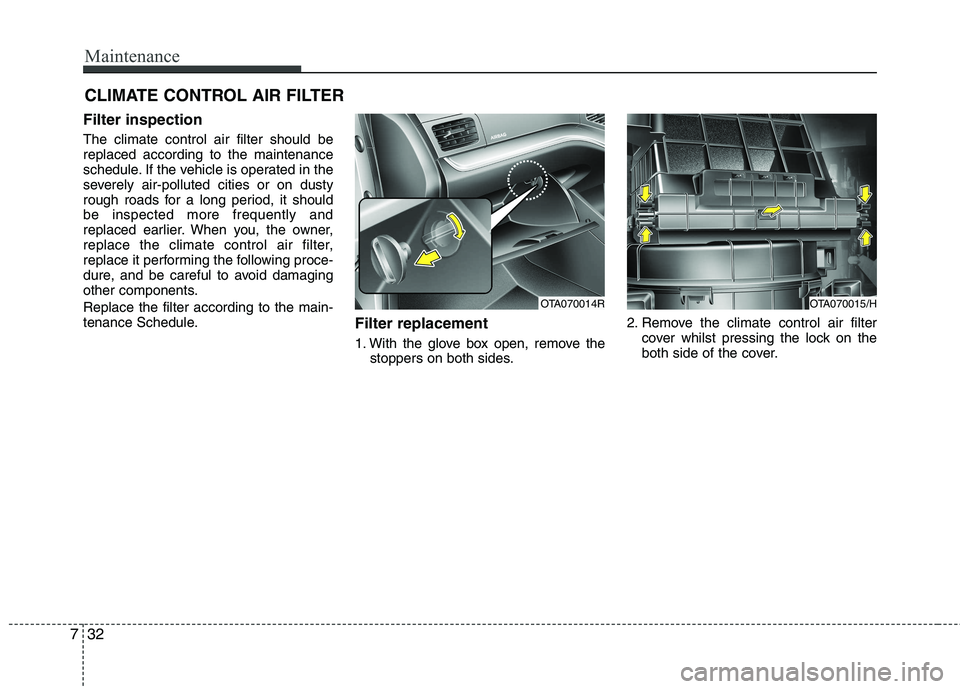
tenance Schedule. Filter replacement
1. With the glove box open, remove the
stoppers on both sides. 2. Remove the climate control air filter
cover whilst pressing the lock on the
both side of the cover.
OTA070015/HOTA070014R
Page 841 of 846

Index
4
I
Economical operation ....................................................5-37
Electric power steering ..................................................4-34
Electronic stability program (ESP) ................................5-30
Emergency starting ..........................................................6-5
Jump starting ..............................................................6-5
Push starting ................................................................6-6
Emergency stop signal (ESS) ........................................5-35
Emergency towing ..........................................................6-28
Emergency whilst driving ................................................6-3
Emergency commodity ..................................................6-31
Emission control system ................................................7-75 Crankcase emission control system ..........................7-75
Evaporative emission control system ........................7-75
Exhaust emission control system ..............................7-76
Engine compartment..................................................2-4, 7-2
Engine coolant ................................................................7-23
Engine number ..................................................................8-7
Engine oil ........................................................................7-21
Engine overheats ..............................................................6-7
Engine start/stop button ....................................................5-6
Engine will not start..........................................................6-4
Evaporative emission control system..............................7-75
Exhaust emission control system ....................................7-76
Explanation of scheduled maintenance items ................7-18
Exterior care....................................................................7-69 Flat tyre ............................................................................6-8
Changing tyres ............................................................6-9
Jack and tools ..............................................................6-8
Removing and storing the spare tyre ..........................6-9
Fluid Automatic transaxle fluid ..........................................7-27
Washer fluid ..............................................................7-29
Brake fluid ................................................................7-26
Folding the rear seat........................................................3-10
Front seat adjustment - manual ........................................3-4
Fuel filler lid ..................................................................4-27
Fuel gauge ......................................................................4-42
Fuel requirements ............................................................1-2
Fuses ..............................................................................7-50 Fuse/relay panel description......................................7-54
Instrument panel fuse ................................................7-51
Multi fuse ..................................................................7-53
Memory fuse ............................................................7-52
Gauge Fuel gauge ................................................................4-42
Glassroof, see sunroof ....................................................4-30
Glove box ......................................................................4-100
F
G
E
Page 845 of 846

Index
8
I
Special driving conditions ..............................................5-39
Driving at night ........................................................5-40
Driving in flooded areas............................................5-42
Driving in the rain ....................................................5-41
Hazardous driving conditions ..................................5-39
Highway driving ........................................................5-42
Rocking the vehicle ..................................................5-39
Smooth cornering ......................................................5-40
Speedometer....................................................................4-42
Starting difficulties, see engine will not start ..................6-4
Starting the engine ............................................................5-9
Steering wheel ................................................................4-34 Electric power steering..............................................4-34
Heated steering wheel ..............................................4-35
Horn ..........................................................................4-36
Tilt steering ..............................................................4-34
Steering wheel audio control ........................................4-108
Storage compartment ......................................................4-99 Glove box ................................................................4-100
Sunglass holder ......................................................4-100
Sunglass holder ............................................................4-100
Sunroof............................................................................4-30
Sunvisor ........................................................................4-103 Tachometer ......................................................................4-42
Tailgate ............................................................................4-18
Tilt steering ....................................................................4-34
Towing ............................................................................6-27
Emergency towing ....................................................6-28
Transaxle Automatic transaxle ..................................................5-19
Manual transaxle ......................................................5-16
Tripmeter ........................................................................4-44
Trip computer..................................................................4-43
Tyre Pressure Monitoring System (TPMS) ....................6-22
Tyre specification and pressure label................................8-7
Tyres and wheels ....................................................7-40, 8-2 Checking tyre inflation pressure ..............................7-41
Recommended cold tyre inflation pressures ............7-40
Tyre care ....................................................................7-40
Tyre maintenance ......................................................7-45
Tyre replacement ......................................................7-44
Tyre rotation ..............................................................7-42
Tyre sidewall labeling ..............................................7-46
Tyre traction ..............................................................7-45
Wheel alignment and tyre balance ............................7-43
Wheel replacement ....................................................7-45T