2015 KIA PICANTO ECO
[x] Cancel search: ECOPage 40 of 846
Safety features of your vehicle
28
3
Children riding in the car should sit in the
rear seat and must always be properly
restrained to minimize the risk of injury inan accident, sudden stop or sudden
maneuver. According to accident statis-
tics, children are safer when properly
restrained in the rear seats than in the
front seat. Larger children not in a child
restraint should use one of the seat belts
provided.
You should be aware of the specific
requirements in your country. Child
and/or infant safety seats must be prop-
erly placed and installed in the rear seat.
You must use a commercially available
child restraint system that meets the
requirements of the Safety Standards of
your country. Child restraint systems are
designed to be secured in vehicle seats
by lap belts or the lap belt portion of a
lap/shoulder belt, or by a tether anchorand/or ISOFIX anchors (if equipped). Children could be injured or killed in a
crash if their restraints are not properly
secured. For small children and babies, a
child seat or infant seat must be used.
Before buying a particular child restraint
system, make sure it fits your car seat
and seat belts, and fits your child. Follow
all the instructions provided by the man-
ufacturer when installing the child
restraint system. CHILD RESTRAINT SYSTEM
WARNING
A child restraint system must be placed in the rear seat. Never
install a child or infant seat on the
front passenger's seat. Should anaccident occur and cause the
passenger side air bag to deploy,
it could severely injure or kill an
infant or child seated in an infant
or child seat. Thus only use a
child restraint in the rear seat of
your vehicle.
A seat belt or child restraint sys- tem can become very hot if it is
left in a closed vehicle on a sunny
day, even if the outside tempera-
ture does not feel hot. Be sure to
check the seat cover and buckles
before placing a child there.
When the child restraint system is not in use, store it in the lug-
gage area or fasten it with a seat
belt so that it will not be thrown
forward in the case of a suddenstop or an accident.
Children may be seriously injured or killed by an inflating air bag.
All children, even those too large
for child restraints, must ride inthe rear seat.WARNING
To reduce the chance or serious or fatal injuries:
Children of all ages are safer when restrained in the rear seat.
A child riding in the front passen-
ger seat can be forcefully struck
by an inflating air bag resulting inserious or fatal injuries.
Always follow the child restraint system manufacturer’s instruc-
tions for installation and use of
the child restraint.
Always make sure the child seat is secured properly in the car and
your child is securely restrained
in the child seat.
Never hold a child in your arms or lap when riding in a vehicle. The
violent forces created during a
crash will tear the child from your
arms and throw the child against
the car’s interior.
Never put a seat belt over your- self and a child. During a crash,the belt could press deep into the
child causing serious internalinjuries.
(Continued)
Page 41 of 846
329
Safety features of your vehicle
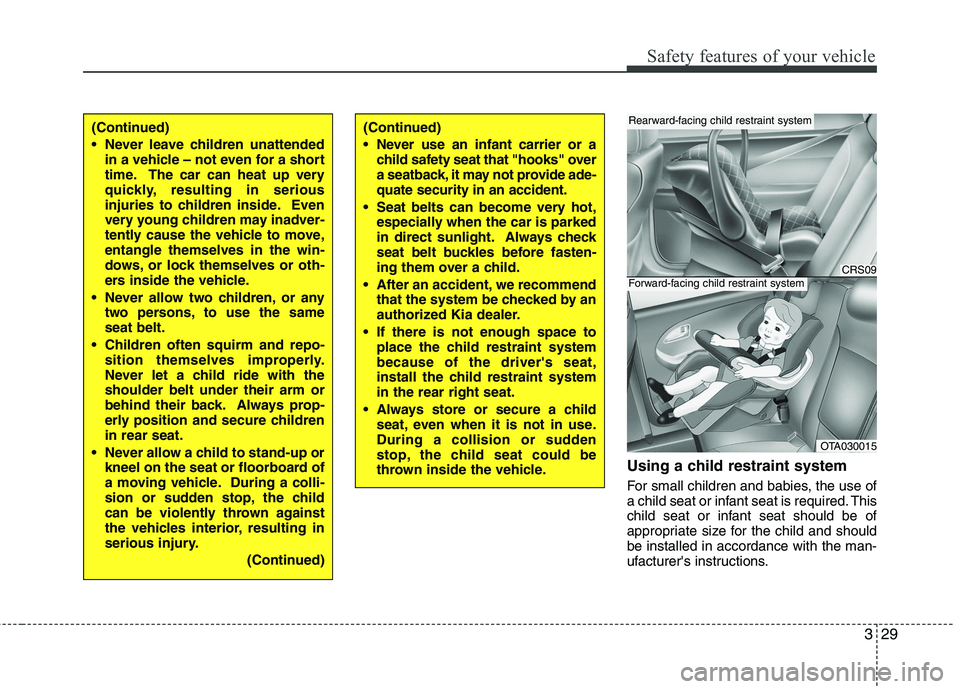
Using a child restraint system
For small children and babies, the use of
a child seat or infant seat is required. This
child seat or infant seat should be of
appropriate size for the child and shouldbe installed in accordance with the man-
ufacturer's instructions.
(Continued)
Never leave children unattendedin a vehicle – not even for a short
time. The car can heat up very
quickly, resulting in serious
injuries to children inside. Even
very young children may inadver-
tently cause the vehicle to move,entangle themselves in the win-
dows, or lock themselves or oth-
ers inside the vehicle.
Never allow two children, or any two persons, to use the sameseat belt.
Children often squirm and repo- sition themselves improperly.
Never let a child ride with theshoulder belt under their arm or
behind their back. Always prop-
erly position and secure childrenin rear seat.
Never allow a child to stand-up or kneel on the seat or floorboard of
a moving vehicle. During a colli-
sion or sudden stop, the child
can be violently thrown against
the vehicles interior, resulting in
serious injury.
(Continued)(Continued)
Never use an infant carrier or achild safety seat that "hooks" over
a seatback, it may not provide ade-quate security in an accident.
Seat belts can become very hot, especially when the car is parked
in direct sunlight. Always check
seat belt buckles before fasten-
ing them over a child.
After an accident, we recommend that the system be checked by an
authorized Kia dealer.
If there is not enough space to place the child restraint systembecause of the driver's seat,
install the child restraint systemin the rear right seat.
Always store or secure a child seat, even when it is not in use.
During a collision or sudden
stop, the child seat could be
thrown inside the vehicle.
CRS09
OTA030015
Rearward-facing child restraint system
Forward-facing child restraint system
Page 42 of 846
Safety features of your vehicle
30
3
For safety reasons, we recommend that
the child restraint system be used in the
rear seats.
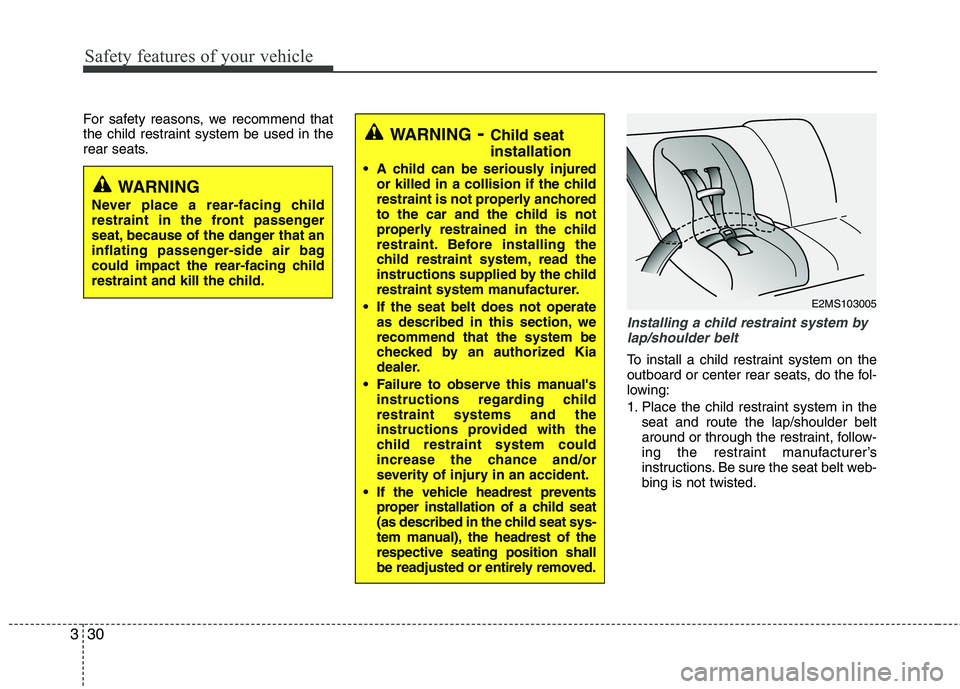
Installing a child restraint system by
lap/shoulder belt
To install a child restraint system on the
outboard or center rear seats, do the fol-
lowing:
1. Place the child restraint system in the seat and route the lap/shoulder belt
around or through the restraint, follow-
ing the restraint manufacturer’s
instructions. Be sure the seat belt web-bing is not twisted.
E2MS103005
WARNING
Never place a rear-facing child
restraint in the front passenger
seat, because of the danger that an
inflating passenger-side air bag
could impact the rear-facing child
restraint and kill the child.
WARNING - Child seat installation
A child can be seriously injured or killed in a collision if the child
restraint is not properly anchored
to the car and the child is not
properly restrained in the child
restraint. Before installing the
child restraint system, read the
instructions supplied by the child
restraint system manufacturer.
If the seat belt does not operate as described in this section, werecommend that the system be
checked by an authorized Kia
dealer.
Failure to observe this manual's instructions regarding childrestraint systems and the
instructions provided with the
child restraint system could
increase the chance and/or
severity of injury in an accident.
If the vehicle headrest prevents proper installation of a child seat
(as described in the child seat sys-
tem manual), the headrest of therespective seating position shall
be readjusted or entirely removed.
Page 48 of 846
Safety features of your vehicle
36
3
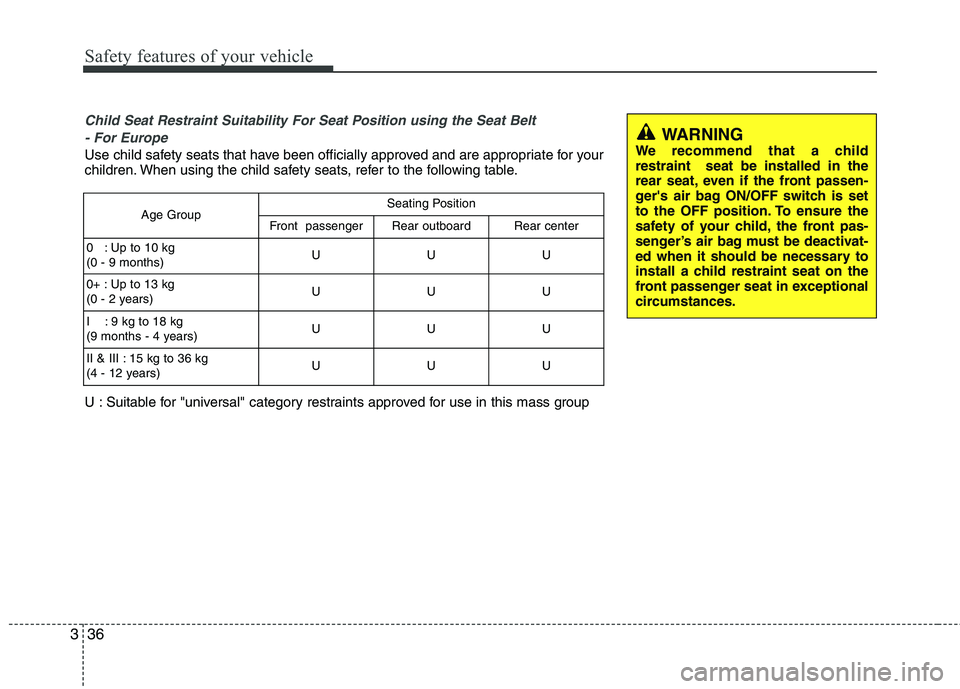
Child Seat Restraint Suitability For Seat Position using the Seat Belt
- For Europe
Use child safety seats that have been officially approved and are appropriate for your
children. When using the child safety seats, refer to the following table.
Age Group Seating Position
Front passenger Rear outboard Rear center
0 : Up to 10 kg (0 - 9 months) UUU
0+ : Up to 13 kg
(0 - 2 years) UUU
I : 9 kg to 18 kg
(9 months - 4 years) UUU
II & III : 15 kg to 36 kg
(4 - 12 years) UUU
WARNING
We recommend that a child restraint seat be installed in the
rear seat, even if the front passen-
ger's air bag ON/OFF switch is set
to the OFF position. To ensure the
safety of your child, the front pas-
senger’s air bag must be deactivat-
ed when it should be necessary to
install a child restraint seat on the
front passenger seat in exceptional
circumstances.
U : Suitable for "universal" category restraints approved for use in this mass group
Page 49 of 846
337
Safety features of your vehicle
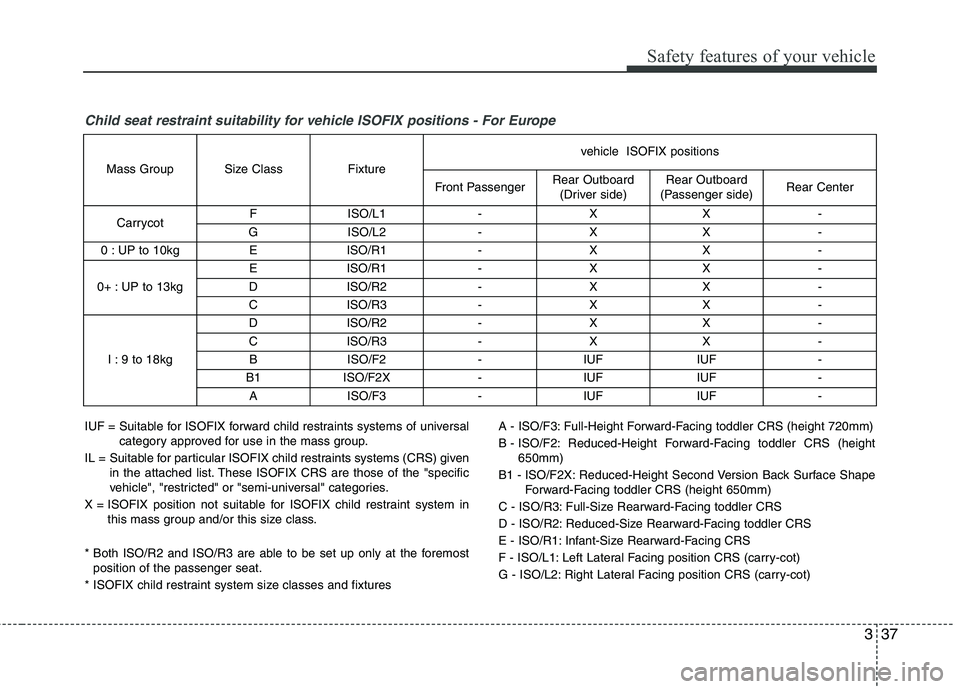
Child seat restraint suitability for vehicle ISOFIX positions - For Europe
IUF = Suitable for ISOFIX forward child restraints systems of universalcategory approved for use in the mass group.
IL = Suitable for particular ISOFIX child restraints systems (CRS) given in the attached list. These ISOFIX CRS are those of the "specific
vehicle", "restricted" or "semi-universal" categories.
X = ISOFIX position not suitable for ISOFIX child restraint system in this mass group and/or this size class.
* Both ISO/R2 and ISO/R3 are able to be set up only at the foremost position of the passenger seat.
* ISOFIX child restraint system size classes and fixtures A - ISO/F3: Full-Height Forward-Facing toddler CRS (height 720mm)
B - ISO/F2: Reduced-Height Forward-Facing toddler CRS (height
650mm)
B1 - ISO/F2X: Reduced-Height Second Version Back Surface Shape Forward-Facing toddler CRS (height 650mm)
C - ISO/R3: Full-Size Rearward-Facing toddler CRS
D - ISO/R2: Reduced-Size Rearward-Facing toddler CRS
E - ISO/R1: Infant-Size Rearward-Facing CRS
F - ISO/L1: Left Lateral Facing position CRS (carry-cot)
G - ISO/L2: Right Lateral Facing position CRS (carry-cot)
Mass Group Size Class Fixture
vehicle ISOFIX positions
Front Passenger Rear Outboard
(Driver side) Rear Outboard
(Passenger side) Rear Center
Carrycot F ISO/L1 - X X -
G ISO/L2 - X X -
0 : UP to 10kg E ISO/R1 - X X -
0+ : UP to 13kg E ISO/R1 - X X -
D ISO/R2 - X X -
C ISO/R3 - X X -
I : 9 to 18kg D ISO/R2 - X X -
C ISO/R3 - X X -
B ISO/F2 - IUF IUF -
B1 ISO/F2X - IUF IUF -
A ISO/F3 - IUF IUF -
Page 50 of 846
Safety features of your vehicle
38
3
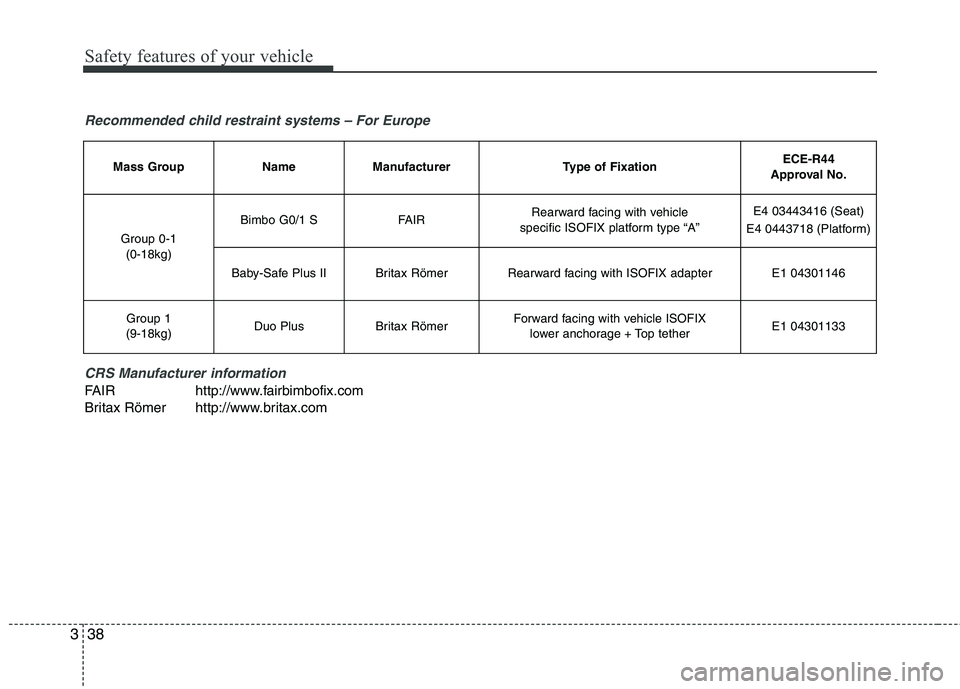
Recommended child restraint systems – For Europe
CRS Manufacturer information
FAIR http://www.fairbimbofix.com
Britax Römer http://www.britax.com
Mass GroupNameManufacturerType of FixationECE-R44
Approval No.
Group 0-1 (0-18kg)
Bimbo G0/1 SFAIRRearward facing with vehicle
specific ISOFIX platform type “A”E4 03443416 (Seat)
E4 0443718 (Platform)
Baby-Safe Plus IIBritax RömerRearward facing with ISOFIX adapterE1 04301146
Group 1
(9-18kg)Duo PlusBritax RömerForward facing with vehicle ISOFIX lower anchorage + Top tetherE1 04301133
Page 54 of 846
Safety features of your vehicle
42
3
Air bag warning light
The purpose of the air bag warning light
in your instrument panel is to alert you of
a potential problem with your air bag -
Supplemental Restraint System (SRS).
When the ignition switch is turned ON,
the warning light should illuminate for
approximately 6 seconds, then go off.
Have the system checked if:
The light does not turn on briefly when
you turn the ignition ON.
The light stays on after illuminating for approximately 6 seconds.
The light comes on while the vehicle is in motion.
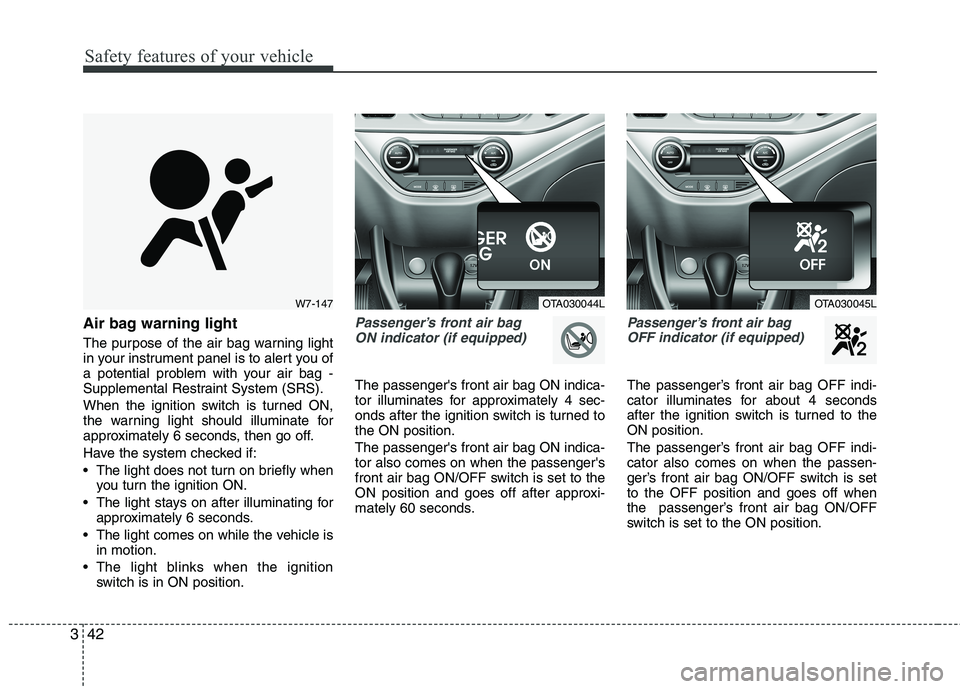
The light blinks when the ignition switch is in ON position.Passenger’s front air bag
ON indicator (if equipped)
The passenger's front air bag ON indica-
tor illuminates for approximately 4 sec-
onds after the ignition switch is turned tothe ON position. The passenger's front air bag ON indica- tor also comes on when the passenger's
front air bag ON/OFF switch is set to the
ON position and goes off after approxi-
mately 60 seconds.
Passenger’s front air bag OFF indicator (if equipped)
The passenger’s front air bag OFF indi-
cator illuminates for about 4 seconds
after the ignition switch is turned to theON position.
The passenger’s front air bag OFF indi- cator also comes on when the passen-
ger’s front air bag ON/OFF switch is setto the OFF position and goes off when
the passenger’s front air bag ON/OFF
switch is set to the ON position.
W7-147OTA030044LOTA030045L
Page 55 of 846

343
Safety features of your vehicle
SRS components and functions
The SRS consists of the following com- ponents:
1. Driver's front air bag module*
2. Passenger's front air bag module*
3. Side impact air bag modules*
4. Curtain air bag modules*
5. Driver’s knee air bag module*
6. Retractor pre-tensioner assemblies*
7. Air bag warning light
8. SRS control module (SRSCM)
9. Side impact sensors*
10. Anchor pre-tensioner assembly* (driver side)
11. Passenger’s front air bag ON/OFF switch*
12. Passenger’s front air bag ON/OFF indicator*
* : if equipped The SRSCM continually monitors all SRS components while the ignition
switch is ON to determine if a crash
impact is severe enough to require air
bag deployment or pre-tensioner seat
belt deployment.
The SRS air bag warning light " " on
the instrument panel will illuminate for
about 6 seconds after the ignition switch
is turned to the ON position, after which
the SRS air bag warning light " "should go out.
WARNING
If any of the following conditions
occurs, this indicates a malfunction
of the SRS. We recommend that the
system be inspected by an author-
ized Kia dealer.
The light does not turn on briefly when you turn the ignition ON.
The light stays on after illuminat- ing for approximately 6 seconds.
The light comes on while the vehicle is in motion.
The light blinks when the ignition switch is in ON position.
CAUTION
If the passenger’s front air bag
ON/OFF switch malfunctions, the
passenger’s front air bag OFF indi-cator will not illuminate (The pas-senger's front air bag ON indicator comes on and goes off after
approximately 60 seconds) and thepassenger’s front air bag will inflatein a frontal impact even if the pas-
senger’s front air bag ON/OFFswitch is set to the OFF position.
If this occurs, we recommend thatthe passenger’s front air bagON/OFF switch and the SRS air bag
system be inspected by an author- ized Kia dealer.