2015 KIA CEED park assist
[x] Cancel search: park assistPage 790 of 1210

4 105
Features of your vehicle
2. Select parking assist mode
• Select the parking assist mode bypressing the Smart Parking Assist
System button with the shift lever in N
(Neutral) or D(Drive) and the brakepedal depressed.
• The right side parallel mode is select- ed automatically when the Smart
Parking Assist System is activated.
• To select the left side parallel mode press the Smart Parking Assist System
button once more.
• If the button is pressed again, the sys- tem will turn off.
3. Search for parking space
• Slowly drive forward maintaining thedistance of approximately 50cm ~ 150cm (19.6in.~59.0in.) with the
parked vehicles. The side sensors will
search for a parking space.
• If the vehicle speed is over 30km/h (18.6mph), a message will appear tonotify to reduce speed.
• If the vehicle speed is over 40km/h (24.8mph), the system will cancel.
✽NOTICE
• Turn on the hazard warning flasher if it is crowded with other vehicles.
• If the parking lot is small, slowly drive more nearer to the parking space.
• The search for a parking space will be
completed only when there is enough
space for the vehicle to move to park.
✽NOTICE
• When searching for a parking space, the system may not be able to find a
parking space if there is no vehicle
parked, a parking space is available
after driving by or a parking space is
available before driving by.
• The system may not operate normally
in the following conditions:
(1) When the sensors are frozen
(2) When the sensors are dirty
(3) When it snows or rains heavily
(4) When a pillar or object is near
OJD042219/OJD042216
■
Right side
- parallel mode ■
Left side
-parallel modeOJD042220/OJD042217
■
Right side
- parallel mode ■
Left side
-parallel mode
JD RHD 4a(~171).QXP 4/14/2015 7:01 PM Page 105
Page 792 of 1210

4 107
Features of your vehicle
✽NOTICE
• If you do not follow the instructions provided, you may fail to park your
vehicle.
However, if the Parking Assist System
warning sound (distance from object
is within 30cm: continuous beep)
occurs, slowly drive the vehicle to the
reverse direction of the detected
object after checking the surrounding.
• Always check the surrounding before
driving your vehicle if the Parking
Assist System warning sound (dis-
tance from object is within 30cm: con-
tinuous beep) is heard for the object is
close to your vehicle.
To cancel the system whilst parking
Press the Smart Parking Assist System
button or turn the steering wheel to the
left or right.
Gear shift whilst steering wheel control
When the above message appears with a
beep sound, shift the gear and drive the
vehicle with the brake pedal depressed.CAUTION
• Always drive slowly with thebrake pedal applied.
• Always check for objects around your vehicle before driving.
• If the vehicle does not move even though the brake pedal is notdepressed, check the surround-
ing before depressing the accel-erator pedal. Be sure not to speed over 7km/h(4.3mph).
OJD042224/OJD042225/OJD042223/OJD042225
■
Manual transaxle
■ Automatic transaxle
JD RHD 4a(~171).QXP 4/14/2015 7:02 PM Page 107
Page 793 of 1210

Features of your vehicle
108
4
6. Smart Parking Assist System com-
pleted
Complete parking your vehicle according
to the instructions on the LCD display. If
required, manually control the steering
wheel and complete parking your vehicle.
✽NOTICE
The brake pedal must be depressed by
the driver whilst parking your vehicle.
The system may be cancelled in the below
conditions:
• Ignoring the gear shift message and drive the vehicle approximately 150cm (59in).
• The front and rear Parking Assist System warning sound (distance from
object is within 30cm: continuous
beep) is heard at the same time.
• 6 minutes have passed since the vehi- cle has been controlled by the Smart
Parking Assist System.
• The shift lever is changed to the P (Park) or R (Reverse) position whilst
searching for parking space.
WARNING
Always be careful whilst parking for
other vehicles or pedestrians.
CAUTION
Always check the surrounding before releasing the brake pedal.
OJD042226
JD RHD 4a(~171).QXP 4/14/2015 7:02 PM Page 108
Page 794 of 1210

4 109
Features of your vehicle
Additional instructions(messages)
When the Smart Parking Assist System
is operating, a message may appear
regardless of the parking order. The messages will appear according to
the circumstances. Follow the instruc-
tions provided whilst parking your vehicle
with the Smart Parking Assist System.
✽NOTICE
• In the below conditions the system will be cancelled. Park your vehicle
manually.
1. Search for parking space
- When the ABS/ESC is activated
- When the vehicle speed is over
40km/h (24.8mph)
- When you press the Smart Parking
Assist System button (the front and
rear Parking Assist System operates)
- When you shift the shift lever to R
(Reverse)
2. Steering wheel control
- When the ABS/ESC is activated
- When the vehicle speed is over7km/h (4.3 mph)
- When you press the Smart Parking Assist System button (the front and
rear Parking Assist System operates)
- When you shift the shift lever to D
(Drive) before entering the parking
space
- When you hold the steering wheel
firmly
System malfunction
• If there is a problem with the system, when the system is turned on, the
above message will appear. Also, the
indicator on the button will not light up and a beep sound will be heard 3
times.
• If there is a problem with only the Smart Parking Assist System, the
Parking Assist System will operate
after 2 seconds.
If you notice any problem, have your
vehicle checked by an authorised Kia
dealer as soon as possible.
OJD042227/OJD042229OJD042228
JD RHD 4a(~171).QXP 4/14/2015 7:02 PM Page 109
Page 951 of 1210

Driving your vehicle
Before driving . . . . . . . . . . . . . . . . . . . . . . . . . . . . . . 5-4 Before entering vehicle. . . . . . . . . . . . . . . . . . . . . . . . . 5-4
Necessary inspections . . . . . . . . . . . . . . . . . . . . . . . . . . 5-4
Before starting . . . . . . . . . . . . . . . . . . . . . . . . . . . . . . . 5-4
Key positions . . . . . . . . . . . . . . . . . . . . . . . . . . . . . . 5-5 Illuminated ignition switch . . . . . . . . . . . . . . . . . . . . . 5-5
Ignition switch position . . . . . . . . . . . . . . . . . . . . . . . . 5-6
Starting the engine . . . . . . . . . . . . . . . . . . . . . . . . . . . . 5-7
Engine START/STOP button . . . . . . . . . . . . . . . . . 5-9 Illuminated engine start/stop button . . . . . . . . . . . . . 5-9
Engine start/stop button position . . . . . . . . . . . . . . . . 5-9
Starting the engine . . . . . . . . . . . . . . . . . . . . . . . . . . . . 5-12
ISG (Idle Stop and Go) system . . . . . . . . . . . . . . . . 5-15 Auto stop . . . . . . . . . . . . . . . . . . . . . . . . . . . . . . . . . . . . 5-15
Auto start. . . . . . . . . . . . . . . . . . . . . . . . . . . . . . . . . . . . 5-17
Condition of ISG system operation . . . . . . . . . . . . . . 5-18
ISG system deactivation. . . . . . . . . . . . . . . . . . . . . . . . 5-18
ISG system malfunction . . . . . . . . . . . . . . . . . . . . . . . . 5-19
Manual transaxle . . . . . . . . . . . . . . . . . . . . . . . . . . . 5-20 Manual transaxle operation . . . . . . . . . . . . . . . . . . . . 5-20
Good driving practices. . . . . . . . . . . . . . . . . . . . . . . . . 5-22
Automatic transaxle/Double clutch transmission . . 5-23
Automatic transaxle/Double clutch transmission operation . . . . . . . . . . . . . . . . . . . . . . . . . . . . . . . . . . 5-23
Good driving practices. . . . . . . . . . . . . . . . . . . . . . . . . 5-30 Active eco system . . . . . . . . . . . . . . . . . . . . . . . . . . . 5-32
Active ECO operation . . . . . . . . . . . . . . . . . . . . . . . . . 5-32
Limitation of Active ECO operation . . . . . . . . . . . . . 5-32
Brake system . . . . . . . . . . . . . . . . . . . . . . . . . . . . . . 5-33 Power brakes. . . . . . . . . . . . . . . . . . . . . . . . . . . . . . . . . 5-33
Parking brake - Hand type . . . . . . . . . . . . . . . . . . . . . 5-35
Electric parking brake (EPB) . . . . . . . . . . . . . . . . . . . 5-37
Emergency braking . . . . . . . . . . . . . . . . . . . . . . . . . . . 5-41
Anti-lock brake system (ABS) . . . . . . . . . . . . . . . . . . . 5-41
Electronic stability control (ESC) . . . . . . . . . . . . . . . . 5-44
Vehicle stability management (VSM) . . . . . . . . . . . . . 5-47
Hill-start assist control (HAC) . . . . . . . . . . . . . . . . . . 5-48
Emergency Stop Signal (ESS) . . . . . . . . . . . . . . . . . . . 5-48
Good braking practices . . . . . . . . . . . . . . . . . . . . . . . . 5-49
Cruise control system . . . . . . . . . . . . . . . . . . . . . . . 5-51
Speed limit control system . . . . . . . . . . . . . . . . . . . 5-56
Lane departure warning system (LDWS) . . . . . . . 5-59
Economical operation . . . . . . . . . . . . . . . . . . . . . . . 5-62
Special driving conditions . . . . . . . . . . . . . . . . . . . . 5-64 Hazardous driving conditions . . . . . . . . . . . . . . . . . . . 5-64
Rocking the vehicle . . . . . . . . . . . . . . . . . . . . . . . . . . . 5-64
Smooth cornering . . . . . . . . . . . . . . . . . . . . . . . . . . . . . 5-65
Driving at night . . . . . . . . . . . . . . . . . . . . . . . . . . . . . . 5-65
Driving in the rain . . . . . . . . . . . . . . . . . . . . . . . . . . . . 5-65
Driving in flooded areas. . . . . . . . . . . . . . . . . . . . . . . . 5-66
5
JD RHD 5.QXP 2/17/2015 10:32 AM Page 1
Page 998 of 1210

Driving your vehicle
48
5
Hill-start assist control (HAC) (if equipped)
A vehicle has the tendency to slip back
on a steep hill when it starts to go after
stopping. The Hill-start Assist Control
(HAC) prevents the vehicle from slipping
back by operating the brakes automati-
cally for about 1~2 seconds. The brakes
are released when the accelerator pedal
is depressed or after about 1~2 seconds.
✽✽
NOTICE
The HAC does not operate when the transaxle shift lever is in the P (Park)
or N (Neutral) position.
The HAC activates even though the ESC is off but it does not activate
when the ESC has malfunctioned.
Emergency Stop Signal (ESS) The Emergency Stop Signal system
alerts the driver behind by blinking the
stop light when the vehicle is braked rap-
idly and severely.
The system is activated when:
The vehicle suddenly stops (vehiclespeed is over 55km/h and the vehicle
deceleration at greater than 7 m/s 2
)
The ABS is activating
When the vehicle speed is under 40 km/h
and the ABS deactivates or the sudden
stop situation is over, the stop light blink-
ing will stop. Instead, the hazard warning
flasher will turn on automatically.
The hazard warning flasher will turn off
when vehicle speed is over 10km/h after
the vehicle has stopped. Also, it will turn
off when the vehicle is driven at low
speed for some time. You can turn it off
manually by pushing the hazard warning
flasher switch.
WARNING
The HAC is activated only for about
1~2 seconds, so when the vehicle
is starting off always depress theaccelerator pedal.
CAUTION
The Emergency Stop Signal (ESS) system will not work if the hazard
warning flasher is already on.
JD RHD 5.QXP 2/17/2015 10:34 AM Page 48
Page 1035 of 1210
65
What to do in an emergency
EMERGENCY STARTING
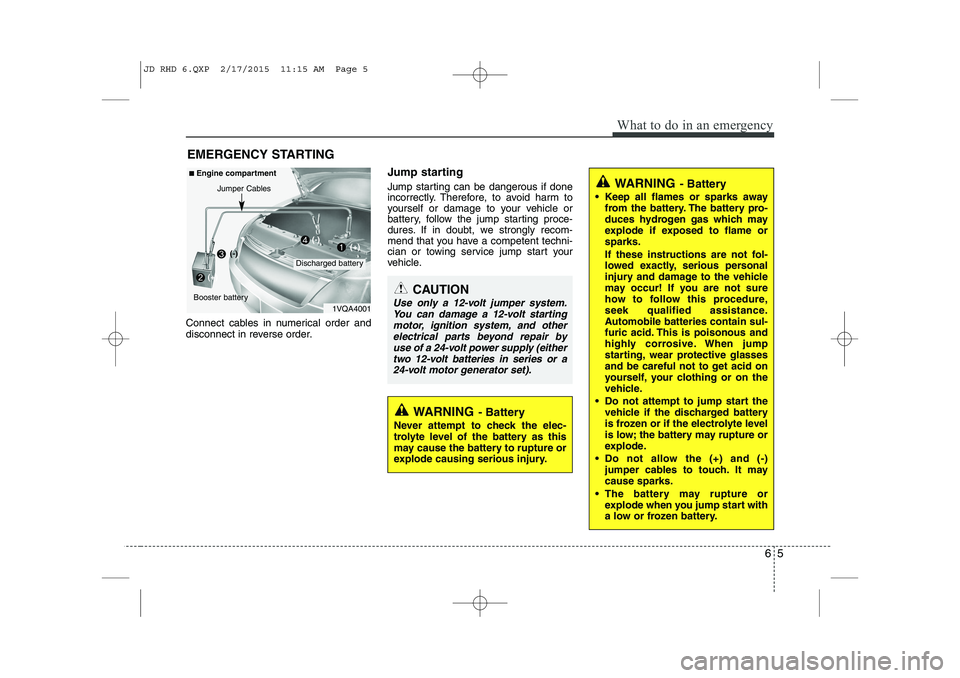
Connect cables in numerical order and
disconnect in reverse order. Jump starting
Jump starting can be dangerous if done
incorrectly. Therefore, to avoid harm to
yourself or damage to your vehicle or
battery, follow the jump starting proce-
dures. If in doubt, we strongly recom-
mend that you have a competent techni-
cian or towing service jump start your
vehicle.
CAUTION
Use only a 12-volt jumper system.
You can damage a 12-volt starting motor, ignition system, and otherelectrical parts beyond repair by
use of a 24-volt power supply (eithertwo 12-volt batteries in series or a 24-volt motor generator set).
WARNING - Battery
• Keep all flames or sparks away from the battery. The battery pro-
duces hydrogen gas which may
explode if exposed to flame orsparks.
If these instructions are not fol-
lowed exactly, serious personal
injury and damage to the vehicle
may occur! If you are not sure
how to follow this procedure,
seek qualified assistance.
Automobile batteries contain sul-
furic acid. This is poisonous and
highly corrosive. When jump
starting, wear protective glasses
and be careful not to get acid on
yourself, your clothing or on the
vehicle.
Do not attempt to jump start the vehicle if the discharged battery
is frozen or if the electrolyte level
is low; the battery may rupture or
explode.
Do not allow the (+) and (-) jumper cables to touch. It maycause sparks.
The battery may rupture or explode when you jump start with
a low or frozen battery.
WARNING - Battery
Never attempt to check the elec-
trolyte level of the battery as this
may cause the battery to rupture or
explode causing serious injury.
1VQA4001
Discharged battery
Jumper Cables
■
Engine compartment
Booster battery(-)
(+)
(+)(-)
JD RHD 6.QXP 2/17/2015 11:15 AM Page 5
Page 1138 of 1210
775
Maintenance
No.Fuse ratingSymbolFuse NameProtected component
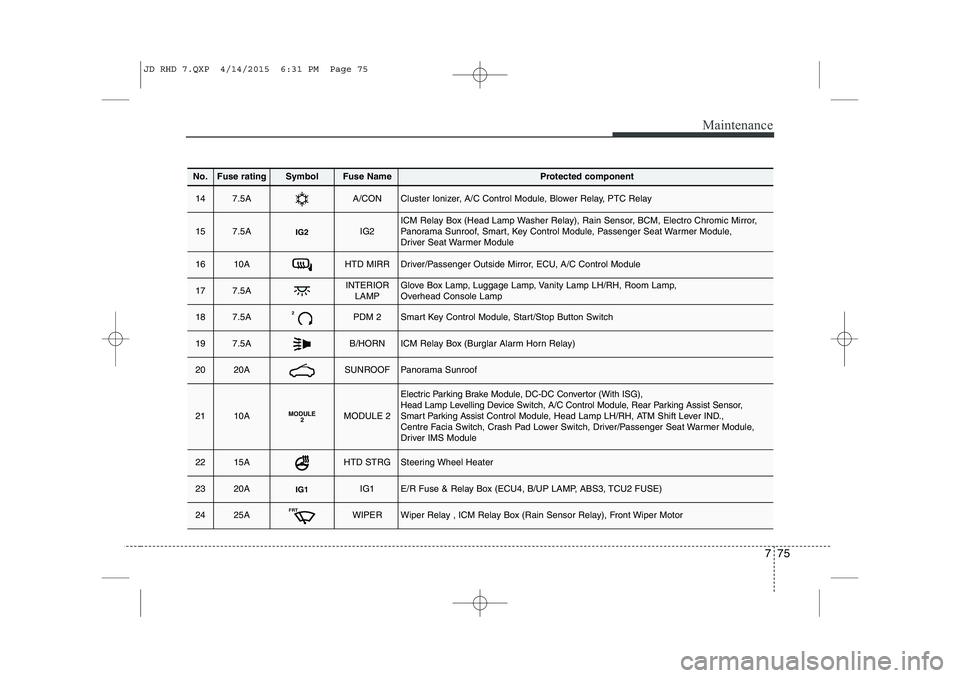
147.5AA/CONCluster Ionizer, A/C Control Module, Blower Relay, PTC Relay
157.5AIG2IG2ICM Relay Box (Head Lamp Washer Relay), Rain Sensor, BCM, Electro Chromic Mirror,
Panorama Sunroof, Smart, Key Control Module, Passenger Seat Warmer Module,
Driver Seat Warmer Module
1610AHTD MIRRDriver/Passenger Outside Mirror, ECU, A/C Control Module
177.5AINTERIORLAMPGlove Box Lamp, Luggage Lamp, Vanity Lamp LH/RH, Room Lamp,
Overhead Console Lamp
187.5A2PDM 2Smart Key Control Module, Start/Stop Button Switch
197.5AB/HORNICM Relay Box (Burglar Alarm Horn Relay)
2020ASUNROOFPanorama Sunroof
2110AMODULE 2MODULE 2
Electric Parking Brake Module, DC-DC Convertor (With ISG),
Head Lamp Levelling Device Switch, A/C Control Module, Rear Parking Assist Sensor,
Smart Parking Assist Control Module, Head Lamp LH/RH, ATM Shift Lever IND.,
Centre Facia Switch, Crash Pad Lower Switch, Driver/Passenger Seat Warmer Module,
Driver IMS Module
2215AHTD STRGSteering Wheel Heater
2320AIG1IG1E/R Fuse & Relay Box (ECU4, B/UP LAMP, ABS3, TCU2 FUSE)
2425AFRTWIPERWiper Relay , ICM Relay Box (Rain Sensor Relay), Front Wiper Motor
JD RHD 7.QXP 4/14/2015 6:31 PM Page 75