2015 KIA CEED inflation pressure
[x] Cancel search: inflation pressurePage 603 of 1210

Index
12
I
Tilt and telescopic steering . . . . . . . . . . . . . . . . . . . 4-38
Storage compartment . . . . . . . . . . . . . . . . . . . . . . . . 4-152 Center console storage . . . . . . . . . . . . . . . . . . . . . . 4-152
Cool box . . . . . . . . . . . . . . . . . . . . . . . . . . . . . . . . . . 4-153
Glove box . . . . . . . . . . . . . . . . . . . . . . . . . . . . . . . . . 4-153
Luggage side tray . . . . . . . . . . . . . . . . . . . . . . . . . 4-155
Luggage tray . . . . . . . . . . . . . . . . . . . . . . . . . . . . . . 4-154
Sliding armrest . . . . . . . . . . . . . . . . . . . . . . . . . . . . 4-152
Sunglass holder . . . . . . . . . . . . . . . . . . . . . . . . . . . . 4-154
Sunroof, see panorama sunroof. . . . . . . . . . . . . . . . . 4-33
Sunvisor . . . . . . . . . . . . . . . . . . . . . . . . . . . . . . . . . . . 4-158
Tachometer (Normal vision) . . . . . . . . . . . . . . . . . . . 4-47
Tachometer (Super vision) . . . . . . . . . . . . . . . . . . . . . 4-61
Tailgate . . . . . . . . . . . . . . . . . . . . . . . . . . . . . . . . . . . . . 4-22
Tether anchor system . . . . . . . . . . . . . . . . . . . . . . . . . 3-36
Theft-alarm system . . . . . . . . . . . . . . . . . . . . . . . . . . . 4-14
Tilt and telescopic steering. . . . . . . . . . . . . . . . . . . . . 4-38
Tire chains . . . . . . . . . . . . . . . . . . . . . . . . . . . . . . . . . . 5-68
Tire pressure monitoring system (TPMS) . . . . . . . . 6-24
Tire rotation . . . . . . . . . . . . . . . . . . . . . . . . . . . . . . . . 7-58
Tire specification and pressure label . . . . . . . . . . . . 8-12
Tires and wheels . . . . . . . . . . . . . . . . . . . . . . . . . 7-55, 8-7
Checking tire inflation pressure . . . . . . . . . . . . . . . 7-57 Compact spare tire replacement . . . . . . . . . . . . . . . 7-60
Low aspect ratio tire . . . . . . . . . . . . . . . . . . . . . . . . 7-65
Recommended cold tire inflation pressures . . . . . . 7-55
Tire care. . . . . . . . . . . . . . . . . . . . . . . . . . . . . . . . . . . 7-55
Tire maintenance . . . . . . . . . . . . . . . . . . . . . . . . . . . 7-61
Tire replacement . . . . . . . . . . . . . . . . . . . . . . . . . . . . 7-59
Tire rotation . . . . . . . . . . . . . . . . . . . . . . . . . . . . . . . 7-58
Tire sidewall labeling . . . . . . . . . . . . . . . . . . . . . . . . 7-61
Tire traction . . . . . . . . . . . . . . . . . . . . . . . . . . . . . . . 7-61
Wheel alignment and tire balance . . . . . . . . . . . . . 7-59
Wheel replacement . . . . . . . . . . . . . . . . . . . . . . . . . . 7-60
Towing . . . . . . . . . . . . . . . . . . . . . . . . . . . . . . . . . . . . . 6-29
Trailer towing . . . . . . . . . . . . . . . . . . . . . . . . . . . . . . . 5-71
Transaxle Automatic transaxle . . . . . . . . . . . . . . . . . . . . . . . . . 5-23
Double clutch transmission . . . . . . . . . . . . . . . . . . . 5-23
Manual transaxle . . . . . . . . . . . . . . . . . . . . . . . . . . . 5-20
Trip computer (Normal vision) . . . . . . . . . . . . . . . . . 4-51 Service mode . . . . . . . . . . . . . . . . . . . . . . . . . . . . . . . 4-55
User Settings . . . . . . . . . . . . . . . . . . . . . . . . . . . . . . . 4-56
Trip computer (Super vision) . . . . . . . . . . . . . . . . . . 4-67 Driving information mode . . . . . . . . . . . . . . . . . . . . 4-68
Lane Departure Warning System Mode . . . . . . . . 4-69
Service mode . . . . . . . . . . . . . . . . . . . . . . . . . . . . . . . 4-70
User Settings . . . . . . . . . . . . . . . . . . . . . . . . . . . . . . . 4-71
Turn signals . . . . . . . . . . . . . . . . . . . . . . . . . . . . . . . . 4-115
T
JD eng Index.QXP 3/12/2015 3:06 PM Page 12
Page 668 of 1210

Safety features of your vehicle
48
3
The air bag modules are located both in
the centre of the steering wheel and in
the front passenger's panel above the
glove box. When the SRSCM detects a
sufficiently severe impact to the front of
the vehicle, it will automatically deploy
the front air bags. Upon deployment, tear seams molded
directly into the pad covers will separate
under pressure from the expansion of the
air bags. Further opening of the covers
then allows full inflation of the air bags.
A fully inflated air bag, in combination
with a properly worn seat belt, slows the
driver's or the passenger's forward
motion, reducing the risk of head and
chest injury. After complete inflation, the air bag
immediately starts deflating, enabling the
driver to maintain forward visibility and
the ability to steer or operate other con-
trols.
B240B02L/HB240B03L/H
Driver’s front air bag (2) Driver’s front air bag (3)B240B01L/H
Driver’s front air bag (1)
JD RHD 3.QXP 4/14/2015 6:42 PM Page 48
Page 1012 of 1210
Driving your vehicle
62
5
ECONOMICAL OPERATION
Your vehicle's fuel economy depends
mainly on your style of driving, where you
drive and when you drive.
Each of these factors affects how many
kilometers (miles) you can get from a
litre (gallon) of fuel. To operate your vehi-
cle as economically as possible, use the
following driving suggestions to help
save money in both fuel and repairs:
Drive smoothly. Accelerate at a moder- ate rate. Do not make "jack-rabbit"
starts or full-throttle shifts and maintain
a steady cruising speed. Do not race
between stoplights. Try to adjust your
speed to the traffic so you do not have
to change speeds unnecessarily. Avoid
heavy traffic whenever possible.
Always maintain a safe distance from
other vehicles so you can avoid unnec-
essary braking. This also reduces
brake wear.
Drive at a moderate speed. The faster you drive, the more fuel your vehicle
uses. Driving at a moderate speed,
especially on the highway, is one of the
most effective ways to reduce fuel con-sumption. Do not "ride" the brake or clutch pedal.
This can increase fuel consumption
and also increase wear on these com-
ponents. In addition, driving with your
foot resting on the brake pedal may
cause the brakes to overheat, which
reduces their effectiveness and may
lead to more serious consequences.
Take care of your tyres. Keep them inflated to the recommended pressure.
Incorrect inflation, either too much or
too little, results in unnecessary tyre
wear. Check the tyre pressures at leastonce a month.
Be sure that the wheels are aligned correctly. Improper alignment can
result from hitting kerbs or driving too
fast over irregular surfaces. Poor align-
ment causes faster tyre wear and may
also result in other problems as well as
greater fuel consumption. Keep your vehicle in good condition.
For better fuel economy and reduced
maintenance costs, maintain your vehi-cle in accordance with the mainte-
nance schedule. If you drive your vehi-
cle in severe conditions, more frequentmaintenance is required.
Keep your vehicle clean. For maximum service, your vehicle should be kept
clean and free of corrosive materials. It
is especially important that mud, dirt,
ice, etc. not be allowed to accumulate
on the underside of the vehicle. This
extra weight can result in increased
fuel consumption and also contributeto corrosion.
Travel lightly. Do not carry unnecessary weight in your vehicle. Weight reduces
fuel economy.
Do not let the engine idle longer than necessary. If you are waiting (and not
in traffic), turn off your engine and
restart only when you're ready to go.
JD RHD 5.QXP 2/17/2015 10:35 AM Page 62
Page 1016 of 1210
Driving your vehicle
66
5
Driving in flooded areas
Avoid driving through flooded areas
unless you are sure the water is no high-
er than the bottom of the wheel hub.
Drive through any water slowly. Allowadequate stopping distance because
brake performance may be affected.
After driving through water, dry the
brakes by gently applying them several
times whilst the vehicle is moving slowly.
Driving off-road
Drive carefully off-road because your
vehicle may be damaged by rocks or
roots of trees. Become familiar with the
off-road conditions where you are going
to drive before you begin driving. Highway driving
Tyres
Adjust the tyre inflation pressures to
specification. Low tyre inflation pressures
will result in overheating and possible
failure of the tyres.
Avoid using worn or damaged tyres
which may result in reduced traction or
tyre failure.
✽✽
NOTICE
Never exceed the maximum tyre infla-
tion pressure shown on the tyres.
Fuel, engine coolant and engine oil
High speed travel consumes more fuel
than urban motoring. Do not forget to
check both engine coolant and engineoil.
Drive belt
A loose or damaged drive belt may result
in overheating of the engine.
WARNING
Underinflated or overinflated tyres can cause poor handling,
loss of vehicle control, and sud-den tyre failure leading to acci-
dents, injuries, and even death.
Always check the tyres for proper
inflation before driving. For prop-
er tyre pressures, refer to section
8, “Tyres and wheels”.
(Continued)
(Continued)
Driving on tyres with no or insuf-ficient tread is dangerous. Worn- out tyres can result in loss of
vehicle control, collisions, injury,
and even death. Worn-out tyresshould be replaced as soon as
possible and should never be
used for driving. Always check
the tyre tread before driving your
vehicle. For further information
and tread limits, refer to section
7, “Tyres and wheels”.
JD RHD 5.QXP 2/17/2015 10:35 AM Page 66
Page 1031 of 1210
What to do in an emergency
Road warning . . . . . . . . . . . . . . . . . . . . . . . . . . . . . . 6-2 Hazard warning flasher. . . . . . . . . . . . . . . . . . . . . . . . 6-2
In case of an emergency whilst driving . . . . . . . . . 6-3 If the engine stalls at a crossroad or crossing . . . . . . 6-3
If you have a flat tyre whilst driving . . . . . . . . . . . . . 6-3
If engine stalls whilst driving . . . . . . . . . . . . . . . . . . . 6-3
If the engine will not start . . . . . . . . . . . . . . . . . . . . 6-4 If engine doesn’t turn over or turns over slowly. . . . 6-4
If engine turns over normally but does not start . . . 6-4
Emergency starting . . . . . . . . . . . . . . . . . . . . . . . . . 6-5 Jump starting . . . . . . . . . . . . . . . . . . . . . . . . . . . . . . . . 6-5
Push-starting. . . . . . . . . . . . . . . . . . . . . . . . . . . . . . . . . 6-7
If the engine overheats . . . . . . . . . . . . . . . . . . . . . . 6-8
If you have a flat tyre (with spare tyre). . . . . . . . . 6-9 Jack and tools . . . . . . . . . . . . . . . . . . . . . . . . . . . . . . . . 6-9
Removing and storing the spare tyre . . . . . . . . . . . . . 6-10
Changing tyres . . . . . . . . . . . . . . . . . . . . . . . . . . . . . . . 6-10
Wheel nut tightening torque . . . . . . . . . . . . . . . . . . . . 6-14
Jack label . . . . . . . . . . . . . . . . . . . . . . . . . . . . . . . . . . . 6-17
EC Declaration of Conformity for Jack . . . . . . . . . . 6-18
If you have a flat tyre (with Tyre Mobility Kit) . . 6-19 Introduction . . . . . . . . . . . . . . . . . . . . . . . . . . . . . . . . . 6-19
Components of the Tyre Mobility Kit . . . . . . . . . . . . 6-20
Using the Tyre Mobility Kit . . . . . . . . . . . . . . . . . . . . 6-21
Distributing the sealant . . . . . . . . . . . . . . . . . . . . . . . . 6-22
Producing the tyre inflation pressure. . . . . . . . . . . . . 6-22 Notes on the safe use of the Tyre
Mobility Kit . . . . . . 6-23
Technical Data . . . . . . . . . . . . . . . . . . . . . . . . . . . . . . . 6-23
Tyre Pressure Monitoring System (TPMS) . . . . . . 6-24 Tyre Pressure Monitoring System (TPMS) malfunction indicator . . . . . . . . . . . . . . . . . . . . . . . . 6-26
Changing a tyre with TPMS . . . . . . . . . . . . . . . . . . . . 6-27
Towing . . . . . . . . . . . . . . . . . . . . . . . . . . . . . . . . . . . . 6-29 Towing service. . . . . . . . . . . . . . . . . . . . . . . . . . . . . . . . 6-29
Removable towing hook. . . . . . . . . . . . . . . . . . . . . . . . 6-30
Emergency towing . . . . . . . . . . . . . . . . . . . . . . . . . . . . 6-30
Emergency commodity . . . . . . . . . . . . . . . . . . . . . . 6-33 Fire extinguisher . . . . . . . . . . . . . . . . . . . . . . . . . . . . . . 6-33
First aid kit . . . . . . . . . . . . . . . . . . . . . . . . . . . . . . . . . . 6-33
Triangle reflector . . . . . . . . . . . . . . . . . . . . . . . . . . . . . 6-33
Tyre pressure gauge . . . . . . . . . . . . . . . . . . . . . . . . . . . 6-33
6
JD RHD 6.QXP 2/17/2015 11:15 AM Page 1
Page 1044 of 1210
What to do in an emergency
14
6
Wheel nut tightening torque:
Steel wheel & aluminium alloy wheel:
9~11 kg.m (65~79 lb.ft)
If you have a tyre gauge, remove the
valve cap and check the air pressure.
If the pressure is lower than recom-
mended, drive slowly to the nearest
service station and inflate to the cor-
rect pressure. If it is too high, adjust
it until it is correct. Always reinstall
the valve cap after checking or
adjusting tyre pressure. If the cap is
not replaced, air may leak from the
tyre. If you lose a valve cap, buyanother and install it as soon as pos-
sible.
After you have changed wheels,
always secure the flat tyre in its place
and return the jack and tools to their
proper storage locations. To prevent the jack, jack handle,
wheel lug nut wrench and spare tyre
from rattling whilst the vehicle is in
motion, store them properly.CAUTION
Your vehicle has metric threads
on the wheel studs and nuts.Make certain during wheel removal that the same nuts thatwere removed are reinstalled -or, if replaced, that nuts with metric threads and the samechamfer configuration are used.Installation of a non-metric thread nut on a metric stud orvice-versa will not secure thewheel to the hub properly andwill damage the stud so that it must be replaced.
Note that most lug nuts do nothave metric threads. Be sure touse extreme care in checking for thread style before installingaftermarket lug nuts or wheels.If in doubt, we recommend thatyou consult an authorised Kia dealer.
WARNING - Wheel studs
If the studs are damaged, they
may lose their ability to retain
the wheel. This could lead to theloss of the wheel and a collisionresulting in serious injuries.
WARNING - Inadequate
spare tyre pressure
Check the inflation pressures as
soon as possible after installing
the spare tyre. Adjust it to the
specified pressure, if necessary.
Refer to “Tyres and wheels” insection 8.
JD RHD 6.QXP 2/17/2015 11:15 AM Page 14
Page 1045 of 1210
615
What to do in an emergency
Important - use of compact sparetyre (if equipped)
Your vehicle is equipped with a com-
pact spare tyre. This compact spare
tyre takes up less space than a reg-
ular-size tyre. This tyre is smaller
than a conventional tyre and is
designed for temporary use only.
The compact spare should be inflat-
ed to 420 kPa (60 psi).
✽✽NOTICE
Check the inflation pressure after
installing the spare tyre. Adjust it to
the specified pressure, as necessary.
When using a compact spare tyre,
observe the following precautions:
Under no circumstances should you exceed 80 km/h (50 mph); a higher speed could damage the
tyre.
Ensure that you drive slowly enough to avoid all hazards. Anyroad hazard, such as a pothole or
debris, could seriously damage the
compact spare.
Any continuous road use of this tyre could result in tyre failure, loss
of vehicle control, and possible
personal injury.
Do not exceed the vehicle’s maxi- mum load rating or the load-carry-
ing capacity shown on the sidewall
of the compact spare tyre.
Avoid driving over obstacles. The compact spare tyre diameter issmaller than the diameter of a con-
ventional tyre and reduces the
ground clearance approximately25 mm (1 inch), which could result
in damage to the vehicle.
CAUTION
You should drive carefully
when the compact spare is inuse. The compact spareshould be replaced by theproper conventional tyre and rim at the first opportunity.
The operation of this vehicle is not recommended withmore than one compact spare tyre in use at the same time.
WARNING
The compact spare tyre is for
emergency use only. Do not
operate your vehicle on thiscompact spare at the speed
over 80 km/h (50 mph). The orig-inal tyre should be repaired or
replaced as soon as possible to
avoid failure of the spare possi-
bly leading to personal injury ordeath.
JD RHD 6.QXP 2/17/2015 11:15 AM Page 15
Page 1050 of 1210
What to do in an emergency
20
6
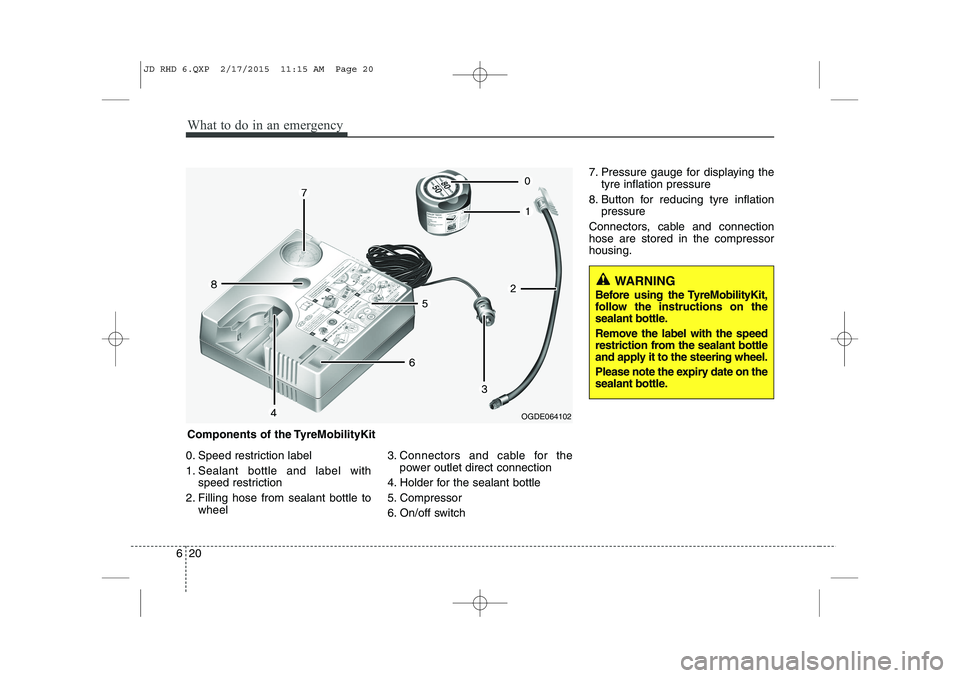
0. Speed restriction label
1. Sealant bottle and label with
speed restriction
2. Filling hose from sealant bottle to wheel 3. Connectors and cable for the
power outlet direct connection
4. Holder for the sealant bottle
5. Compressor
6. On/off switch 7. Pressure gauge for displaying the
tyre inflation pressure
8. Button for reducing tyre inflation pressure
Connectors, cable and connection hose are stored in the compressorhousing.
WARNING
Before using the TyreMobilityKit,
follow the instructions on the
sealant bottle.
Remove the label with the speed
restriction from the sealant bottle
and apply it to the steering wheel.
Please note the expiry date on the
sealant bottle.
Components of the TyreMobilityKit
OGDE064102
JD RHD 6.QXP 2/17/2015 11:15 AM Page 20