2015 KIA CEED tire type
[x] Cancel search: tire typePage 485 of 1210
Maintenance
26
7
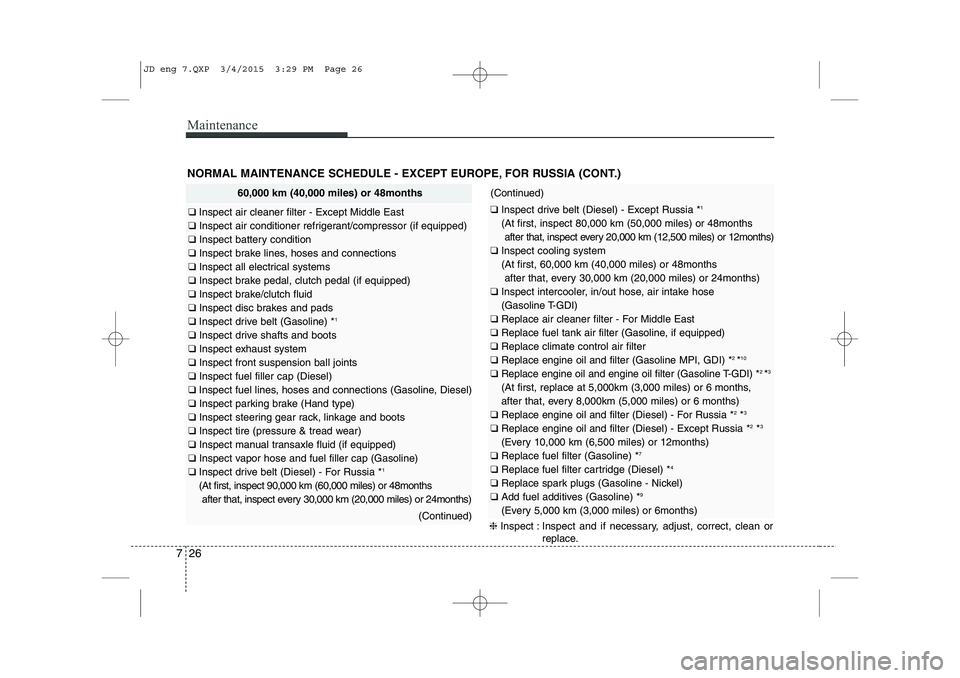
NORMAL MAINTENANCE SCHEDULE - EXCEPT EUROPE, FOR RUSSIA (CONT.)
60,000 km (40,000 miles) or 48months
❑ Inspect air cleaner filter - Except Middle East
❑ Inspect air conditioner refrigerant/compressor (if equipped)
❑ Inspect battery condition
❑ Inspect brake lines, hoses and connections
❑ Inspect all electrical systems
❑ Inspect brake pedal, clutch pedal (if equipped)
❑ Inspect brake/clutch fluid
❑ Inspect disc brakes and pads
❑ Inspect drive belt (Gasoline) * 1
❑ Inspect drive shafts and boots
❑ Inspect exhaust system
❑ Inspect front suspension ball joints
❑ Inspect fuel filler cap (Diesel)
❑ Inspect fuel lines, hoses and connections (Gasoline, Diesel)
❑ Inspect parking brake (Hand type)
❑ Inspect steering gear rack, linkage and boots
❑ Inspect tire (pressure & tread wear)
❑ Inspect manual transaxle fluid (if equipped)
❑ Inspect vapor hose and fuel filler cap (Gasoline)
❑ Inspect drive belt (Diesel) - For Russia * 1
(At first, inspect 90,000 km (60,000 miles) or 48months after that, inspect every 30,000 km (20,000 miles) or 24months)
(Continued)
(Continued)
❑ Inspect drive belt (Diesel) - Except Russia * 1
(At first, inspect 80,000 km (50,000 miles) or 48months after that, inspect every 20,000 km (12,500 miles) or 12months)
❑ Inspect cooling system
(At first, 60,000 km (40,000 miles) or 48months
after that, every 30,000 km (20,000 miles) or 24months)
❑ Inspect intercooler, in/out hose, air intake hose
(Gasoline T-GDI)
❑ Replace air cleaner filter - For Middle East
❑ Replace fuel tank air filter (Gasoline, if equipped)
❑ Replace climate control air filter
❑ Replace engine oil and filter (Gasoline MPI, GDI) * 2
*10
❑ Replace engine oil and engine oil filter (Gasoline T-GDI) * 2
*3
(At first, replace at 5,000km (3,000 miles) or 6 months,
after that, every 8,000km (5,000 miles) or 6 months)
❑ Replace engine oil and filter (Diesel) - For Russia * 2
*3
❑ Replace engine oil and filter (Diesel) - Except Russia * 2
*3
(Every 10,000 km (6,500 miles) or 12months)
❑ Replace fuel filter (Gasoline) * 7
❑ Replace fuel filter cartridge (Diesel) * 4
❑ Replace spark plugs (Gasoline - Nickel)
❑ Add fuel additives (Gasoline) * 9
(Every 5,000 km (3,000 miles) or 6months)
❈ Inspect : Inspect and if necessary, adjust, correct, clean or
replace.
JD eng 7.QXP 3/4/2015 3:29 PM Page 26
Page 487 of 1210

Maintenance
28
7
NORMAL MAINTENANCE SCHEDULE - EXCEPT EUROPE, FOR RUSSIA (CONT.)
90,000 km (60,000 miles) or 72months
❑ Inspect air conditioner refrigerant/compressor (if equipped)
❑ Inspect battery condition
❑ Inspect brake lines, hoses and connections
❑ Inspect all electrical system
❑ Inspect brake pedal, clutch pedal (if equipped)
❑ Inspect brake/clutch fluid
❑ Inspect disc brakes and pads
❑ Inspect drive belt (Gasoline) * 1
❑ Inspect drive shafts and boots
❑ Inspect exhaust system
❑ Inspect front suspension ball joints
❑ Inspect fuel filter (Gasoline) * 7
❑ Inspect fuel tank air filter (Gasoline, if equipped)
❑ Inspect fuel filter cartridge (Diesel) * 4
❑ Inspect fuel lines, hoses and connections (Diesel)
❑ Inspect parking brake (Hand type)
❑ Inspect steering gear rack, linkage and boots
❑ Inspect tire (pressure & tread wear)
❑ Inspect cooling system
(At first, 60,000 km (40,000 miles) or 48months
after that, every 30,000 km (20,000 miles) or 24months)
(Continued)
(Continued)
❑ Inspect drive belt (Diesel) - For Russia * 1
(At first, inspect 90,000 km (60,000 miles) or 48months after that, inspect every 30,000 km (20,000 miles) or 24months)
❑ Inspect drive belt (Diesel) - Except Russia * 1
(At first, inspect 80,000 km (50,000 miles) or 48months after that, inspect every 20,000 km (12,500 miles) or 12months)
❑ Inspect valve clearance * 6
❑ Inspect intercooler, in/out hose, air intake hose
(Gasoline T-GDI)
❑ Replace air cleaner filter
❑ Replace climate control air filter
❑ Replace engine oil and filter (Gasoline MPI, GDI) * 2
*10
❑ Replace engine oil and engine oil filter (Gasoline T-GDI) * 2
*3
(At first, replace at 5,000km (3,000 miles) or 6 months,
after that, every 8,000km (5,000 miles) or 6 months)
❑ Replace engine oil and filter (Diesel) - For Russia * 2
*3
❑ Replace engine oil and filter (Diesel) - Except Russia * 2
*3
(Every 10,000 km (6,500 miles) or 12months)
❑ Add fuel additives (Gasoline) * 9
(Every 5,000 km (3,000 miles) or 6months)
❈ Inspect : Inspect and if necessary, adjust, correct, clean or
replace.
JD eng 7.QXP 3/4/2015 3:29 PM Page 28
Page 489 of 1210

Maintenance
30
7
NORMAL MAINTENANCE SCHEDULE - EXCEPT EUROPE, FOR RUSSIA (CONT.)
120,000 km (80,000 miles) or 96months
❑ Inspect air cleaner filter - Except Middle East
❑ Inspect air conditioner refrigerant/compressor (if equipped)
❑ Inspect battery condition
❑ Inspect brake lines, hoses and connections
❑ Inspect all electrical system
❑ Inspect brake pedal, clutch pedal (if equipped)
❑ Inspect brake/clutch fluid
❑ Inspect disc brakes and pads
❑ Inspect drive belt (Gasoline) * 1
❑ Inspect drive shafts and boots
❑ Inspect exhaust system
❑ Inspect front suspension ball joints
❑ Inspect fuel filler cap (Diesel)
❑ Inspect fuel lines, hoses and connections (Gasoline, Diesel)
❑ Inspect parking brake (Hand type)
❑ Inspect steering gear rack, linkage and boots
❑ Inspect tire (pressure & tread wear)
❑ Inspect manual transaxle fluid (if equipped)
❑ Inspect vapor hose and fuel filler cap (Gasoline)
❑ Inspect fuel tank air filter (Gasoline, if equipped)
❑ Inspect cooling system
(At first, 60,000 km (40,000 miles) or 48months
after that, every 30,000 km (20,000 miles) or 24months)
(Continued)
(Continued)
❑ Inspect drive belt (Diesel) - For Russia * 1
(At first, inspect 90,000 km (60,000 miles) or 48months after that, inspect every 30,000 km (20,000 miles) or 24months)
❑ Inspect drive belt (Diesel) - Except Russia * 1
(At first, inspect 80,000 km (50,000 miles) or 48months after that, inspect every 20,000 km (12,500 miles) or 12months)
❑ Inspect intercooler, in/out hose, air intake hose
(Gasoline T-GDI)
❑ Replace air cleaner filter - For Middle East
❑ Replace climate control air filter
❑ Replace engine oil and filter (Gasoline MPI, GDI) * 2
*10
❑ Replace engine oil and engine oil filter (Gasoline T-GDI) * 2
*3
(At first, replace at 5,000km (3,000 miles) or 6 months,
after that, every 8,000km (5,000 miles) or 6 months)
❑ Replace engine oil and filter (Diesel) - For Russia * 2
*3
❑ Replace engine oil and filter (Diesel) - Except Russia * 2
*3
(Every 10,000 km (6,500 miles) or 12months)
❑ Replace fuel filter (Gasoline) * 7
❑ Replace fuel filter cartridge (Diesel) * 4
❑ Replace spark plugs (Gasoline - Nickel)
❑ Replace spark plugs (Gasoline GDI - Iridium) * 5
(Every 160,000 km (100,000 miles) or 120months)
(Continued)
JD eng 7.QXP 3/4/2015 3:29 PM Page 30
Page 519 of 1210

Maintenance
60
7
Compact spare tire replacement
(if equipped)
A compact spare tire has a shorter
tread life than a regular size tire.
Replace it when you can see the
tread wear indicator bars on the tire.The replacement compact spare tire
should be the same size and design
tire as the one provided with your
new vehicle and should be mountedon the same compact spare tire
wheel. The compact spare tire is notdesigned to be mounted on a regular
size wheel, and the compact spare
tire wheel is not designed for mount-
ing a regular size tire.
(Continued)
The use of any other tire size
or type may seriously affect
ride, handling, ground clear-
ance, stopping distance, body
to tire clearance, snow tire
clearance, and speedometer
reliability.
It is best to replace all four tires at the same time. If that
is not possible, or necessary,
then replace the two front or
two rear tires as a pair.Replacing just one tire can
seriously affect your vehicle’shandling.
The ABS works by comparing the speed of the wheels. Tire
size can affect wheel speed.
When replacing tires, all 4
tires must use the same size
originally supplied with the
vehicle. Using tires of a differ-
ent size can cause the ABS
(Anti-lock Brake System) and
ESC (Electronic Stability
Control) to work irregularly.WARNING - Replacing
tires
Driving on worn-out tires is very hazardous and will
reduce braking effectiveness,
steering accuracy, and trac-tion.
Your vehicle is equipped with tires designed to provide for
safe ride and handling capa-
bility. Do not use a size andtype of tire and wheel that is
different from the one that is
originally installed on your
vehicle. It can affect the safety
and performance of your vehi-
cle, which could lead to han-
dling failure or rollover and
serious injury. When replacing
the tires, be sure to equip all
four tires with the tire and
wheel of the same size, type,
tread, brand and load-carrying
capacity.
(Continued)
JD eng 7.QXP 3/4/2015 3:30 PM Page 60
Page 521 of 1210

Maintenance
62
7
2. Tire size designation
A tire’s sidewall is marked with a tire
size designation. You will need this
information when selecting replace-
ment tires for your car. The following
explains what the letters and num-
bers in the tire size designationmean.
Example tire size designation:
(These numbers are provided as an
example only; your tire size designa-
tor could vary depending on your
vehicle.) 195/65R15 91H
P - Applicable vehicle type (tires
marked with the prefix “P’’ are
intended for use on passenger
vehicles or light trucks; however,
not all tires have this marking).
195 - Tire width in millimeters.
65 - Aspect ratio. The tire’s chapter height as a percentage of its width.
R - Tire construction code (Radial).
15 - Rim diameter in inches. 91 - Load Index, a numerical code
associated with the maximum
load the tire can carry.
H - Speed Rating Symbol. See the speed rating chart in this chapter
for additional information.
Wheel size designation
Wheels are also marked with impor-
tant information that you need if you
ever have to replace one. The follow-
ing explains what the letters and
numbers in the wheel size designa-tion mean.
Example wheel size designation: 6.0JX15
6.0 - Rim width in inches. J - Rim contour designation.
15 - Rim diameter in inches. Tire speed ratings
The chart below lists many of the dif-
ferent speed ratings currently being
used for passenger cars. The speed
rating is part of the tire size designa-
tion on the sidewall of the tire. Thissymbol corresponds to that tire's
designed maximum safe operatingspeed.
S 180 km/h (112 mph)
T 190 km/h (118 mph)
H 210 km/h (130 mph)
V 240 km/h (149 mph)
W 270 km/h (167 mph) Y 300 km/h (186 mph)
Maximum Speed
Speed
Rating
Symbol
JD eng 7.QXP 3/4/2015 3:30 PM Page 62
Page 554 of 1210

795
Maintenance
4. Remove the bulb-socket from thehousing by turning the socket counter
clockwise until the tabs on the socketalign with the slots on the housing.
5. Install the new bulb-socket into the housing by aligning the tabs on the
socket with the slots in the housing.
Push the socket into the housing and
turn the socket clockwise.
6. Connect the power connector to the socket. Headlight and front fog light aim-
ing (for Europe)
Headlight aiming
Without AFLS
1. Inflate the tires to the specified pres-
sure and remove any loads from the
vehicle except the driver, spare tire,
and tools.
2. The vehicle should be placed on a flat floor.
3. Draw vertical lines (Vertical lines pass- ing through respective head lamp cen-
ters) and a horizontal line (Horizontalline passing through center of headlamps) on the screen. 4. With the head lamp and battery in nor-
mal condition, aim the head lamps so
the brightest portion falls on the hori-
zontal and vertical lines.
5. To aim the low beam left or right, turn the driver (1) clockwise or counter-
clockwise. To aim the low beam up or
down, turn the driver (2) clockwise or
counterclockwise.
To aim the high beam up or down, turnthe driver (3) clockwise or counter-
clockwise.
OJD072027
■ Fog light
■Fog light+DRL (Bulb type) ■
DRL
OJD073067/OJD073068/OJD073069
JD eng 7.QXP 3/4/2015 3:32 PM Page 95
Page 555 of 1210

Maintenance
96
7
With AFLS
1. Turn off the engine
2. Turn the light switch to the low beam
position.
3. Position the tires straight ahead with the steering wheel.
4. Turn on the engine.
5. Inflate the tires to the specified pres- sure and remove any loads from the
vehicle except the driver, spare tire,
and tools.
6. The vehicle should be placed on a flat floor.
7. Draw vertical lines (Vertical lines pass- ing through respective head lamp cen-
ters) and a horizontal line (Horizontalline passing through center of headlamps) on the screen.
8. With the head lamp and battery in nor- mal condition, aim the head lamps so
the brightest portion falls on the hori-
zontal and vertical lines.
9. To aim the low beam left or right, turn the driver (1) clockwise or counter-
clockwise. To aim the low beam up or
down, turn the driver (2) clockwise or
counterclockwise. To aim the high
beam up or down, turn the driver (3)
clockwise or counterclockwise.Front fog light aiming
The front fog lamp can be aimed as the same manner of the head lamps aiming.
With the front fog lamps and battery nor-
mal condition, aim the front fog lamps. To
aim the front fog lamp up or down, turn
the driver (1) clockwise or counterclock-
wise.
OJD072028
OJD073070
OJD073082
■Type A
■Type B
■Type C
JD eng 7.QXP 3/4/2015 3:33 PM Page 96
Page 590 of 1210

Specifications & Consumer information
12
8
The tires supplied on your new vehicle
are chosen to provide the best perform-
ance for normal driving.
The tire label located on the driver's side
center pillar gives the tire pressures rec-
ommended for your vehicle.
The engine number is stamped on the
engine block as shown in the drawing.A compressor label informs you the type
of compressor your vehicle is equipped
with such as model, supplier part num-
ber, production number, refrigerant (1)
and refrigerant oil (2).
TIRE SPECIFICATION AND PRESSURE LABEL
ENGINE NUMBER
OJD082005
■
Gasoline engine
■Diesel engineOGDE081006
OGD081005 AIR CONDITIONER COMPRESSOR LABEL
OHC081001
JD eng 8.QXP 3/4/2015 3:13 PM Page 12