2015 KIA CEED charging
[x] Cancel search: chargingPage 1036 of 1210
What to do in an emergency
6
6
Jump starting procedure ✽✽
NOTICE
If the battery is discharged, the engine
can be started using a battery of anoth-
er vehicle and two jumper cables. Only
use jumper cables with fully insulated
clamp handles.
To prevent personal injury or damage to
both vehicles, adhere strictly to the fol-
lowing procedure.
1. Make sure the booster battery is 12- volt and that its negative terminal is
grounded.
2. If the booster battery is in another vehicle, do not allow the vehicles totouch.
3. Turn off all unnecessary electrical loads. 4. Connect the jumper cables in the exact
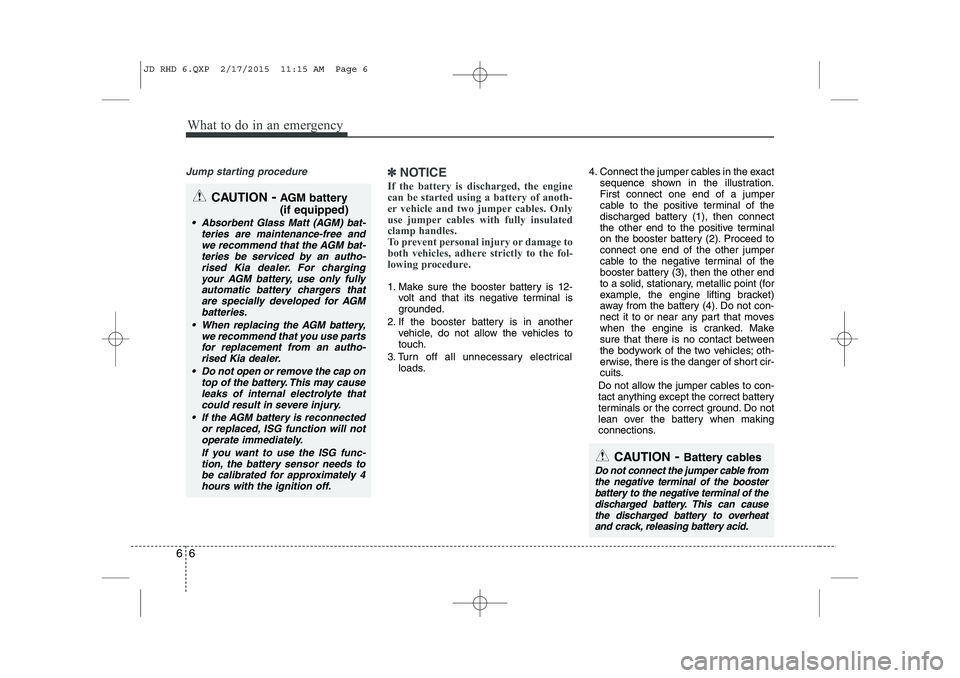
sequence shown in the illustration.First connect one end of a jumper
cable to the positive terminal of the
discharged battery (1), then connect
the other end to the positive terminal
on the booster battery (2). Proceed toconnect one end of the other jumper
cable to the negative terminal of the
booster battery (3), then the other end
to a solid, stationary, metallic point (for
example, the engine lifting bracket)
away from the battery (4). Do not con-
nect it to or near any part that moves
when the engine is cranked. Make
sure that there is no contact between
the bodywork of the two vehicles; oth-
erwise, there is the danger of short cir-
cuits.
Do not allow the jumper cables to con-
tact anything except the correct battery
terminals or the correct ground. Do not
lean over the battery when making
connections.
CAUTION - Battery cables
Do not connect the jumper cable from
the negative terminal of the booster battery to the negative terminal of thedischarged battery. This can cause
the discharged battery to overheatand crack, releasing battery acid.
CAUTION -AGM battery (if equipped)
Absorbent Glass Matt (AGM) bat-
teries are maintenance-free andwe recommend that the AGM bat-
teries be serviced by an autho-rised Kia dealer. For chargingyour AGM battery, use only fully
automatic battery chargers thatare specially developed for AGMbatteries.
When replacing the AGM battery, we recommend that you use parts
for replacement from an autho-rised Kia dealer.
Do not open or remove the cap on top of the battery. This may cause
leaks of internal electrolyte thatcould result in severe injury.
If the AGM battery is reconnected or replaced, ISG function will notoperate immediately.
If you want to use the ISG func-tion, the battery sensor needs to be calibrated for approximately 4hours with the ignition off.
JD RHD 6.QXP 2/17/2015 11:15 AM Page 6
Page 1037 of 1210
67
What to do in an emergency
5. Start the engine of the vehicle with thebooster battery and let it run at 2,000
rpm, then start the engine of the vehi-
cle with the discharged battery. If the
first starting attempt is not successful,
wait a few minutes before making
another attempt in order to allow the
discharged battery to recharge.
If the cause of your battery discharging is
not apparent, we recommend that the system be checked by an authorised Kia
dealer.
Push-starting
Your manual transaxle-equipped vehicle
should not be push-started because itmight damage the emission control sys-
tem. Vehicles equipped with automatic
transaxle cannot be push-started. Follow
the directions in this section for jump-
starting.
WARNING
Never tow a vehicle to start it
because the sudden surge forward
when the engine starts could cause
a collision with the tow vehicle.
JD RHD 6.QXP 2/17/2015 11:15 AM Page 7
Page 1064 of 1210
Maintenance
Engine compartment . . . . . . . . . . . . . . . . . . . . . . . . 7-3
Maintenance services . . . . . . . . . . . . . . . . . . . . . . . . 7-6 Owner’s responsibility . . . . . . . . . . . . . . . . . . . . . . . . . 7-6
Owner maintenance precautions . . . . . . . . . . . . . . . . 7-6
Engine compartment precautions (Diesel engine). . . 7-7
Owner maintenance . . . . . . . . . . . . . . . . . . . . . . . . . 7-9 Owner maintenance schedule . . . . . . . . . . . . . . . . . . . 7-9
Scheduled maintenance service . . . . . . . . . . . . . . . 7-11 For Europe, Except Russia . . . . . . . . . . . . . . . . . . . . . 7-12
Except Russia, for Russia . . . . . . . . . . . . . . . . . . . . . . 7-23
Explanation of scheduled maintenance items . . . . 7-35
Engine oil . . . . . . . . . . . . . . . . . . . . . . . . . . . . . . . . . 7-38 Checking the engine oil level . . . . . . . . . . . . . . . . . . . . 7-38
Changing the engine oil and filter . . . . . . . . . . . . . . . 7-39
Engine coolant . . . . . . . . . . . . . . . . . . . . . . . . . . . . . 7-40 Checking the coolant level . . . . . . . . . . . . . . . . . . . . . . 7-40
Changing the coolant . . . . . . . . . . . . . . . . . . . . . . . . . . 7-42
Brake/clutch fluid . . . . . . . . . . . . . . . . . . . . . . . . . . 7-43 Checking the brake/clutch fluid level. . . . . . . . . . . . . 7-43
Washer fluid . . . . . . . . . . . . . . . . . . . . . . . . . . . . . . . 7-44 Checking the washer fluid level . . . . . . . . . . . . . . . . . 7-44
Parking brake - hand type . . . . . . . . . . . . . . . . . . . 7-44 Checking the parking brake . . . . . . . . . . . . . . . . . . . . 7-44
Fuel filter (for Diesel) . . . . . . . . . . . . . . . . . . . . . . . 7-45 Draining water from fuel filter . . . . . . . . . . . . . . . . . . 7-45 Extracting air from the fuel filter . . . . . . . . . . . . . . . . 7-45
Air cleaner . . . . . . . . . . . . . . . . . . . . . . . . . . . . . . . . 7-46 Filter replacement . . . . . . . . . . . . . . . . . . . . . . . . . . . . 7-46
Climate control air filter . . . . . . . . . . . . . . . . . . . . . 7-48 Filter inspection . . . . . . . . . . . . . . . . . . . . . . . . . . . . . . 7-48
Filter replacement . . . . . . . . . . . . . . . . . . . . . . . . . . . . 7-48
Wiper blades . . . . . . . . . . . . . . . . . . . . . . . . . . . . . . . 7-50 Blade inspection . . . . . . . . . . . . . . . . . . . . . . . . . . . . . . 7-50
Blade replacement . . . . . . . . . . . . . . . . . . . . . . . . . . . . 7-50
Battery. . . . . . . . . . . . . . . . . . . . . . . . . . . . . . . . . . . . 7-53 For best battery service . . . . . . . . . . . . . . . . . . . . . . . . 7-53
Battery capacity label . . . . . . . . . . . . . . . . . . . . . . . . . 7-54
Battery recharging . . . . . . . . . . . . . . . . . . . . . . . . . . . . 7-54
Reset items . . . . . . . . . . . . . . . . . . . . . . . . . . . . . . . . . . 7-55
Tyres and wheels . . . . . . . . . . . . . . . . . . . . . . . . . . . 7-56 Tyre care . . . . . . . . . . . . . . . . . . . . . . . . . . . . . . . . . . . . 7-56
Recommended cold tyre inflation pressures . . . . . . . 7-56
Checking tyre inflation pressure. . . . . . . . . . . . . . . . . 7-58
Tyre rotation . . . . . . . . . . . . . . . . . . . . . . . . . . . . . . . . . 7-59
Wheel alignment and tyre balance . . . . . . . . . . . . . . . 7-60
Tyre replacement . . . . . . . . . . . . . . . . . . . . . . . . . . . . . 7-60
Wheel replacement . . . . . . . . . . . . . . . . . . . . . . . . . . . . 7-62
Tyre traction . . . . . . . . . . . . . . . . . . . . . . . . . . . . . . . . . 7-62
Tyre maintenance . . . . . . . . . . . . . . . . . . . . . . . . . . . . . 7-62
Tyre sidewall labeling. . . . . . . . . . . . . . . . . . . . . . . . . . 7-62
Low aspect ratio tyre . . . . . . . . . . . . . . . . . . . . . . . . . . 7-66
7
JD RHD 7.QXP 4/14/2015 6:29 PM Page 1
Page 1116 of 1210
753
Maintenance
BATTERY
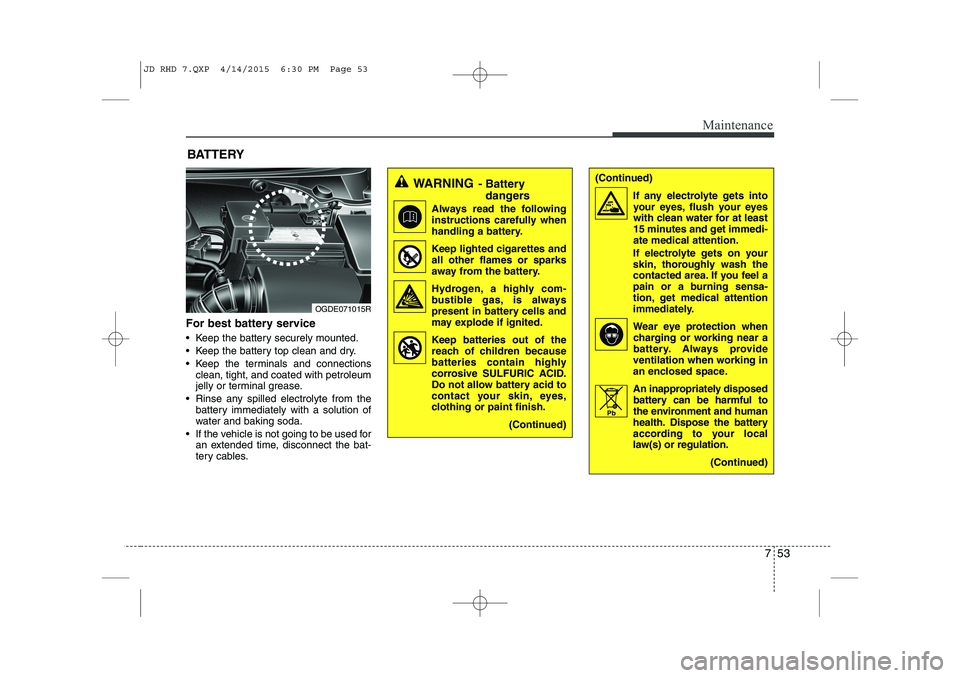
For best battery service
Keep the battery securely mounted.
Keep the battery top clean and dry.
Keep the terminals and connections clean, tight, and coated with petroleum
jelly or terminal grease.
Rinse any spilled electrolyte from the battery immediately with a solution of
water and baking soda.
If the vehicle is not going to be used for an extended time, disconnect the bat-
tery cables.
WARNING - Battery
dangers
Always read the following
instructions carefully when
handling a battery.
Keep lighted cigarettes and all other flames or sparks
away from the battery.
Hydrogen, a highly com- bustible gas, is always
present in battery cells and
may explode if ignited.
Keep batteries out of the reach of children because
batteries contain highly
corrosive SULFURIC ACID.
Do not allow battery acid to
contact your skin, eyes,
clothing or paint finish.
(Continued)
OGDE071015R
(Continued)If any electrolyte gets intoyour eyes, flush your eyes
with clean water for at least
15 minutes and get immedi-ate medical attention.
If electrolyte gets on your
skin, thoroughly wash the
contacted area. If you feel a
pain or a burning sensa-
tion, get medical attention
immediately.
Wear eye protection when charging or working near a
battery. Always provide
ventilation when working in
an enclosed space.
An inappropriately disposed battery can be harmful to
the environment and human
health. Dispose the battery
according to your local
law(s) or regulation.
(Continued)
Pb
JD RHD 7.QXP 4/14/2015 6:30 PM Page 53
Page 1117 of 1210
Maintenance
54
7
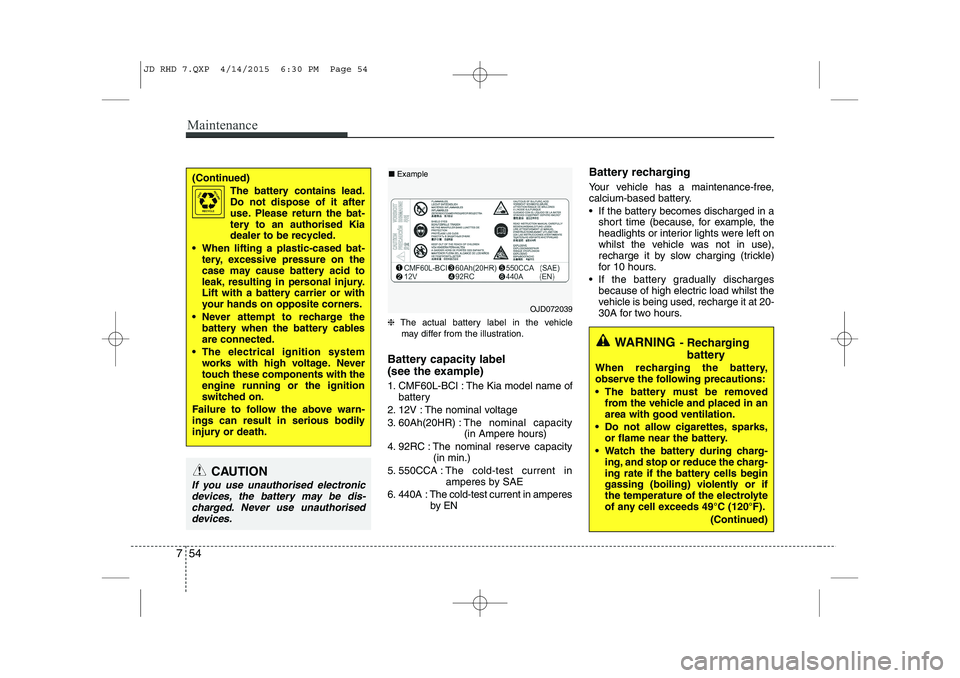
❈ The actual battery label in the vehicle
may differ from the illustration.
Battery capacity label
(see the example)
1. CMF60L-BCI : The Kia model name of battery
2. 12V : The nominal voltage
3. 60Ah(20HR) : The nominal capacity
(in Ampere hours)
4. 92RC : The nominal reserve capacity (in min.)
5. 550CCA : The cold-test current in
amperes by SAE
6. 440A : The cold-test current in amperes by EN Battery recharging
Your vehicle has a maintenance-free,
calcium-based battery.
If the battery becomes discharged in a
short time (because, for example, the
headlights or interior lights were left on
whilst the vehicle was not in use),
recharge it by slow charging (trickle)
for 10 hours.
If the battery gradually discharges because of high electric load whilst the
vehicle is being used, recharge it at 20-
30A for two hours.
(Continued)
The battery contains lead.
Do not dispose of it after
use. Please return the bat-
tery to an authorised Kia
dealer to be recycled.
When lifting a plastic-cased bat- tery, excessive pressure on the
case may cause battery acid to
leak, resulting in personal injury.
Lift with a battery carrier or with
your hands on opposite corners.
Never attempt to recharge the battery when the battery cablesare connected.
The electrical ignition system works with high voltage. Never
touch these components with theengine running or the ignition
switched on.
Failure to follow the above warn-
ings can result in serious bodily
injury or death.
CAUTION
If you use unauthorised electronic devices, the battery may be dis- charged. Never use unauthoriseddevices.
OJD072039
WARNING - Recharging
battery
When recharging the battery,
observe the following precautions:
The battery must be removed from the vehicle and placed in an area with good ventilation.
Do not allow cigarettes, sparks, or flame near the battery.
Watch the battery during charg- ing, and stop or reduce the charg-
ing rate if the battery cells begin
gassing (boiling) violently or if
the temperature of the electrolyte
of any cell exceeds 49°C (120°F).
(Continued)
■Example
JD RHD 7.QXP 4/14/2015 6:30 PM Page 54
Page 1118 of 1210
755
Maintenance
Reset items
Items should be reset after the battery
has been discharged or the battery hasbeen disconnected.
Auto up/down window (See section 4)
Sunroof (See section 4)
Trip computer (See section 4)
Climate control system (See section 4)
Audio (See section 4)(Continued)
Wear eye protection when check- ing the battery during charging.
Disconnect the battery charger in the following order.
1. Turn off the battery charger
main switch.
2. Unhook the negative clamp from the negative battery ter- minal.
3. Unhook the positive clamp from the positive battery termi-nal.
Before performing maintenance or recharging the battery, turn offall accessories and stop the
engine.
The negative battery cable must be removed first and installed
last when the battery is discon-nected.
JD RHD 7.QXP 4/14/2015 6:30 PM Page 55