2015 KIA CEED coolant level
[x] Cancel search: coolant levelPage 498 of 1210

739
Maintenance
ENGINE COOLANT
The high-pressure cooling system has a
reservoir filled with year-round antifreeze
coolant. The reservoir is filled at the fac-
tory.
Check the antifreeze protection and
coolant concentration level at least once a
year, at the beginning of the winter season,
and before traveling to a colder climate. Checking the coolant level
WARNING
Removing radiatorcap
Never attempt to remove the radi- ator cap while the engine is oper-
ating or hot. Doing so might leadto cooling system and engine
damage and could result in seri-
ous personal injury from escap-ing hot coolant or steam.
Turn the engine off and wait until it cools down. Use extreme care
when removing the radiator cap.
Wrap a thick towel around it, and
turn it counterclockwise slowly to
the first stop. Step back while the
pressure is released from the
cooling system. When you aresure all the pressure has been
released, press down on the cap,
using a thick towel, and continue
turning counterclockwise to
remove it.
(Continued)
(Continued)
Even if the engine is not operat-ing, do not remove the radiator cap or the drain plug while the
engine and radiator are hot. Hot
coolant and steam may still blow
out under pressure, causing seri-
ous injury.
CAUTION
When the engine overheats from
low engine coolant, suddenly
adding engine coolant may cause cracks in the engine. To preventdamage, add engine coolantslowly in small quantities.
Do not drive with no engine coolant. It may cause water pumpfailure and engine seizure, etc.
JD eng 7.QXP 3/4/2015 3:29 PM Page 39
Page 499 of 1210

Maintenance
40
7
Check the condition and connections of all cooling system hoses and heater
hoses. Replace any swollen or deterio-
rated hoses.
The coolant level should be filled
between F (MAX) and L (MIN) marks on
the side of the coolant reservoir when theengine is cool.
If the coolant level is low, add enough
distilled (deionized) water. Bring the level
to F (MAX), but do not overfill. If frequent
coolant refill is required, we recommend
that the system be inspected by an
authorized Kia dealer.
OGD071007
■ Gasoline engine
Type A
OJD073078
OGD071008
Type B
■Diesel engine
WARNING
The electric motor (cool-
ing fan) is controlled byengine coolant tempera-
ture, refrigerant pres-
sure and vehicle speed.
It may sometimes operate evenwhen the engine is not running.
Use extreme caution when working
near the blades of the cooling fan
so that you are not injured by a
rotating fan blades. As the engine
coolant temperature decreases, the
electric motor will automatically
shut off. This is a normal condition.
If your vehicle is equipped with
GDI, the electric motor (cooling fan)
may operate until you disconnect
the negative battery cable.
JD eng 7.QXP 3/4/2015 3:29 PM Page 40
Page 502 of 1210

743
Maintenance
WASHER FLUID
Checking the washer fluid level
Check the fluid level in the washer fluid
reservoir and add fluid if necessary.
Plain water may be used if washer fluid is
not available. However, use washer sol-
vent with antifreeze characteristics in
cold climates to prevent freezing. Checking the parking brake
Check the stroke of the parking brake by
counting the number of “clicks’’ heardwhile fully applying it from the released
position. Also, the parking brake alone
should securely hold the vehicle on a fair-
ly steep grade. If the stroke is more or
less than specified, we recommend that
the system be serviced by an authorized
Kia dealer.
Stroke :
6~8 “clicks’’ at a force of
20 kg (44 lbs, 196 N).
OGD071010
WARNING - Coolant
Do not use radiator coolant or antifreeze in the washer fluid
reservoir.
Radiator coolant can severely obscure visibility when sprayed
on the windshield and may cause
loss of vehicle control or damage
to paint and body trim.
Windshield Washer fluid agents contain some amounts of alcohol
and can be flammable under cer-
tain circumstances. Do not allowsparks or flame to contact thewasher fluid or the washer fluid
reservoir. Damage to the vehicle
or occupants could occur.
Windshield washer fluid is poi- sonous to humans and animals.
Do not drink and avoid contact-ing windshield washer fluid.
Serious injury or death could
occur.
PARKING BRAKE - HAND TYPE
OJD052010
JD eng 7.QXP 3/4/2015 3:29 PM Page 43
Page 597 of 1210

Index
6
I
Fuse switch . . . . . . . . . . . . . . . . . . . . . . . . . . . . . . . . 7-68
Fuse/relay panel description . . . . . . . . . . . . . . . . . . 7-71
Inner panel fuse . . . . . . . . . . . . . . . . . . . . . . . . . . . . 7-67
Main fuse . . . . . . . . . . . . . . . . . . . . . . . . . . . . . . . . . . 7-69
Multi fuse. . . . . . . . . . . . . . . . . . . . . . . . . . . . . . . . . . 7-70
Gauge (Normal vision) Engine coolant temperature gauge . . . . . . . . . . . . . 4-48
Fuel gauge . . . . . . . . . . . . . . . . . . . . . . . . . . . . . . . . . 4-48
Gauge (Super vision)
Engine coolant temperature gauge . . . . . . . . . . . . 4-64
Fuel gauge . . . . . . . . . . . . . . . . . . . . . . . . . . . . . . . . . 4-62
Glove box . . . . . . . . . . . . . . . . . . . . . . . . . . . . . . . . . . 4-153
Glove box lamp . . . . . . . . . . . . . . . . . . . . . . . . . . . . . 4-125
Hazard warning flasher . . . . . . . . . . . . . . . . . . . . . . 4-110
Hazardous driving conditions . . . . . . . . . . . . . . . . . . 5-64
Headlamp delay function . . . . . . . . . . . . . . . . . . . . . 4-111
Headlight (Headlamp) welcome function . . . . . . . . 4-111
Headlight bulb replacement. . . . . . . . . . . . . . . . . . . . 7-90
Headlight leveling device . . . . . . . . . . . . . . . . . . . . . 4-117
Headlight position . . . . . . . . . . . . . . . . . . . . . . . . . . . 4-113
Headlight washer . . . . . . . . . . . . . . . . . . . . . . . . . . . 4-122
Headrest (front). . . . . . . . . . . . . . . . . . . . . . . . . . . . . . . 3-9 Headrest(rear) . . . . . . . . . . . . . . . . . . . . . . . . . . . . . . . 3-14
Heated steering wheel. . . . . . . . . . . . . . . . . . . . . . . . . 4-38
High - beam operation . . . . . . . . . . . . . . . . . . . . . . . 4-114
Hight adjustment (seat belt) . . . . . . . . . . . . . . . . . . . 3-23
Highway driving . . . . . . . . . . . . . . . . . . . . . . . . . . . . . 5-66
Hill-start assist control (HAC). . . . . . . . . . . . . . . . . . 5-48
Hood . . . . . . . . . . . . . . . . . . . . . . . . . . . . . . . . . . . . . . . 4-28
Horn . . . . . . . . . . . . . . . . . . . . . . . . . . . . . . . . . . . . . . . 4-39
How to use this manual . . . . . . . . . . . . . . . . . . . . . . . . 1-2
Icy road warning . . . . . . . . . . . . . . . . . . . . . . . . . . . . . 4-91
Indicators and warnings . . . . . . . . . . . . . . . . . . . . . . 4-79
Inside rearview mirror . . . . . . . . . . . . . . . . . . . . . . . . 4-42
Instrument cluster
LCD display information . . . . . . . . . . . . . . . . . . . . . 4-73
Warning and indicators . . . . . . . . . . . . . . . . . . . . . . 4-79
Instrument cluster (Normal vision). . . . . . . . . . . . . . 4-46 Automatic transaxle shift position indicator . . . . . 4-49
Double clutch transmission shift indicator . . . . . . 4-50
Fuel gauge . . . . . . . . . . . . . . . . . . . . . . . . . . . . . . . . . 4-48
Instrument panel illumination . . . . . . . . . . . . . . . . 4-47
Manual transaxle shift indicator. . . . . . . . . . . . . . . 4-49
Odometer . . . . . . . . . . . . . . . . . . . . . . . . . . . . . . . . . . 4-51
Speed limiter indicator. . . . . . . . . . . . . . . . . . . . . . . 4-51
Speedometer . . . . . . . . . . . . . . . . . . . . . . . . . . . . . . . 4-47
G
H
I
JD eng Index.QXP 3/12/2015 3:06 PM Page 6
Page 733 of 1210

Features of your vehicle
48
4
Fuel gauge
The fuel gauge indicates the approxi- mate amount of fuel remaining in the fueltank.
✽NOTICE
• The fuel tank capacity is given in sec- tion 8.
• The fuel gauge is supplemented by a
low fuel warning light, which will illu-
minate when the fuel tank is nearly
empty.
• On inclines or curves, the fuel gauge may fluctuate or the low fuel warning
light may come on earlier than usual
due to the movement of fuel in the
tank.
Engine coolant temperature gauge
This gauge shows the temperature of the
engine coolant when the ignition switchis ON.
Do not continue driving with an overheat-
ed engine. If your vehicle overheats, refer
to “If the engine overheats” in section 6.
WARNING - Fuel gauge
Running out of fuel can expose
vehicle occupants to danger.
You must stop and obtain addition-
al fuel as soon as possible after the warning light comes on or when the
gauge indicator comes close to the
“O (Empty)” level.
CAUTION
Avoid driving with an extremely low fuel level. Running out of fuel could
cause the engine to misfire damag-ing the catalytic converter.
OJD042046OJD042058
JD RHD 4a(~171).QXP 4/14/2015 6:58 PM Page 48
Page 954 of 1210

Driving your vehicle
4
5
Before entering vehicle
• Be sure that all windows, outside mir-
ror(s), and outside lights are clean.
Check the condition of the tyres.
Check under the vehicle for any sign of leaks.
Be sure there are no obstacles behind you if you intend to back up. Necessary inspections
Fluid levels, such as engine oil, engine
coolant, brake fluid, and washer fluid
should be checked on a regular basis,
with the exact interval depending on the
fluid. Further details are provided in sec-
tion 7, “Maintenance”.
Before starting
Close and lock all doors.
Position the seat so that all controls are
easily reached.
Adjust the inside and outside rearview mirrors.
Be sure that all lights work.
Check all gauges.
Check the operation of warning lights when the ignition switch is turned to the ON position.
Release the parking brake and make sure the brake warning light goes out.
For safe operation, be sure you are famil-
iar with your vehicle and its equipment.
BEFORE DRIVING
WARNING
All passengers must be properly
belted whenever the vehicle is mov-
ing. Refer to “Seat belts” in section
3 for more information on their
proper use.
WARNING
Always check the surrounding areas
near your vehicle for people, espe-
cially children, before putting a vehi-
cle into “D (Drive)” or “R (Reverse)”.
WARNING
Driving whilst distracted can result
in a loss of vehicle control, that
may lead to an accident, severe
personal injury, and death. The dri-
ver’s primary responsibility is in
the safe and legal operation of a
vehicle, and use of any handheld
devices, other equipment, or vehi-
cle systems which take the driver’s
eyes, attention and focus away
from the safe operation of a vehicle
or which are not permissible by law
should never be used during oper-
ation of the vehicle.
JD RHD 5.QXP 2/17/2015 10:32 AM Page 4
Page 1038 of 1210
What to do in an emergency
8
6
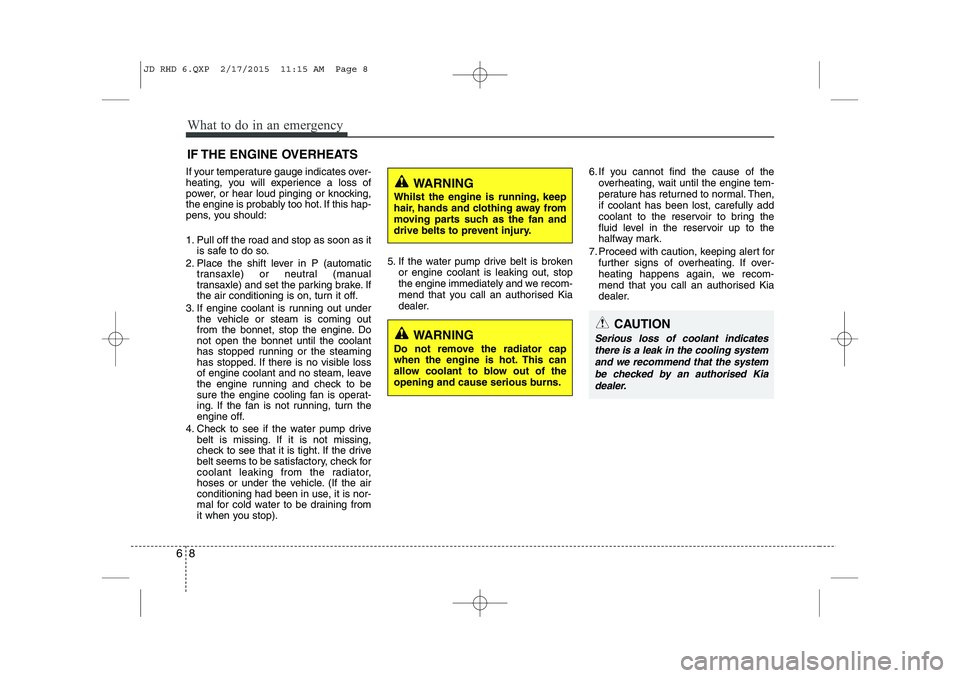
IF THE ENGINE OVERHEATS
If your temperature gauge indicates over-
heating, you will experience a loss of
power, or hear loud pinging or knocking,
the engine is probably too hot. If this hap-
pens, you should:
1. Pull off the road and stop as soon as it is safe to do so.
2. Place the shift lever in P (automatic transaxle) or neutral (manual
transaxle) and set the parking brake. If
the air conditioning is on, turn it off.
3. If engine coolant is running out under the vehicle or steam is coming out
from the bonnet, stop the engine. Donot open the bonnet until the coolant
has stopped running or the steaming
has stopped. If there is no visible loss
of engine coolant and no steam, leave
the engine running and check to be
sure the engine cooling fan is operat-
ing. If the fan is not running, turn the
engine off.
4. Check to see if the water pump drive belt is missing. If it is not missing,
check to see that it is tight. If the drive
belt seems to be satisfactory, check for
coolant leaking from the radiator,
hoses or under the vehicle. (If the air
conditioning had been in use, it is nor-
mal for cold water to be draining from
it when you stop). 5. If the water pump drive belt is broken
or engine coolant is leaking out, stop
the engine immediately and we recom-
mend that you call an authorised Kia
dealer. 6. If you cannot find the cause of the
overheating, wait until the engine tem-
perature has returned to normal. Then,if coolant has been lost, carefully add
coolant to the reservoir to bring the
fluid level in the reservoir up to the
halfway mark.
7. Proceed with caution, keeping alert for further signs of overheating. If over-
heating happens again, we recom-
mend that you call an authorised Kia
dealer.
CAUTION
Serious loss of coolant indicates
there is a leak in the cooling systemand we recommend that the systembe checked by an authorised Kia dealer.
WARNING
Whilst the engine is running, keep
hair, hands and clothing away from
moving parts such as the fan and
drive belts to prevent injury.
WARNING
Do not remove the radiator cap
when the engine is hot. This can
allow coolant to blow out of the
opening and cause serious burns.
JD RHD 6.QXP 2/17/2015 11:15 AM Page 8
Page 1064 of 1210
Maintenance
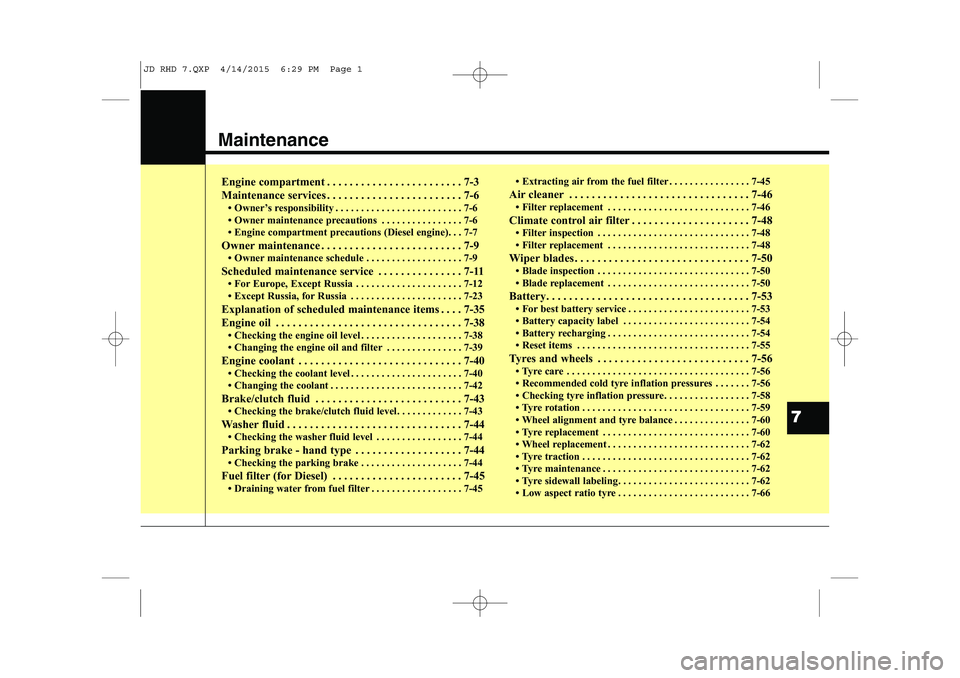
Engine compartment . . . . . . . . . . . . . . . . . . . . . . . . 7-3
Maintenance services . . . . . . . . . . . . . . . . . . . . . . . . 7-6 Owner’s responsibility . . . . . . . . . . . . . . . . . . . . . . . . . 7-6
Owner maintenance precautions . . . . . . . . . . . . . . . . 7-6
Engine compartment precautions (Diesel engine). . . 7-7
Owner maintenance . . . . . . . . . . . . . . . . . . . . . . . . . 7-9 Owner maintenance schedule . . . . . . . . . . . . . . . . . . . 7-9
Scheduled maintenance service . . . . . . . . . . . . . . . 7-11 For Europe, Except Russia . . . . . . . . . . . . . . . . . . . . . 7-12
Except Russia, for Russia . . . . . . . . . . . . . . . . . . . . . . 7-23
Explanation of scheduled maintenance items . . . . 7-35
Engine oil . . . . . . . . . . . . . . . . . . . . . . . . . . . . . . . . . 7-38 Checking the engine oil level . . . . . . . . . . . . . . . . . . . . 7-38
Changing the engine oil and filter . . . . . . . . . . . . . . . 7-39
Engine coolant . . . . . . . . . . . . . . . . . . . . . . . . . . . . . 7-40 Checking the coolant level . . . . . . . . . . . . . . . . . . . . . . 7-40
Changing the coolant . . . . . . . . . . . . . . . . . . . . . . . . . . 7-42
Brake/clutch fluid . . . . . . . . . . . . . . . . . . . . . . . . . . 7-43 Checking the brake/clutch fluid level. . . . . . . . . . . . . 7-43
Washer fluid . . . . . . . . . . . . . . . . . . . . . . . . . . . . . . . 7-44 Checking the washer fluid level . . . . . . . . . . . . . . . . . 7-44
Parking brake - hand type . . . . . . . . . . . . . . . . . . . 7-44 Checking the parking brake . . . . . . . . . . . . . . . . . . . . 7-44
Fuel filter (for Diesel) . . . . . . . . . . . . . . . . . . . . . . . 7-45 Draining water from fuel filter . . . . . . . . . . . . . . . . . . 7-45 Extracting air from the fuel filter . . . . . . . . . . . . . . . . 7-45
Air cleaner . . . . . . . . . . . . . . . . . . . . . . . . . . . . . . . . 7-46 Filter replacement . . . . . . . . . . . . . . . . . . . . . . . . . . . . 7-46
Climate control air filter . . . . . . . . . . . . . . . . . . . . . 7-48 Filter inspection . . . . . . . . . . . . . . . . . . . . . . . . . . . . . . 7-48
Filter replacement . . . . . . . . . . . . . . . . . . . . . . . . . . . . 7-48
Wiper blades . . . . . . . . . . . . . . . . . . . . . . . . . . . . . . . 7-50 Blade inspection . . . . . . . . . . . . . . . . . . . . . . . . . . . . . . 7-50
Blade replacement . . . . . . . . . . . . . . . . . . . . . . . . . . . . 7-50
Battery. . . . . . . . . . . . . . . . . . . . . . . . . . . . . . . . . . . . 7-53 For best battery service . . . . . . . . . . . . . . . . . . . . . . . . 7-53
Battery capacity label . . . . . . . . . . . . . . . . . . . . . . . . . 7-54
Battery recharging . . . . . . . . . . . . . . . . . . . . . . . . . . . . 7-54
Reset items . . . . . . . . . . . . . . . . . . . . . . . . . . . . . . . . . . 7-55
Tyres and wheels . . . . . . . . . . . . . . . . . . . . . . . . . . . 7-56 Tyre care . . . . . . . . . . . . . . . . . . . . . . . . . . . . . . . . . . . . 7-56
Recommended cold tyre inflation pressures . . . . . . . 7-56
Checking tyre inflation pressure. . . . . . . . . . . . . . . . . 7-58
Tyre rotation . . . . . . . . . . . . . . . . . . . . . . . . . . . . . . . . . 7-59
Wheel alignment and tyre balance . . . . . . . . . . . . . . . 7-60
Tyre replacement . . . . . . . . . . . . . . . . . . . . . . . . . . . . . 7-60
Wheel replacement . . . . . . . . . . . . . . . . . . . . . . . . . . . . 7-62
Tyre traction . . . . . . . . . . . . . . . . . . . . . . . . . . . . . . . . . 7-62
Tyre maintenance . . . . . . . . . . . . . . . . . . . . . . . . . . . . . 7-62
Tyre sidewall labeling. . . . . . . . . . . . . . . . . . . . . . . . . . 7-62
Low aspect ratio tyre . . . . . . . . . . . . . . . . . . . . . . . . . . 7-66
7
JD RHD 7.QXP 4/14/2015 6:29 PM Page 1