2015 KIA CEED automatic transmission
[x] Cancel search: automatic transmissionPage 369 of 1210

523
Driving your vehicle
Automatic transaxle/Double
clutch transmission operation
The automatic transaxle/Double clutch
transmission has 6 forward speeds and
one reverse speed. The individual speeds
are selected automatically, depending on
the position of the shift lever.
✽✽NOTICE
The first few shifts on a new vehicle, if
the battery has been disconnected, may
be somewhat abrupt. This is a normal
condition, and the shifting sequence will
adjust after shifts are cycled a few times
by the TCM (Transaxle Control Module)
or PCM (Powertrain Control Module).
AUTOMATIC TRANSAXLE/DOUBLE CLUTCH TRANSMISSION (IF EQUIPPED)
OJD052005
++++ ((((UUUUPPPP))))
---- ((((DDDDOOOOWWWWNNNN))))
The shift lever can be shifted freely.
Press the lock release button when shifting.
Depress the brake pedal and the lock release button when shifting.
(If the shift lock system is not equipped, it is not necessary to depress the brake pedal.
However, it is recommended to depress the brake pedal to avoid inadvertent movement
of the vehicle.)
JD eng 5.QXP 3/4/2015 2:51 PM Page 23
Page 370 of 1210

Driving your vehicle
24
5
✽✽
NOTICE
The double clutch transmission gives the driving feel of a Manual
Transaxle, yet provides the ease of a
fully Automatic Transaxle. Unlike a
traditional Automatic Transaxle, the
gear shifting can be felt (and heard)
on the double clutch transmission
- Think of it as an automatically shift-ing Manual Transaxle.
- Shift into Drive range and you get great shifting feedback and sound,
but no shifting hassle.
Dry-type clutch transfers driving
torque and also delivers direct driving
feel which can be felt different from
smooth Automatic Transaxle with slip
of torque converter. This might be
easily felt especially at launch & low
vehicle speed.
Double clutch transmission adopts dry-type double clutch, which is dif-
ferent from torque converter of
Automatic Transaxle, and shows bet-
ter acceleration performance during
driving. But, initial launch might be
little bit slower than Automatic
Transaxle.
(Continued)(Continued)
When rapidly accelerating at low
vehicle speed, engine could rev at high
rpm depending on vehicle drive con-
dition.
For smooth launch at uphill, press
down the accelerator pedal properly
depending on the vehicle drive condi-
tion.
If you release your foot from the accel-
erator pedal at low vehicle speed, you
may feel strong engine brake, which is
similar to manual transaxle.
In case if you want to speed down at
downhill, you may use sport mode or
paddle shift to downshift, and also use
foot brake properly depending on
driving condition to get enough decel-
eration.
When you turn the ignition on and off, you may hear clicking sounds as the
transmission solenoids turn on and
off, cycling through a self test. This is
a normal sound for the Double Clutch
Transmission.For smooth operation, depress the brake
pedal when shifting from N (Neutral) to aforward or reverse gear.
WARNING - Automatic
transaxle
Always check the surrounding areas near your vehicle for peo-
ple, especially children, before
shifting a vehicle into D (Drive) or
R (Reverse).
Before leaving the driver’s seat, always make sure the shift lever
is in the P (Park) position; then
set the parking brake fully and
shut the engine off. Unexpected
and sudden vehicle movementcan occur if these precautions
are not followed in the order iden-tified.
JD eng 5.QXP 3/4/2015 2:51 PM Page 24
Page 377 of 1210

531
Driving your vehicle
Moving up a steep grade from a stand-ing start
Automatic transaxle and Double clutch
transmission
To move up a steep grade from a stand-
ing start, depress the brake pedal, shift
the shift lever to D (Drive). Select the
appropriate gear depending on load
weight and steepness of the grade, and
release the parking brake. Depress the
accelerator pedal gradually while releas-
ing the service brakes.
Automatic transaxle
When accelerating from a stop on a
steep hill, the vehicle may have a ten-
dency to roll backwards. Shifting the
shift lever into 2 (Second Gear) will
help prevent the vehicle from rolling
backwards.
WARNING
If your vehicle becomes stuck in
snow, mud, sand, etc., then you
may attempt to rock the vehicle free
by moving it forward and backward.
Do not attempt this procedure if
people or objects are anywhere
near the vehicle. During the rocking
operation the vehicle may suddenly
move forward of backward as it
becomes unstuck, causing injury
or damage to nearby people orobjects.
JD eng 5.QXP 3/4/2015 2:51 PM Page 31
Page 423 of 1210

577
Driving your vehicle
If you do decide to pull a trailer
Here are some important points if you decide to pull a trailer:
Consider using a sway control. You can ask a hitch dealer about sway control.
Do not do any towing with your car during its first 2,000 km (1,200 miles) in order to allow the engine to properly break in. Failure
to heed this caution may result in serious engine or transaxle damage.
When towing a trailer, we recommend that you consult an authorized Kia dealer on additional requirements such as a towing kit, etc.
Always drive your vehicle at a moderate speed (less than 100 km/h (60 mph)).
On a long uphill grade, do not exceed 70 km/h (45 mph) or the posted towing speed limit, whichever is lower.
The chart contains important considerations that have to do with weight:
Engine
Item
Gasoline 1.4LGasoline
1.6L MPI Gasoline
1.6L GDIGasoline
1.6L T-GDIDiesel 1.4L Diesel
1.6L
M/TM/TA/T M/T A/T
(DCT)M/TM/T M/T A/T
Maximum trailer
weight kg (Ibs.)
Without brakeSystem600
(1,323)600
(1,323)600
(1,323) 600
(1,323) 600
(1,323)600
(1,323)650
(1,433) 650
(1,433) 650
(1,433)
With brake System
1,200
(2,646)1,300
(2,866)1200
(2,646) 1,400
(3,086) 1,300
(2,866)1,400
(3,086)1,500
(3,307) 1,500
(3,307) 1,300
(2,866)
Maximum permissible static
vertical load on the coupling device kg (Ibs.)
60
(132)60
(132)60
(132) 60
(132) 60
(132)60
(132)75
(165) 75
(165) 75
(165)
Recommended distance from rear wheel center to coupling point mm (inch)
3 Door and 5 Door : 859 (33.8)Wagon : 1,055 (41.54)
For Europe
M/T : Manual transaxle
A/T : Automatic transaxle
DCT : Double clutch transmission
JD eng 5.QXP 3/4/2015 2:53 PM Page 77
Page 458 of 1210

What to do in an emergency
32
6
Use a towing strap less than 5 m (16
feet) long. Attach a white or red cloth (about 30 cm (12 inches) wide) in the
middle of the strap for easy visibility.
Drive carefully so that the towing strap is not loosened during towing.
Emergency towing precautions
Turn the ignition switch to ACC so thesteering wheel isn’t locked.
Place the transaxle shift lever in N (Neutral).
Release the parking brake.
Depress the brake pedal with more force than normal since you will have
reduced brake performance.
More steering effort will be required because the power steering system
will be disabled.
If you are driving down a long hill, the brakes may overheat and brake per-
formance will be reduced. Stop often
and let the brakes cool off.
OXM069009
CAUTION - Automatic
transaxle / Double clutch transmission
If the car is being towed with all four wheels on the ground, it can
be towed only from the front. Be sure that the transaxle is in neu-tral. Be sure the steering isunlocked by placing the ignition
switch in the ACC position. A driv-er must be in the towed vehicle to operate the steering and brakes.
To avoid serious damage to the automatic transaxle, limit thevehicle speed to 15 km/h (10 mph)and drive less than 1.5 km (1 mile) when towing.
JD eng 6.QXP 3/12/2015 3:06 PM Page 32
Page 467 of 1210

Maintenance
8
7
OWNER MAINTENANCE
We recommend that the following lists
are vehicle checks and inspections that
should be performed by the owner or an
authorized Kia dealer at the frequencies
indicated to help ensure safe, depend-
able operation of your vehicle.
If you have any question, we recommend
that you consult an authorized Kia deal-
er.
These Owner Maintenance Checks are
generally not covered by warranties and
you may be charged for labor, parts and
lubricants used. Owner maintenance schedule
When you stop for fuel:
Check the engine oil level.
Check coolant level in coolant reser-
voir.
Check the windshield washer fluid level.
Look for low or under-inflated tires.
Check the radiator and condenser. Check if the front of the radiator and
condenser are clean and not blocked
with leaves, dirt or insects etc.
If any of the above parts are extremely
dirty or you are not sure of their condi-
tion, we recommend that you contact
an authorized Kia dealer.
While operating your vehicle:
Note any changes in the sound of theexhaust or any smell of exhaust fumes
in the vehicle.
Check for vibrations in the steering wheel. Notice any increased steering
effort or looseness in the steering
wheel, or change in its straight-aheadposition.
Notice if your vehicle constantly turns slightly or “pulls” to one side when trav-
eling on smooth, level road.
When stopping, listen and check for unusual sounds, pulling to one side,
increased brake pedal travel or “hard-
to-push” brake pedal.
If any slipping or changes in the oper- ation of your transaxle occurs, check
the transaxle fluid level.
Check manual transaxle operation, including clutch operation.
Check automatic transaxle/double clutch transmission P (Park) function.
Check parking brake.
Check for fluid leaks under your vehicle (water dripping from the air conditioning
system during or after use is normal).
WARNING
Be careful when checking your
engine coolant level when the
engine is hot. Scalding hot coolant
and steam may blow out under
pressure. This could cause burns
or other serious injury.
JD eng 7.QXP 3/4/2015 3:29 PM Page 8
Page 478 of 1210
719
Maintenance
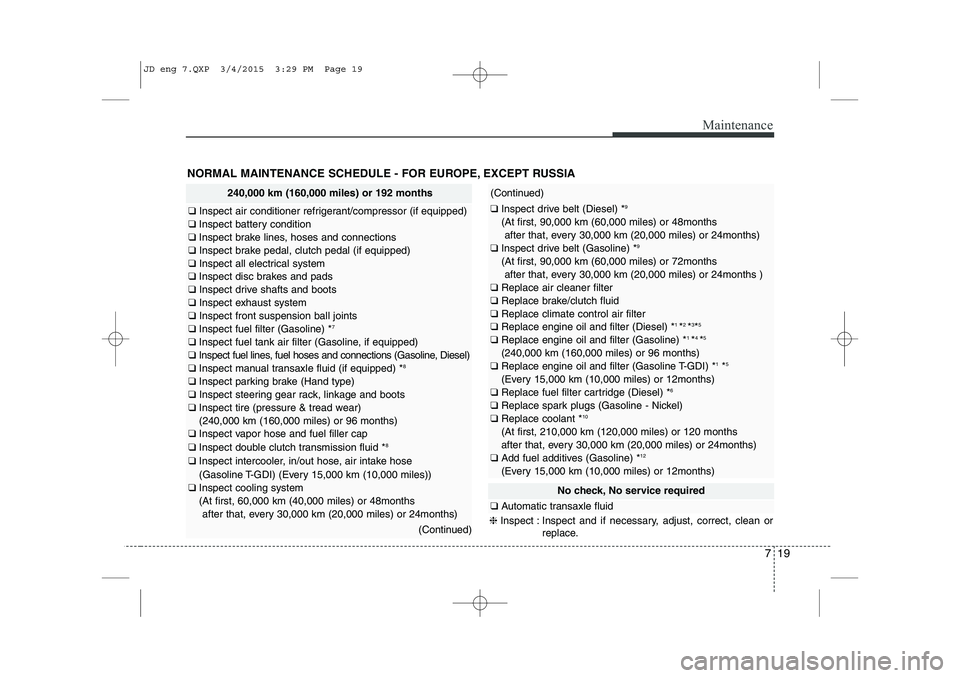
NORMAL MAINTENANCE SCHEDULE - FOR EUROPE, EXCEPT RUSSIA
240,000 km (160,000 miles) or 192 months
❑ Inspect air conditioner refrigerant/compressor (if equipped)
❑ Inspect battery condition
❑ Inspect brake lines, hoses and connections
❑ Inspect brake pedal, clutch pedal (if equipped)
❑ Inspect all electrical system
❑ Inspect disc brakes and pads
❑ Inspect drive shafts and boots
❑ Inspect exhaust system
❑ Inspect front suspension ball joints
❑ Inspect fuel filter (Gasoline) * 7
❑ Inspect fuel tank air filter (Gasoline, if equipped)
❑ Inspect fuel lines, fuel hoses and connections (Gasoline, Diesel)
❑ Inspect manual transaxle fluid (if equipped) * 8
❑ Inspect parking brake (Hand type)
❑ Inspect steering gear rack, linkage and boots
❑ Inspect tire (pressure & tread wear) (240,000 km (160,000 miles) or 96 months)
❑ Inspect vapor hose and fuel filler cap
❑ Inspect double clutch transmission fluid * 8
❑ Inspect intercooler, in/out hose, air intake hose
(Gasoline T-GDI) (Every 15,000 km (10,000 miles))
❑ Inspect cooling system
(At first, 60,000 km (40,000 miles) or 48months
after that, every 30,000 km (20,000 miles) or 24months)
(Continued)
(Continued)
❑ Inspect drive belt (Diesel) * 9
(At first, 90,000 km (60,000 miles) or 48months after that, every 30,000 km (20,000 miles) or 24months)
❑ Inspect drive belt (Gasoline) * 9
(At first, 90,000 km (60,000 miles) or 72months after that, every 30,000 km (20,000 miles) or 24months )
❑ Replace air cleaner filter
❑ Replace brake/clutch fluid
❑ Replace climate control air filter
❑ Replace engine oil and filter (Diesel) * 1
*2
*3
* 5
❑ Replace engine oil and filter (Gasoline) * 1
*4
*5
(240,000 km (160,000 miles) or 96 months)
❑ Replace engine oil and filter (Gasoline T-GDI) * 1
*5
(Every 15,000 km (10,000 miles) or 12months)
❑ Replace fuel filter cartridge (Diesel) * 6
❑ Replace spark plugs (Gasoline - Nickel)
❑ Replace coolant * 10
(At first, 210,000 km (120,000 miles) or 120 months
after that, every 30,000 km (20,000 miles) or 24months)
❑ Add fuel additives (Gasoline) * 12
(Every 15,000 km (10,000 miles) or 12months)
No check, No service required
❑ Automatic transaxle fluid
❈ Inspect : Inspect and if necessary, adjust, correct, clean or
replace.
JD eng 7.QXP 3/4/2015 3:29 PM Page 19
Page 479 of 1210

Maintenance
20
7
MAINTENANCE UNDER SEVERE USAGE CONDITIONS - FOR EUROPE, EXCEPT RUSSIA
The following items must be serviced more frequently on cars mainly used under severe driving conditions.
Refer to the chart below for the appropriate maintenance intervals.
R : Replace I : Inspect and if necessary, adjust, correct, clean or replace
MAINTENANCE ITEMMAINTENANCE
OPERATIONMAINTENANCE INTERVALSDRIVING
CONDITION
Engine oil and engine oil filterGasoline
MPI* 1REvery 15,000 km (10,000 miles) or 6 months
A, B, C, F, G,
H, I, J, K, LGDI* 1REvery 15,000 km (10,000 miles) or 6 months
T-GDIREvery 5,000 km (3,000 miles) or 3 months
Diesel * 2REvery 15,000 km (10,000 miles) or 12 monthsA, B, C, F, G,
H, I, J, K, L
Air cleaner filterRReplace more frequently depending on the conditionC, E
Manual transaxle fluid (if equipped)REvery 120,000 km (80,000 miles)C, D, E, F, G, H, I, K
Double clutch transmission fluid (if equipped)REvery 120,000 km (80,000 miles)C, D, E, F, G, H, I, K
Automatic transaxle fluid (if equipped)REvery 90,000 km (60,000 miles)A, C, D, E, F, G, H, I, K
*1
: If the recommended oil is not available, replace engine oil and engine oil filter every 7,500 km or 6 months for MPI engine an d
5,000 km or 6 months for GDI engine.
* 2
: If the recommended oil is not available, replace engine oil and engine oil filter every 10,000 km or 6 months.
JD eng 7.QXP 3/4/2015 3:29 PM Page 20