Page 407 of 695
Automatic Operation
The Automatic Temperature Control system automati-
cally maintains the climate in the cabin of the vehicle at
the comfort levels desired by the driver and passenger.
Operation of the system is quite simple.
Turn the Mode Control knob (on the right) and the
Blower Control knob (on the left) to AUTO.
NOTE:The AUTO position performs best for front seat
occupants only.
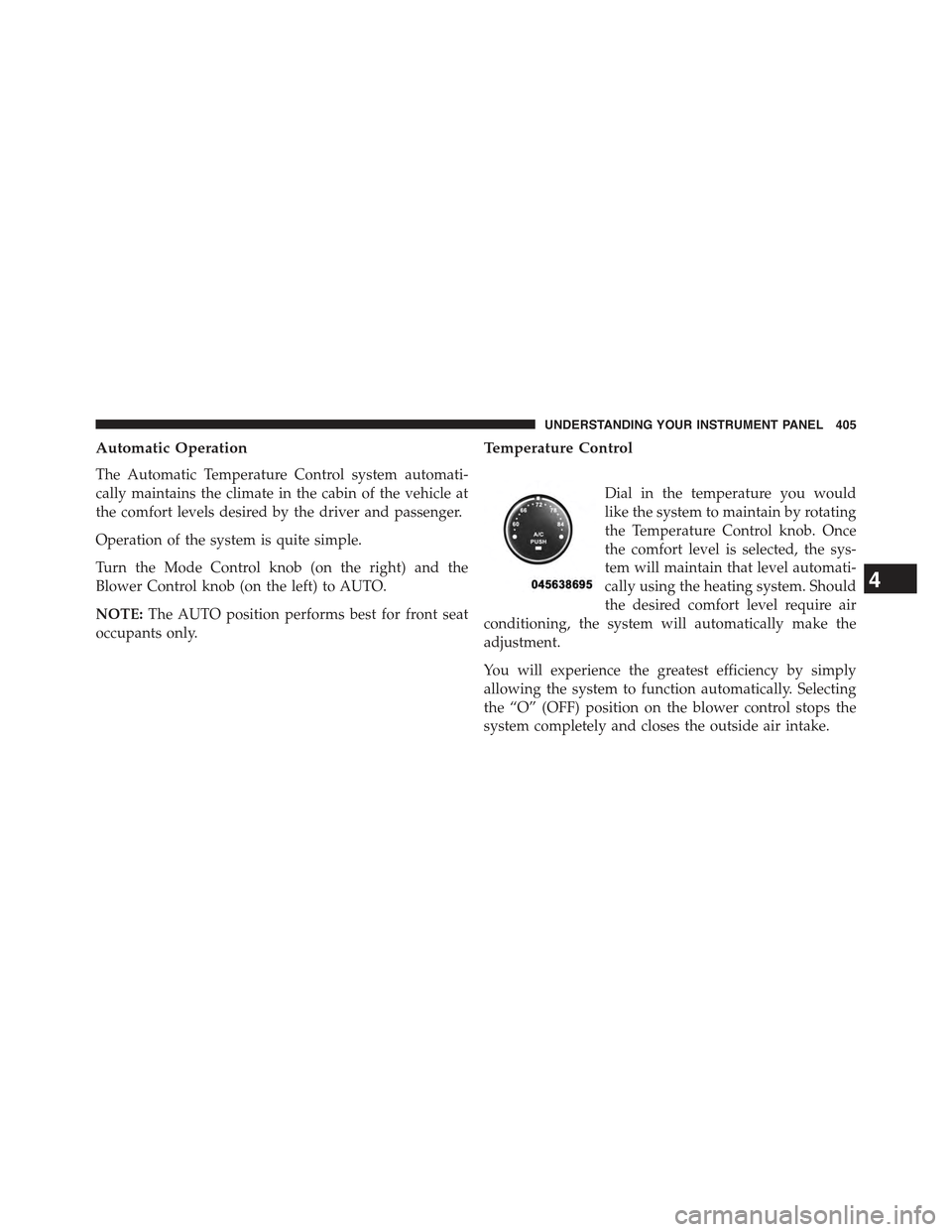
Temperature Control
Dial in the temperature you would
like the system to maintain by rotating
the Temperature Control knob. Once
the comfort level is selected, the sys-
tem will maintain that level automati-
cally using the heating system. Should
the desired comfort level require air
conditioning, the system will automatically make the
adjustment.
You will experience the greatest efficiency by simply
allowing the system to function automatically. Selecting
the “O” (OFF) position on the blower control stops the
system completely and closes the outside air intake.
4
UNDERSTANDING YOUR INSTRUMENT PANEL 405
Page 562 of 695

HAZARD WARNING FLASHERS
The Hazard Warning flasher switch is located on the
instrument panel below the climate controls.
Press the switch to turn on the Hazard Warning
flasher. When the switch is activated, all direc-
tional turn signals will flash on and off to warn oncoming
traffic of an emergency. Press the switch a second time to
turn off the Hazard Warning flashers.
This is an emergency warning system and it should not
be used when the vehicle is in motion. Use it when your
vehicle is disabled and it is creating a safety hazard for
other motorists.
When you must leave the vehicle to seek assistance, the
Hazard Warning flashers will continue to operate even
though the ignition is placed in the OFF position.
NOTE:With extended use the Hazard Warning flashers
may wear down your battery.
IF YOUR ENGINE OVERHEATS
In any of the following situations, you can reduce the
potential for overheating by taking the appropriate ac-
tion.
•On the highways — slow down.
•In city traffic — while stopped, shift transmission into
NEUTRAL, but do not increase engine idle speed.
CAUTION!
Driving with a hot cooling system could damage
your vehicle. If the temperature gauge reads HOT
(H), pull over and stop the vehicle. Idle the vehicle
with the air conditioner turned off until the pointer
drops back into the normal range. If the pointer
remains on HOT (H), and you hear continuous
chimes, turn the engine off immediately, and call for
service.
560 WHAT TO DO IN EMERGENCIES
Page 639 of 695
Cavity Cartridge FuseMini FuseDescription
M10–15 Amp BlueIgnition Off Draw – Vehicle Entertainment Sys-
tem, Satellite Digital Audio Receiver (SDARS),
DVD, Hands-Free Module, RADIO, Antenna,
Universal Garage Door Opener, Vanity Lamp
M11–10 Amp Red (Ignition Off Draw) Climate Control System,
Underhood Lamp
M12–30 Amp GreenAmplifier
M13–20 Amp Yellow Ignition Off Draw – Cabin Compartment
Node, Wireless Control Module, SIREN,
Multifunction Control Switch
M14–20 Amp YellowTrailer Tow (Export Only)
M15–20 Amp Yellow Climate Control System, Rear View Mirror,
Cabin Compartment Node, Transfer Case
Switch, Multi-Function Control Switch, Tire
Pressure Monitor, Glow Plug Module –
Export Diesel Only
7
MAINTAINING YOUR VEHICLE 637
Page 641 of 695
Cavity Cartridge FuseMini FuseDescription
M29–10 Amp RedPowertrain
M30–15 Amp Blue Wiper Motor Frt, J1962 Diagnostic Feed
M31–20 Amp YellowBackup Lamps
M32–10 Amp RedAirbag Controller, TT EUROPE
M33–10 Amp RedPowertrain Controller
M34–10 Amp Red Park Assist, Climate Control System, Head-
lamp Wash, Compass
M35–10 Amp RedHeated Mirrors
M36–20 Amp YellowPower Outlet
M37–10 Amp RedAnti-Lock Brake System, Electronic Stability
Control, Stop Lamp Switch, Fuel Pump Relay
M38–25 Amp ClearLock/Unlock Motors
7
MAINTAINING YOUR VEHICLE 639
Page 671 of 695

Call toll free at:
•1–800–890–4038 (U.S.)
•1–800–387–1143 (Canada)
Or
Visit us on the Worldwide Web at:
•www.techauthority.com
DEPARTMENT OF TRANSPORTATION UNIFORM
TIRE QUALITY GRADES
The following tire grading categories were established by
the National Highway Traffic Safety Administration. The
specific grade rating assigned by the tire’s manufacturer
in each category is shown on the sidewall of the tires on
your vehicle.
All passenger car tires must conform to Federal safety
requirements in addition to these grades.
Treadwear
The Treadwear grade is a comparative rating, based on
the wear rate of the tire when tested under controlled
conditions on a specified government test course. For
example, a tire graded 150 would wear one and one-half
times as well on the government course as a tire graded
100. The relative performance of tires depends upon the
actual conditions of their use, however, and may depart
significantly from the norm due to variations in driving
habits, service practices, and differences in road charac-
teristics and climate.
Traction Grades
The Traction grades, from highest to lowest, are AA, A, B,
and C. These grades represent the tire’s ability to stop on
wet pavement, as measured under controlled conditions
on specified government test surfaces of asphalt and
concrete. A tire marked C may have poor traction perfor-
mance.
9
IF YOU NEED CONSUMER ASSISTANCE 669
Page 676 of 695

Capacities, Fluid..........................646
Caps, Filler
Fuel.................................530
Power Steering.........................465
Radiator (Coolant Pressure)................615
Carbon Monoxide Warning..................100
Cargo Light.............................173
Car Washes.............................626
Cellular Phone...........................115
Center High Mounted Stop Light..............645
Certification Label.........................532
Chains, Tire.............................510
Changing A Flat Tire.......................563
Chart, Tire Sizing.........................488
Check Engine Light (Malfunction Indicator Light) . .310
Checking Your Vehicle For Safety...............99
Checks, Safety............................99
Child Restraint............................76
Child Restraints
Booster Seats...........................81
Child Restraints.........................76
Child Seat Installation.....................95
How To Stow An Unused ALR Seat Belt........91
Infants And Child Restraints................79
Install A LATCH-compatible Child Restraint.....90
Installing Child Restraints Using The Vehicle Seat
Belt..................................92
Locating The LATCH Anchorages............87
Lower Anchors And Tethers For Children.......83
Older Children And Child Restraints..........79
Seating Positions........................82
Child Safety Locks.........................42
Clean Air Gasoline........................526
Cleaning
Wheels...............................627
Climate Control..........................400
Clock..................................344
Cold Weather Operation....................421
674 INDEX

