Page 219 of 695
WARNING!
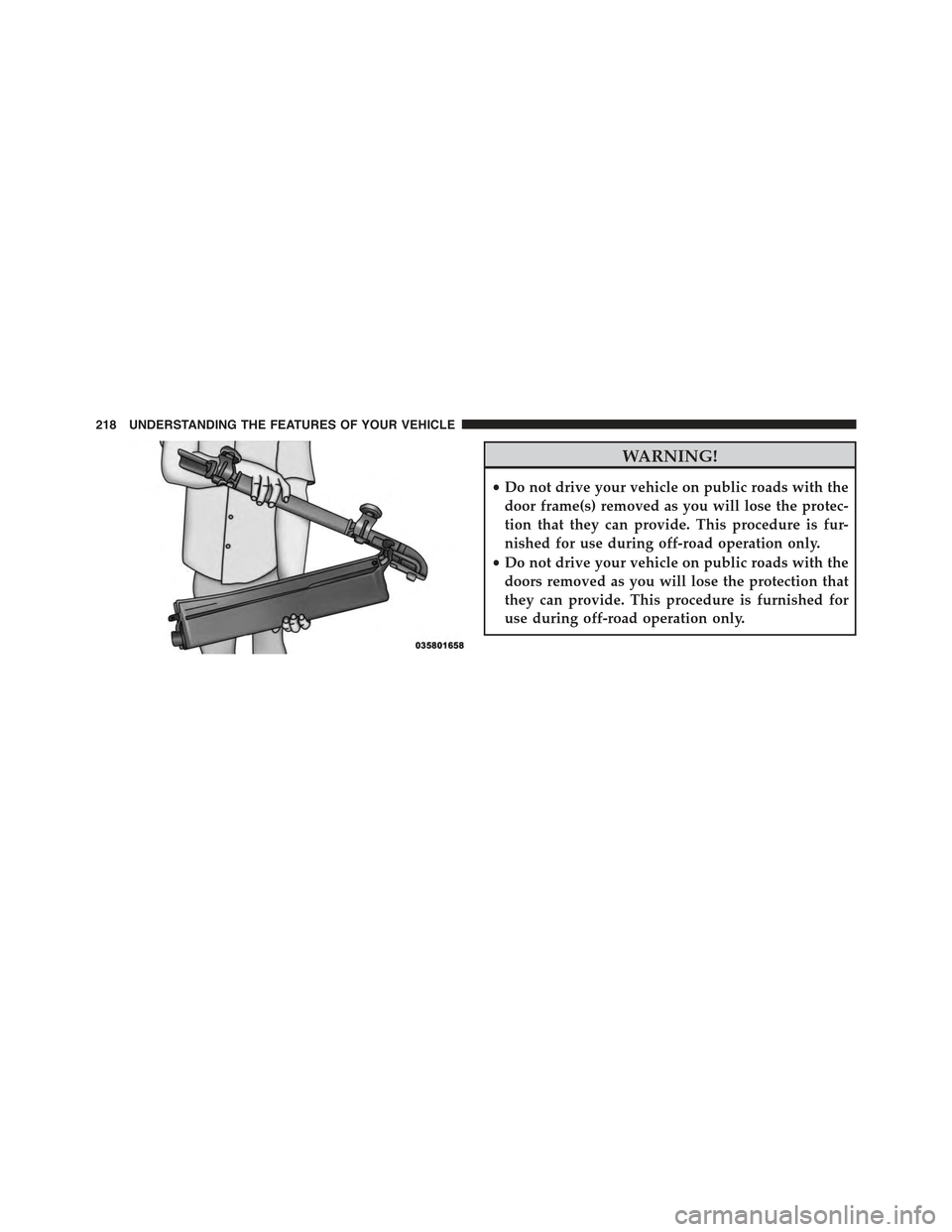
Use both hands to remove the door frames. The door
frames will fold and could cause injury if both hands
are not used.
2. Place one hand on the upper rear and one hand on the
front of the door frame.
3. Pull the frame toward you with your rearward hand to
remove the frame from the vehicle.
4. Screw the knobs back into the door frame and fold for
storage. Store in a secure location.
3
UNDERSTANDING THE FEATURES OF YOUR VEHICLE 217
Page 220 of 695
WARNING!
•Do not drive your vehicle on public roads with the
door frame(s) removed as you will lose the protec-
tion that they can provide. This procedure is fur-
nished for use during off-road operation only.
•Do not drive your vehicle on public roads with the
doors removed as you will lose the protection that
they can provide. This procedure is furnished for
use during off-road operation only.
218 UNDERSTANDING THE FEATURES OF YOUR VEHICLE
Page 226 of 695

CAUTION!(Continued)
•Refer to “Appearance Care For Fabric Top Models”
in “Maintaining Your Vehicle” for further informa-
tion. It contains important information on cleaning
and caring for your vehicle’s fabric top.
•Do not use any tools (screwdrivers, etc.) to pry or
force any of the clamps, clips, or retainers securing
the soft top. Do not force or pry the soft top
framework when opening or closing. Damage to
the top may result.
WARNING!
•Do not drive the vehicle with the rear window
curtain up unless the side curtains are also re-
moved. Dangerous exhaust gases could enter the
vehicle causing harm to the driver and passengers.
(Continued)
WARNING!(Continued)
•The fabric upper doors and fabric top are designed
only for protection against the elements. Do not
rely on them to contain occupants within the ve-
hicle or to protect against injury during an acci-
dent. Remember, always wear seat belts.
CAUTION!
Failure to follow these cautions may cause interior
water damage, stains or mildew on the top material:
•It is recommended that the top be free of water
prior to opening it. Operating the top, opening a
door or lowering a window while the top is wet
may allow water to drip into the vehicle’s interior.
(Continued)
224 UNDERSTANDING THE FEATURES OF YOUR VEHICLE
Page 259 of 695
WARNING!
•Do not drive the vehicle with the rear window
curtain up unless the side curtains are also open.
Dangerous exhaust gases which can kill could
enter the vehicle.
•The fabric upper doors and fabric top are designed
only for protection against the elements. Do not
rely on them to contain occupants within the ve-
hicle or to protect against injury during an acci-
dent. Remember, always wear seat belts.
CAUTION!
Failure to follow these cautions may cause interior
water damage, stains or mildew on the top material:
•It is recommended that the top be free of water
prior to opening it. Operating the top, opening a
door or lowering a window while the top is wet
may allow water to drip into the vehicle’s interior.
•Careless handling and storage of the soft top may
damage the seals, causing water to leak into the
vehicle’s interior.
•The soft top must be positioned properly to ensure
sealing. Improper installation can cause water to
leak into the vehicle’s interior.
3
UNDERSTANDING THE FEATURES OF YOUR VEHICLE 257
Page 294 of 695
WARNING!
Carefully follow these warnings to help protect
against personal injury:
•Do not drive your vehicle on-road with the wind-
shield down.
•Do not drive your vehicle unless the windshield is
securely fastened, either up or down.
•Eye protection, such as goggles, should be worn at
all times when the windshield is down.
•Be sure that you carefully follow the instructions
for raising the windshield. Make sure that the
folding windshield, windshield wipers, side bars,
and all associated hardware and fasteners are cor-
rectly and tightly assembled before driving your
vehicle. Failure to follow these instructions may
prevent your vehicle from providing you and your
passengers protection in some accidents.
(Continued)
WARNING!(Continued)
•If you remove the doors, store them outside the
vehicle. In the event of an accident, a loose door
may cause personal injury.
Lowering The Windshield And Removing Side
Bars
1. Lower the fabric top or remove the hard top following
the instructions in this manual.
NOTE:To assist in properly reinstalling side bars, mark
the original locations prior to removing.
292 UNDERSTANDING THE FEATURES OF YOUR VEHICLE
Page 296 of 695
CAUTION!
Do not remove the head impact foam from the side
bars, as damage to the foam may result.
NOTE:Store all of the mounting bolts in their original
threaded holes and tighten for safekeeping.
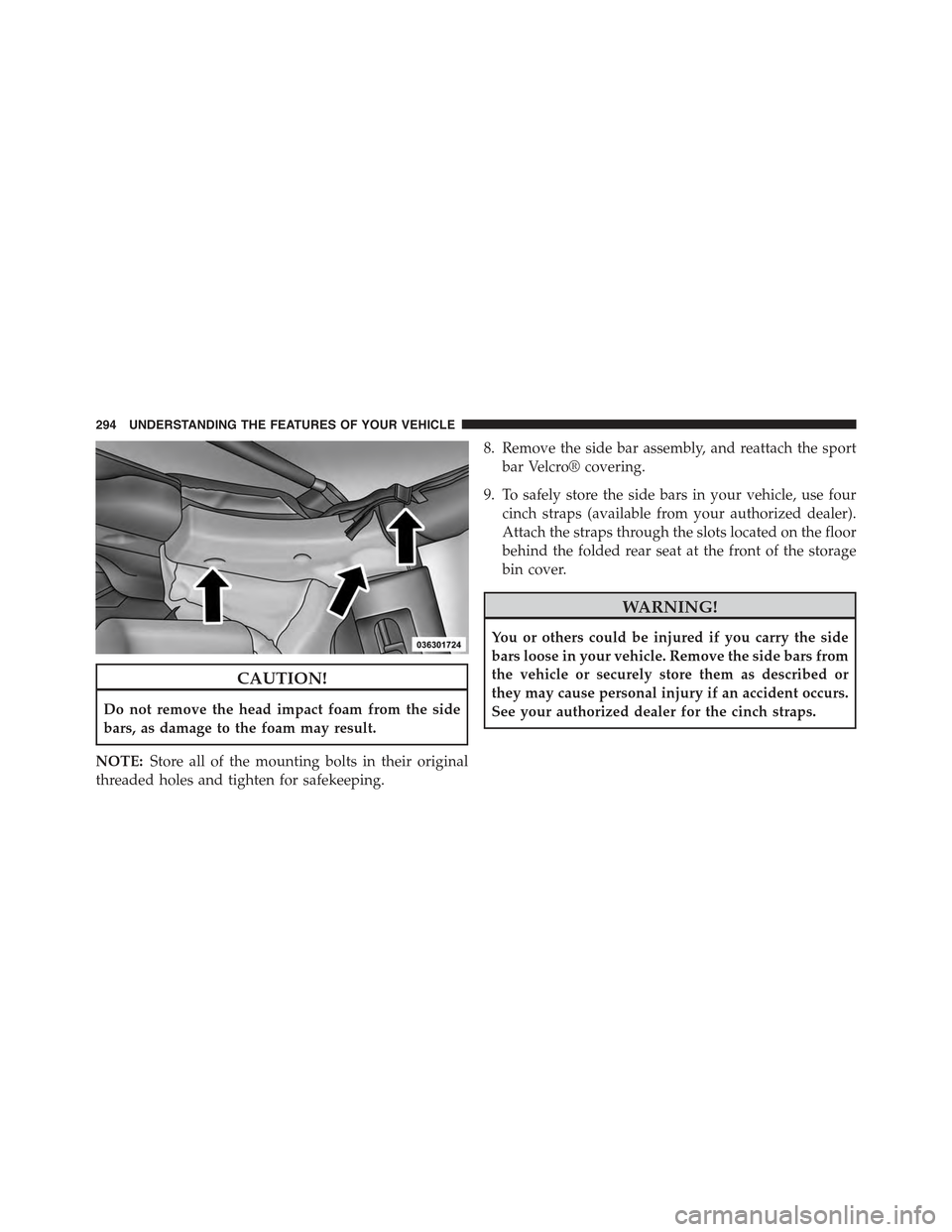
8. Remove the side bar assembly, and reattach the sport
bar Velcro® covering.
9. To safely store the side bars in your vehicle, use four
cinch straps (available from your authorized dealer).
Attach the straps through the slots located on the floor
behind the folded rear seat at the front of the storage
bin cover.
WARNING!
You or others could be injured if you carry the side
bars loose in your vehicle. Remove the side bars from
the vehicle or securely store them as described or
they may cause personal injury if an accident occurs.
See your authorized dealer for the cinch straps.
294 UNDERSTANDING THE FEATURES OF YOUR VEHICLE
Page 308 of 695
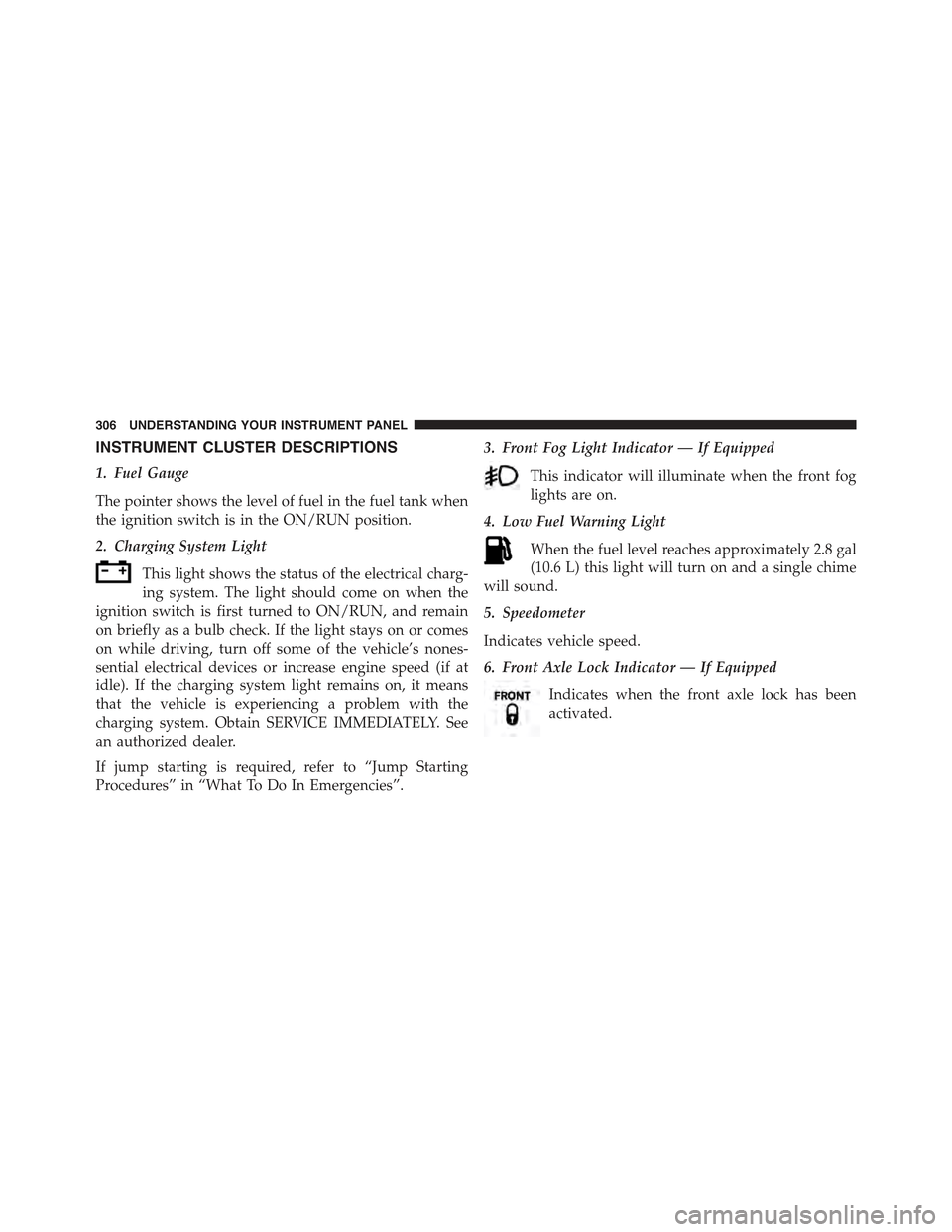
INSTRUMENT CLUSTER DESCRIPTIONS
1. Fuel Gauge
The pointer shows the level of fuel in the fuel tank when
the ignition switch is in the ON/RUN position.
2. Charging System Light
This light shows the status of the electrical charg-
ing system. The light should come on when the
ignition switch is first turned to ON/RUN, and remain
on briefly as a bulb check. If the light stays on or comes
on while driving, turn off some of the vehicle’s nones-
sential electrical devices or increase engine speed (if at
idle). If the charging system light remains on, it means
that the vehicle is experiencing a problem with the
charging system. Obtain SERVICE IMMEDIATELY. See
an authorized dealer.
If jump starting is required, refer to “Jump Starting
Procedures” in “What To Do In Emergencies”.
3. Front Fog Light Indicator — If Equipped
This indicator will illuminate when the front fog
lights are on.
4. Low Fuel Warning Light
When the fuel level reaches approximately 2.8 gal
(10.6 L) this light will turn on and a single chime
will sound.
5. Speedometer
Indicates vehicle speed.
6. Front Axle Lock Indicator — If Equipped
Indicates when the front axle lock has been
activated.
306 UNDERSTANDING YOUR INSTRUMENT PANEL
Page 309 of 695

7. Seat Belt Reminder Light
When the ignition switch is first turned to ON/
RUN, this light will turn on for four to eight
seconds as a bulb check. During the bulb check, if
the driver’s seat belt is unbuckled, a chime will sound.
After the bulb check or when driving, if the driver seat
belt remains unbuckled, the Seat Belt Reminder Light
will flash or remain on continuously. Refer to “Occupant
Restraints” in “Things To Know Before Starting Your
Vehicle” for further information.
8. Turn Signal Indicators
The left or right arrow will flash with the corre-
sponding exterior turn signal lights when the turn
signal lever is operated. A chime will sound if the vehicle is
driven more than 1 mile (1.6 km) with either turn signal on.
NOTE:If either indicator flashes at a rapid rate, check
for a defective outside light bulb.
9. Oil Pressure Warning Light
This light indicates low engine oil pressure. The
light should turn on momentarily when the engine is
started; if the bulb does not come on, have the system
checked by an authorized dealer. If the light turns on
while driving, stop the vehicle and shut off the engine as
soon as possible. A chime will sound when this light
turns on.
Do not operate the vehicle until the cause is corrected.
This light does not indicate how much oil is in the engine.
The engine oil level must be checked under the hood.
10. Brake Warning Light
This light monitors various brake functions,
including brake fluid level and parking brake
application. If the brake light turns on it may
indicate that the parking brake is applied, that
the brake fluid level is low, or that there is a problem with
the anti-lock brake system reservoir.
4
UNDERSTANDING YOUR INSTRUMENT PANEL 307