Page 185 of 678

WARNING!
A hot engine cooling system is dangerous. You or
others could be badly burned by steam or boiling
coolant. You may want to call an authorized dealer
for service if your vehicle overheats. If you decide to
look under the hood yourself, see “Maintaining And
Caring For Your Vehicle.” Follow the warnings under
the “Cooling System Pressure Cap” paragraph.
WARNING LIGHTS AND MESSAGES
The EVIC/DID display consists of three sections:
1. The reconfigurable top line where compass, direction,
and outside temperature are displayed.
•Right side default to Ignition Status for those with
push button ignition.
2. The main display area where the menus and pop up
messages are displayed.
3. The reconfigurable telltales section.
The main display area will normally display the main
menu or the screens of a selected feature of the main
menu. The main display area also displays#pop up#
messages that consist of approximately 60 possible warn-
ing or information messages. These pop up messages fall
into several categories:
•Five Second Stored Messages
When the appropriate conditions occur, this type of
message takes control of the main display area for five
seconds and then returns to the previous screen. Most of
the messages of this type are then stored (as long as the
condition that activated it remains active) and can be
reviewed from the#Messages#main menu item. As long
as there is a stored message, an#i#will be displayed in the
EVIC’s compass/outside temp line. Examples of this
message type are#Right Front Turn Signal Lamp Out#
and#Low Tire Pressure.#
5
GETTING TO KNOW YOUR INSTRUMENT PANEL 183
Page 312 of 678

Exhaust Gas
WARNING!
Exhaust gases can injure or kill. They contain carbon
monoxide (CO), which is colorless and odorless.
Breathing it can make you unconscious and can
eventually poison you. To avoid breathing (CO),
follow these safety tips:
•Do not run the engine in a closed garage or in
confined areas any longer than needed to move
your vehicle in or out of the area.
•If you are required to drive with the trunk/liftgate/
rear doors open, make sure that all windows are
closed and the climate control BLOWER switch is
set at high speed. DO NOT use the recirculation
mode.
(Continued)
WARNING!(Continued)
•If it is necessary to sit in a parked vehicle with the
engine running, adjust your heating or cooling
controls to force outside air into the vehicle. Set the
blower at high speed.
The best protection against carbon monoxide entry into
the vehicle body is a properly maintained engine exhaust
system.
Whenever a change is noticed in the sound of the exhaust
system, when exhaust fumes can be detected inside the
vehicle, or when the underside or rear of the vehicle is
damaged, have a competent mechanic inspect the com-
plete exhaust system and adjacent body areas for broken,
damaged, deteriorated, or mispositioned parts. Open
seams or loose connections could permit exhaust fumes
to seep into the passenger compartment. In addition,
inspect the exhaust system each time the vehicle is raised
for lubrication or oil change. Replace as required.
310 SAFETY
Page 423 of 678
Electronic Speed Control — If Equipped
•Do not use in hilly terrain or with heavy loads.
•When using the speed control, if you experience speed
drops greater than 10 mph (16 km/h), disengage until
you can get back to cruising speed.
•Use speed control in flat terrain and with light loads to
maximize fuel efficiency.
Cooling System
To reduce potential for engine and transmission over-
heating, take the following actions:
City Driving
When stopped for short periods of time, shift the trans-
mission into NEUTRAL and increase engine idle speed.
Highway Driving
Reduce speed.
Air Conditioning
Turn off temporarily.
7
STARTING AND OPERATING 421
Page 467 of 678
Cavity Maxi FuseMini FuseMicro Fuse Description
F0170 Amp Tan——Module Body
Computer
F0270 Amp Tan——Module Body
Computer, Rear
Distribution Units
F03—20 Amp Yellow—Controller Power
Supply Body
Computer
F04—30 Amp Green—Brake Control
Electronics Module
F0570 Amp Tan——Electric Power-
Assisted Steering
F06 20 Amp Yellow——Engine Cooling fan
F06 40 Amp Orange——Engine Cooling fan
F07 30 Amp Green——Engine Cooling fan
F07 40 Amp Orange——Engine Cooling fan
8
IN CASE OF EMERGENCY 465
Page 495 of 678

WARNING!
•Take care to avoid the radiator cooling fan when-
ever the hood is raised. It can start anytime the
ignition switch is ON. You can be injured by
moving fan blades.
•Remove any metal jewelry such as rings, watch
bands and bracelets that could make an inadvertent
electrical contact. You could be seriously injured.
•Batteries contain sulfuric acid that can burn your
skin or eyes and generate hydrogen gas which is
flammable and explosive. Keep open flames or
sparks away from the battery.
Proceed as follows:
1. Set the Electric Park Brake, shift the automatic trans-
mission into PARK (manual transmission in NEU-
TRAL) and turn the ignition to STOP/OFF.
2. Turn off the heater, radio, and all unnecessary electri-
cal accessories.
3. If using another vehicle to jump-start the battery, park
the vehicle within the jumper cables reach, set the
parking brake and make sure the ignition is STOP/
OFF.
WARNING!
Do not allow vehicles to touch each other as this
could establish a ground connection and personal
injury could result.
8
IN CASE OF EMERGENCY 493
Page 500 of 678

IF YOUR ENGINE OVERHEATS
In any of the following situations, you can reduce the
potential for overheating your engine by taking the
appropriate action.
•On the highways — slow down.
•In city traffic — while stopped, put transmission in
NEUTRAL, but do not increase engine idle speed.
CAUTION!
Driving with a hot cooling system could damage
your vehicle. If the temperature gauge reads “H,”
pull over and stop the vehicle. Idle the vehicle with
the air conditioner turned off until the pointer drops
back into the normal range. If the pointer remains on
the “H” and you hear continuous chimes, turn the
engine off immediately and call for service.
NOTE:There are steps that you can take to slow down
an impending overheat condition:
•If your air conditioner (A/C) is on, turn it off. The A/C
system adds heat to the engine cooling system and
turning the A/C off can help remove this heat.
•You can also turn the temperature control to maximum
heat, the mode control to floor and the blower control
to high. This allows the heater core to act as a
supplement to the radiator and aids in removing heat
from the engine cooling system.
WARNING!
You or others can be badly burned by hot engine
coolant (antifreeze) or steam from your radiator. If
you see or hear steam coming from under the hood,
do not open the hood until the radiator has had time
to cool. Never try to open a cooling system pressure
cap when the radiator or coolant bottle is hot.
498 IN CASE OF EMERGENCY
Page 514 of 678
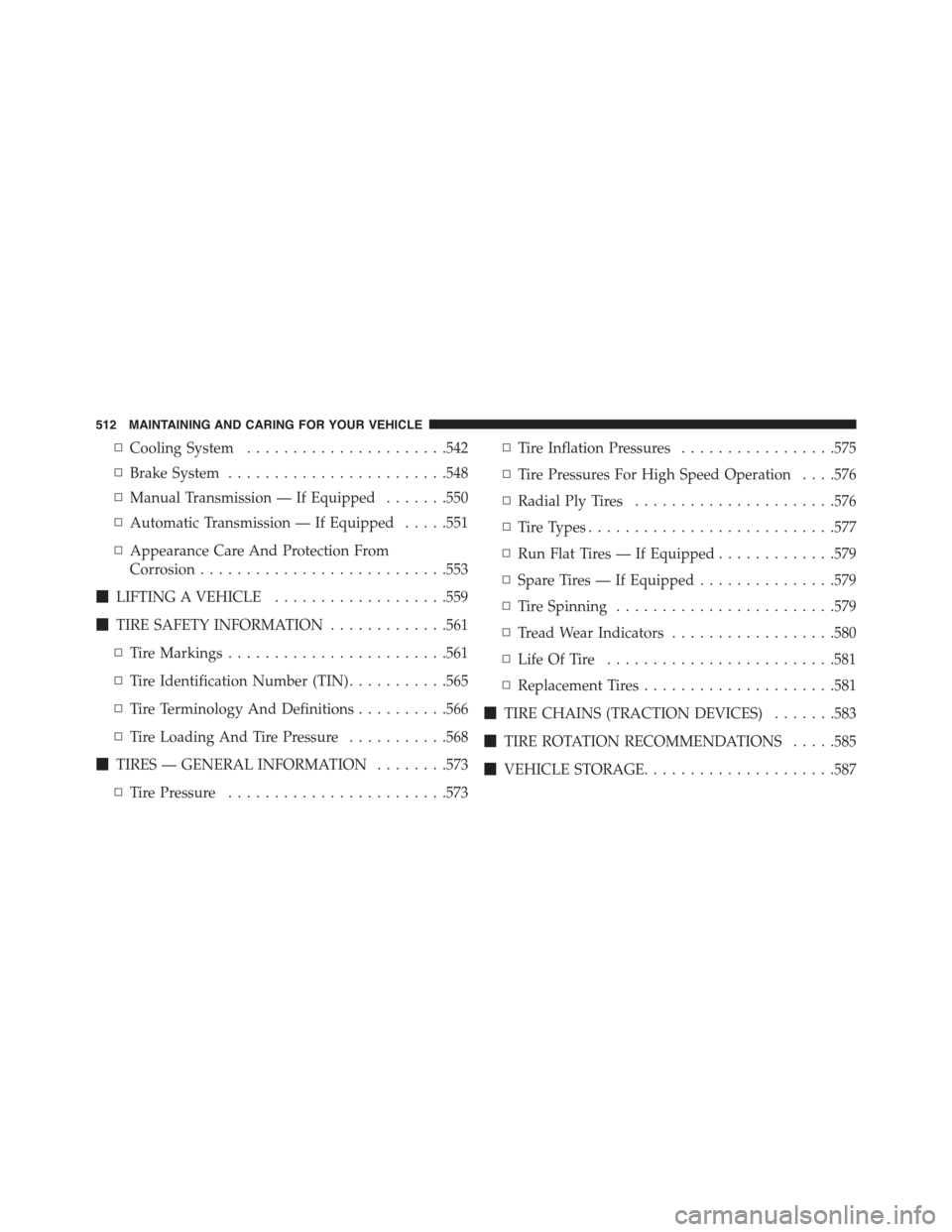
▫Cooling System......................542
▫Brake System........................548
▫Manual Transmission — If Equipped.......550
▫Automatic Transmission — If Equipped.....551
▫Appearance Care And Protection From
Corrosion...........................553
!LIFTING A VEHICLE...................559
!TIRE SAFETY INFORMATION.............561
▫Tire Markings........................561
▫Tire Identification Number (TIN)...........565
▫Tire Terminology And Definitions..........566
▫Tire Loading And Tire Pressure...........568
!TIRES — GENERAL INFORMATION........573
▫Tire Pressure........................573
▫Tire Inflation Pressures.................575
▫Tire Pressures For High Speed Operation . . . .576
▫Radial Ply Tires......................576
▫Tire Types...........................577
▫Run Flat Tires — If Equipped.............579
▫Spare Tires — If Equipped...............579
▫Tire Spinning........................579
▫Tread Wear Indicators..................580
▫Life Of Tire.........................581
▫Replacement Tires.....................581
!TIRE CHAINS (TRACTION DEVICES).......583
!TIRE ROTATION RECOMMENDATIONS.....585
!VEHICLE STORAGE.....................587
512 MAINTAINING AND CARING FOR YOUR VEHICLE
Page 519 of 678
Once A Month Or Before A Long Trip:
•Check engine oil level.
•Check windshield washer fluid level.
•Check the tire inflation pressures and look for unusual
wear or damage.
•Check the fluid levels of the coolant reservoir, and
brake master cylinder reservoir, and fill as needed.
•Check function of all interior and exterior lights.
Required Maintenance Intervals.
Refer to the “Maintenance Schedules” on the following
page for the required maintenance intervals.
At Every Oil Change Interval As Indicated By Oil
Change Indicator System:
Change oil and filter.
Inspect battery and clean and tighten terminals as
required.
Inspect brake pads, shoes, rotors, drums, and hoses.
Inspect engine cooling system protection and hoses.
Check and adjust hand brake.
Inspect exhaust system.
Inspect engine air cleaner if using in dusty or off-road
conditions.
9
MAINTAINING AND CARING FOR YOUR VEHICLE 517


