2015 JEEP PATRIOT load capacity
[x] Cancel search: load capacityPage 400 of 572
WARNING!
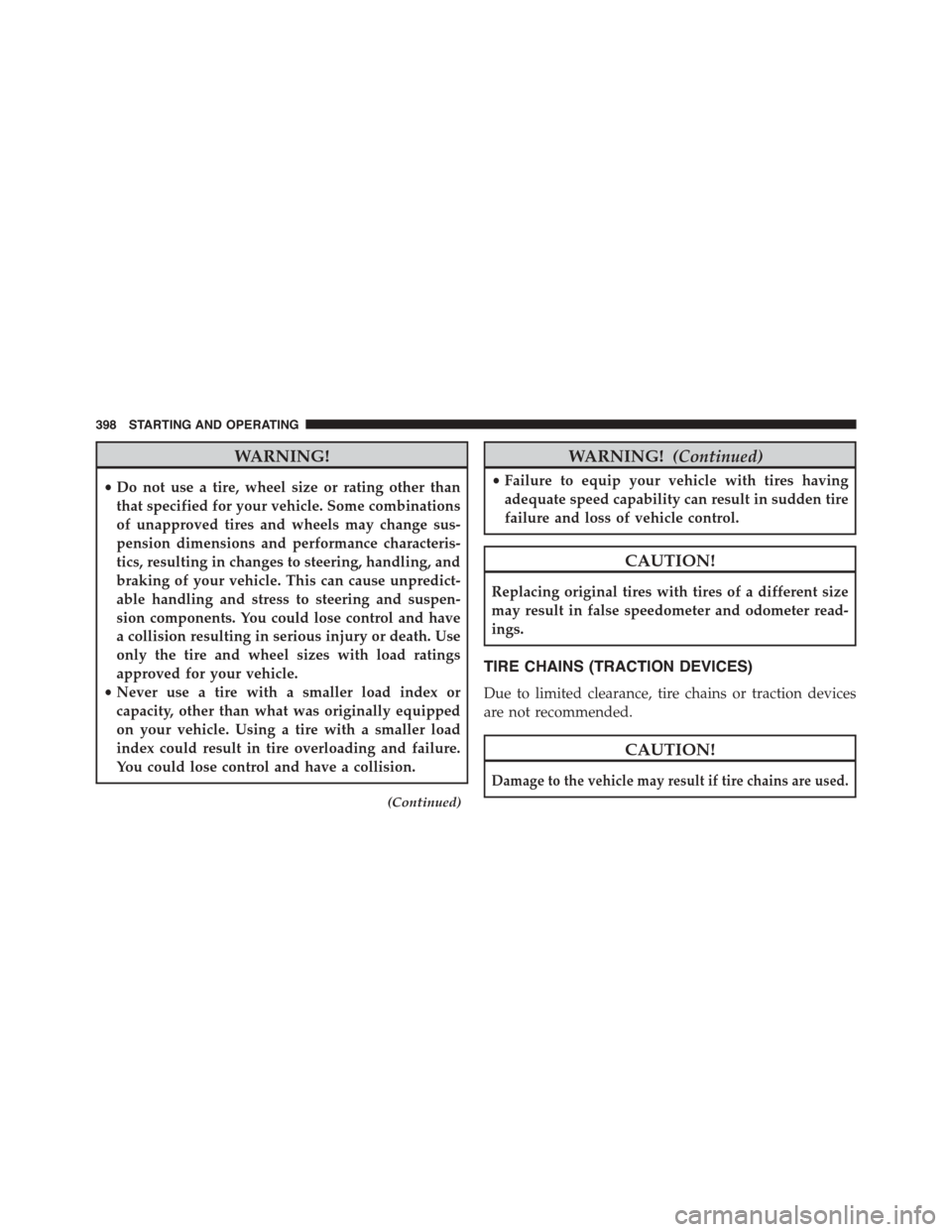
•Do not use a tire, wheel size or rating other than
that specified for your vehicle. Some combinations
of unapproved tires and wheels may change sus-
pension dimensions and performance characteris-
tics, resulting in changes to steering, handling, and
braking of your vehicle. This can cause unpredict-
able handling and stress to steering and suspen-
sion components. You could lose control and have
a collision resulting in serious injury or death. Use
only the tire and wheel sizes with load ratings
approved for your vehicle.
•Never use a tire with a smaller load index or
capacity, other than what was originally equipped
on your vehicle. Using a tire with a smaller load
index could result in tire overloading and failure.
You could lose control and have a collision.
(Continued)
WARNING!(Continued)
•Failure to equip your vehicle with tires having
adequate speed capability can result in sudden tire
failure and loss of vehicle control.
CAUTION!
Replacing original tires with tires of a different size
may result in false speedometer and odometer read-
ings.
TIRE CHAINS (TRACTION DEVICES)
Due to limited clearance, tire chains or traction devices
are not recommended.
CAUTION!
Damage to the vehicle may result if tire chains are used.
398 STARTING AND OPERATING
Page 418 of 572

VEHICLE LOADING
As required by National Highway Traffic Safety Admin-
istration regulations, your vehicle has a certification label
affixed to the driver’s side door or B-Pillar.
Vehicle Certification Label
Your vehicle has a Vehicle Certification Label attached to
the driver’s door B-Pillar.
The label contains the following information:
•Name of manufacturer
•Month and year of manufacture
•Gross Vehicle Weight Rating (GVWR)
•Vehicle Identification Number (VIN)
•Type of Vehicle
•Month, Day and Hour of Manufacture (MDH)
The bar code allows a computer scanner to read the
Vehicle Identification Number (VIN).
Gross Vehicle Weight Rating (GVWR)
The GVWR is the total allowable weight of your vehicle.
This includes driver, passengers, and cargo. The total
load must be limited so that you do not exceed the
GVWR.
Tire Size
The tire size on the Vehicle Certification Label represents
the actual tire size on your vehicle. Replacement tires
must be equal to the load capacity of this tire size.
Rim Size
This is the rim size that is appropriate for the tire size
listed.
416 STARTING AND OPERATING
Page 419 of 572

Inflation Pressure
This is the cold tire inflation pressure for your vehicle for
all loading conditions up to full GAWR.
Curb Weight
The curb weight of a vehicle is defined as the total weight
of the vehicle with all fluids, including vehicle fuel, at full
capacity conditions, and with no occupants or cargo
loaded into the vehicle. The front and rear curb weight
values are determined by weighing your vehicle on a
commercial scale before any occupants or cargo are
added.
Overloading
The load carrying components (springs, tires, wheels,
etc.) of your vehicle will provide satisfactory service as
long as you do not exceed the GVWR.
The best way to figure out the total weight of your
vehicle is to weigh it when it is fully loaded and ready for
operation. Weigh it on a commercial scale to ensure that
it is not over the GVWR.
Overloading can cause potential safety hazards and
shorten useful service life. Heavier suspension compo-
nents do not necessarily increase the vehicle’s GVWR.
Loading
To load your vehicle properly, first figure out its empty
weight. Store heavier items down low and be sure you
distribute their weight as evenly as possible. Stow all
loose items securely before driving. Improper weight
distribution can have an adverse effect on the way your
vehicle steers and handles, and the way the brakes
operate.
5
STARTING AND OPERATING 417
Page 421 of 572
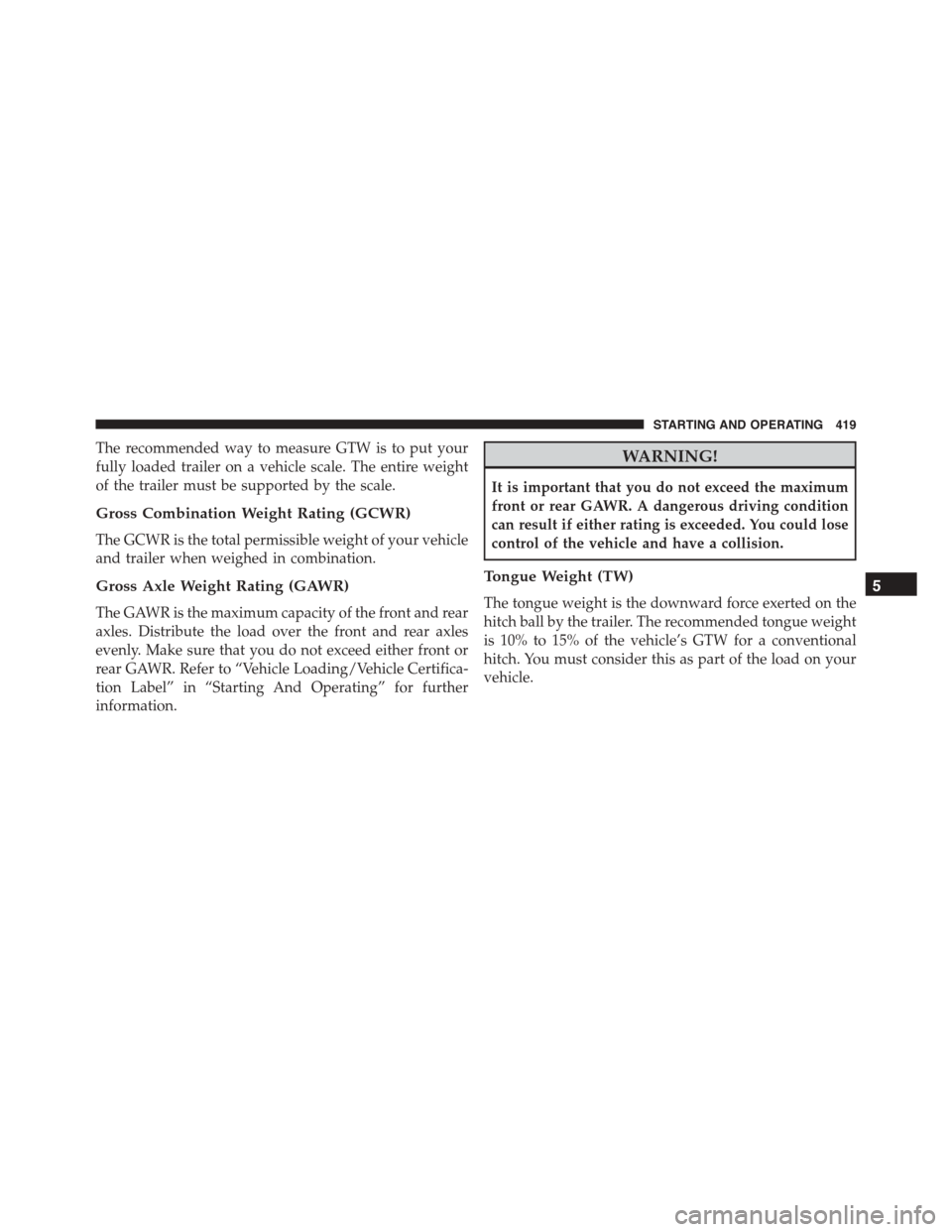
The recommended way to measure GTW is to put your
fully loaded trailer on a vehicle scale. The entire weight
of the trailer must be supported by the scale.
Gross Combination Weight Rating (GCWR)
The GCWR is the total permissible weight of your vehicle
and trailer when weighed in combination.
Gross Axle Weight Rating (GAWR)
The GAWR is the maximum capacity of the front and rear
axles. Distribute the load over the front and rear axles
evenly. Make sure that you do not exceed either front or
rear GAWR. Refer to “Vehicle Loading/Vehicle Certifica-
tion Label” in “Starting And Operating” for further
information.
WARNING!
It is important that you do not exceed the maximum
front or rear GAWR. A dangerous driving condition
can result if either rating is exceeded. You could lose
control of the vehicle and have a collision.
Tongue Weight (TW)
The tongue weight is the downward force exerted on the
hitch ball by the trailer. The recommended tongue weight
is 10% to 15% of the vehicle’s GTW for a conventional
hitch. You must consider this as part of the load on your
vehicle.
5
STARTING AND OPERATING 419
Page 429 of 572

WARNING!(Continued)
•Total weight must be distributed between the tow
vehicle and the trailer such that the following four
ratings are not exceeded:
1. GVWR
2. GTW
3. GAWR
4. Tongue weight rating for the trailer hitch uti-
lized.
Towing Requirements — Tires
•Do not attempt to tow a trailer while using a compact
spare tire.
•Proper tire inflation pressures are essential to the safe
and satisfactory operation of your vehicle. Refer to
“Tires – General Information” in “Starting And Oper-
ating” for proper tire inflation procedures.
•Check the trailer tires for proper tire inflation pres-
sures before trailer usage.
•Check for signs of tire wear or visible tire damage
before towing a trailer. Refer to “Tires – General
Information” in “Starting And Operating” for the
proper inspection procedure.
•When replacing tires, refer to “Tires – General Infor-
mation” in “Starting And Operating” for the proper
tire replacement procedures. Replacing tires with a
higher load carrying capacity will not increase the
vehicle’s GVWR and GAWR limits.
5
STARTING AND OPERATING 427
Page 430 of 572

Towing Requirements — Trailer Brakes
•Donotinterconnect the hydraulic brake system or
vacuum system of your vehicle with that of the trailer.
This could cause inadequate braking and possible
personal injury.
•An electronically actuated trailer brake controller is
required when towing a trailer with electronically
actuated brakes. When towing a trailer equipped with
a hydraulic surge actuated brake system, an electronic
brake controller is not required.
•Trailer brakes are recommended for trailers over
1,000 lbs (454 kg) and required for trailers in excess of
2,000 lbs (907 kg).
WARNING!
•Do not connect trailer brakes to your vehicle’s
hydraulic brake lines. It can overload your brake
system and cause it to fail. You might not have
brakes when you need them and could have a
collision.
•Towing any trailer will increase your stopping
distance. When towing you should allow for addi-
tional space between your vehicle and the vehicle
in front of you. Failure to do so could result in a
collision.
CAUTION!
If the trailer weighs more than 1,000 lbs (454 kg)
loaded, it should have its own brakes and they
should be of adequate capacity. Failure to do this
(Continued)
428 STARTING AND OPERATING
Page 563 of 572

Oil Change Indicator.......................237
Oil Change Indicator, Reset..................237
Oil, Engine..............................483
Capacity.............................526
Change Interval........................484
Checking.............................483
Disposal..............................485
Filter................................486
Filter Disposal.........................485
Identification Logo......................484
Materials Added To......................485
Recommendation.......................484
Synthetic.............................485
Viscosity.............................485
Oil Filter, Selection........................486
Onboard Diagnostic System..................479
Opener, Garage Door (HomeLink®)............182
Operating Precautions......................479
Operator Manual (Owner’s Manual).............5
Overheating, Engine.......................437
Owner’s Manual (Operator Manual).............5
Paint Care..............................509
Panic Alarm..............................24
Parking Brake............................357
Passing Light............................170
Personal Settings..........................240
Pets....................................99
Phone, Cellular...........................113
Phone, Hands-Free (Uconnect®)...............113
Placard, Tire And Loading Information..........382
Power
Door Locks............................31
Mirrors..............................112
Outlet (Auxiliary Electrical Outlet)...........194
Steering..............................356
Sunroof..............................191
Transfer Unit..........................509
10
INDEX 561
Page 567 of 572

Starting Procedures........................321
Steering
Power...............................356
Tilt Column...........................176
Storage................................522
Storage Bin..............................200
Storage, Vehicle...........................313
Stuck, Freeing............................466
Sun Roof...............................191
Sun Visor Extension.......................113
Supplemental Restraint System - Air Bag.........62
Synthetic Engine Oil.......................485
System, Remote Starting.....................26
Tachometer..............................218
Taillights...............................525
Temperature Control, Automatic (ATC)..........307
Temperature Gauge, Engine Coolant............218
Tie Down Hooks, Cargo....................206
Tilt Steering Column.......................176
Tire And Loading Information Placard..........381
Tire Markings............................374
Ti re s . . . . . . . . . . . . . . . . . . . . . . . . . . . . . . . . ..104
Aging (Life Of Tires).....................396
Air Pressure...........................386
Chains...............................398
Changing.............................440
Compact Spare.........................393
General Information.....................386
High Speed...........................389
Inflation Pressures.......................387
Jacking...............................440
Life Of Tires...........................396
Load Capacity.........................381
Pressure Monitor System (TPMS)............400
Pressure Warning Light...................218
Quality Grading........................547
Radial...............................389
10
INDEX 565