2015 JEEP PATRIOT check engine light
[x] Cancel search: check engine lightPage 362 of 572

BRAKE SYSTEM
Your vehicle is equipped with power assisted brakes as
standard equipment. In the event power assist is lost for
any reason (for example, repeated brake applications
with the engine off), the brakes will still function. How-
ever, the effort required to brake the vehicle will be much
greater than that required with the power system oper-
ating.
WARNING!
Riding the brakes can lead to brake failure and
possibly a collision. Driving with your foot resting or
riding on the brake pedal can result in abnormally
high brake temperatures, excessive lining wear, and
possible brake damage. You would not have your full
braking capacity in an emergency.
If either of the two hydraulic systems lose normal capa-
bility, the remaining system will still function with some
loss of overall braking effectiveness. This will be evident
by increased pedal travel during application and greater
pedal force required to slow or stop. In addition, if the
malfunction is caused by an internal leak, as the brake
fluid in the master cylinder drops, the “Brake Warning
Light” will light.
WARNING!
Driving a vehicle with the “Brake Warning Light” on
is dangerous. A significant decrease in braking per-
formance or vehicle stability during braking may
occur. It will take you longer to stop the vehicle or
will make your vehicle harder to control. You could
have a collision. Have the vehicle checked immedi-
ately.
360 STARTING AND OPERATING
Page 482 of 572

persists, the message will appear the next time the
vehicle is started. This might indicate a damaged cap. If
the problem is detected twice in a row, the system will
turn on the MIL. Resolving the problem will turn the MIL
light off.
EMISSIONS INSPECTION AND MAINTENANCE
PROGRAMS
In some localities, it may be a legal requirement to pass
an inspection of your vehicle’s emissions control system.
Failure to pass could prevent vehicle registration.
For states that require an Inspection and Mainte-
nance (I/M), this check verifies the “Malfunction
Indicator Light (MIL)” is functioning and is not
on when the engine is running, and that the OBD II
system is ready for testing.
Normally, the OBD II system will be ready. The OBD II
system maynotbe ready if your vehicle was recently
serviced, recently had a dead battery or a battery replace-
ment. If the OBD II system should be determined not
ready for the I/M test, your vehicle may fail the test.
Your vehicle has a simple ignition actuated test, which
you can use prior to going to the test station. To check if
your vehicle’s OBD II system is ready, you must do the
following:
1. Cycle the ignition switch to the ON position, but do
not crank or start the engine.
NOTE:If you crank or start the engine, you will have to
start this test over.
2. As soon as you cycle the ignition switch to the ON
position, you will see the Malfunction Indicator Light
(MIL) symbol come on as part of a normal bulb check.
480 MAINTAINING YOUR VEHICLE
Page 503 of 572

•Keep the front of the radiator clean. If your vehicle is
equipped with air conditioning, keep the front of the
condenser clean.
•Do not change the thermostat for Summer or Winter
operation. If replacement is ever necessary, install
ONLY the correct type thermostat. Other designs may
result in unsatisfactory engine coolant (antifreeze)
performance, poor gas mileage, and increased emis-
sions.
Brake System
In order to assure brake system performance, all brake
system components should be inspected periodically.
Refer to the “Maintenance Schedule” for the proper
maintenance intervals.
WARNING!
Riding the brakes can lead to brake failure and
possibly a collision. Driving with your foot resting or
riding on the brake pedal can result in abnormally
high brake temperatures, excessive lining wear, and
possible brake damage. You would not have your full
braking capacity in an emergency.
Brake Master Cylinder
The fluid level in the master cylinder should be checked
when performing under hood services, or immediately if
the brake system warning light is on.
Be sure to clean the top of the master cylinder area before
removing the cap. If necessary, add fluid to bring the
fluid level up to the requirements described on the brake
fluid reservoir. Fluid level can be expected to fall as the
brake pads wear. The brake fluid level should be checked
7
MAINTAINING YOUR VEHICLE 501
Page 535 of 572

Once A Month Or Before A Long Trip:
•Check engine oil level
•Check windshield washer fluid level
•Check the tire inflation pressures and look for unusual
wear or damage
•Check the fluid levels of the coolant reservoir, brake
master cylinder, power steering and fill as needed
•Check function of all interior and exterior lights
Required Maintenance Intervals.
Refer to the maintenance schedules on the following
page for the required maintenance intervals.
At Every Oil Change Interval As Indicated By Oil
Change Indicator System:
•Change oil and filter.
•Rotate the tires.Rotate at the first sign of irregu-
lar wear, even if it occurs before the oil indicator
system turns on.
•Inspect battery and clean and tighten terminals as
required.
•Inspect brake pads, shoes, rotors, drums, hoses
and park brake.
•Inspect engine cooling system protection and hoses.
•Inspect exhaust system.
•Inspect engine air cleaner if using in dusty or
off-road conditions.
8
MAINTENANCE SCHEDULES 533
Page 553 of 572

Anti-Lock Warning Light....................218
Appearance Care.........................509
Assistance Towing.........................129
Automatic Dimming Mirror..................110
Automatic Door Locks......................32
Automatic Temperature Control (ATC)..........307
Automatic Transaxle........................12
Fluid Level Check.......................507
Automatic Transmission....................327
Autostick.............................342
Fluid And Filter Changes..................505
Fluid Level Check.......................505
Fluid Type............................504
Gear Ranges...........................330
Special Additives.......................504
Autostick...............................342
Axle Fluid..............................529
Battery.................................487
Keyless Transmitter Replacement (RKE)........25
Belts, Seat...............................102
Body Mechanism Lubrication.................490
B-Pillar Location..........................381
Brake Assist System.......................364
Brake Fluid.............................529
Brake, Parking...........................357
Brakes.................................360
Brake System............................360
Anti-Lock (ABS)........................361
Master Cylinder........................501
Parking..............................357
Warning Light.........................218
Brake/Transmission Interlock.................329
Bulb Replacement.........................522
Bulbs, Light.............................104
Calibration, Compass......................244
Capacities, Antifreeze (Engine Coolant)..........526
10
INDEX 551
Page 554 of 572

Capacities, Fluid..........................526
Caps, Filler
Fuel.................................413
Oil (Engine)...........................477
Power Steering.........................356
Radiator (Coolant Pressure)................498
Carbon Monoxide Warning..................101
Cargo Area Cover.........................203
Cargo Area Features.......................203
Cargo Compartment.......................203
Light................................203
Luggage Carrier........................210
Cargo Light.............................203
Cargo Load Floor.........................205
Cargo Tie-Downs.........................206
Car Washes.............................510
Cellular Phone...........................113
Center High Mounted Stop Light..............525
Chains, Tire.............................398
Changing A Flat Tire.......................440
Chart, Tire Sizing.........................376
Check Engine Light (Malfunction Indicator Light) . .480
Checking Your Vehicle For Safety..............100
Checks, Safety...........................100
Child Restraint............................77
Child Restraints
Booster Seats...........................82
Child Restraints.........................77
Child Seat Installation.....................96
How To Stow An Unused ALR Seat Belt........92
Infants And Child Restraints................80
Install A LATCH-Compatible Child Restraint....91
Installing Child Restraints Using The Vehicle Seat
Belt..................................93
Lower Anchors And Tethers For Children.......85
Older Children And Child Restraints..........81
Seating Positions........................84
Child Safety Locks.........................34
552 INDEX
Page 557 of 572
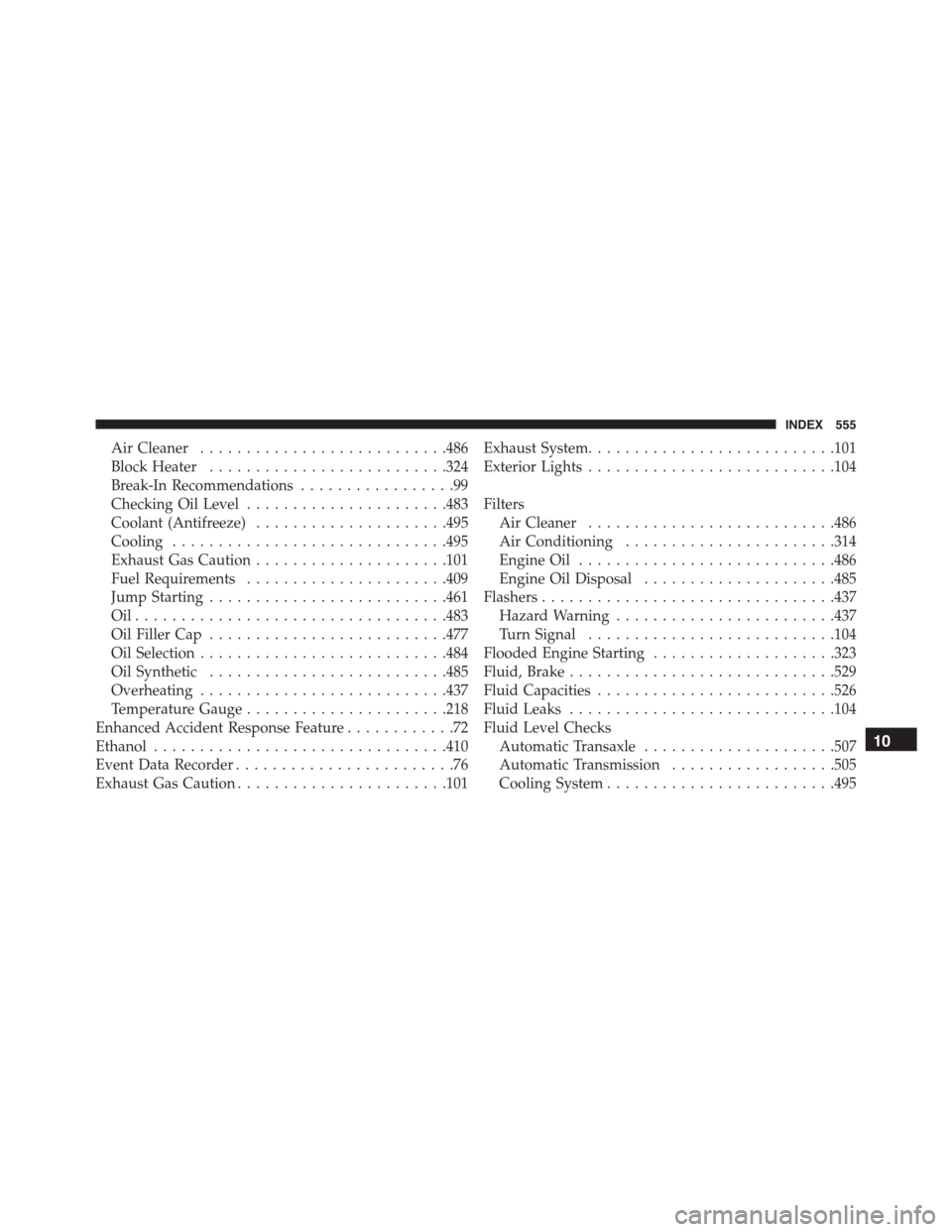
Air Cleaner...........................486
Block Heater..........................324
Break-In Recommendations.................99
Checking Oil Level......................483
Coolant (Antifreeze).....................495
Cooling..............................495
Exhaust Gas Caution.....................101
Fuel Requirements......................409
Jump Starting..........................461
Oil . . . . . . . . . . . . . . . . . . . . . . . . . . . . . . . . ..483
Oil Filler Cap..........................477
Oil Selection...........................484
Oil Synthetic..........................485
Overheating...........................437
Temperature Gauge......................218
Enhanced Accident Response Feature............72
Ethanol................................410
Event Data Recorder........................76
Exhaust Gas Caution.......................101
Exhaust System...........................101
Exterior Lights...........................104
Filters
Air Cleaner...........................486
Air Conditioning.......................314
Engine Oil............................486
Engine Oil Disposal.....................485
Flashers................................437
Hazard Warning........................437
Turn Signal...........................104
Flooded Engine Starting....................323
Fluid, Brake.............................529
Fluid Capacities..........................526
Fluid Leaks.............................104
Fluid Level Checks
Automatic Transaxle.....................507
Automatic Transmission..................505
Cooling System.........................495
10
INDEX 555
Page 561 of 572

Cargo . . . . . . . . . . . . . . . . . . . . . . . . . . . . . ..203
Center Mounted Stop....................525
Daytime Running.......................168
Dimmer Switch, Headlight.................167
Engine Temperature Warning...............218
Exterior..............................104
Fog . . . . . . . . . . . . . . . . . . . . . . . . . . . . . . . ..168
Headlights............................168
Headlight Switch.......................168
High Beam............................170
High Beam Indicator.....................218
High Beam/Low Beam Select...............170
Instrument Cluster......................168
License..............................525
Lights On Reminder.....................168
Low Fuel.............................218
Malfunction Indicator (Check Engine).........218
Map Reading..........................171
Oil Pressure...........................218
Seat Belt Reminder......................218
Security Alarm..........................19
Service...............................524
Tire Pressure Monitoring (TPMS)............218
Traction Control........................373
Turn Signal...........................104
Voltage..............................218
Warning (Instrument Cluster Description)......218
Loading Vehicle..........................416
Capacities............................417
Ti re s . . . . . . . . . . . . . . . . . . . . . . . . . . . . . . ..381
Locks..................................30
Automatic Door.........................32
Child Protection.........................34
Door.................................30
Power Door............................31
Lubrication, Body.........................490
Luggage Rack (Roof Rack)...................210
LugNuts...............................438
10
INDEX 559