Page 448 of 560

WARNING!(Continued)
•Keep Tire Service Kit away from open flames or
heat source.
•A loose Tire Service Kit thrown forward in a
collision or hard stop could endanger the occupants
of the vehicle. Always stow the Tire Service Kit in
the place provided. Failure to follow these warn-
ings can result in injuries that are serious or fatal to
you, your passengers, and others around you.
•Take care not to allow the contents of Tire Service
Kit to come in contact with hair, eyes, or clothing.
Tire Service Kit is harmful if inhaled, swallowed,
or absorbed through the skin. It causes skin, eye,
and respiratory irritation. Flush immediately with
plenty of water if there is any contact with eyes or
skin. Change clothing as soon as possible, if there
is any contact with clothing.
(Continued)
WARNING!(Continued)
•Tire Service Kit Sealant solution contains latex. In
case of an allergic reaction or rash, consult a phy-
sician immediately. Keep Tire Service Kit out of
reach of children. If swallowed, rinse mouth imme-
diately with plenty of water and drink plenty of
water. Do not induce vomiting! Consult a physician
immediately.
Sealing A Tire With Tire Service Kit
(A) Whenever You Stop To Use Tire Service Kit:
1. Pull over to a safe location and turn on the vehicle’s
Hazard Warning flashers.
2. Verify that the valve stem (on the wheel with the
deflated tire) is in a position that is near to the ground.
This will allow the Tire Service Kit Hoses (6) and (7) to
reach the valve stem and keep the Tire Service Kit flat
446 WHAT TO DO IN EMERGENCIES
Page 462 of 560
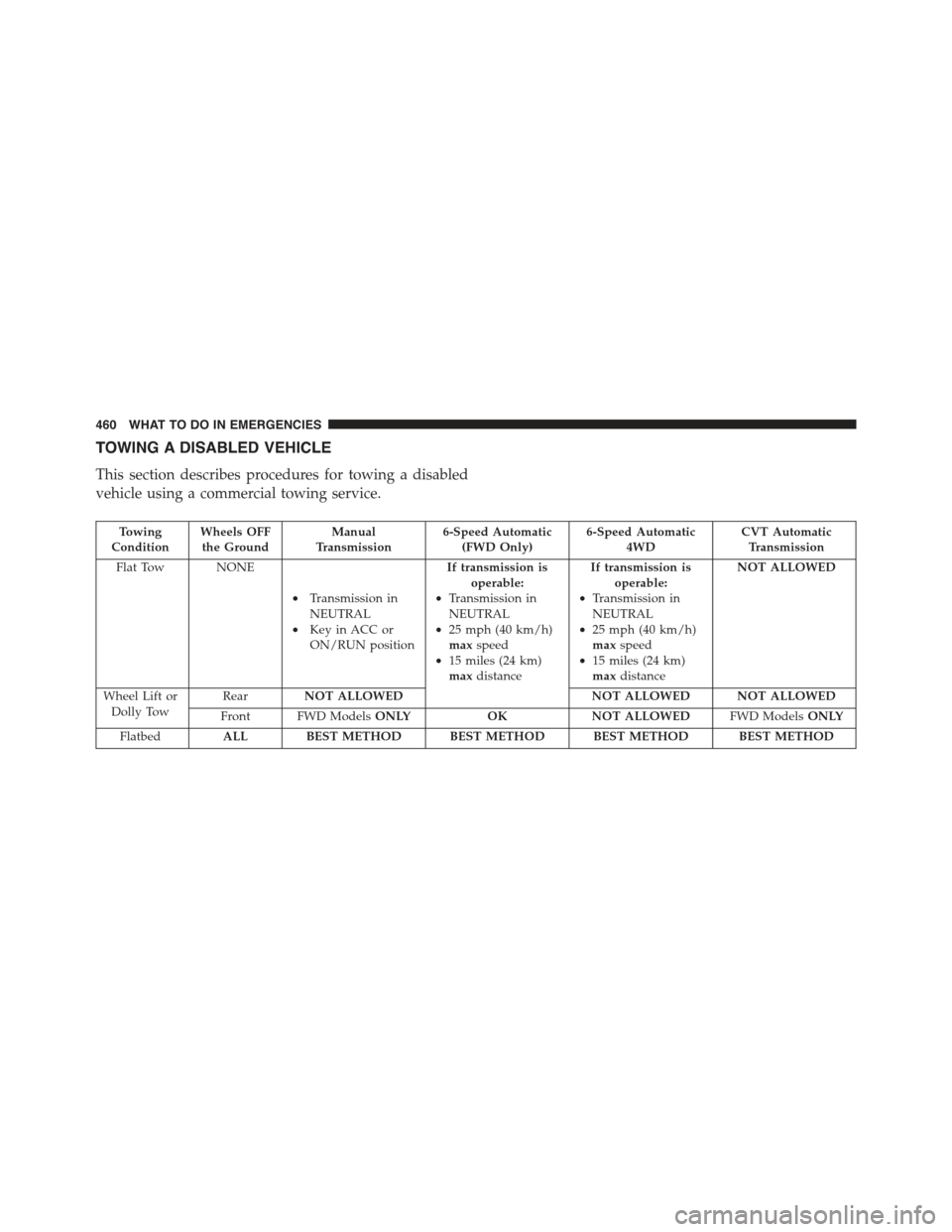
TOWING A DISABLED VEHICLE
This section describes procedures for towing a disabled
vehicle using a commercial towing service.
To w i n gConditionWheels OFFthe GroundManualTransmission6-Speed Automatic(FWD Only)6-Speed Automatic4WDCVT AutomaticTransmission
Flat Tow NONE
•Transmission inNEUTRAL•Key in ACC orON/RUN position
If transmission isoperable:•Transmission inNEUTRAL•25 mph (40 km/h)maxspeed•15 miles (24 km)maxdistance
If transmission isoperable:•Transmission inNEUTRAL•25 mph (40 km/h)maxspeed•15 miles (24 km)maxdistance
NOT ALLOWED
Wheel Lift orDolly TowRearNOT ALLOWEDNOT ALLOWED NOT ALLOWED
Front FWD ModelsONLYOKNOT ALLOWEDFWD ModelsONLY
FlatbedALL BEST METHOD BEST METHOD BEST METHOD BEST METHOD
460 WHAT TO DO IN EMERGENCIES
Page 463 of 560
With Ignition Key
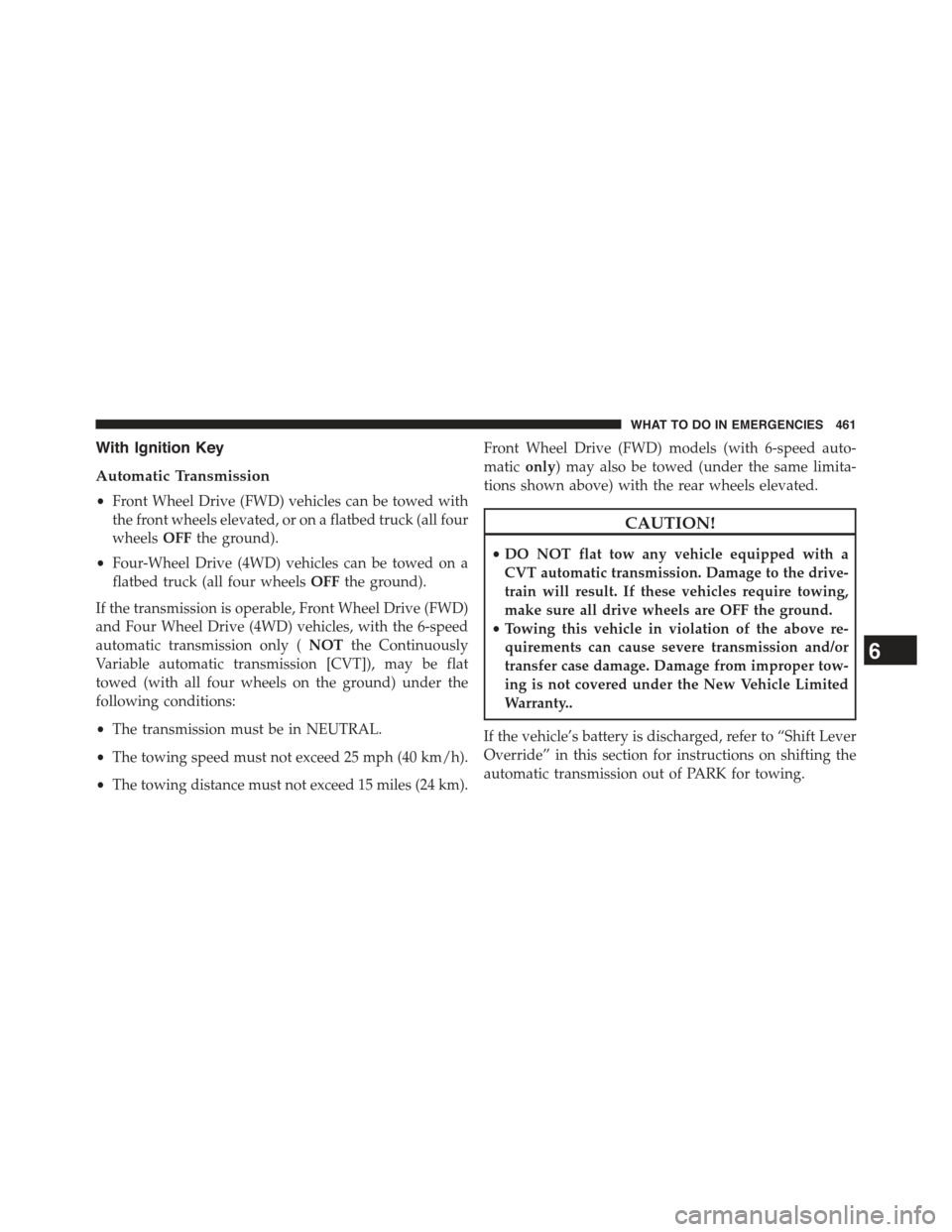
Automatic Transmission
•Front Wheel Drive (FWD) vehicles can be towed with
the front wheels elevated, or on a flatbed truck (all four
wheelsOFFthe ground).
•Four-Wheel Drive (4WD) vehicles can be towed on a
flatbed truck (all four wheelsOFFthe ground).
If the transmission is operable, Front Wheel Drive (FWD)
and Four Wheel Drive (4WD) vehicles, with the 6-speed
automatic transmission only (NOTthe Continuously
Variable automatic transmission [CVT]), may be flat
towed (with all four wheels on the ground) under the
following conditions:
•The transmission must be in NEUTRAL.
•The towing speed must not exceed 25 mph (40 km/h).
•The towing distance must not exceed 15 miles (24 km).
Front Wheel Drive (FWD) models (with 6-speed auto-
maticonly) may also be towed (under the same limita-
tions shown above) with the rear wheels elevated.
CAUTION!
•DO NOT flat tow any vehicle equipped with a
CVT automatic transmission. Damage to the drive-
train will result. If these vehicles require towing,
make sure all drive wheels are OFF the ground.
•Towing this vehicle in violation of the above re-
quirements can cause severe transmission and/or
transfer case damage. Damage from improper tow-
ing is not covered under the New Vehicle Limited
Warranty..
If the vehicle’s battery is discharged, refer to “Shift Lever
Override” in this section for instructions on shifting the
automatic transmission out of PARK for towing.
6
WHAT TO DO IN EMERGENCIES 461
Page 464 of 560
Manual Transmission
•Front Wheel Drive (FWD) or Four-Wheel Drive (4WD)
vehicles can be flat towed (all four wheels on the
ground) with the transmission in NEUTRAL.
•FWD vehicles can be towed with the front wheels
elevated.
•FWD or 4WD vehicles can be towed on a flatbed truck
(all wheelsOFFthe ground).
CAUTION!
•DO NOT flat tow any disabled vehicle if condition
is related to the clutch, transmission or driveline.
Additional damage to the drivetrain could result.
(Continued)
CAUTION!(Continued)
•Towing this vehicle in violation of the above re-
quirements can cause severe engine, transmission,
or drivetrain damage. Damage from improper tow-
ing is not covered under the New Vehicle Limited
Warranty.
All Transmissions
If you must use the accessories (wipers, defroster, etc.)
while being towed, the key must be in the ON/RUN
position, not the ACC position. Make certain the trans-
mission remains in NEUTRAL.
462 WHAT TO DO IN EMERGENCIES
Page 465 of 560
CAUTION!
•Do not use sling-type equipment when towing.
Vehicle damage may occur.
•When securing the vehicle to a flatbed truck, do not
attach to front or rear suspension components.
Damage to your vehicle may result from improper
towing.
Without The Ignition Key
Special care must be taken when the vehicle is towed
with the ignition in the LOCK/OFF position. The only
approved method of towing without the ignition key is
with a flatbed truck. Proper towing equipment is neces-
sary to prevent damage to the vehicle.
6
WHAT TO DO IN EMERGENCIES 463
Page 471 of 560

ONBOARD DIAGNOSTIC SYSTEM — OBD II
Your vehicle is equipped with a sophisticated onboard
diagnostic system called OBD II. This system monitors
the performance of the emissions, engine, and automatic
transmission control systems. When these systems are
operating properly, your vehicle will provide excellent
performance and fuel economy, as well as engine emis-
sions well within current government regulations.
If any of these systems require service, the OBD II system
will turn on the “Malfunction Indicator Light” (MIL). It
will also store diagnostic codes and other information to
assist your service technician in making repairs. Al-
though your vehicle will usually be drivable and not
need towing, see your authorized dealer for service as
soon as possible.
CAUTION!
•Prolonged driving with the MIL on could cause
further damage to the emission control system. It
could also affect fuel economy and driveability.
The vehicle must be serviced before any emissions
tests can be performed.
•If the MIL is flashing while the engine is running,
severe catalytic converter damage and power loss
will soon occur. Immediate service is required.
Loose Fuel Filler Cap Message
After fuel is added, the vehicle diagnostic system can
determine if the fuel filler cap is possibly loose or
improperly installed. A “gASCAP” message will be dis-
played in the instrument cluster. Tighten the gas cap until
a#clicking#sound is heard. This is an indication that the
gas cap is properly tightened. Press the trip odometer
7
MAINTAINING YOUR VEHICLE 469
Page 482 of 560
WARNING!
Do not remove the A/C air filter while the blower is
operating or personal injury may result.
The A/C air filter is located in the fresh air inlet behind
the glove box. Perform the following procedure to re-
place the filter:
1. Open the glove compartment and remove all contents.
2. Push in on the sides of the glove compartment and
lower the door.
3. Pivot the glove compartment downward.
4. Disengage the two retaining tabs that secure the filter
cover to the HVAC housing, and remove the cover.
5. Remove the A/C air filter by pulling it straight out of
the housing.
6.Install the A/C air filter with the arrow on the filter
pointing toward the floor. When installing the filter
cover, make sure the retaining tabs fully engage the
cover.
A/C Air Filter Replacement
480 MAINTAINING YOUR VEHICLE
Page 484 of 560

Avoid using the wiper blades to remove frost or ice from
the windshield. Keep the blade rubber out of contact with
petroleum products such as engine oil, gasoline, etc.
NOTE:Life expectancy of wiper blades varies depending
on geographical area and frequency of use. Poor perfor-
mance of blades may be present with chattering, marks,
water lines or wet spots. If any of these conditions are
present, clean the wiper blades or replace as necessary.
Adding Washer Fluid
The washer fluid reservoir is located in the engine
compartment, and the fluid level should be checked at
regular intervals. Fill the reservoir with windshield
washer solvent only (not radiator antifreeze).
When refilling the washer fluid reservoir, take some
washer fluid and apply it to a cloth or towel and wipe
clean the wiper blades, this will help blade performance.
To prevent freeze-up of your windshield washer system
in cold weather, select a solution or mixture that meets or
exceeds the temperature range of your climate. This
rating information can be found on most washer fluid
containers.
WARNING!
Commercially available windshield washer solvents
are flammable. They could ignite and burn you. Care
must be exercised when filling or working around
the washer solution.
Exhaust System
The best protection against carbon monoxide entry into
the vehicle body is a properly maintained engine exhaust
system.
If you notice a change in the sound of the exhaust system;
or if the exhaust fumes can be detected inside the vehicle;
or when the underside or rear of the vehicle is damaged;
482 MAINTAINING YOUR VEHICLE