Page 236 of 560

EVIC Functions
•Compass/Temperature/Audio
•Average Fuel Economy
•Distance To Empty (DTE)
•Units In
•Elapsed Time
•Tire Pressure Monitor (TPM)
•Personal Settings
To Reset The Display
Pushing and holding the RIGHT/SELECT arrow button
once will clear the function currently being displayed.
Reset will only occur if a resettable function is currently
being displayed. To reset all resettable functions, push
and release the RIGHT/SELECT arrow button a second
time within three seconds of resetting the currently
displayed function. Reset ALL will be displayed during
this three-second window.
Compass/Temperature/Audio
Push and release the COMPASS button to display one of
eight compass headings to indicate the direction the
vehicle is facing, the outside temperature, and the current
radio station.
For additional information regarding the compass, refer
to Personal Settings (Customer-Programmable Features).
Average Fuel Economy
Shows the average fuel economy since the last reset.
When the fuel economy is reset, the display will read
“RESET” or show dashes for two seconds. Then, the
history information will be erased, and the averaging will
continue from the last fuel reading before the reset.
234 UNDERSTANDING YOUR INSTRUMENT PANEL
Page 237 of 560

Distance To Empty (DTE)
Shows the estimated distance that can be traveled with
the fuel remaining in the tank. This estimated distance is
determined by a weighted average of the instantaneous
and average fuel economy, according to the current fuel
tank level. This is not resettable.
NOTE:Significant changes in driving style or vehicle
loading will greatly affect the actual drivable distance of
the vehicle, regardless of the DTE displayed value.
When the DTE value is less than 30 miles (48 km)
estimated driving distance, the DTE display will change
to a text display of#LOW FUEL#. This display will
continue until the vehicle runs out of fuel. Adding a
significant amount of fuel to the vehicle will turn off the
#LOW FUEL#text and a new DTE value will be dis-
played, based on the current values in the DTE calcula-
tion and the current fuel tank level.
Tire Pressure Monitor (TPM)
Refer to “Starting And Operating”, “Tire Pressure Moni-
toring System (TPMS)” for system operation.
Elapsed Time
Shows the total elapsed time of travel since the last reset.
Elapsed time will increment when the ignition switch is
in the RUN/START position.
Elapsed time is displayed as follows:
hours:minutes:seconds
Elapsed time can be reset by pushing and holding the
SELECT button (as prompted in the EVIC display). Upon
reset all digits will change to zeros and time will start
incrementing again if the ignition switch is in RUN or
START.
4
UNDERSTANDING YOUR INSTRUMENT PANEL 235
Page 315 of 560
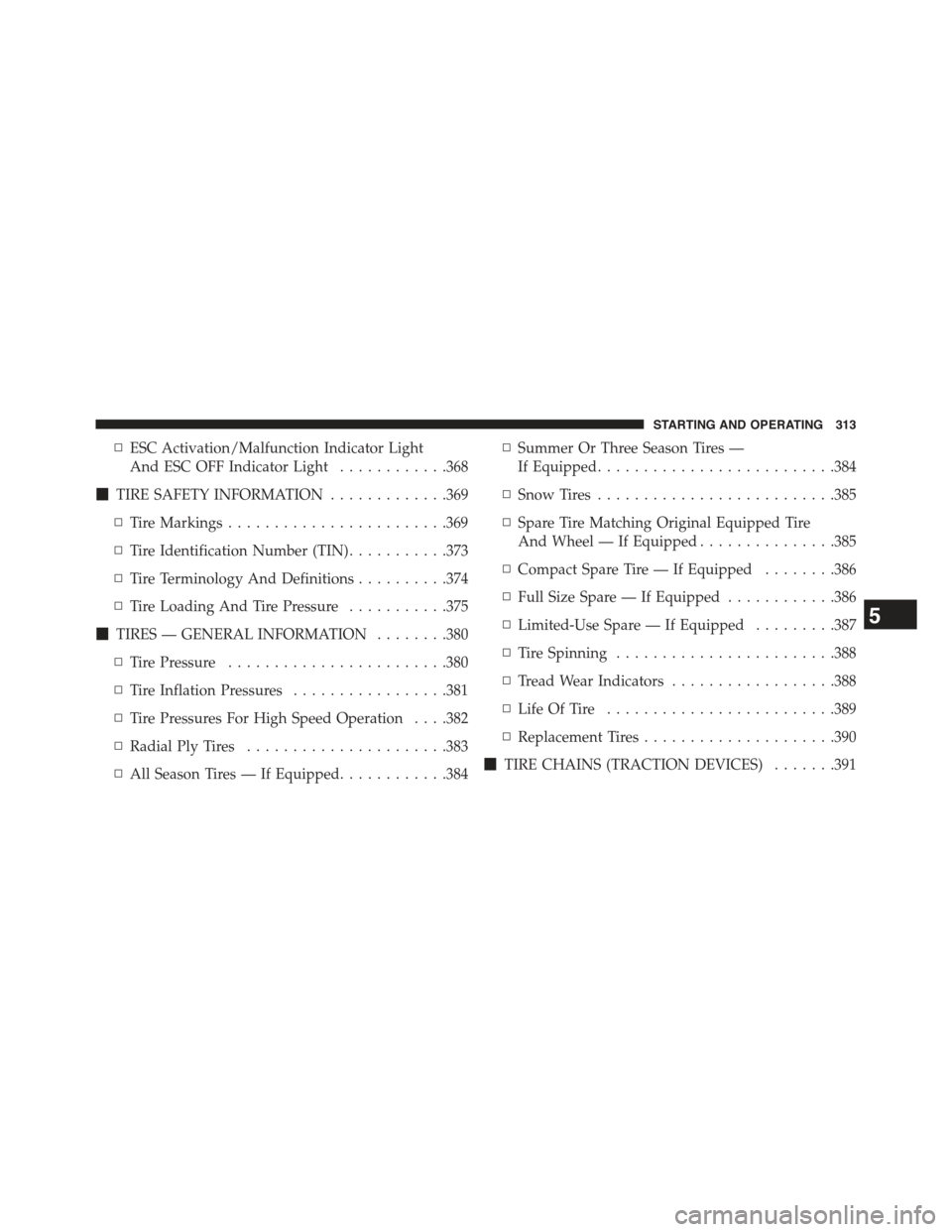
▫ESC Activation/Malfunction Indicator Light
And ESC OFF Indicator Light............368
!TIRE SAFETY INFORMATION.............369
▫Tire Markings........................369
▫Tire Identification Number (TIN)...........373
▫Tire Terminology And Definitions..........374
▫Tire Loading And Tire Pressure...........375
!TIRES — GENERAL INFORMATION........380
▫Tire Pressure........................380
▫Tire Inflation Pressures.................381
▫Tire Pressures For High Speed Operation . . . .382
▫Radial Ply Tires......................383
▫All Season Tires — If Equipped............384
▫Summer Or Three Season Tires —
If Equipped..........................384
▫Snow Tires..........................385
▫Spare Tire Matching Original Equipped Tire
And Wheel — If Equipped...............385
▫Compact Spare Tire — If Equipped........386
▫Full Size Spare — If Equipped............386
▫Limited-Use Spare — If Equipped.........387
▫Tire Spinning........................388
▫Tread Wear Indicators..................388
▫Life Of Tire.........................389
▫Replacement Tires.....................390
!TIRE CHAINS (TRACTION DEVICES).......391
5
STARTING AND OPERATING 313
Page 316 of 560

!TIRE ROTATION RECOMMENDATIONS.....392
!TIRE PRESSURE MONITORING
SYSTEM (TPMS).......................393
▫Base System.........................396
▫Premium System — If Equipped...........398
▫General Information...................402
!FUEL REQUIREMENTS..................403
▫2.0L And 2.4L Engine...................403
▫Reformulated Gasoline.................403
▫Gasoline/Oxygenate Blends..............404
▫E-85 Usage In Non-Flex Fuel Vehicles.......404
▫MMT In Gasoline.....................405
▫Materials Added To Fuel................405
▫Fuel System Cautions...................406
▫Carbon Monoxide Warnings.............407
!ADDING FUEL........................407
▫Fuel Filler Cap (Gas Cap)...............407
▫Loose Fuel Filler Cap Message............409
!VEHICLE LOADING....................410
▫Vehicle Certification Label...............410
!TRAILER TOWING.....................412
▫Common Towing Definitions.............412
▫Trailer Hitch Classification...............415
▫Trailer Towing Weights
(Maximum Trailer Weight Ratings).........416
▫Trailer And Tongue Weight..............417
314 STARTING AND OPERATING
Page 346 of 560

Snow
In heavy snow or for additional control and traction at
slower speeds, activate the 4WD LOCK and shift the
transaxle to low (L Off-Road) if necessary. Do not shift to
a lower gear than necessary to maintain headway. Over-
revving the engine can spin the wheels and traction will
be lost. If you start to slow to a stop, try turning your
steering wheel no more than a 1/4 turn quickly back and
forth, while still applying throttle. This will allow the
tires to get a fresh#bite#and help maintain your momen-
tum.
CAUTION!
On icy or slippery roads, do not downshift at high
engine RPM’s or vehicle speeds because engine brak-
ing may cause skidding and loss of control.
Mud
Deep mud creates a great deal of suction around the tires
and is very difficult to get through. You should use low
(L Off-Road) with the 4WD LOCK engaged and maintain
your momentum. If you start to slow to a stop, try
turning your steering wheel no more than a 1/4 turn
quickly back and forth for additional traction. Mud holes
pose an increased threat of vehicle damage and getting
stuck. They are normally full of debris from previous
vehicles getting stuck. As a good practice before entering
any mud hole, get out and determine how deep it is, if
there are any hidden obstacles and if the vehicle can be
safely recovered if stuck.
Sand
Soft sand is very difficult to travel through with full
tire pressure. When crossing soft sandy spots in a trail
maintain your vehicle’s momentum and do not stop.
344 STARTING AND OPERATING
Page 347 of 560

The key to driving in soft sand is using the appropriate
tire pressure, accelerating slowly, avoiding abrupt ma-
neuvers and maintaining the vehicle’s momentum. If you
are going to be driving on large soft sandy areas or
dunes, reduce your tire pressure to a minimum of 15 psi
(103 kPa) to allow for a greater tire surface area. You
should use low (L Off-Road) with the 4WD LOCK
engaged and ESC turned off. Reduced tire pressure will
drastically improve your traction and handling, while
driving on the soft sand, but you must return the tires to
normal air pressure before driving on pavement or other
hard surfaces. Be sure you have a way to reinflate the
tires prior to reducing the pressure.
CAUTION!
Reduced tire pressures may cause tire unseating and
total loss of air pressure. To reduce the risk of tire
(Continued)
CAUTION!(Continued)
unseating, while at a reduced tire pressure, reduce
your speed and avoid sharp turns or abrupt maneu-
vers.
Hill Climbing
Hill climbing requires good judgment and a good under-
standing of your abilities and your vehicle’s limitations.
Hills can cause serious problems. Some are just too steep
to climb and should not be attempted. You should always
feel confident with the vehicle and your abilities. You
should always climb hills straight up and down. Never
attempt to climb a hill on an angle.
Before Climbing A Steep Hill
As you approach a hill consider its grade or steepness.
Determine if it is too steep. Look to see what the traction
is on the hill side trail. Is the trail straight up and down?
5
STARTING AND OPERATING 345
Page 361 of 560

WARNING!
The Anti-Lock Brake System (ABS) contains sophis-
ticated electronic equipment that may be susceptible
to interference caused by improperly installed or
high output radio transmitting equipment. This in-
terference can cause possible loss of Anti-Lock brak-
ing capability. Installation of such equipment should
be performed by qualified professionals.
All vehicle wheels and tires must be the same size and
type and tires must be properly inflated to produce
accurate signals for the computer.
Traction Control System (TCS)
This system monitors the amount of wheel spin of each of
the driven wheels. If wheel spin is detected, brake
pressure is applied to the slipping wheel(s) and engine
power is reduced to provide enhanced acceleration and
stability. A feature of the TCS system functions similar to
a limited slip differential and controls the wheel spin
across a driven axle. If one wheel on a driven axle is
spinning faster than the other, the system will apply the
brake of the spinning wheel. This will allow more engine
torque to be applied to the wheel that is not spinning.
This feature remains active even if TCS and ESC are in
either the “Partial Off” or “Full Off” modes. Refer to
“Electronic Stability Control (ESC)” in this section of this
manual.
Brake Assist System (BAS)
The BAS is designed to optimize the vehicle’s braking
capability during emergency braking maneuvers. The
system detects an emergency braking situation by sens-
ing the rate and amount of brake application and then
applies optimum pressure to the brakes. This can help
reduce braking distances. The BAS complements the
Anti-Lock Brake System (ABS). Applying the brakes very
quickly results in the best BAS assistance. To receive the
5
STARTING AND OPERATING 359
Page 371 of 560
•Each time the ignition is cycled to the ON/RUN
position, the ESC system will be ON even if it was
cycled off previously, except for when the vehicle is
started while in 4L Range.
•The ESC system will make buzzing or clicking sounds
when it is active. This is normal; the sounds will stop
when ESC becomes inactive following the maneuver
that caused the ESC activation.
The “ESC OFF Indicator Light” indicates the
Electronic Stability Control (ESC) is partially
off or full off.
TIRE SAFETY INFORMATION
Tire Markings
1—U.S.DOTSafetyStandardsCode (TIN)4—MaximumLoad
2 — Size Designation5—MaximumPressure
3 — Service Description6—Treadwear,TractionandTemperature Grades
5
STARTING AND OPERATING 369
