Page 625 of 772

on the ground. This will provide the best positioning
of the kit when injecting the sealant into the deflated
tire and running the air pump. Move the vehicle as
necessary to place the valve stem in this position
before proceeding.
3. Place the transmission in PARK (auto transmission) or
in Gear (manual transmission) and turn Off the igni-
tion.
4. Set the parking brake.
(B) Setting Up To Use Tire Service Kit:
1. Push in the Mode Select Knob (5) and turn to the
Sealant Mode position.
2. Uncoil the Sealant Hose (6) and then remove the cap
from the fitting at the end of the hose.
3. Place the Tire Service Kit flat on the ground next to the
deflated tire.
4. Remove the cap from the valve stem and then screw
the fitting at the end of the Sealant Hose (6) onto the
valve stem.
5. Uncoil the Power Plug (8) and insert the plug into the
vehicle’s 12 Volt power outlet.
NOTE:Do not remove foreign objects (e.g., screws or
nails) from the tire.
(C) Injecting Tire Service Kit Sealant Into The
Deflated Tire:
•Always start the engine before turning ON the Tire
Service Kit.
NOTE:Manual transmission vehicles must have the
parking brake engaged and the shift lever in NEUTRAL.
•After pressing the Power Button (4), the sealant (white
fluid) will flow from the Sealant Bottle (1) through the
Sealant Hose (6) and into the tire.
6
WHAT TO DO IN EMERGENCIES 623
Page 656 of 772
▫Brake System........................692
▫Automatic Transmission................694
▫Sky Slider™ Top Care..................696
▫Appearance Care And Protection From
Corrosion...........................698
!FUSES..............................705
▫Power Distribution Center...............706
▫Interior Fuses........................719
!VEHICLE STORAGE....................720
!REPLACEMENT BULBS.................721
!BULB REPLACEMENT..................722
▫Low Beam And High Beam Headlamps.....722
▫Front Turn Signals And Front Side
Marker Lamps.......................724
▫Front Fog Lamp......................724
▫Front Fog Lamp (Trailhawk).............725
▫Bodyside Mounted Back-up Lamp.........725
▫Liftgate Mounted Back-up Lamp..........726
▫License Plate Lamp....................726
!FLUID CAPACITIES....................727
!FLUIDS, LUBRICANTS AND GENUINE PARTS . .728
▫Engine.............................728
▫Chassis............................730
654 MAINTAINING YOUR VEHICLE
Page 657 of 772
ENGINE COMPARTMENT — 2.4L
1 — Air Cleaner Filter5 — Power Distribution Center (Fuses)2 — Engine Coolant Pressure Cap6 — Battery3 — Oil Fill Cap7 — Washer Fluid Reservoir4 — Brake Fluid Reservoir8 — Engine Oil Dipstick
7
MAINTAINING YOUR VEHICLE 655
Page 658 of 772
ENGINE COMPARTMENT — 3.2L
1 — Engine Coolant Reservoir5 — Washer Fluid Reservoir2 — Engine Oil Filter Access Cover6 — Engine Oil Dipstick3 — Brake Fluid Reservoir7 — Engine Oil Fill4 — Power Distribution Center (Fuses)8 — Air Cleaner Filter
656 MAINTAINING YOUR VEHICLE
Page 695 of 772

WARNING!
Riding the brakes can lead to brake failure and
possibly a collision. Driving with your foot resting or
riding on the brake pedal can result in abnormally
high brake temperatures, excessive lining wear, and
possible brake damage. You would not have your full
braking capacity in an emergency.
Brake Master Cylinder
The fluid in the master cylinder should be checked when
performing under hood services or immediately if the
“Brake Warning Light” is illuminated.
Be sure to clean the top of the master cylinder area before
removing the cap. If necessary, add fluid to bring the
fluid level up to the requirements described on the brake
fluid reservoir. With disc brakes, fluid level can be
expected to fall as the brake pads wear. Brake fluid level
should be checked when pads are replaced. However,
low fluid level may be caused by a leak and a checkup
may be needed.
Use only manufacturer’s recommended brake fluid. Re-
fer to “Fluids, Lubricants, and Genuine Parts” in “Main-
taining Your Vehicle” for further information.
WARNING!
•Use only manufacturer’s recommended brake
fluid. Refer to “Fluids, Lubricants, and Genuine
Parts” in “Maintaining Your Vehicle” for further
information. Using the wrong type of brake fluid
can severely damage your brake system and/or
impair its performance. The proper type of brake
fluid for your vehicle is also identified on the
original factory installed hydraulic master cylinder
reservoir.
(Continued)
7
MAINTAINING YOUR VEHICLE 693
Page 696 of 772

WARNING!(Continued)
•To avoid contamination from foreign matter or
moisture, use only new brake fluid or fluid that has
been in a tightly closed container. Keep the master
cylinder reservoir cap secured at all times. Brake
fluid in a open container absorbs moisture from the
air resulting in a lower boiling point. This may
cause it to boil unexpectedly during hard or pro-
longed braking, resulting in sudden brake failure.
This could result in a collision.
•Overfilling the brake fluid reservoir can result in
spilling brake fluid on hot engine parts, causing
the brake fluid to catch fire. Brake fluid can also
damage painted and vinyl surfaces, care should be
taken to avoid its contact with these surfaces.
(Continued)
WARNING!(Continued)
•Do not allow petroleum based fluid to contaminate
the brake fluid. Brake seal components could be
damaged, causing partial or complete brake failure.
This could result in a collision.
Automatic Transmission
Selection Of Lubricant
It is important to use the proper transmission fluid to
ensure optimum transmission performance and life. Use
only the manufacturer’s specified transmission fluid.
Refer to “Fluids, Lubricants, and Genuine Parts” in this
section for fluid specifications. It is important to maintain
the transmission fluid at the correct level using the
recommended fluid.
694 MAINTAINING YOUR VEHICLE
Page 732 of 772
Chassis
ComponentFluid, Lubricant, or Genuine Part
Automatic TransmissionUse only MOPAR® ZF 8&9 Speed ATF™ Automatic
Transmission Fluid, or equivalent.
Failure to use the correct fluid may affect the function or
performance of your transmission.
Brake Master CylinderWe recommend you use MOPAR® DOT 3 Brake Fluid,
SAE J1703 should be used. If DOT 3, SAE J1703 brake
fluid is not available, then DOT 4 is acceptable. Use only
recommended brake fluids.
730 MAINTAINING YOUR VEHICLE
Page 735 of 772
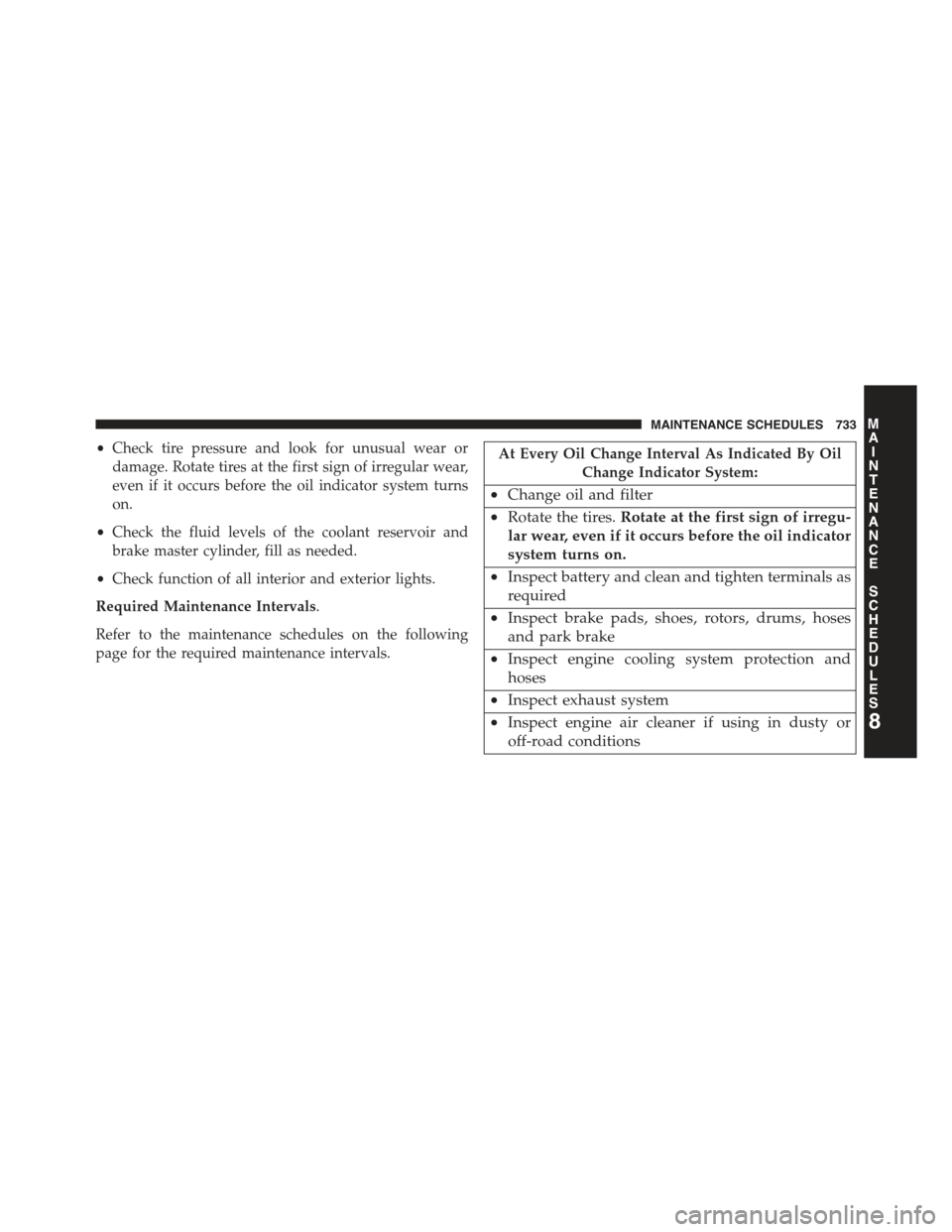
•Check tire pressure and look for unusual wear or
damage. Rotate tires at the first sign of irregular wear,
even if it occurs before the oil indicator system turns
on.
•Check the fluid levels of the coolant reservoir and
brake master cylinder, fill as needed.
•Check function of all interior and exterior lights.
Required Maintenance Intervals.
Refer to the maintenance schedules on the following
page for the required maintenance intervals.
At Every Oil Change Interval As Indicated By Oil
Change Indicator System:
•Change oil and filter
•Rotate the tires.Rotate at the first sign of irregu-
lar wear, even if it occurs before the oil indicator
system turns on.
•Inspect battery and clean and tighten terminals as
required
•Inspect brake pads, shoes, rotors, drums, hoses
and park brake
•Inspect engine cooling system protection and
hoses
•Inspect exhaust system
•Inspect engine air cleaner if using in dusty or
off-road conditions
8
MAINTENANCE
SCHEDULES
MAINTENANCE SCHEDULES 733