2015 HYUNDAI TUCSON lock
[x] Cancel search: lockPage 13 of 653
1-2
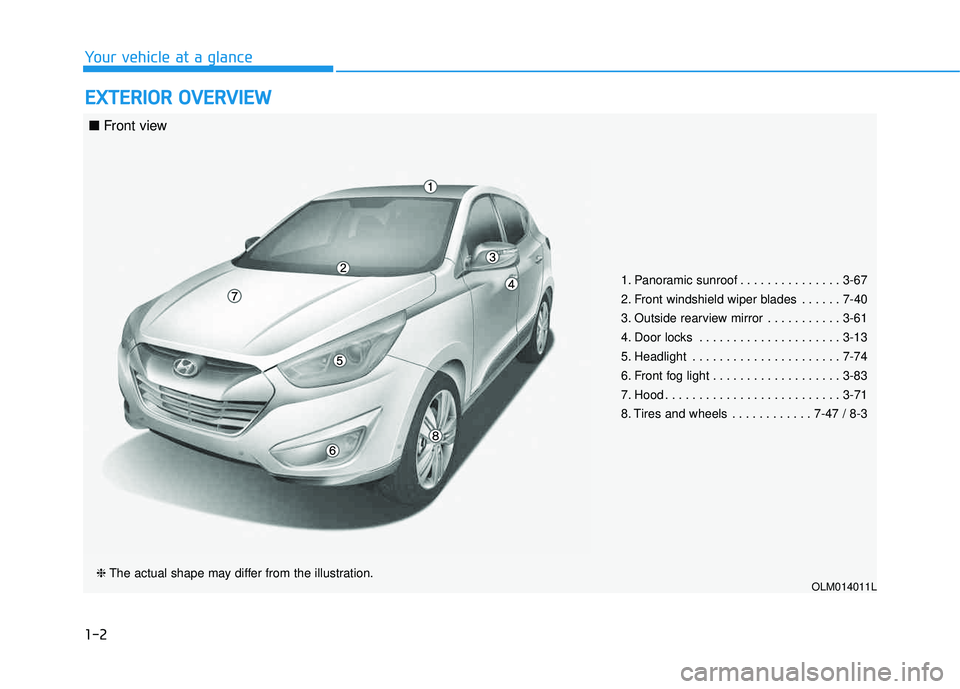
EEXX TTEERR IIOO RR OO VVEERR VV IIEE WW
Your vehicle at a glance
1. Panoramic sunroof . . . . . . . . . . . . . . . 3-67
2. Front windshield wiper blades . . . . . . 7-40
3. Outside rearview mirror . . . . . . . . . . . 3-61
4. Door locks . . . . . . . . . . . . . . . . . . . . . 3-13
5. Headlight . . . . . . . . . . . . . . . . . . . . . . 7-74
6. Front fog light . . . . . . . . . . . . . . . . . . . 3-83
7. Hood . . . . . . . . . . . . . . . . . . . . . . . . . . 3-71
8. Tires and wheels . . . . . . . . . . . . 7-47 / 8-3
OLM014011L❈ The actual shape may differ from the illustration.
■ Front view
Page 15 of 653
1-4
Your vehicle at a glance
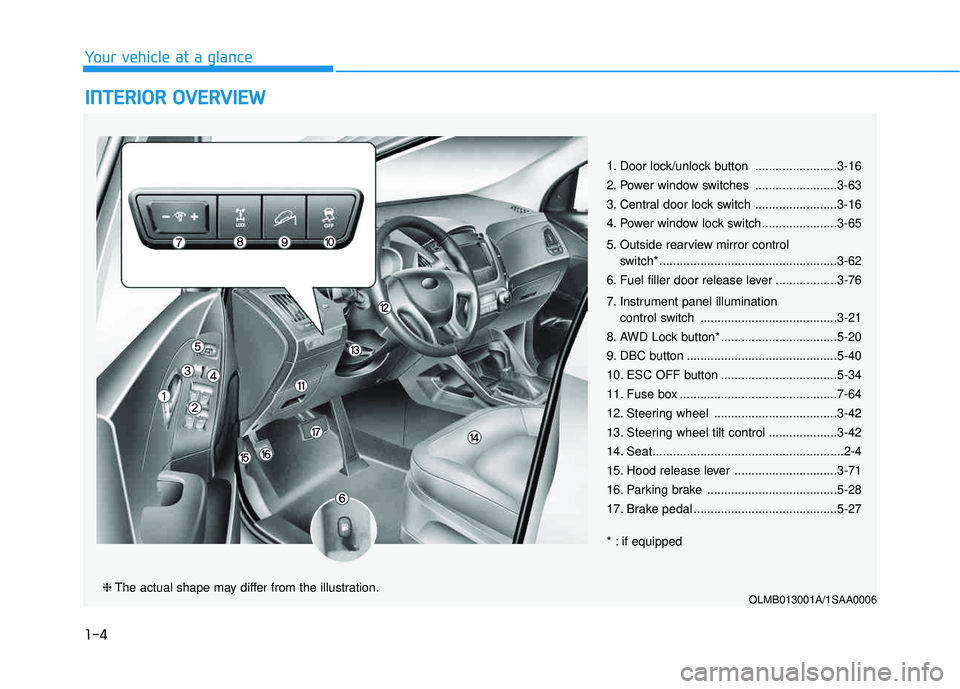
IINN TTEERR IIOO RR OO VVEERR VV IIEE WW
1. Door lock/unlock button ........................3-16
2. Power window switches ........................3-63
3. Central door lock switch ........................3-16
4. Power window lock switch......................3-65
5. Outside rearview mirror control
switch* ....................................................3-62
6. Fuel filler door release lever ..................3-76
7. Instrument panel illumination control switch ........................................3-21
8. AWD Lock button* ..................................5-20
9. DBC button ............................................5-40
10. ESC OFF button ..................................5-34
11. Fuse box ..............................................7-64
12. Steering wheel ....................................3-42
13. Steering wheel tilt control ....................3-42
14. Seat........................................................2-4
15. Hood release lever ..............................3-71
16. Parking brake ......................................5-28
17. Brake pedal ..........................................5-27
* : if equipped
OLMB013001A/1SAA0006❈ The actual shape may differ from the illustration.
Page 16 of 653
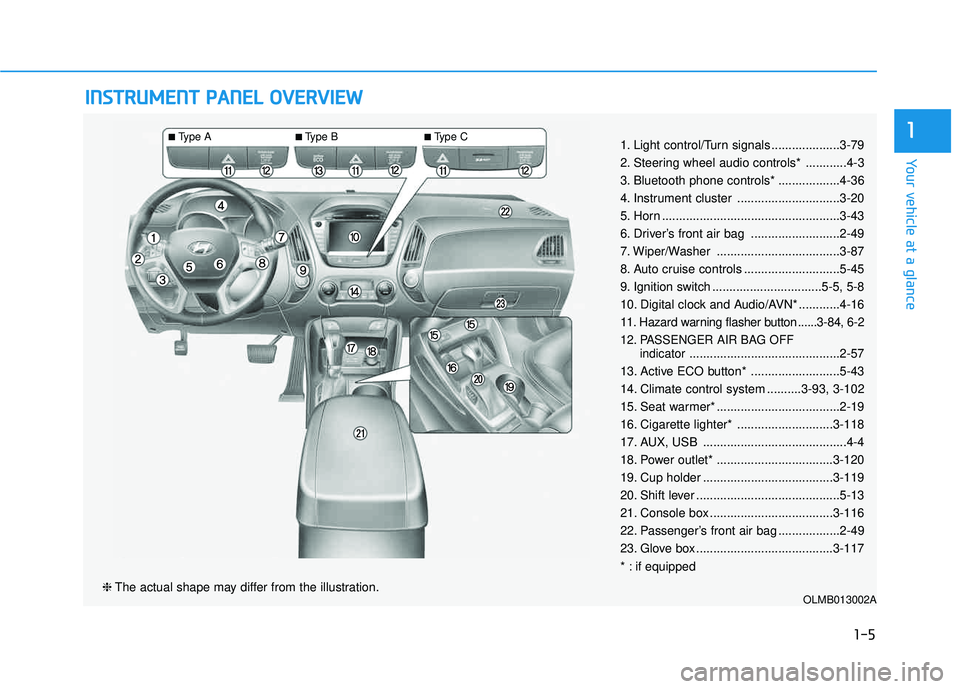
IINN SSTT RR UU MM EENN TT PP AA NN EELL OO VVEERR VV IIEE WW
OLMB013002A❈ The actual shape may differ from the illustration.
■Type A ■Type B ■
Type C
1-5
Your vehicle at a glance
11. Light control/Turn signals ....................3-79
2. Steering wheel audio controls* ............4-3
3. Bluetooth phone controls* ..................4-36
4. Instrument cluster ..............................3-20
5. Horn ....................................................3-43
6. Driver’s front air bag ..........................2-49
7. Wiper/Washer ....................................3-87
8. Auto cruise controls ............................5-45
9. Ignition switch ................................5-5, 5-8
10. Digital clock and Audio/AVN* ............4-16
11. Hazard warning flasher button ......3-84, 6-2
12. PASSENGER AIR BAG OFF
indicator............................................2-57
13. Active ECO button* ..........................5-43
14. Climate control system ..........3-93, 3-102
15. Seat warmer* ....................................2-19
16. Cigarette lighter* ............................3-118
17. AUX, USB ..........................................4-4
18. Power outlet* ..................................3-120
19. Cup holder ......................................3-119
20. Shift lever ..........................................5-13
21. Console box ....................................3-116
22. Passenger’s front air bag ..................2-49
23. Glove box ........................................3-117
* : if equipped
Page 22 of 653
Safety precautions
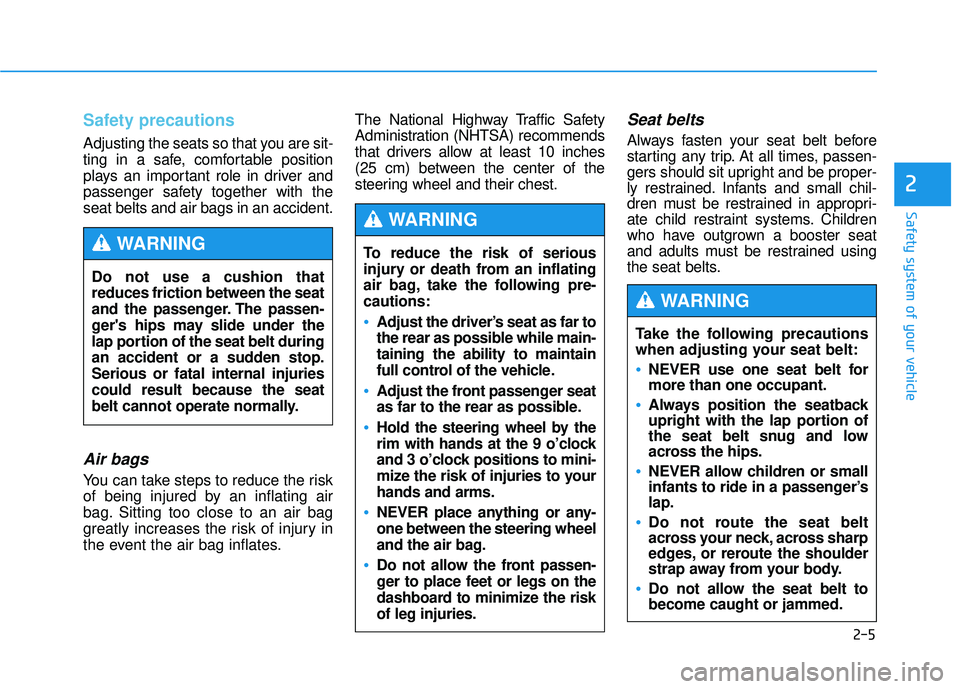
Adjusting the seats so that you are sit-
ting in a safe, comfortable position
plays an important role in driver and
passenger safety together with theseat belts and air bags in an accident.
Air bags
You can take steps to reduce the risk
of being injured by an inflating air
bag. Sitting too close to an air bag
greatly increases the risk of injury in
the event the air bag inflates.The National Highway Traffic Safety
Administration (NHTSA) recommends
that drivers allow at least 10 inches
(25 cm) between the center of the
steering wheel and their chest.
Seat belts
Always fasten your seat belt before
starting any trip. At all times, passen-
gers should sit upright and be proper-
ly restrained. Infants and small chil-
dren must be restrained in appropri-
ate child restraint systems. Children
who have outgrown a booster seat
and adults must be restrained using
the seat belts.
Do not use a cushion that reduces friction between the seat
and the passenger. The passen-
ger's hips may slide under the
lap portion of the seat belt during
an accident or a sudden stop.Serious or fatal internal injuriescould result because the seat
belt cannot operate normally.
WARNING To reduce the risk of serious
injury or death from an inflating
air bag, take the following pre-cautions:
•Adjust the driver’s seat as far to
the rear as possible while main-taining the ability to maintain
full control of the vehicle.
Adjust the front passenger seat
as far to the rear as possible.
Hold the steering wheel by the
rim with hands at the 9 o’clock
and 3 o’clock positions to mini-
mize the risk of injuries to yourhands and arms.
NEVER place anything or any- one between the steering wheel
and the air bag.
Do not allow the front passen-
ger to place feet or legs on the
dashboard to minimize the riskof leg injuries.
WARNING
2-5
Safety system of your vehicle
2
Take the following precautions
when adjusting your seat belt:
NEVER use one seat belt for more than one occupant.
Always position the seatback
upright with the lap portion of
the seat belt snug and low
across the hips.
NEVER allow children or small
infants to ride in a passenger’s lap.
Do not route the seat belt
across your neck, across sharp
edges, or reroute the shoulder
strap away from your body.
Do not allow the seat belt to become caught or jammed.
WARNING
Page 23 of 653
2-6
Safety system of your vehicle
Front seatsManual adjustment
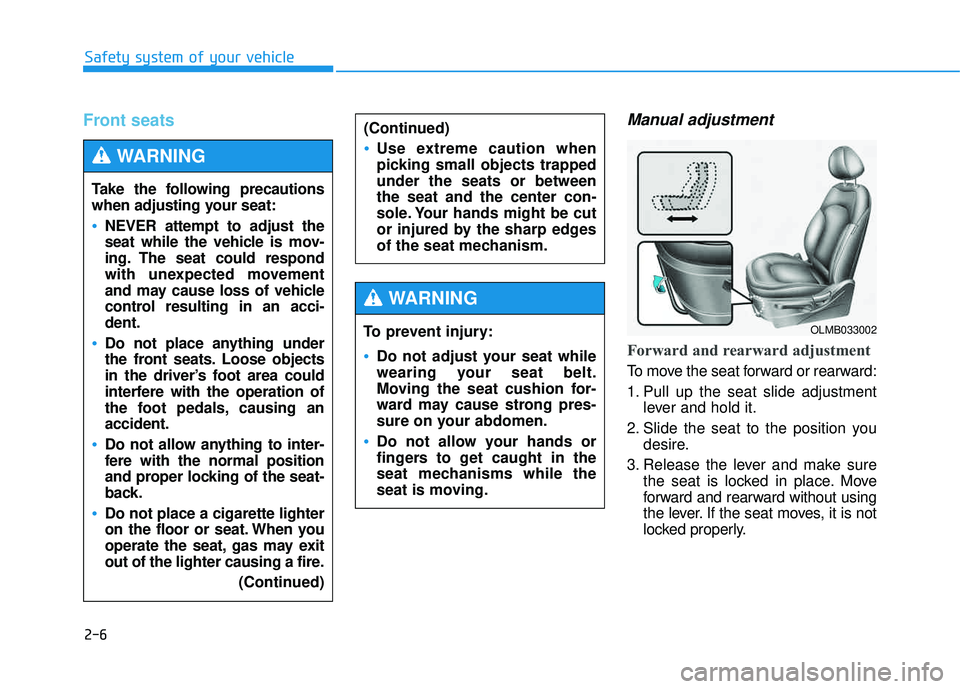
Forward and rearward adjustment
To move the seat forward or rearward:
1. Pull up the seat slide adjustmentlever and hold it.
2. Slide the seat to the position you desire.
3. Release the lever and make sure the seat is locked in place. Move
forward and rearward without using
the lever. If the seat moves, it is not
locked properly.
Take the following precautions
when adjusting your seat:
NEVER attempt to adjust the
seat while the vehicle is mov-
ing. The seat could respond
with unexpected movement
and may cause loss of vehicle
control resulting in an acci-dent.
Do not place anything under
the front seats. Loose objects
in the driver’s foot area could
interfere with the operation of
the foot pedals, causing anaccident.
Do not allow anything to inter-
fere with the normal position
and proper locking of the seat-
back.
Do not place a cigarette lighter
on the floor or seat. When you
operate the seat, gas may exit
out of the lighter causing a fire.
(Continued)
(Continued)
Use extreme caution when
picking small objects trappedunder the seats or betweenthe seat and the center con-
sole. Your hands might be cut
or injured by the sharp edges
of the seat mechanism.WARNING
To prevent injury:
Do not adjust your seat while
wearing your seat belt.
Moving the seat cushion for-
ward may cause strong pres-
sure on your abdomen.
Do not allow your hands or
fingers to get caught in the
seat mechanisms while the
seat is moving.
WARNING
OLMB033002
Page 24 of 653
2-7
Safety system of your vehicle
2
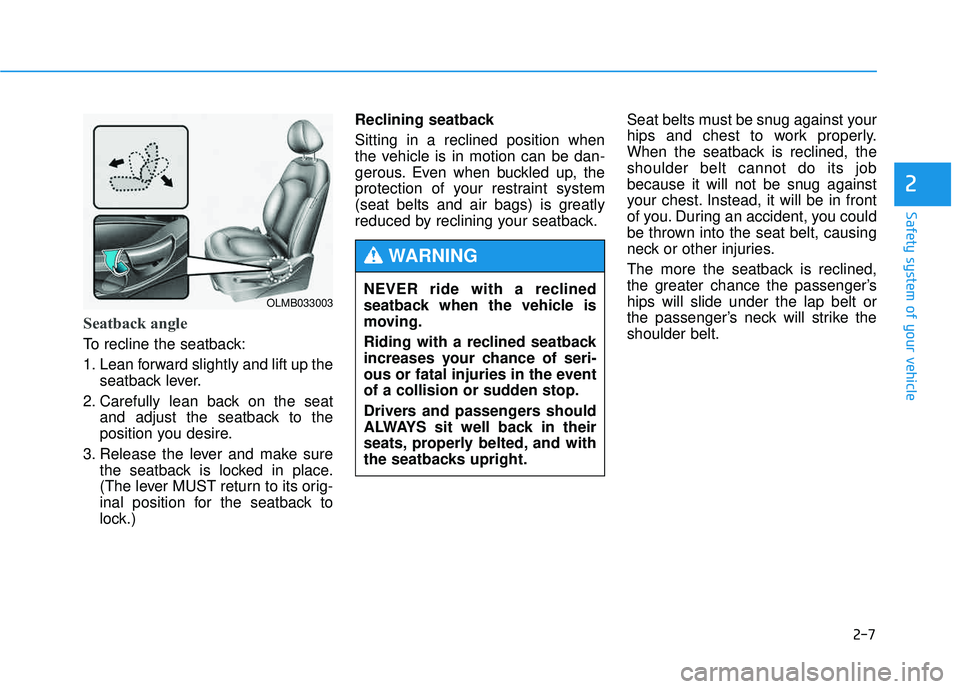
Seatback angle
To recline the seatback:
1. Lean forward slightly and lift up theseatback lever.
2. Carefully lean back on the seat and adjust the seatback to the
position you desire.
3. Release the lever and make sure the seatback is locked in place.
(The lever MUST return to its orig-
inal position for the seatback to
lock.) Reclining seatback Sitting in a reclined position when
the vehicle is in motion can be dan-
gerous. Even when buckled up, the
protection of your restraint system
(seat belts and air bags) is greatly
reduced by reclining your seatback.
Seat belts must be snug against your
hips and chest to work properly.
When the seatback is reclined, theshoulder belt cannot do its job
because it will not be snug against
your chest. Instead, it will be in front
of you. During an accident, you could
be thrown into the seat belt, causing
neck or other injuries.
The more the seatback is reclined,
the greater chance the passenger’ships will slide under the lap belt or
the passenger’s neck will strike theshoulder belt.
OLMB033003NEVER ride with a reclined
seatback when the vehicle is
moving.
Riding with a reclined seatback
increases your chance of seri-
ous or fatal injuries in the event
of a collision or sudden stop.
Drivers and passengers should
ALWAYS sit well back in their
seats, properly belted, and with
the seatbacks upright.
WARNING
Page 29 of 653
2-12
Safety system of your vehicle
Rear seats
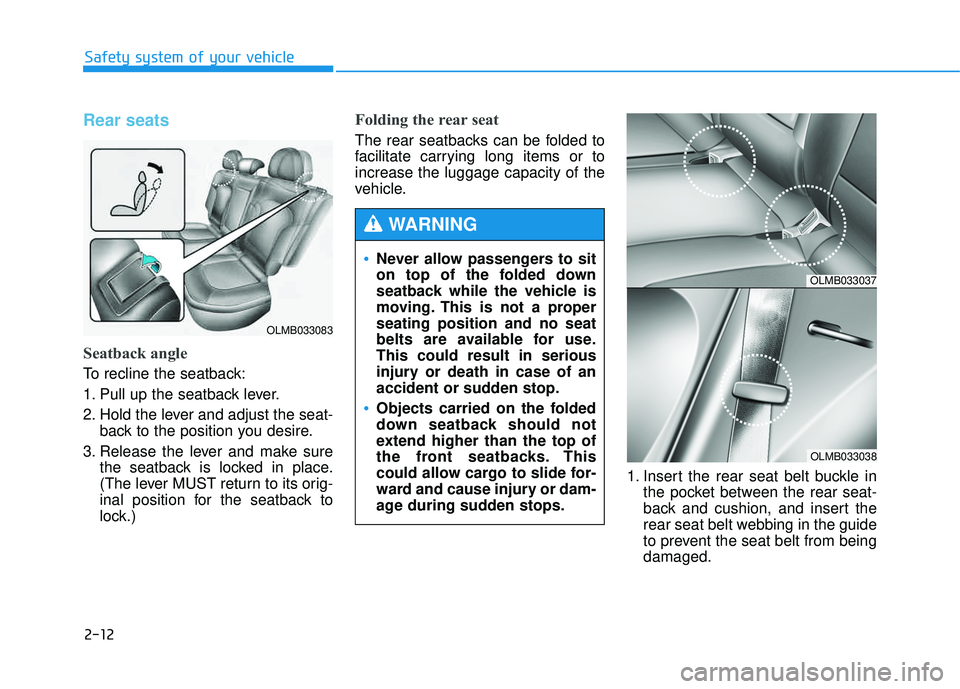
Seatback angle
To recline the seatback:
1. Pull up the seatback lever.
2. Hold the lever and adjust the seat-back to the position you desire.
3. Release the lever and make sure the seatback is locked in place.
(The lever MUST return to its orig-
inal position for the seatback to
lock.)
Folding the rear seat
The rear seatbacks can be folded to
facilitate carrying long items or toincrease the luggage capacity of the
vehicle.
1. Insert the rear seat belt buckle inthe pocket between the rear seat-
back and cushion, and insert the
rear seat belt webbing in the guide
to prevent the seat belt from beingdamaged.
OLMB033083
Never allow passengers to sit
on top of the folded down
seatback while the vehicle is
moving. This is not a properseating position and no seat
belts are available for use.This could result in serious
injury or death in case of an
accident or sudden stop.
Objects carried on the folded
down seatback should not
extend higher than the top of
the front seatbacks. This
could allow cargo to slide for-
ward and cause injury or dam-
age during sudden stops.
WARNING
OLMB033037
OLMB033038
Page 30 of 653
2-13
Safety system of your vehicle
2
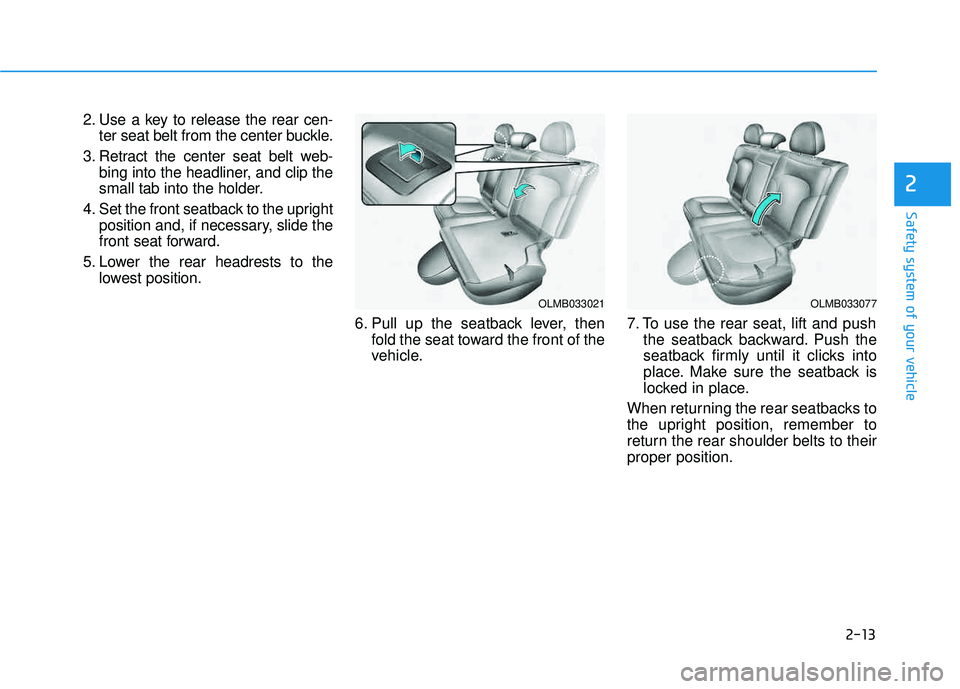
2. Use a key to release the rear cen-ter seat belt from the center buckle.
3. Retract the center seat belt web- bing into the headliner, and clip the
small tab into the holder.
4. Set the front seatback to the upright position and, if necessary, slide the
front seat forward.
5. Lower the rear headrests to the lowest position.
6. Pull up the seatback lever, thenfold the seat toward the front of the
vehicle. 7. To use the rear seat, lift and push
the seatback backward. Push the
seatback firmly until it clicks into
place. Make sure the seatback is
locked in place.
When returning the rear seatbacks to
the upright position, remember to
return the rear shoulder belts to theirproper position.
OLMB033021OLMB033077