Page 155 of 653
3-69
Convenient features of your vehicle
3
✽✽NOTICE
After washing the vehicle or after a
rain, be sure to wipe off the water on
the sunroof before operating the
sunroof.
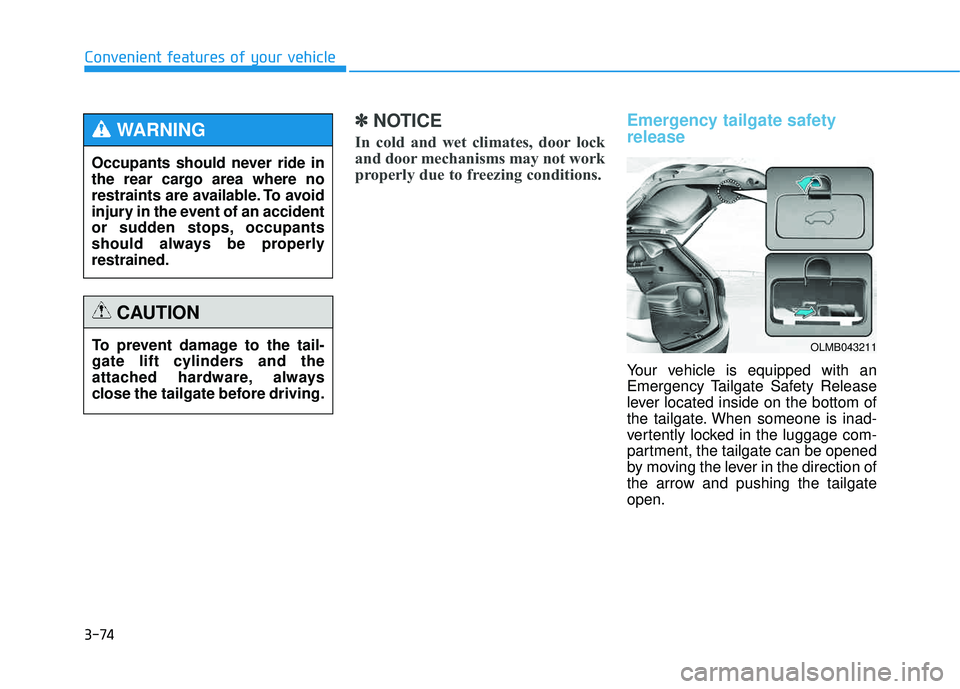
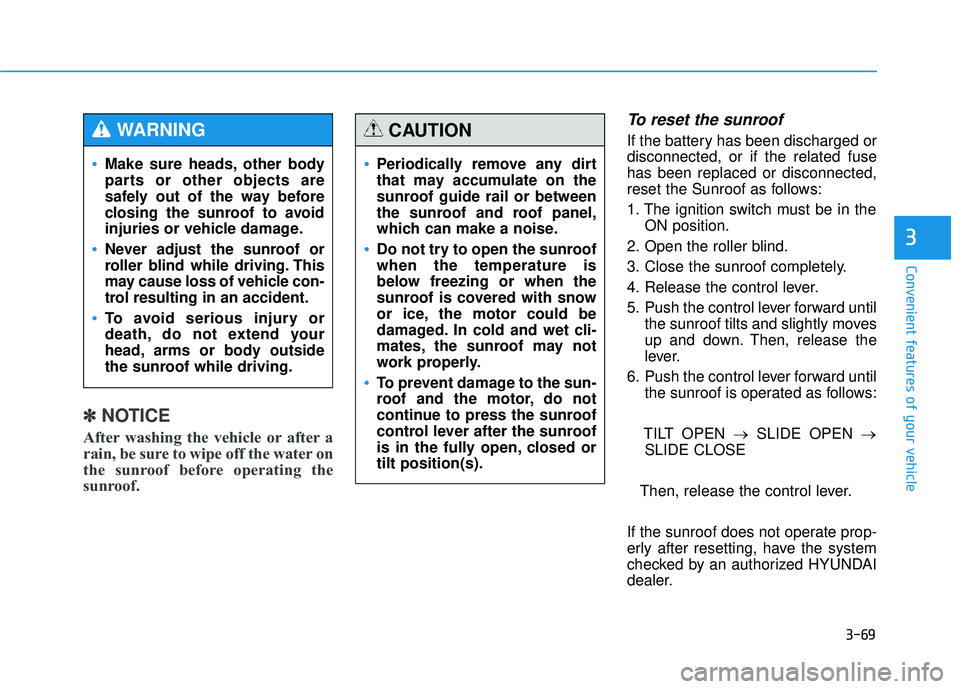
To reset the sunroof
If the battery has been discharged or disconnected, or if the related fusehas been replaced or disconnected,
reset the Sunroof as follows:
1. The ignition switch must be in the ON position.
2. Open the roller blind.
3. Close the sunroof completely.
4. Release the control lever.
5. Push the control lever forward until the sunroof tilts and slightly moves
up and down. Then, release the
lever.
6. Push the control lever forward until the sunroof is operated as follows:
TILT OPEN SLIDE OPEN
SLIDE CLOSE
Then, release the control lever.
If the sunroof does not operate prop-
erly after resetting, have the system
checked by an authorized HYUNDAI
dealer.
Periodically remove any dirt
that may accumulate on the
sunroof guide rail or between
the sunroof and roof panel,
which can make a noise.
Do not try to open the sunroof when the temperature is
below freezing or when the
sunroof is covered with snow
or ice, the motor could be
damaged. In cold and wet cli-
mates, the sunroof may not
work properly.
To prevent damage to the sun-
roof and the motor, do not
continue to press the sunroof
control lever after the sunroof
is in the fully open, closed ortilt position(s).
CAUTION
Make sure heads, other body
parts or other objects are
safely out of the way before
closing the sunroof to avoid
injuries or vehicle damage.
Never adjust the sunroof or
roller blind while driving. This
may cause loss of vehicle con-
trol resulting in an accident.
To avoid serious injury or
death, do not extend your
head, arms or body outside
the sunroof while driving.
WARNING
Page 156 of 653
3-70
Convenient features of your vehicle
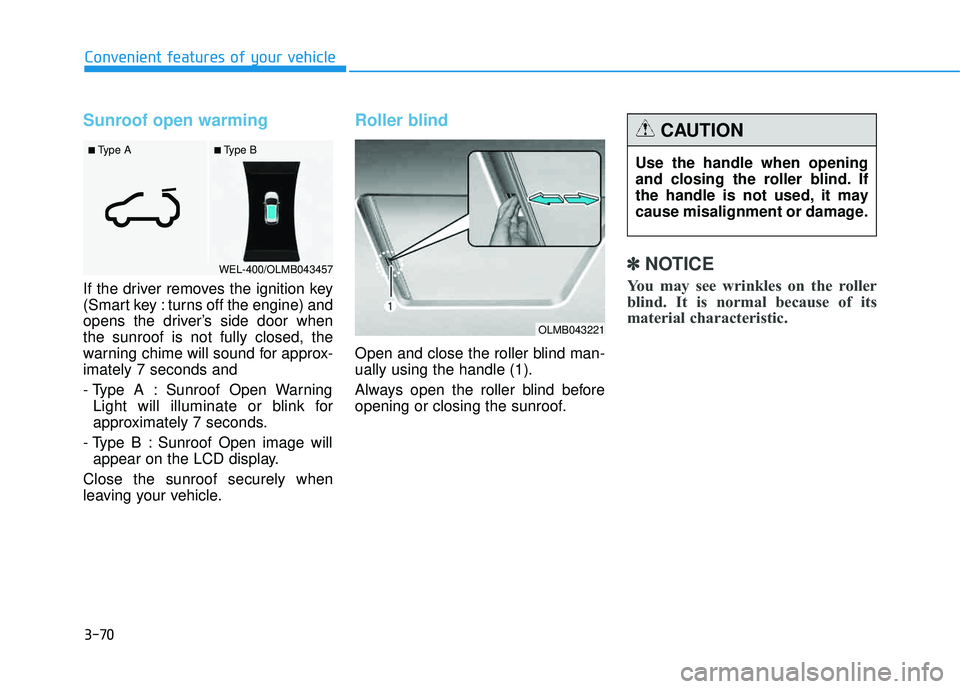
Sunroof open warming
If the driver removes the ignition key
(Smart key : turns off the engine) and
opens the driver’s side door whenthe sunroof is not fully closed, the
warning chime will sound for approx-imately 7 seconds and
- Type A : Sunroof Open WarningLight will illuminate or blink for
approximately 7 seconds.
- Type B : Sunroof Open image will appear on the LCD display.
Close the sunroof securely when
leaving your vehicle.
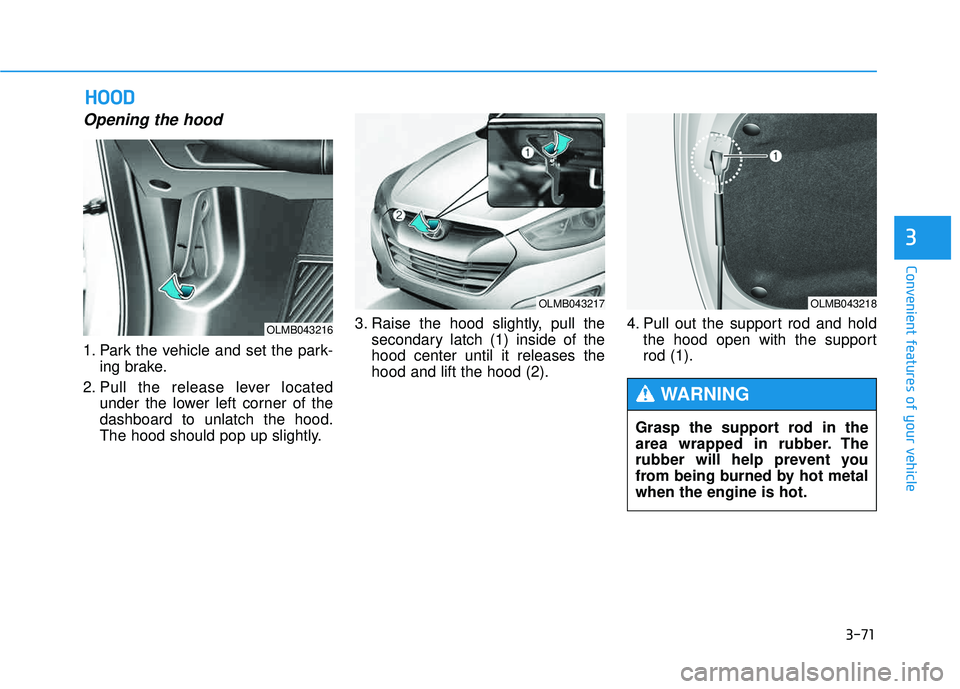
Roller blind
Open and close the roller blind man- ually using the handle (1).
Always open the roller blind before
opening or closing the sunroof.
✽✽ NOTICE
You may see wrinkles on the roller
blind. It is normal because of its
material characteristic.
■ Type B
■ Type A
WEL-400/OLMB043457
Use the handle when opening
and closing the roller blind. If
the handle is not used, it may
cause misalignment or damage.
CAUTION
OLMB043221
Page 157 of 653
3-71
Convenient features of your vehicle
3
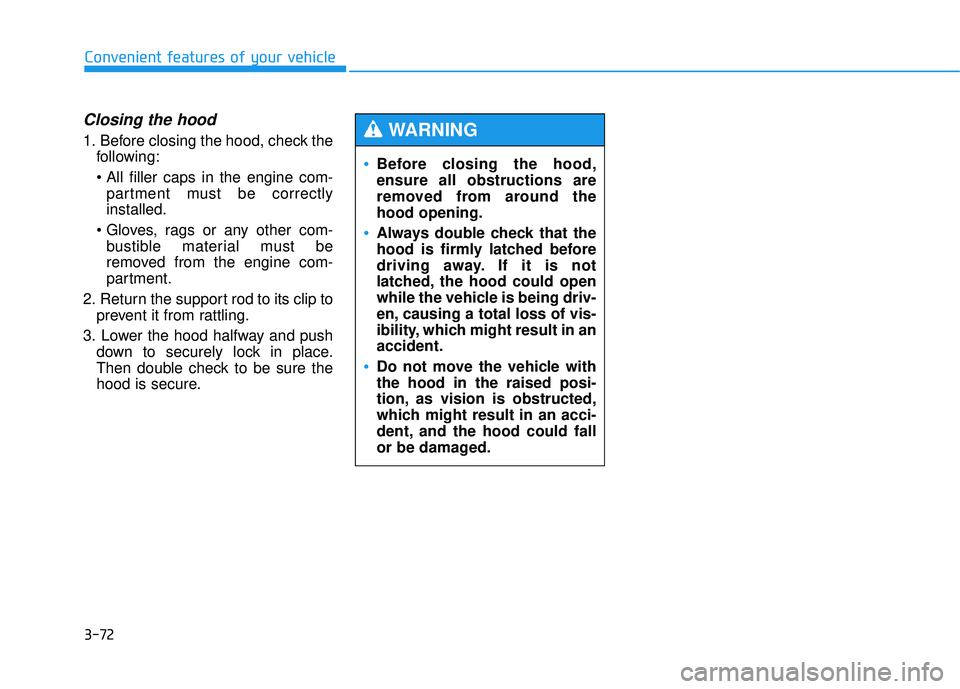
Opening the hood
1. Park the vehicle and set the park-ing brake.
2. Pull the release lever located under the lower left corner of the dashboard to unlatch the hood.
The hood should pop up slightly. 3. Raise the hood slightly, pull the
secondary latch (1) inside of thehood center until it releases thehood and lift the hood (2). 4. Pull out the support rod and hold
the hood open with the supportrod (1).
HHOO OO DD
OLMB043216
OLMB043217OLMB043218
Grasp the support rod in the
area wrapped in rubber. The
rubber will help prevent you
from being burned by hot metalwhen the engine is hot.
WARNING
Page 158 of 653
3-72
Convenient features of your vehicle
Closing the hood
1. Before closing the hood, check thefollowing:
partment must be correctly installed.
bustible material must be
removed from the engine com-
partment.
2. Return the support rod to its clip to prevent it from rattling.
3. Lower the hood halfway and push down to securely lock in place.
Then double check to be sure the
hood is secure.
Before closing the hood, ensure all obstructions are
removed from around thehood opening.
Always double check that the
hood is firmly latched before
driving away. If it is not
latched, the hood could open
while the vehicle is being driv-
en, causing a total loss of vis-
ibility, which might result in anaccident.
Do not move the vehicle with the hood in the raised posi-
tion, as vision is obstructed,
which might result in an acci-
dent, and the hood could fall
or be damaged.
WARNING
Page 159 of 653
3-73
Convenient features of your vehicle
3
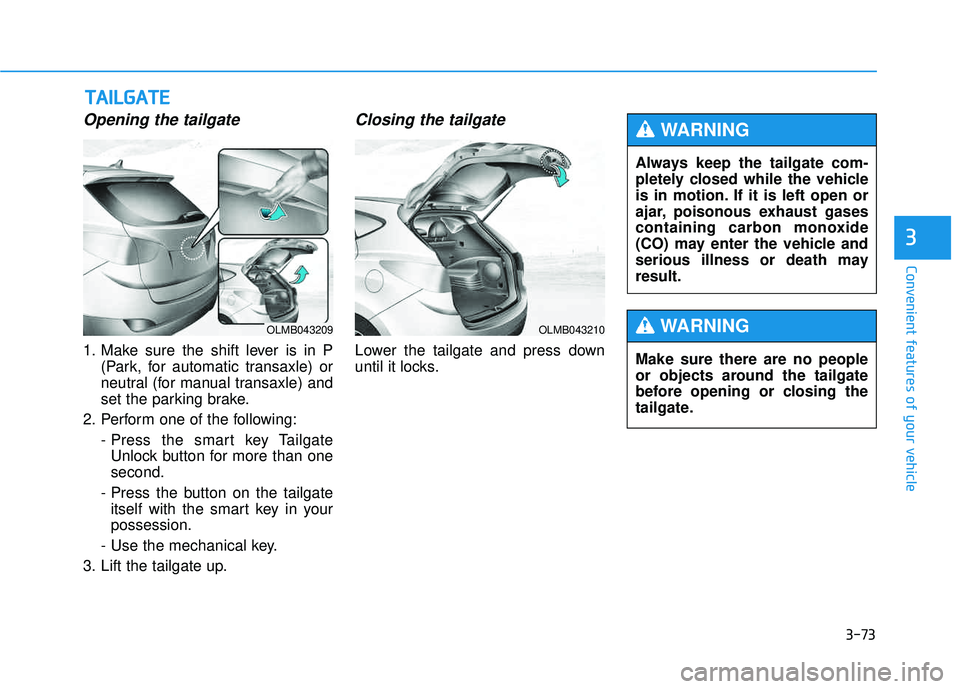
Opening the tailgate
1. Make sure the shift lever is in P(Park, for automatic transaxle) or
neutral (for manual transaxle) and
set the parking brake.
2. Perform one of the following:
- Press the smart key TailgateUnlock button for more than onesecond.
- Press the button on the tailgate itself with the smart key in yourpossession.
- Use the mechanical key.
3. Lift the tailgate up.
Closing the tailgate
Lower the tailgate and press down
until it locks.
TT AA IILL GG AATTEE
OLMB043209OLMB043210
Always keep the tailgate com-
pletely closed while the vehicle
is in motion. If it is left open or
ajar, poisonous exhaust gases
containing carbon monoxide
(CO) may enter the vehicle and
serious illness or death mayresult.
WARNING
Make sure there are no people
or objects around the tailgate
before opening or closing the
tailgate.
WARNING
Page 160 of 653
3-74
Convenient features of your vehicle
✽✽NOTICE
In cold and wet climates, door lock
and door mechanisms may not work
properly due to freezing conditions. Emergency tailgate safety release
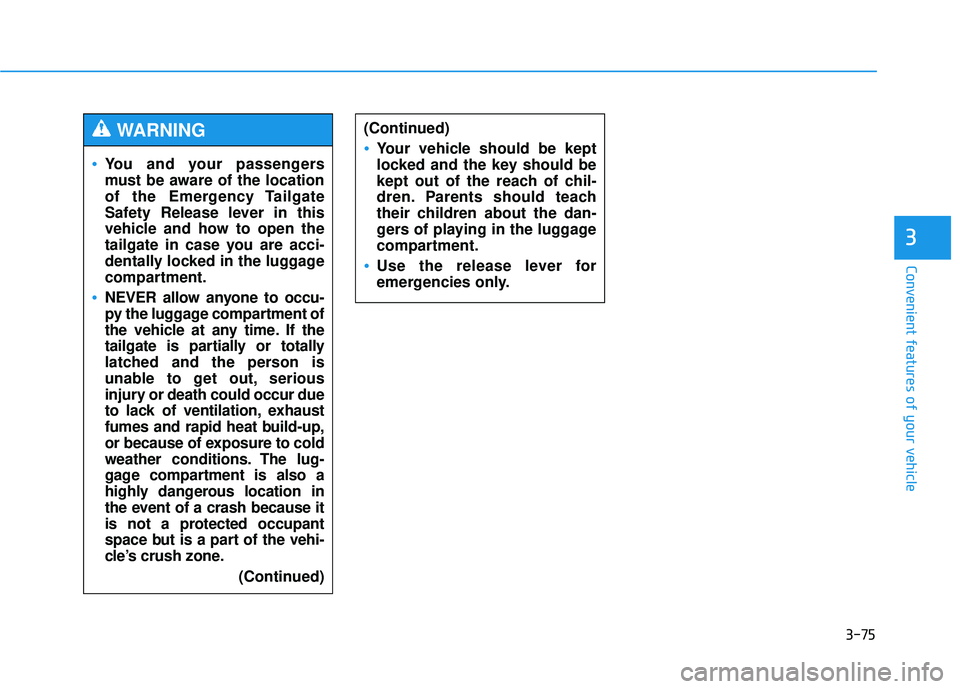
Your vehicle is equipped with an
Emergency Tailgate Safety Release
lever located inside on the bottom of
the tailgate. When someone is inad-
vertently locked in the luggage com-
partment, the tailgate can be opened
by moving the lever in the direction of
the arrow and pushing the tailgateopen.
Occupants should never ride in
the rear cargo area where no
restraints are available. To avoid
injury in the event of an accident
or sudden stops, occupants
should always be properlyrestrained.
WARNING
To prevent damage to the tail-
gate lift cylinders and the
attached hardware, always
close the tailgate before driving.
CAUTION
OLMB043211
Page 161 of 653
3-75
Convenient features of your vehicle
3
You and your passengers
must be aware of the location
of the Emergency Tailgate
Safety Release lever in this
vehicle and how to open the
tailgate in case you are acci-
dentally locked in the luggage
compartment.
NEVER allow anyone to occu-
py the luggage compartment of
the vehicle at any time. If the
tailgate is partially or totally
latched and the person is
unable to get out, serious
injury or death could occur due
to lack of ventilation, exhaust
fumes and rapid heat build-up,
or because of exposure to cold
weather conditions. The lug-
gage compartment is also a
highly dangerous location in
the event of a crash because it
is not a protected occupant
space but is a part of the vehi-
cle’s crush zone.(Continued)
WARNING (Continued)
Your vehicle should be kept
locked and the key should be
kept out of the reach of chil-
dren. Parents should teach
their children about the dan-
gers of playing in the luggage
compartment.
Use the release lever for
emergencies only.
Page 163 of 653
3-77
Convenient features of your vehicle
3
Closing the fuel filler door
1. To install the fuel tank cap, turn itclockwise until it clicks one time.
2. Close the fuel filler door until it is latched securely.
If the Malfunction Indicator Light ( )
comes ON, turn the engine off and
check or retighten the fuel filler cap
until it clicks one time. If the
Malfunction Indicator Light ( ) does
not go off, have your vehicle checked
by your HYUNDAI dealer.
Gasoline is highly flammable
and explosive. Failure to follow
these guidelines may result in
SERIOUS INJURY or DEATH:
Read and follow all warnings posted at the gas station.
Before refueling, note the
location of the Emergency
Gasoline Shut-Off, if available,at the gas station.
Before touching the fuel noz-
zle, you should eliminate the
potential build-up of static
electricity by touching a metal
part of the vehicle, a safe dis-
tance away from the fuel filler
neck, nozzle, or other gas
source, with your bare hand.
Do not use cellular phones
while refueling. Electric cur-
rent and/or electronic interfer-
ence from cellular phones can
potentially ignite fuel vapors
and cause a fire. (Continued)
WARNING (Continued)
Do not get back into a vehicle
once you have begun refuel-
ing. You can generate a build-
up of static electricity by
touching, rubbing or sliding
against any item or fabric
capable of producing static
electricity. Static electricity
discharge can ignite fuel
vapors causing a fire. If you
must re-enter the vehicle, you
should once again eliminate
potentially dangerous static
electricity discharge by touch-
ing a metal part of the vehicle,
away from the fuel filler neck,
nozzle or other gasoline source,
with your bare hand.(Continued)