2015 Hyundai Sonata shift
[x] Cancel search: shiftPage 471 of 603
6-17
What to do in an emergency
Follow these steps to change your
vehicle’s tire:
1. Park on a level, firm surface.
2. Move the shift lever into P(Park),apply the parking brake, and place
the ignition switch in the
LOCK/OFF position.
3. Press the hazard warning flasher button.
4. Remove the wheel lug nut wrench, jack, jack handle, and spare tire
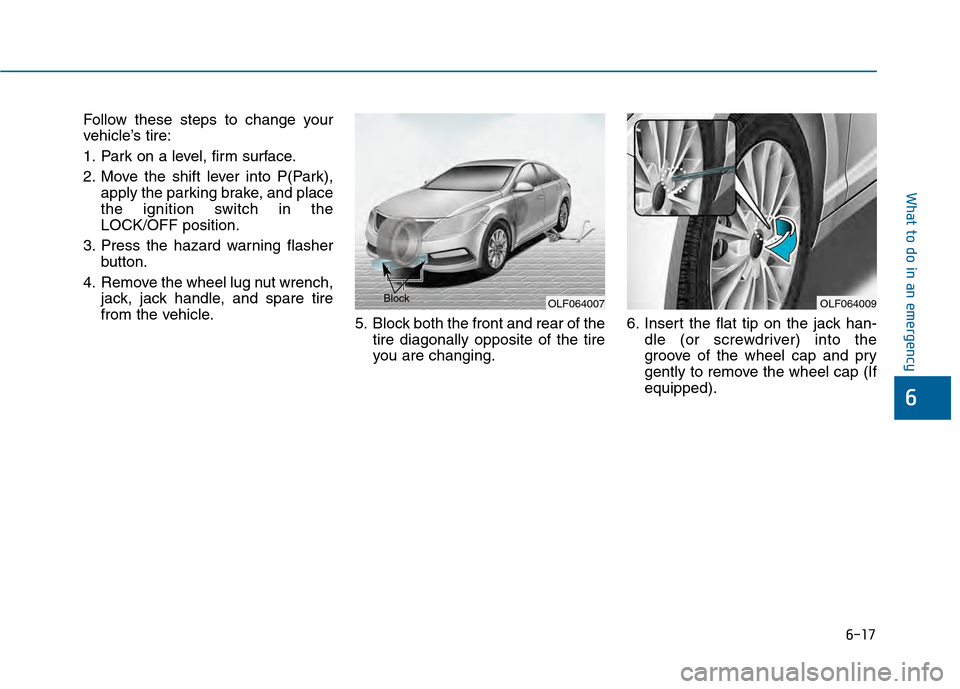
from the vehicle. 5. Block both the front and rear of the
tire diagonally opposite of the tire
you are changing. 6. Insert the flat tip on the jack han-
dle (or screwdriver) into the
groove of the wheel cap and pry
gently to remove the wheel cap (If
equipped).
6
OLF064007BlockOLF064009
Page 476 of 603
6-22
What to do in an emergency
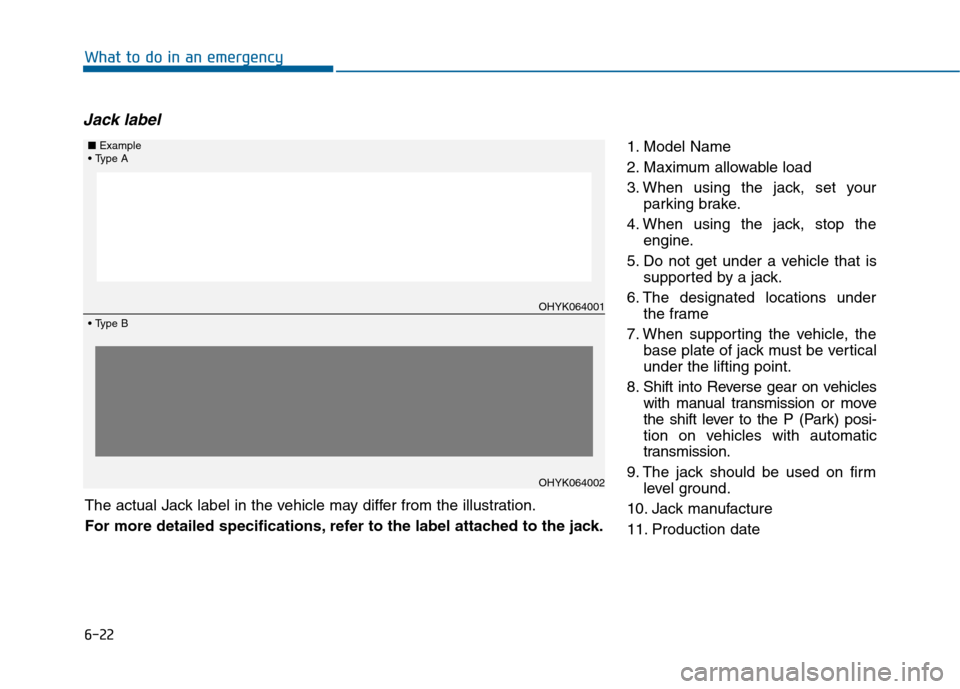
Jack label
1. Model Name
2. Maximum allowable load
3. When using the jack, set yourparking brake.
4. When using the jack, stop the engine.
5. Do not get under a vehicle that is supported by a jack.
6. The designated locations under the frame
7. When supporting the vehicle, the base plate of jack must be vertical
under the lifting point.
8. Shift into Reverse gear on vehicles with manual transmission or move
the shift lever to the P (Park) posi-
tion on vehicles with automatic
transmission.
9. The jack should be used on firm level ground.
10. Jack manufacture
11. Production date
OHYK064001
OHYK064002
Type A■ Example
Type B
The actual Jack label in the vehicle may differ from the illustration.
For more detailed specifications, refer to the label attached to the jack.
Page 485 of 603
6-31
What to do in an emergency
6
When towing your vehicle in an
emergency without wheel dollies :
1. Place the ignition switch in theACC position.
2. Place the shift lever in N (Neutral).
3. Release the parking brake.Emergency Towing
(if equipped)
If towing is necessary, we recom-
mend you to have it done by an
authorized HYUNDAI dealer or a
commercial tow truck service. If towing service is not available in an
emergency, your vehicle may be
temporarily towed using a cable or
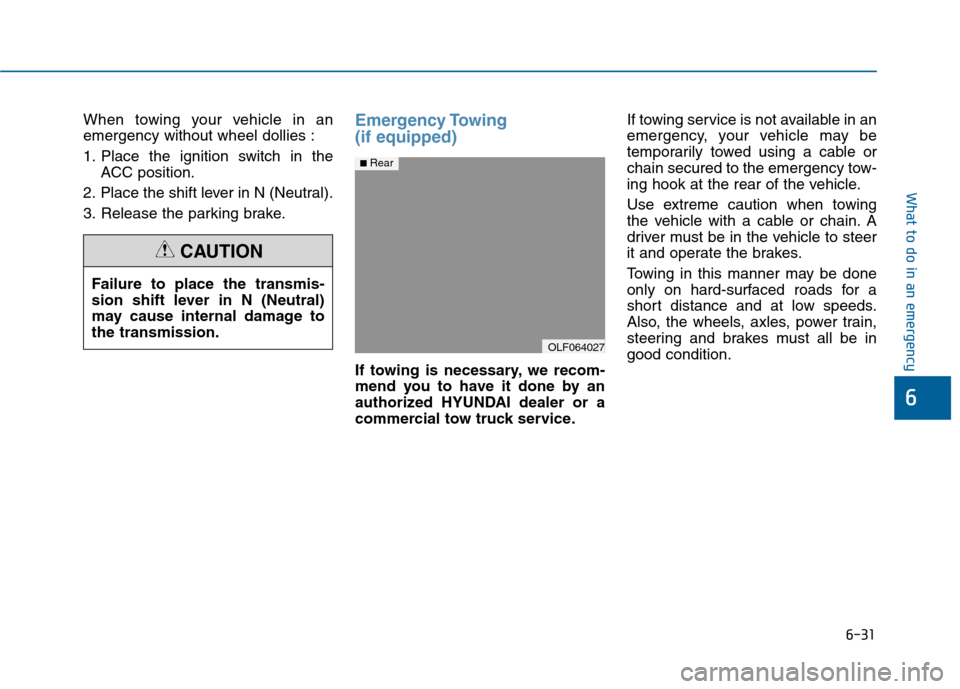
chain secured to the emergency tow-
ing hook at the rear of the vehicle.
Use extreme caution when towing
the vehicle with a cable or chain. A
driver must be in the vehicle to steer
it and operate the brakes.
Towing in this manner may be done
only on hard-surfaced roads for a
short distance and at low speeds.
Also, the wheels, axles, power train,
steering and brakes must all be in
good condition.
Failure to place the transmis-
sion shift lever in N (Neutral)
may cause internal damage to
the transmission.
CAUTION
OLF064027
■Rear
Page 486 of 603

6-32
What to do in an emergency
Always follow these emergency tow-
ing precautions:
Place the ignition switch in the ACC position so the steering
wheel is not locked.
Place the shift lever in N (Neutral).
Release the parking brake.
Depress the brake pedal with more force than normal since you will
have reduced braking perform-
ance.
More steering effort will be required because the power steer-
ing system will be disabled.
Use a vehicle heavier than your own to tow your vehicle.
The drivers of both vehicles should communicate with each other fre-
quently.
Before emergency towing, check that the hook is not broken or dam-
aged.
Fasten the towing cable or chain securely to the hook.
Do not jerk the hook. Apply steady and even force. Use a towing cable or chain less
than 16 feet (5 m) long. Attach a
white or red cloth (about 12 inches
(30 cm) wide) in the middle of the
cable or chain for easy visibility.
Drive carefully so the towing cable or chain remains tight during tow-
ing.
Before towing, check the automat- ic transmission for fluid leaks under
your vehicle. If the automatic trans-
mission fluid is leaking, flatbed
equipment or a towing dolly must
be used.
ODH063025
To avoid damage to your vehicle
and vehicle components when
towing:
Always pull straight ahead
when using the towing hooks.
Do not pull from the side or at
a vertical angle.
Do not use the towing hooks
to pull a vehicle out of mud,
sand or other conditions from
which the vehicle cannot be
driven out under its own
power.
Limit the vehicle speed to 10
mph (15 km/h) and drive less
than 1 mile (1.5 km) when tow-
ing to avoid serious damage
to the automatic transmis-
sion.
CAUTION
Page 493 of 603
7-7
7
Maintenance
O
OW
W N
NE
ER
R
M
M A
AI
IN
N T
TE
EN
N A
AN
N C
CE
E
The following lists are vehicle checks
and inspections that should be per-
formed by the owner or an authorized
HYUNDAI dealer at the frequencies
indicated to help ensure safe,
dependable operation of your vehicle.
Any adverse conditions should be
brought to the attention of your deal-
er as soon as possible.
These Owner Maintenance vehicle
checks are generally not covered by
warranties and you may be charged
for labor, parts and lubricants used.
Performing maintenance work
on a vehicle can be dangerous.
If you lack sufficient knowledge
and experience or the proper
tools and equipment to do the
work, have it done by an author-
ized HYUNDAI dealer. ALWAYS
follow these precautions for
performing maintenance work:
Park your vehicle on level
ground, move the shift lever
into the P (Park, for automatic
transmission vehicle) posi-
tion, apply the parking brake,
place the ignition switch in
the LOCK/OFF position.
Block the tires (front and back)
to prevent the vehicle from
moving.
Remove loose clothing or jew-
elry that can become entan-
gled in moving parts.
(Continued)
WARNING (Continued)
If you must run the engine
during maintenance, do so
out doors or in an area with
plenty of ventilation.
Keep flames, sparks, or smok-
ing materials away from the
battery and fuel-related parts.
Page 549 of 603

7-63
7
Maintenance
Instrument panel fuse panel
Fuse Name Fuse rating Protected Component
4 MODULE10AImmobilizer Module, Smart Key Control Module
MULTI MEDIA15AAudio, A/V & Navigation Head Unit, TMU Unit
1 MEMORY10AImmobilizer Module, Smart Key Control Module
S/HEATER RR25ARear Seat Warmer Module
2 SUN ROOF20APanoramic Sunroof Motor
9 MODULE7.5AFront Air Ventilation Seat Module, Front Seat Warmer Module, Rear Seat Warmer Module
MDPS7.5AMDPS Unit (Column Type/Rack Type)
3 MODULE10ABCM, Sport Mode Switch, Stop Lamp Switch
STOP LAMP20AStop Signal Electronic Module
1 MODULE7.5AKey Solenoid, Driver/Passenger Door Module
1 SUN ROOF20APanoramic Sunroof Motor
A/CON7.5AA/C Control Module, E/R Junction Block (RLY. 3 - Blower Relay)
2 MODULE10AAudio, A/V & Navigation Head Unit, TMU Unit, Digital Clock, BCM, AMP,
Power Outside Mirror Switch, Smart Key Control Module, Overhead Console Lamp,
E/R Junction Block (RLY. 5 - Power Outlet Relay)
A/BAG IND7.5AInstrument Cluster
6 MODULE10AMultipurpose Check Connector, A/C Control Module, TMU Unit, A/V & Navigation Head Unit,
Electro Chromic Mirror, Front Air Ventilation Seat Module, Front Seat Warmer Module,
Rear Seat Warmer Module, Driver IMS Module, A/T Shift Lever IND.
AMP25AAMP (JBL/MOBIS)
HTD STRG15ABCM
Page 555 of 603
7-69
7
Maintenance
L
LI
IG
G H
H T
T
B
B U
U L
LB
B S
S
Consult an authorized HYUNDAI
dealer to replace most vehicle light
bulbs. It is difficult to replace vehicle
light bulbs because other parts of the
vehicle must be removed before you
can get to the bulb. This is especially
true for removing the headlamp
assembly to get to the bulb(s).
Removing/installing the headlamp
assembly can result in damage to
the vehicle.Information
After heavy driving, rain or washing,
headlamp and trunk lenses could
appear frosty. This condition is caused
by the temperature difference between
the lamp inside and the outside tem-
perature. This is similar to the conden-
sation on your windows inside your
vehicle during the rain and doesn’t
indicate a problem with your vehicle.
If the water leaks into the lamp bulb
circuitry, have your vehicle checked by
an authorized HYUNDAI dealer.
i
Prior to replacing a lamp,
depress the foot brake, move
the shift lever into P (Park)
apply the parking brake, place
the igntion switch to the
LOCK/OFF position, and take
the key with you when leaving
the vehicle to avoid sudden
movement of the vehicle and
to prevent possible electric
shock.
Be aware the bulbs may be
hot and may burn your fin-
gers.
WARNING
Page 593 of 603

I-2
A/V mode ........................................................................\
3-73
Air bag warning labels....................................................2-68
Air bags ........................................................................\
...2-45Additional safety precautions .....................................2-67
Air bag collision sensors ............................................2-61
Air bag inflation conditions .......................................2-63
Air bag non-inflation conditions ................................2-64
Air bag warning labels ...............................................2-68
Curtain air bags ..........................................................2-49
Do not install a child restraint on the front passenger seat ...........................................................2-60
Driver’s front air bag..................................................2-47
Driver’s knee air bag ..................................................2-47
How does the air bag system operate? .......................2-50
Occupant classification system (OCS) .......................2-56
Passenger’s front air bag ............................................2-47
Side air bags ...............................................................2-48
SRS Care ....................................................................2-66\
SRS warning light .....................................................2-51
What to expect after an air bag inflates .....................2-55
Why didn’t my air bag go off in a collision ..............2-61
Air cleaner.......................................................................7\
-32
Air conditioner compressor label ...................................8-10
Air conditioning system (Refrigerant/Compressor) .........8-5
Air ventilation seats ........................................................2-21 Airconditioning system
Automatic climate control system............................3-135
Manual climate control system ................................3-125
Alarm system ..................................................................3-19
Antenna ........................................................................\
.....4-2
Anti-lock brake system (ABS) .......................................5-40
Appearance care..............................................................7-82 Exterior care ...............................................................7-82
Interior care ................................................................7-87
Armrest ........................................................................\
...2-14
Auto door lock/unlock features ......................................3-17
Auto hold ........................................................................\
5-37
Auto light position ........................................................3-105
Automatic climate control system ................................3-135 Air conditioning .......................................................3-142
Automatic heating and air conditioning ...................3-136
Climate control air filter...................................3-133, 145
Manual heating and air conditioning .......................3-137
Automatic transmission ..................................................5-14 Sports mode ................................................................5-17
Automatic transmission shift indicator ..........................3-69
AUX, USB and iPod
®port ...............................................4-2
Index
A