Page 418 of 504
7-7
7
Maintenance
Owner maintenance schedule
When you stop for fuel:
• Check the engine oil level.
• Check coolant level in the engine
coolant reservoir.
• Check the windscreen washer fluid
level.
• Check for low or under-inflated
tyres.
Whilst operating your vehicle:
• Note any changes in the sound of
the exhaust or any smell of exhaust
fumes in the vehicle.
• Check for vibrations in the steering
wheel. Notice if there is any
increased steering effort or loose-
ness in the steering wheel, or
change in its straight-ahead position.
• Notice if your vehicle constantly
turns slightly or “pulls” to one side
when travelling on smooth, level
road.
• When stopping, listen and check for
unusual sounds, pulling to one side,
increased brake pedal travel or
“hard-to-push” brake pedal.
• If any slipping or changes in the
operation of your transaxle occurs,
check the transaxle fluid level.
• Check the automatic transaxle
P (Park) function.
• Check the parking brake.
• Check for fluid leaks under your vehi-
cle (water dripping from the air con-
ditioning system during or after use
is normal).
At least monthly:
• Check coolant level in the engine
coolant reservoir.
• Check the operation of all exterior
lights, including the stoplights, turn
signals and hazard warning flashers.
• Check the inflation pressures of all
tyres including the spare for tyres
that are worn, show uneven wear,
or are damaged.
• Check for loose wheel nuts.
Be careful when checking your
engine coolant level when the
engine is hot. This may result in
coolant being blown out of the
opening and cause serious
burns and other injuries.
WARNING
Page 419 of 504
7-8
Maintenance
At least twice a year:
• Check radiator, heater and air condi-
tioning hoses for leaks or damage.
• Check windscreen washer spray
and wiper operation. Clean wiper
blades with clean cloth dampened
with washer fluid.
• Check headlamp alignment.
• Check muffler, exhaust pipes,
shields and clamps.
• Check the seat belts for wear and
function.
At least once a year:
• Clean body and door drain holes.
• Lubricate door hinges and bonnet
hinges.
• Lubricate door and bonnet locks
and latches.
• Lubricate door rubber weather
strips.
• Check the air conditioning system.
• Inspect and lubricate automatic
transaxle linkage and controls.
• Clean the battery and terminals.
• Check the brake fluid level.
Page 423 of 504
Maintenance
7-12
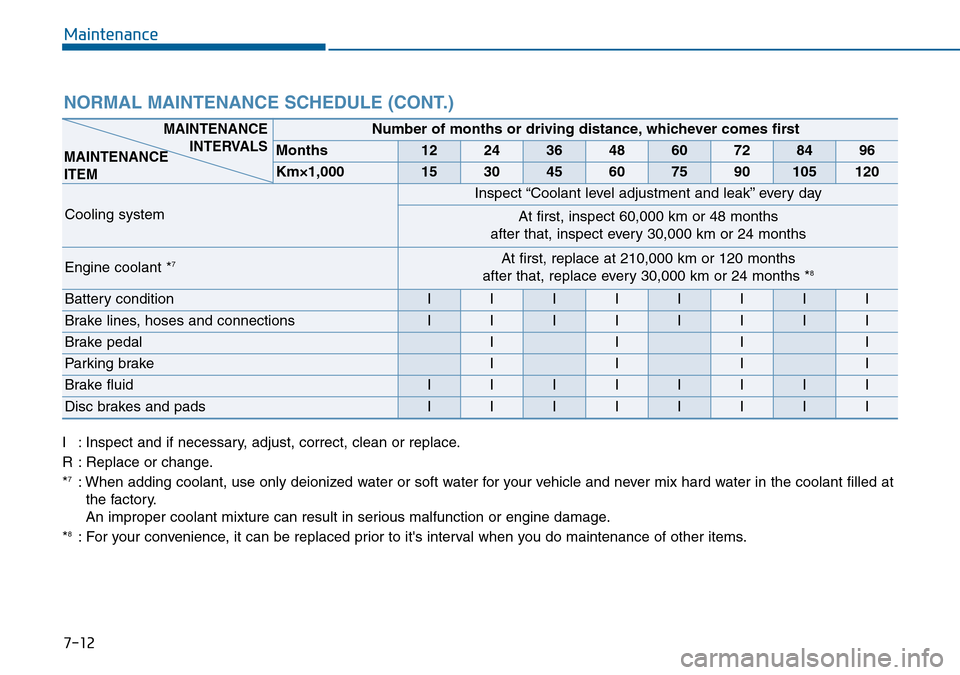
NORMAL MAINTENANCE SCHEDULE (CONT.)
I : Inspect and if necessary, adjust, correct, clean or replace.
R : Replace or change.
*
7: When adding coolant, use only deionized water or soft water for your vehicle and never mix hard water in the coolant filled at
the factory.
An improper coolant mixture can result in serious malfunction or engine damage.
*
8: For your convenience, it can be replaced prior to it's interval when you do maintenance of other items.
Number of months or driving distance, whichever comes first
Months1224364860728496
Km×1,000153045607590105120
Cooling system
Inspect “Coolant level adjustment and leak” every day
At first, inspect 60,000 km or 48 months
after that, inspect every 30,000 km or 24 months
Engine coolant *7At first, replace at 210,000 km or 120 months
after that, replace every 30,000 km or 24 months *8
Battery conditionIIIIIIII
Brake lines, hoses and connectionsIIIIIIII
Brake pedalIIII
Parking brakeIIII
Brake fluidIIIIIIII
Disc brakes and padsIIIIIIII
MAINTENANCE
INTERVALS
MAINTENANCE
ITEM
Page 426 of 504
7-15
7
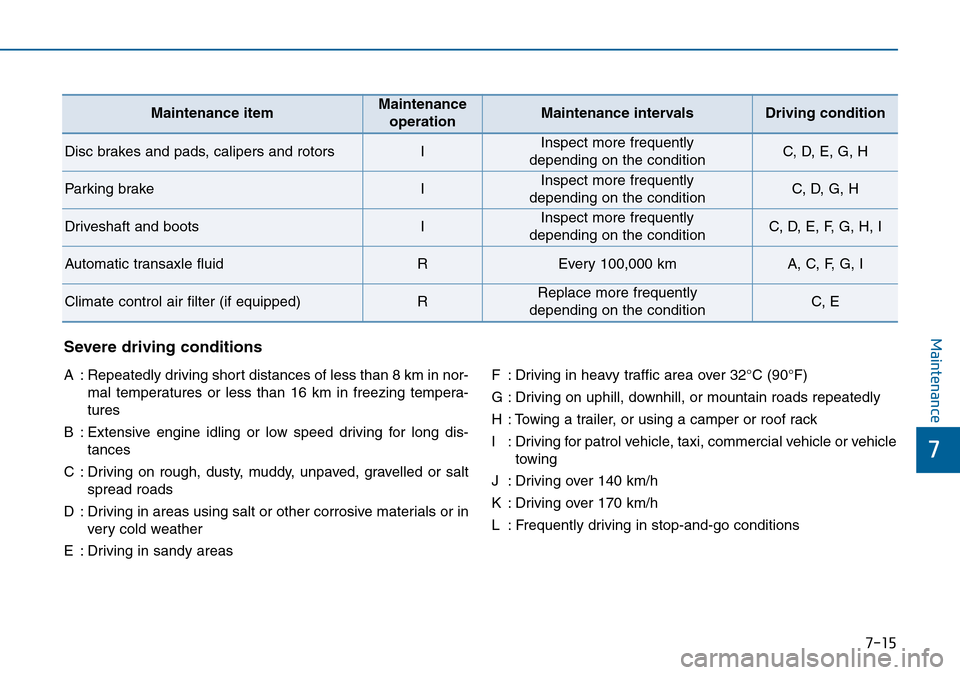
MaintenanceSevere driving conditions
A : Repeatedly driving short distances of less than 8 km in nor-
mal temperatures or less than 16 km in freezing tempera-
tures
B : Extensive engine idling or low speed driving for long dis-
tances
C : Driving on rough, dusty, muddy, unpaved, gravelled or salt
spread roads
D : Driving in areas using salt or other corrosive materials or in
very cold weather
E : Driving in sandy areasF : Driving in heavy traffic area over 32°C (90°F)
G : Driving on uphill, downhill, or mountain roads repeatedly
H : Towing a trailer, or using a camper or roof rack
I : Driving for patrol vehicle, taxi, commercial vehicle or vehicle
towing
J : Driving over 140 km/h
K : Driving over 170 km/h
L : Frequently driving in stop-and-go conditions
Maintenance itemMaintenance
operationMaintenance intervalsDriving condition
Disc brakes and pads, calipers and rotorsIInspect more frequently
depending on the conditionC, D, E, G, H
Parking brakeIInspect more frequently
depending on the conditionC, D, G, H
Driveshaft and bootsIInspect more frequently
depending on the conditionC, D, E, F, G, H, I
Automatic transaxle fluidREvery 100,000 kmA, C, F, G, I
Climate control air filter (if equipped)RReplace more frequently
depending on the conditionC, E
Page 429 of 504
7-18
Maintenance
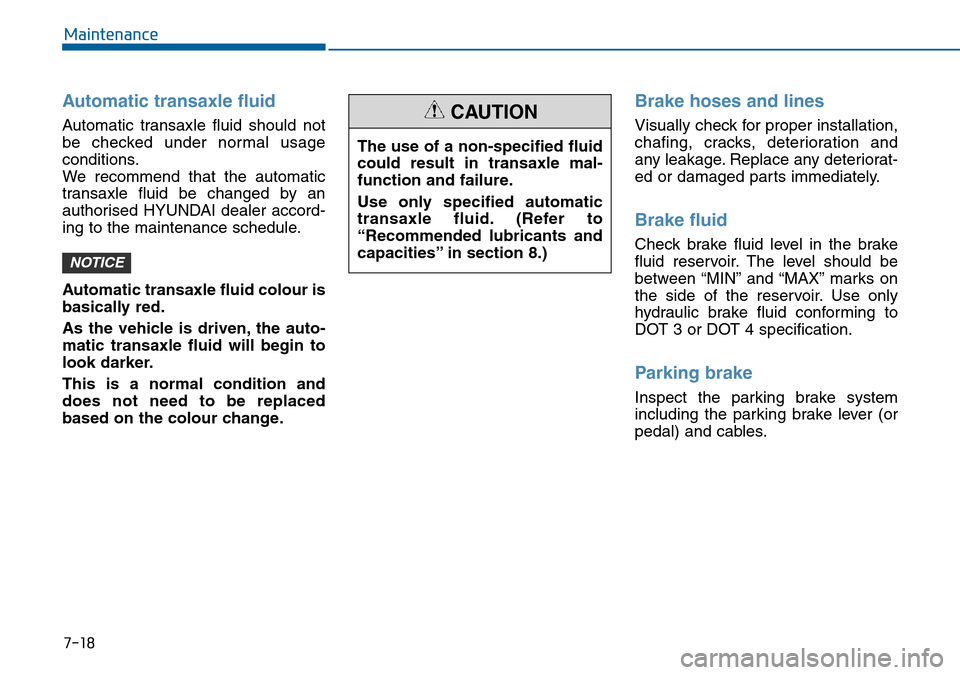
Automatic transaxle fluid
Automatic transaxle fluid should not
be checked under normal usage
conditions.
We recommend that the automatic
transaxle fluid be changed by an
authorised HYUNDAI dealer accord-
ing to the maintenance schedule.
Automatic transaxle fluid colour is
basically red.
As the vehicle is driven, the auto-
matic transaxle fluid will begin to
look darker.
This is a normal condition and
does not need to be replaced
based on the colour change.
Brake hoses and lines
Visually check for proper installation,
chafing, cracks, deterioration and
any leakage. Replace any deteriorat-
ed or damaged parts immediately.
Brake fluid
Check brake fluid level in the brake
fluid reservoir. The level should be
between “MIN” and “MAX” marks on
the side of the reservoir. Use only
hydraulic brake fluid conforming to
DOT 3 or DOT 4 specification.
Parking brake
Inspect the parking brake system
including the parking brake lever (or
pedal) and cables.
NOTICE
The use of a non-specified fluid
could result in transaxle mal-
function and failure.
Use only specified automatic
transaxle fluid. (Refer to
“Recommended lubricants and
capacities” in section 8.)
CAUTION
Page 430 of 504
7-19
7
Maintenance
Brake pads, calipers and
rotors
Check the pads for excessive wear,
discs for run out and wear, and
calipers for fluid leakage.
For more information on checking
the pads or lining wear limit, refer to
the HYUNDAI web site.
(http://brakeman
ual.hmc.co.kr)
Suspension mounting bolts
Check the suspension connections
for looseness or damage. Retighten
to the specified torque.
Steering gear box, linkage &
boots/lower arm ball joint
With the vehicle stopped and engine
off, check for excessive free-play in
the steering wheel.
Check the linkage for bends or dam-
age. Check the dust boots and ball
joints for deterioration, cracks, or
damage. Replace any damaged
parts.
Drive shafts and boots
Check the drive shafts, boots and
clamps for cracks, deterioration, or
damage. Replace any damaged
parts and, if necessary, repack the
grease.
Air conditioning refrigerant/
compressor
Check the air conditioning lines and
connections for leakage and dam-
age.
Page 436 of 504
7-25
7
Maintenance
BRAKE FLUID
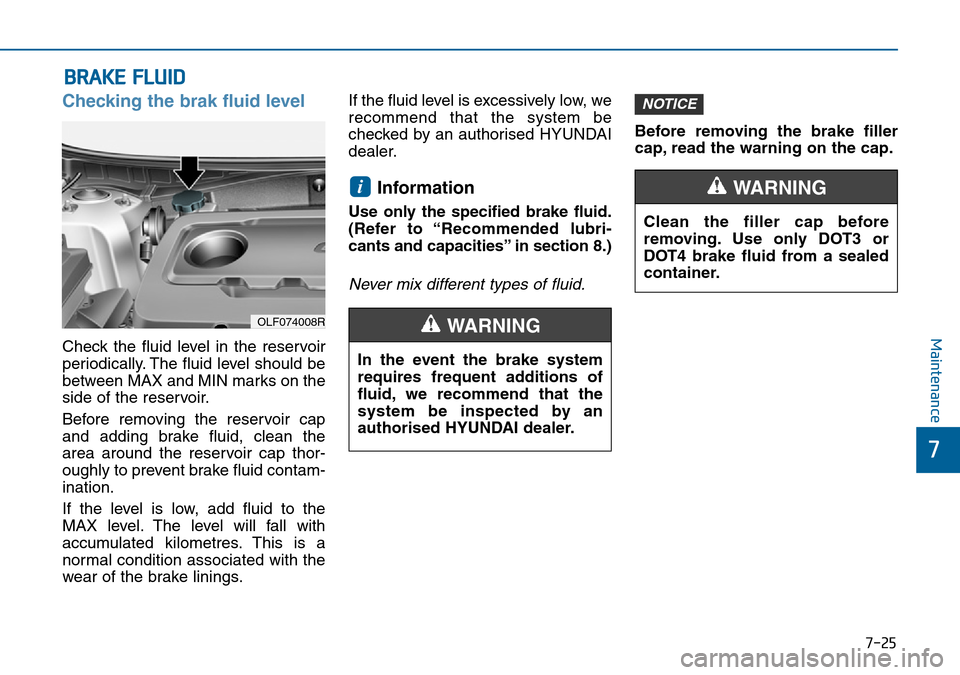
Checking the brak fluid level
Check the fluid level in the reservoir
periodically. The fluid level should be
between MAX and MIN marks on the
side of the reservoir.
Before removing the reservoir cap
and adding brake fluid, clean the
area around the reservoir cap thor-
oughly to prevent brake fluid contam-
ination.
If the level is low, add fluid to the
MAX level. The level will fall with
accumulated kilometres. This is a
normal condition associated with the
wear of the brake linings.If the fluid level is excessively low, we
recommend that the system be
checked by an authorised HYUNDAI
dealer.
Information
Use only the specified brake fluid.
(Refer to “Recommended lubri-
cants and capacities” in section 8.)
Never mix different types of fluid.
Before removing the brake filler
cap, read the warning on the cap.
NOTICE
i
OLF074008R
In the event the brake system
requires frequent additions of
fluid, we recommend that the
system be inspected by an
authorised HYUNDAI dealer.
WARNING
Clean the filler cap before
removing. Use only DOT3 or
DOT4 brake fluid from a sealed
container.
WARNING
Page 437 of 504
7-26
Maintenance
When changing and adding
brake fluid, handle it carefully.
Do not let it come in contact
with your eyes. If brake fluid
should come in contact with
your eyes, immediately flush
them with a large quantity of
fresh tap water. Have your eyes
examined by a doctor as soon
as possible.
WARNING
Do not allow brake fluid to con-
tact the vehicle's body paint, as
paint damage will result. Brake
fluid, which has been exposed
to open air for an extended time
should never be used as its
quality cannot be guaranteed. It
should be disposed of properly.
Don't put in the wrong kind of
fluid.
A few drops of mineral-based
oil, such as engine oil, in your
brake system can damage
brake system parts.
CAUTION