2015 HYUNDAI IX35 service indicator
[x] Cancel search: service indicatorPage 384 of 550
Driving your vehicle36
5Disc brakes wear indicator When your brake pads are worn and new
pads are required, you will hear a high-
pitched warning sound from your front
brakes or rear brakes. You may hear this
sound come and go or it may occur
whenever you depress the brake pedal.
Please remember that some driving con-
ditions or climates may cause a brake
squeal when you first apply (or lightly
apply) the brakes. This is normal and
does not indicate a problem with your
brakes.
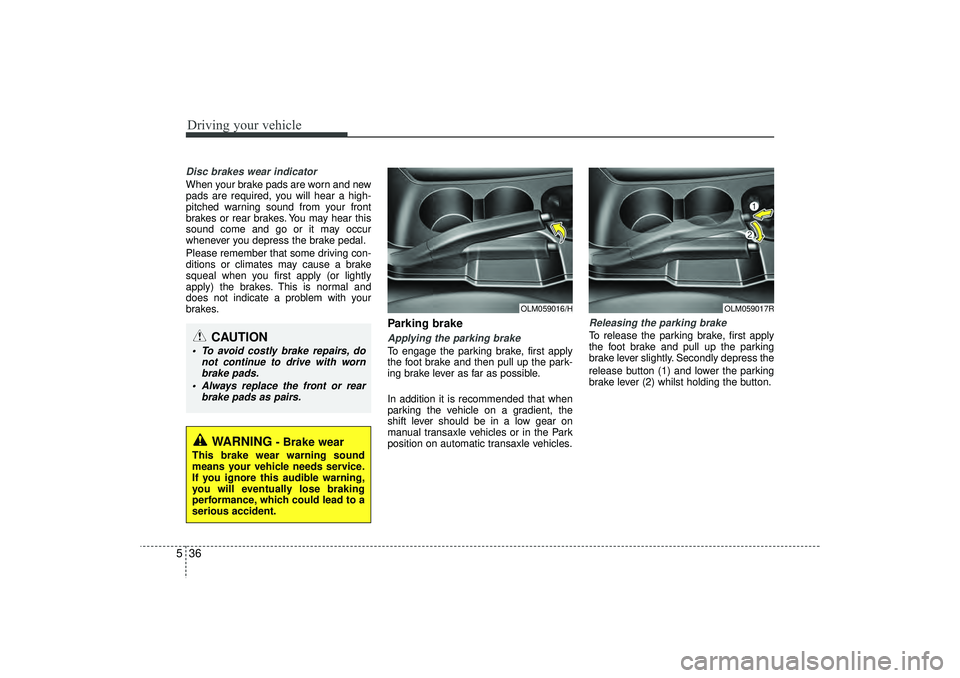
Parking brake Applying the parking brakeTo engage the parking brake, first apply
the foot brake and then pull up the park-
ing brake lever as far as possible.
In addition it is recommended that when
parking the vehicle on a gradient, the
shift lever should be in a low gear on
manual transaxle vehicles or in the Park
position on automatic transaxle vehicles.
Releasing the parking brakeTo release the parking brake, first apply
the foot brake and pull up the parking
brake lever slightly. Secondly depress the
release button (1) and lower the parking
brake lever (2) whilst holding the button.
WARNING
- Brake wear
This brake wear warning sound
means your vehicle needs service.
If you ignore this audible warning,
you will eventually lose braking
performance, which could lead to a
serious accident.
CAUTION
To avoid costly brake repairs, do
not continue to drive with wornbrake pads.
Always replace the front or rear brake pads as pairs.
OLM059016/H
OLM059017R
EL(FL) UK 5.QXP 12/16/2014 8:09 PM Page 36
Page 423 of 550
What to do in an emergencyRoad warning . . . . . . . . . . . . . . . . . . . . . . . . . . . . . . 6-2• Hazard warning flasher . . . . . . . . . . . . . . . . . . . . . . . . 6-2In case of an emergency whilst driving . . . . . . . . . 6-3• If the engine stalls at a crossroad or crossing. . . . . . . 6-3
• If you have a flat tyre whilst driving . . . . . . . . . . . . . . 6-3
• If engine stalls whilst driving . . . . . . . . . . . . . . . . . . . . 6-3If the engine will not start . . . . . . . . . . . . . . . . . . . . 6-4• If engine doesn't turn over or turns over slowly . . . . 6-4
• If engine turns over normally but does not start . . . . 6-4Emergency starting . . . . . . . . . . . . . . . . . . . . . . . . . 6-5• Jump starting . . . . . . . . . . . . . . . . . . . . . . . . . . . . . . . . . 6-5
• Push-starting . . . . . . . . . . . . . . . . . . . . . . . . . . . . . . . . . 6-6If the engine overheats . . . . . . . . . . . . . . . . . . . . . . . 6-7
Tyre pressure monitoring system (TPMS) (Type A) . . . . . . . . . . . . . . . . . . . . . . . . . . . . . . . . . 6-8• Low tyre pressure telltale . . . . . . . . . . . . . . . . . . . . . . . 6-9
• TPMS (tyre pressure monitoring system)
malfunction indicator . . . . . . . . . . . . . . . . . . . . . . . 6-10
• Changing a tyre with tpms . . . . . . . . . . . . . . . . . . . . . 6-11Tyre pressure monitoring system (TPMS) (Type B) . . . . . . . . . . . . . . . . . . . . . . . . . . . . . . . . 6-13• Low tyre pressure telltale . . . . . . . . . . . . . . . . . . . . . . 6-14
• Low tyre pressure position telltale. . . . . . . . . . . . . . . 6-14
• TPMS (tyre pressure monitoring system)
malfunction indicator . . . . . . . . . . . . . . . . . . . . . . . 6-15 • Changing a tyre with tpms . . . . . . . . . . . . . . . . . . . . . 6-16
If you have a flat tyre. . . . . . . . . . . . . . . . . . . . . . . 6-19• Jack and tools . . . . . . . . . . . . . . . . . . . . . . . . . . . . . . . 6-19
• Removing and storing the spare tyre . . . . . . . . . . . 6-20
• Changing tyres . . . . . . . . . . . . . . . . . . . . . . . . . . . . . . 6-20
• Jack label . . . . . . . . . . . . . . . . . . . . . . . . . . . . . . . . . . . 6-\
25
• EC Declaration of Conformity for Jack . . . . . . . . . . 6-26If you have a flat tyre (with tyre mobility kit) . . 6-27• Introduction . . . . . . . . . . . . . . . . . . . . . . . . . . . . . . . . . 6-27
• Notes on the safe use of the tyre mobility kit . . . . . . 6-28
• Components of the tyre mobility kit . . . . . . . . . . . . . 6-29
• Using the tyre mobility kit . . . . . . . . . . . . . . . . . . . . . 6-30
• Distributing the sealant. . . . . . . . . . . . . . . . . . . . . . . . 6-31Towing . . . . . . . . . . . . . . . . . . . . . . . . . . . . . . . . . . . 6-\
34• Towing service . . . . . . . . . . . . . . . . . . . . . . . . . . . . . . . 6-34
• Removable towing hook . . . . . . . . . . . . . . . . . . . . . . . 6-35
• Emergency towing . . . . . . . . . . . . . . . . . . . . . . . . . . . . 6-36
6
EL(FL) UK 6.QXP 12/16/2014 8:12 PM Page 1
Page 431 of 550
69
What to do in an emergency
✽
✽NOTICEIf the TPMS indicator does not illu-
minate for 3 seconds when the igni-
tion switch is turned to the ON posi-
tion or engine is running, or if it
comes on after blinking for approxi-
mately one minute, we recommend
that you contact a HYUNDAI
authorised repairer.
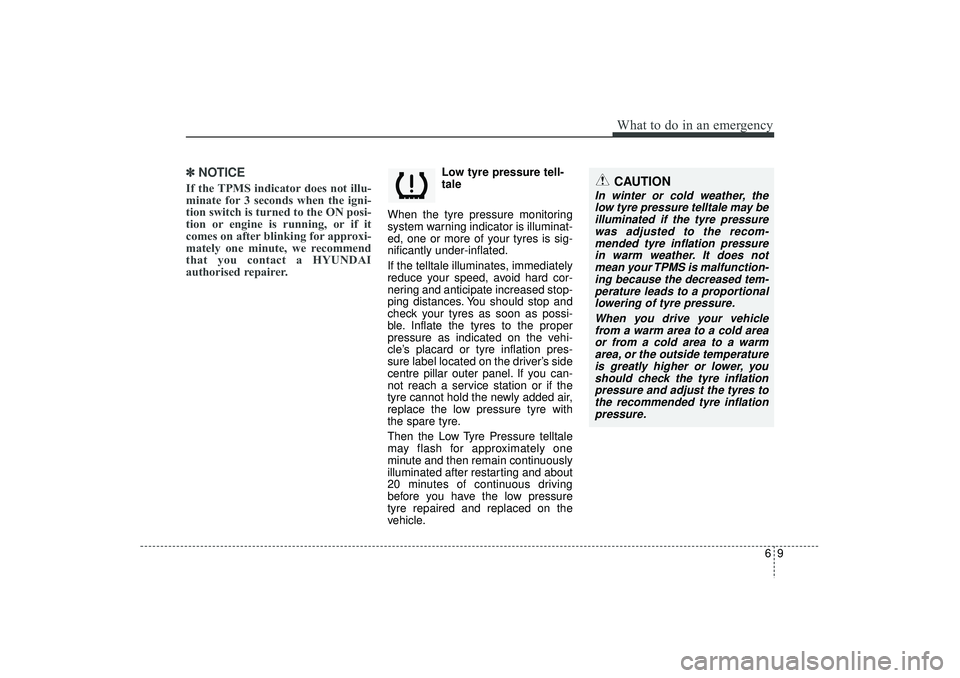
Low tyre pressure tell-
tale
When the tyre pressure monitoring
system warning indicator is illuminat-
ed, one or more of your tyres is sig-
nificantly under-inflated.
If the telltale illuminates, immediately
reduce your speed, avoid hard cor-
nering and anticipate increased stop-
ping distances. You should stop and
check your tyres as soon as possi-
ble. Inflate the tyres to the proper
pressure as indicated on the vehi-
cle’s placard or tyre inflation pres-
sure label located on the driver’s side
centre pillar outer panel. If you can-
not reach a service station or if the
tyre cannot hold the newly added air,
replace the low pressure tyre with
the spare tyre.
Then the Low Tyre Pressure telltale
may flash for approximately one
minute and then remain continuously
illuminated after restarting and about
20 minutes of continuous driving
before you have the low pressure
tyre repaired and replaced on the
vehicle.
CAUTION
In winter or cold weather, the low tyre pressure telltale may beilluminated if the tyre pressurewas adjusted to the recom-mended tyre inflation pressurein warm weather. It does notmean your TPMS is malfunction-ing because the decreased tem-perature leads to a proportionallowering of tyre pressure.
When you drive your vehiclefrom a warm area to a cold areaor from a cold area to a warmarea, or the outside temperatureis greatly higher or lower, youshould check the tyre inflationpressure and adjust the tyres tothe recommended tyre inflationpressure.
EL(FL) UK 6.QXP 12/16/2014 8:12 PM Page 9
Page 433 of 550
611
What to do in an emergency
Changing a tyre with TPMS
If you have a flat tyre, the Low Tyre
Pressure will come on. We recom-
mend that the flat tyre be checked by
a HYUNDAI authorised repairer.Each wheel is equipped with a tyre
pressure sensor mounted inside the
tyre behind the valve stem. You must
use TPMS specific wheels. It is rec-
ommended that you have your tyres
serviced by a HYUNDAI authorised
repairer.
Even if you replace the low pressure
tyre with the spare tyre, the Low Tyre
Pressure Telltale will blink or remain
on until the low pressure tyre is
repaired and placed on the vehicle.
After you replace the low pressure
tyre with the spare tyre, the Low Tyre
Pressure Telltale may blink or illumi-
nate after a few minutes because the
TPMS sensor mounted on the spare
wheel is not initiated.
Once the low pressure tyre is rein-
flated to the recommended pressure
and installed on the vehicle or we
recommend that the TPMS sensor
mounted on the replaced spare
wheel be initiated by a HYUNDAI
authorised repairer, the TPMS mal-
function indicator and the low tyre
pressure telltale will extinguish within
a few minutes of driving.If the indicator is not extinguished
after a few minutes of driving, We
recommend that the system be
checked by a HYUNDAI authorised
repairer.
CAUTION
If original mounted tyre is
replaced with the spare tyre, theTPMS sensor on the replacedspare wheel should be initiatedand we recommend that theTPMS sensor on the originalmounted wheel be deactivatedby a HYUNDAI dealer. If theTPMS sensor on the originalmounted wheel located in thespare tyre carrier still activates,the tyre pressure monitoringsystem may not operate proper-ly. We recommend that the sys-tem be serviced by a HYUNDAIauthorised repairer.
CAUTION
We recommend that you use apuncture-repairing agentapproved by HYUNDAI.
The sealant on the tyre pressuresensor and wheel shall be elim-inated when you replace thetyre with a new one.
EL(FL) UK 6.QXP 12/16/2014 8:12 PM Page 11
Page 436 of 550
What to do in an emergency14
6Always check the TPMS malfunction
telltale after replacing one or more
tyres or wheels on your vehicle to
ensure that the replacement or alter-
nate tyres and wheels allow the
TPMS to continue to function proper-
ly.✽ ✽
NOTICEIf the TPMS, Low Tyre Pressure and
Position indicators do not illuminate
for 3 seconds when the ignition
switch is turned to the ON position
or engine is running, or if they
remain illuminated after coming on
for approximately 3 seconds, we rec-
ommend that the system be checked
by a HYUNDAI authorised repairer.
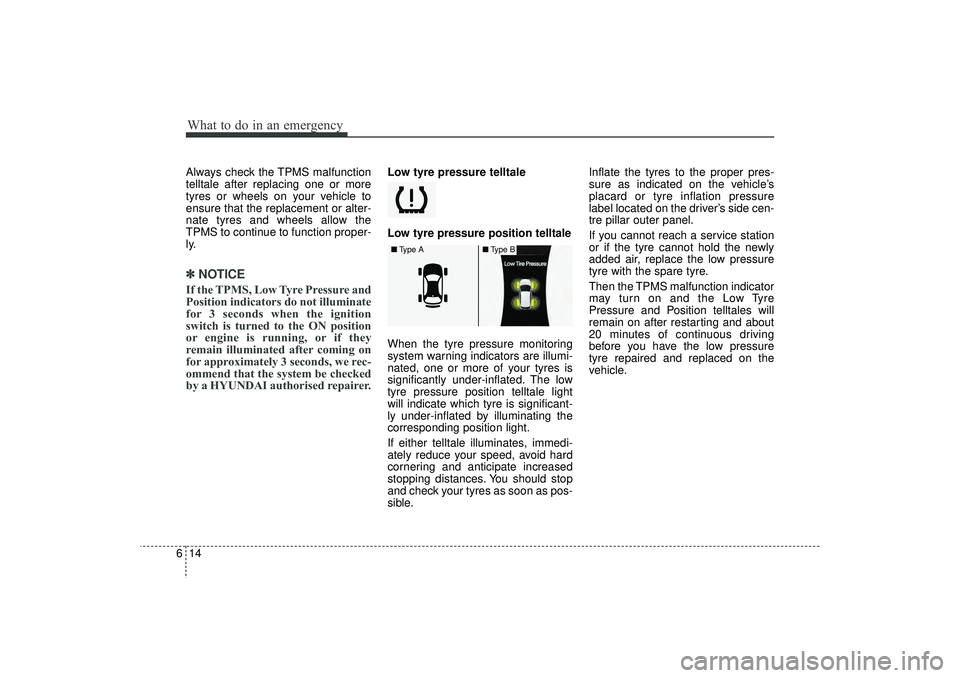
Low tyre pressure telltale
Low tyre pressure position telltale
When the tyre pressure monitoring
system warning indicators are illumi-
nated, one or more of your tyres is
significantly under-inflated. The low
tyre pressure position telltale light
will indicate which tyre is significant-
ly under-inflated by illuminating the
corresponding position light.
If either telltale illuminates, immedi-
ately reduce your speed, avoid hard
cornering and anticipate increased
stopping distances. You should stop
and check your tyres as soon as pos-
sible. Inflate the tyres to the proper pres-
sure as indicated on the vehicle’s
placard or tyre inflation pressure
label located on the driver’s side cen-
tre pillar outer panel.
If you cannot reach a service station
or if the tyre cannot hold the newly
added air, replace the low pressure
tyre with the spare tyre.
Then the TPMS malfunction indicator
may turn on and the Low Tyre
Pressure and Position telltales will
remain on after restarting and about
20 minutes of continuous driving
before you have the low pressure
tyre repaired and replaced on the
vehicle.■
Type A
■Type B
EL(FL) UK 6.QXP 12/16/2014 8:12 PM Page 14
Page 438 of 550
What to do in an emergency16
6
Changing a tyre with TPMS
If you have a flat tyre, the Low Tyre
Pressure and Position telltales will
come on. We recommend that the
system be checked by a HYUNDAI
authorised repairer.
Each wheel is equipped with a tyre
pressure sensor mounted inside the
tyre behind the valve stem. You must
use TPMS specific wheels. It is rec-
ommended that you have your tyres
serviced by a HYUNDAI authorised
repairer. Even if you replace the low pressure
tyre with the spare tyre, the Low Tyre
Pressure and Position telltales will
remain on until the low pressure tyre
is repaired and placed on the vehi-
cle.
After you replace the low pressure
tyre with the spare tyre, the TPMS
malfunction indicator may illuminate
after a few minutes because the
TPMS sensor is not mounted on the
spare wheel.
Once the low pressure tyre is rein-
flated to the recommended pressure
and installed on the vehicle or the
new TPMS sensor mounted on the
wheel, the TPMS malfunction indica-
tor and the low tyre pressure and
position telltales will extinguish within
a few minutes of driving.
If the indicator is not extinguished
after a few minutes of driving, we
recommend that the system be
checked by a HYUNDAI authorised
repairer.
CAUTION
We recommend that you use the
sealant approved by HYUNDAI.The sealant on the tyre pressuresensor and wheel shall be elim-inated when you replace thetyre with a new one.
CAUTION
The TPMS malfunction indica- tor may be illuminated if thevehicle is moving around elec-tric power supply cables orradios transmitter such as atpolice stations, governmentand public offices, broadcast-ing stations, military installa-tions, airports, or transmittingtowers, etc. This can interferewith normal operation of theTyre Pressure MonitoringSystem (TPMS).
The TPMS malfunction indica- tor may be illuminated if snowchains are used or some sep-arate electronic devices suchas notebook computers,mobile charger, remote starteror navigation etc., are used inthe vehicle. This can interferewith normal operation of theTyre Pressure MonitoringSystem (TPMS).
EL(FL) UK 6.QXP 12/16/2014 8:12 PM Page 16